Quick answer
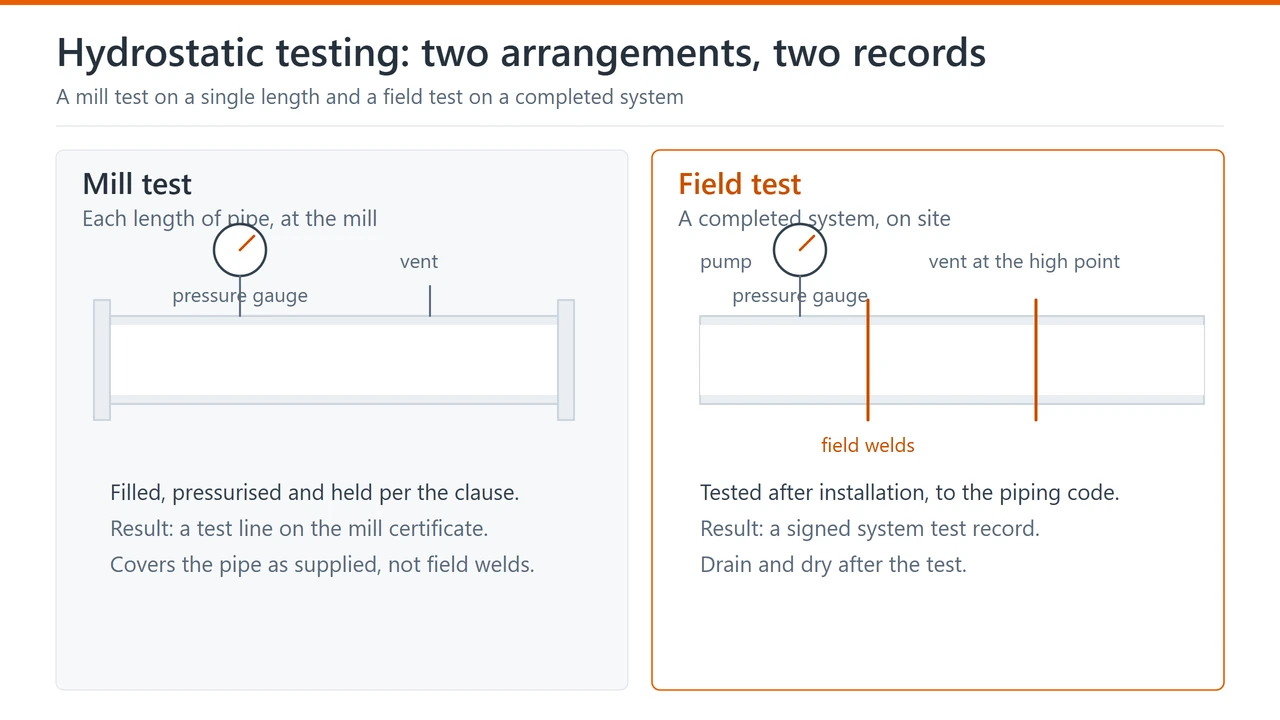
A hydrostatic test pressurises pipe or a completed system with water and holds it to prove it does not leak at that pressure. It proves integrity at the test pressure; it does not prove wall thickness, material grade or the absence of internal defects that the test pressure does not open up. Mill testing is a product requirement; field testing is a system requirement. They share a name and almost nothing else.
Two different tests share the name
| Mill hydrostatic test | Field or system hydrostatic test | |
|---|---|---|
| What is tested | Each length of pipe, at the mill | A completed pipeline or piping system, on site |
| Who sets the requirement | The product standard named on the order, such as API 5L, ASTM A106 or ASTM A312 | The piping or pipeline code applied to the project |
| Who witnesses it | The mill’s own inspection, with third party inspection where the order requires it | The owner or the inspection agency, against an agreed test pack |
| What the buyer holds afterwards | A test line on the mill certificate | A signed test record for the system, with charts or logs |
| What it cannot cover | Field welds, coating damage, installation | The quality of the pipe as delivered |
Most confusion about hydrostatic testing comes from reading a field test requirement into a mill order, or the other way round. If the project needs the mill test specifically, it belongs on the pipe purchase order; if the project needs a system test, it belongs in the construction scope.
What sets the test pressure
For line pipe, the test pressure is defined by reference to a hoop stress as a percentage of the specified minimum yield strength of the grade, with a limit that depends on size and wall thickness. The exact basis, including the percentage and any cap, is given in the edition of the product standard named on the order — API 5L for line pipe, ASTM A106 for seamless carbon steel pipe, ASTM A312 for austenitic stainless pipe.
For a system test, the pressure comes from the design code and the design pressure of the line, and it is normally agreed in the test pack before the test is run. The number on the certificate and the number in the test pack should both be traceable to a clause, not to a habit on site.
Source: the pressure basis is a clause in the applicable product standard or design code. This page states which document governs and where to look; the values are read from the edition named on the order, not from a general figure.
Hold time and acceptance
The hold time is part of the same requirement as the pressure: the standard or the code states how long the pressure is held and what constitutes a pass. In practice the acceptance is reached when the pressure holds without a drop attributable to leakage and no leakage is found at any joint, weld or connection.
Three points decide whether a test stands up afterwards: the gauge and its calibration certificate, the record of the pressure against time, and whether the test was run at a temperature permitted for the material. Testing at a low temperature is not simply slower — codes set a minimum test temperature for the material so that the test itself does not create a brittle failure risk.
When a non destructive test is allowed instead
Some product standards allow the manufacturer to substitute a non destructive electric test for the hydrostatic test, and some project specifications accept the substitute for certain sizes or grades. The consequence for a buyer is simple: if the project requires a hydrostatic test, write that requirement on the purchase order. If it is left open, the mill may satisfy the standard with a different test, and the certificate will be correct for the standard while being wrong for the project.
The buyer checklist: agree these points before production
| Point | What to agree | Why it matters |
|---|---|---|
| Which test | Mill test, field test, or both | They are ordered and witnessed by different people at different times |
| The governing clause | The standard, edition and clause that sets pressure and hold time | The certificate can only be checked against a named clause |
| Substitution | Whether a non destructive test may replace the hydrostatic test | Deciding this at shipment stage means a deviation or a retest |
| Witness points | Who attends, and at which stage | A witnessed test cannot be arranged after the pipe is made |
| Report content | The fields the report has to carry | Chasing a report field after dispatch delays release of the goods |
| Test water | Quality limits, particularly chlorides for austenitic stainless | Water left in a stainless line can cause pitting after the test |
| Post test treatment | Draining, drying and internal protection | A line tested and left wet is a corrosion problem, not a tested line |
Report fields to check when the documents arrive
| Field | What to look for |
|---|---|
| Standard and edition | The edition named on the order, not an earlier one |
| Test pressure | The pressure applied, and the hoop stress basis where the standard states it that way |
| Hold time | The time held, matched against the clause |
| Pipe identification | Heat number, size and wall thickness, so the certificate can be tied to the lengths delivered |
| Test medium and temperature | Water, and the temperature at which the test was run |
| Gauge calibration | Gauge identification and a calibration certificate that is valid at the test date |
| Result and authority | Pass statement, plus the signature and, where required, the third party inspection stamp |
Common problems, and how to avoid them
- The test is quoted but not specified. The mill tests to the standard and the project wanted something else. Name the standard, edition and any supplement on the purchase order.
- The gauge was not in calibration. The test values remain but the report loses its value. Ask for the calibration certificate with the report.
- Chlorides left in a stainless line. Test water quality has to be agreed before the test, and the line drained and dried afterwards.
- A test run before the coating or the lining was completed, then repeated after repair, with no record of the second test. Keep every test record, not only the passing one.
- A repair after a passing test with no re test. Any weld repair on a tested item normally means the item or the system is tested again; the requirement should be written into the inspection and test plan.
What to state on the enquiry
Tell us the standard and edition the pipe is ordered to, the grade and wall thickness, the test pressure basis the project requires, whether a third party has to witness the test, and the report fields your client expects. We confirm the test arrangement with the producing mill before the order is released, and the mill certificate travels with the shipment. Where a system test is part of your scope, we can supply the pipe with the mill test records aligned to your test pack.
FAQ
Is a hydrostatic test the same as a pressure test?
In steel pipe, hydrostatic means the test medium is water. A pressure test may use air or another gas, which is a different activity with different risks and different acceptance rules.
Can a hydrostatic test replace an ultrasonic test?
No. The two look for different things: a hydrostatic test looks for leaks and gross defects at test pressure, while ultrasonic testing looks for internal defects. Standards that allow one of them to be substituted for the other do so within defined limits, and the substitution has to be stated on the order.
How long should the test pressure be held?
The hold time is stated by the standard or the code that applies, and it differs between a mill test and a system test. We quote the clause and the resulting hold time with the test arrangement rather than quoting a figure that may belong to a different standard.
Does every length get tested?
For mill testing, the product standard sets what is tested and how often. For a system test, the whole bounded system is tested at once, including the welds made on site.
Need the test written into the order? Send the standard and edition, the grade, size and wall thickness, the test pressure basis, and whether a third party has to witness the test. We confirm the arrangement with the producing mill before the order is released.
Request a quotation