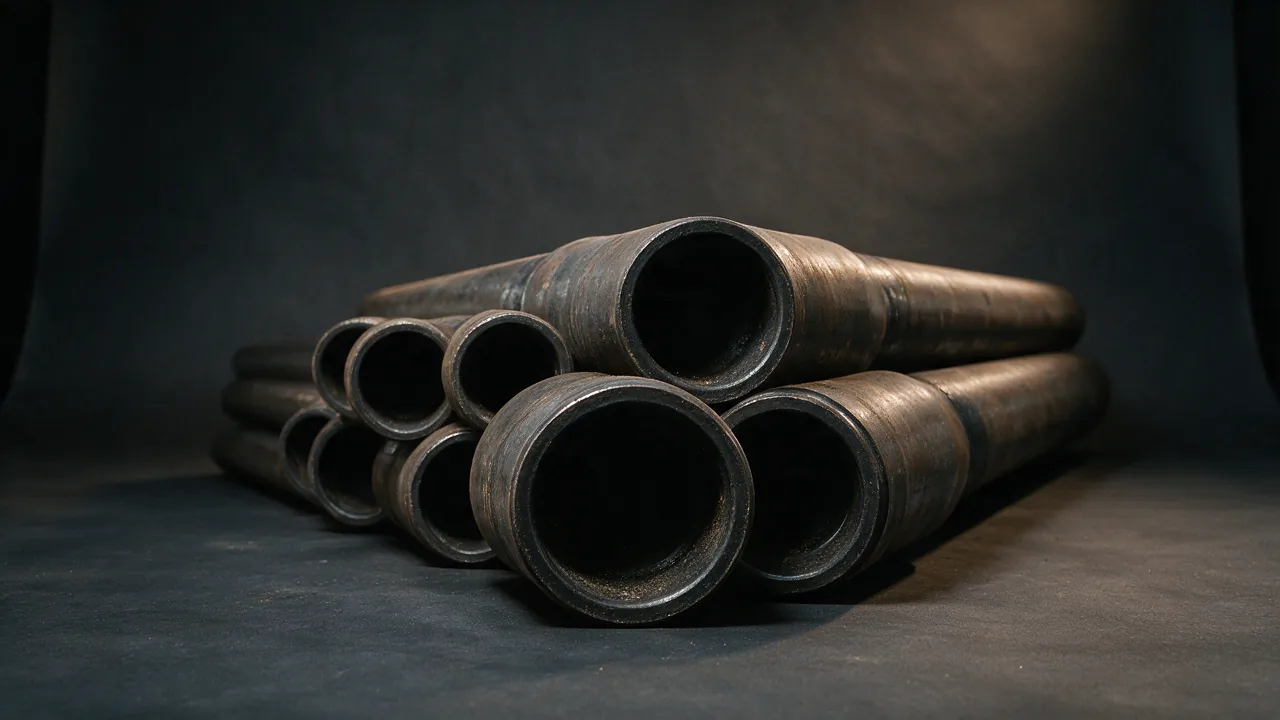
API 5CT N80Q casing is a quenched and tempered carbon steel casing grade with a minimum yield strength of 552 MPa (80,000 psi) and a minimum tensile strength of 689 MPa (100,000 psi). The Q suffix denotes quenched and tempered, which gives uniform properties through the wall thickness.
Download API 5CT N80Q Casing data sheet (PDF) One-page summary of the supply range, chemistry, mechanical properties and inspection documents on this page. The standard is the governing document.
Mejor Steel is the export agent for the mills that make your material: one contract, one delivery date, and the mill named on the quotation. How we supply
We reply within one business day, Monday to Friday 09:00-18:00 CST. Or write to info@mejorsteel.com / WhatsApp.
Size range and specification
- Outside diameter 4-1/2 inch – 20 inch (114.3 – 508 mm)
- Most quoted sizes 4-1/2, 5, 5-1/2, 7, 9-5/8, 10-3/4 and 13-3/8 inch
- Wall thickness 5.21 – 22.22 mm depending on size and weight
- Length R1 4.88 – 7.62 m, R2 7.62 – 10.36 m, R3 10.36 – 14.63 m
- Ends STC, LTC, BTC or premium connection; coupling supplied with the pipe
- Surface treatment Black varnish, phosphate, or as agreed
- Manufacturing process Hot rolled seamless, quenched and tempered
- Delivery standard API 5CT / ISO 11960, PSL1 or PSL2
How this grade is supplied
- Inspection Inspected by the producing mill’s own inspection department, which is independent of production, against the delivery standard above. Third-party inspection — SGS, BV or TUV, or an inspector you send yourself — can be arranged at the mill or before shipment; give us the dates and the scope at the order stage.
- Certificate A mill test certificate to EN 10204 3.1 showing the heat number, the chemical composition and the mechanical results is standard on every order. EN 10204 3.2, countersigned by the inspector you nominate, is available on request.
- Documents with the goods The mill test certificate and the packing list travel with the shipment, and the heat number is traceable from cast through to the finished product.
- Packing Sea-worthy export packing: bundled by size with end protection, corrosion protection on request, stencilled with the size, grade and heat number.
- MOQ One bundle or one truckload; mixed sizes within a bundle accepted.
- Lead time Counted from order confirmation, not from the enquiry. Stock sizes 5–10 days; mill run or non-stock 3–5 weeks. The delivery window is fixed on the quotation.
- How we supply Sourced through partner mills; the producing mill is named on the quotation.
API 5CT N80 chemical composition (maximum, %)
| Item | P max | S max | Note |
|---|---|---|---|
| API 5CT limits for N80-1 and N80Q | 0.030 | 0.030 | Carbon and manganese are not specified; the manufacturer selects them to reach the required strength |
| Typical mill chemistry for N80Q (36Mn2V type) | 0.020 | 0.015 | C 0.34 – 0.38, Si 0.20 – 0.35, Mn 1.45 – 1.70, V 0.11 – 0.16 |
API 5CT controls phosphorus and sulphur for N80 and leaves carbon and manganese to the manufacturer, who must still meet the tensile requirements. Because of this, two mills may supply chemically different material both marked N80Q, and carbon equivalent should be checked when the pipe will be welded. N80Q is not a sour service grade.
Source: chemical composition requirements of API 5CT / ISO 11960. The standard is the governing document.
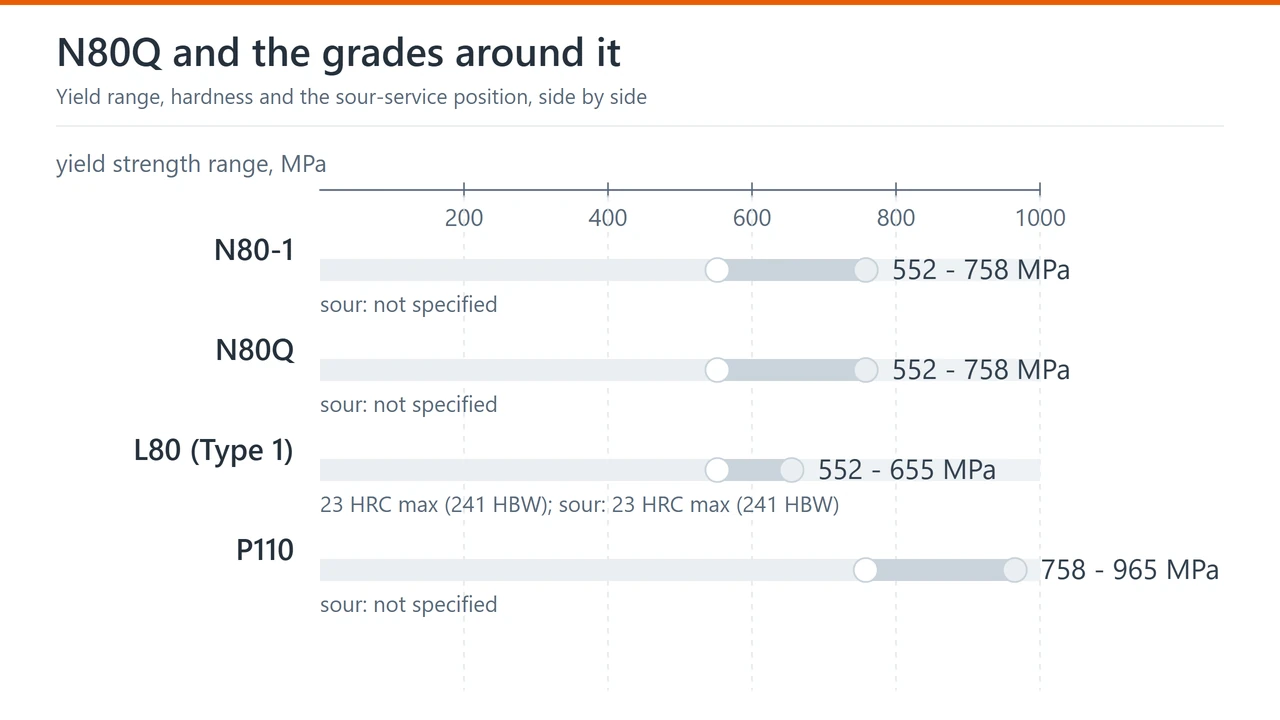
API 5CT N80Q mechanical properties, with L80 and P110 for comparison
| Grade | Yield strength | Tensile strength min | Hardness | Sour service |
|---|---|---|---|---|
| N80-1 | 552 – 758 MPa (80,000 – 110,000 psi) | 689 MPa (100,000 psi) | not specified | not suitable |
| N80Q | 552 – 758 MPa (80,000 – 110,000 psi) | 689 MPa (100,000 psi) | not specified | not suitable |
| L80 (Type 1) | 552 – 655 MPa (80,000 – 95,000 psi) | 655 MPa (95,000 psi) | 23 HRC max (241 HBW) | qualified |
| P110 | 758 – 965 MPa (110,000 – 140,000 psi) | 862 MPa (125,000 psi) | not specified | not suitable |
N80-1 and N80Q have the same strength requirements. The difference is the heat treatment: N80-1 is supplied as-rolled, while N80Q is quenched and tempered. The quenched and tempered structure gives better toughness and more uniform properties, which matters for heavier walls and for premium connections. Collapse and burst ratings come from the dimensional tables of API 5CT and are not properties of the grade alone.
Source: tensile requirements of API 5CT / ISO 11960. The standard is the governing document.
What Is N80Q Casing?
N80 is one of the standard API 5CT casing and tubing grades, with a minimum yield strength of 80,000 psi, or 552 MPa. The suffix Q denotes quenched and tempered, one of the delivery conditions API 5CT allows. Pipe ordered as plain N80 may be supplied as-rolled, which is designated N80-1, or quenched and tempered, designated N80Q. Because the two have the same strength requirements but different microstructure, the suffix should always be stated on the order. N80Q is the version normally specified for deeper wells, heavier wall thicknesses and premium connections, where toughness and uniformity matter.
N80-1 and N80Q – the Practical Difference
N80-1 is produced without a deliberate quench and temper, so its properties depend on the rolling schedule and the wall thickness. N80Q is austenitized, quenched and then tempered, which refines the grain structure and produces a more uniform through-wall hardness and toughness. In practice this shows up in three ways: N80Q is preferred for heavy walls where as-rolled material may struggle to meet toughness requirements, it is required by many operators for premium connection threads because the thread form needs consistent material properties, and it responds more predictably to machining. N80Q normally costs slightly more than N80-1, and where neither toughness nor threading is critical, N80-1 remains acceptable.
Sour Service – Why N80Q Is Not the Right Choice
N80Q is not a sour service grade. API 5CT does not apply a hardness limit to N80, and without a controlled maximum hardness the material is not resistant to sulphide stress cracking in the presence of wet hydrogen sulphide. Where H2S is present, the appropriate grades are L80, C90, T95, C110 or C125, all of which are hardness controlled and qualified under NACE MR0175 / ISO 15156. If a well is expected to turn sour later in its life, this should be considered at the casing design stage, because replacing casing is far more expensive than specifying the correct grade at the outset.
Sizes, Weights and Connections
N80Q casing is produced from 4-1/2 inch up to 20 inch outside diameter, in the standard weight and wall thickness combinations listed in API 5CT. Lengths are supplied as Range 1, Range 2 or Range 3. Threads can be short round thread, long round thread or buttress, and premium connections are available for gas-tight and high-compression service. Each length is normally supplied with a coupling, which is also tested and marked. Collapse and burst ratings should be read from the API 5CT dimensional tables for the exact size, weight and wall thickness, because the rating varies substantially across the range and is not determined by the grade alone.
Inspection and Documentation
API 5CT requires tensile testing and a dimensional inspection including wall thickness and drift. PSL2 orders add non-destructive examination of the body and the coupling, an impact test, and tighter dimensional tolerances. Mill test certificates to EN 10204 3.1 are standard, and 3.2 certification countersigned by an independent inspector can be arranged. Because casing is a safety-critical item in well construction, third-party inspection by SGS, BV or TUV before shipment is common and can be included at the order stage.
N80Q on the order: the four things to specify
N80Q has the same strength as N80-1 but a different delivery condition, so the order has to make that condition explicit:
- Delivery condition: quenched and tempered, not as-rolled or normalised.
- Charpy test temperature and acceptance energy, if the well design requires a specific value beyond the standard requirement.
- Hardness limit: write in 22 HRC maximum only where NACE MR0175 / ISO 15156 sour service applies.
- Connection and coupling: STC, LTC, BTC or premium, with the coupling grade.
For the full N80-1 versus N80Q comparison, grade selection and sour-service limits, see API 5CT N80 Casing.
Typical applications
- Oil and gas well casing
- Intermediate and production casing strings
- Gas wells with premium connections
- Water injection wells
- Deep well construction
Standards covered
Frequently asked questions
What is the difference between N80-1 and N80Q casing?
They have identical strength requirements, a minimum yield strength of 552 MPa and a minimum tensile strength of 689 MPa. N80-1 is supplied as-rolled, while N80Q is quenched and tempered. The heat treatment refines the structure and gives more uniform toughness and hardness through the wall, which is why N80Q is preferred for heavy walls and premium connection threads.
Can N80Q casing be used in sour service?
No. N80Q is not a sour service grade because API 5CT does not impose a hardness limit on it, and without a controlled maximum hardness the material is not resistant to sulphide stress cracking. For wells containing hydrogen sulphide, specify L80, C90, T95, C110 or C125, which are hardness controlled and qualified to NACE MR0175 / ISO 15156.
How are casing collapse and burst ratings determined?
They are determined by the pipe dimensions and the steel grade together, and are tabulated in API 5CT for each combination of outside diameter, weight and wall thickness. A heavier wall in the same size gives a higher collapse rating. The grade sets the yield strength used in the calculation, so the rating must be read from the table for the exact size and weight rather than inferred from the grade alone.
Where to go next
- OCTG: Casing and Tubing – which string, grade, connection and documents the well needs
- API 5CT Casing Pipe – API 5CT well casing
- API 5CT Casing Coupling – casing couplings to API 5CT
- Premium Connection Casing and Tubing – gas-tight premium connections
- API 5CT P110 Casing – high-strength well casing
- API 5CT L80 Tubing – sour-service tubing with controlled hardness
- Get a Quote – send the grade, size, quantity and destination port
- API 5CT K55 Casing – the medium-strength casing grade above J55
- N80-1 vs N80Q – same strength, different heat treatment
Looking for a price on a specific item? We need the standard and grade, the size and wall thickness, the quantity, and the destination port. With those four we can confirm availability and give you a price.
Request a quotation