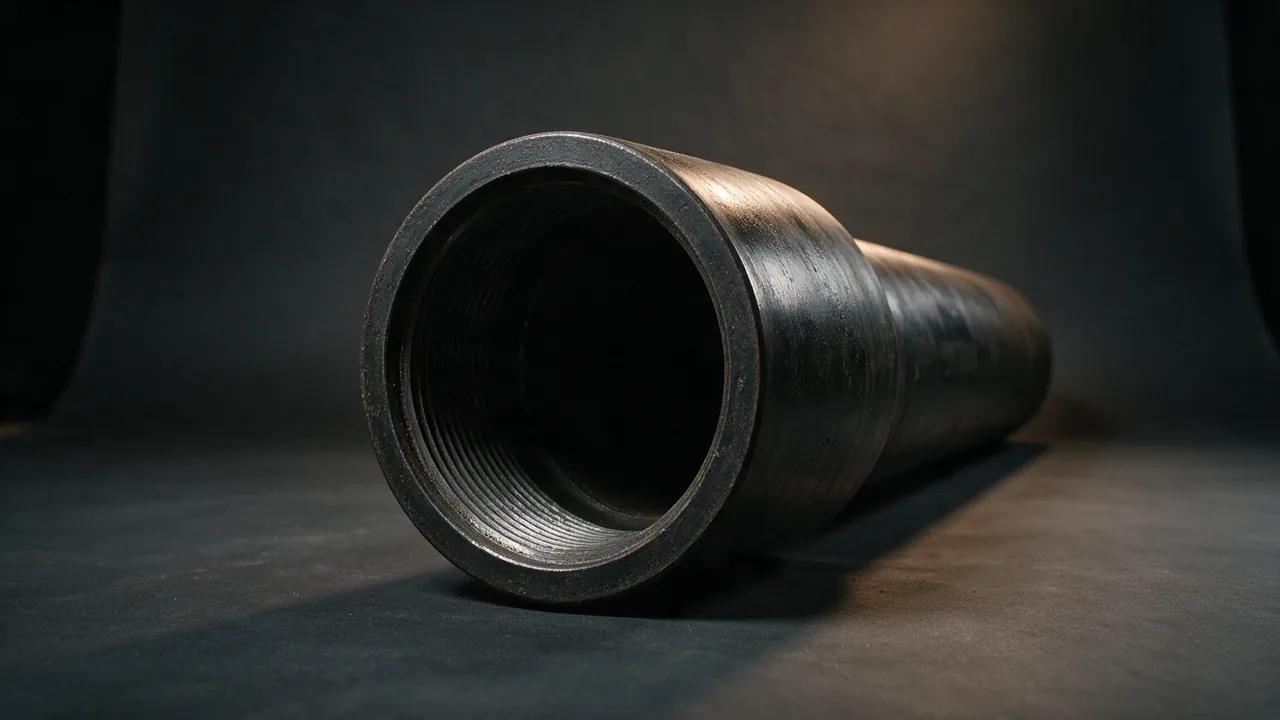
Seamless and welded casing to API 5CT in grades J55, K55, N80-1, N80Q, L80, C90, T95, P110 and Q125, from 4-1/2 inch to 20 inch, with STC, LTC, BTC and premium connections.
- Standard: API 5CT, ISO 11960, API 5B, API 5C3
- Grades: J55, K55, N80-1, N80Q, L80, C90, R95, T95, P110, C110, C125, Q125
- Certificate: EN 10204 3.1 with every order, 3.2 on request
Mejor Steel is the export agent for the mills that make your material: one contract, one delivery date, and the mill named on the quotation. How we supply
We reply within one business day, Monday to Friday 09:00-18:00 CST. Or write to info@mejorsteel.com / WhatsApp.
Specifications
| Outer diameter | 4-1/2" - 20" (114.3 - 508 mm) |
|---|---|
| Wall thickness | Per API 5CT weight schedule, 5.21 - 22.22 mm |
| Size range | 4-1/2" to 20" outside diameter |
| Length | R1 4.88 - 7.62 m, R2 7.62 - 10.36 m, R3 10.36 - 14.63 m |
| Ends | STC, LTC, BTC, premium connections |
| Surface treatment | Black varnish, phosphating, zinc coating on threads |
| Manufacturing process | Seamless, ERW welded |
| Pressure rating | Per API 5C3 burst, collapse and tensile ratings |
| Connection type | STC, LTC, BTC, premium gas-tight |
Casing Grades and How They Are Chosen
Casing grade is selected from a calculated string design covering burst, collapse, tensile and triaxial load cases, not from well depth alone. The lower grades J55 and K55 share the same minimum yield strength of 379 to 552 MPa and the same chemistry; they differ only in minimum tensile strength, 517 MPa for J55 and 655 MPa for K55. They are the cheapest option and are used in shallow, low pressure wells and in surface strings. N80 in both Type 1 and Type Q (quenched and tempered) is the standard workhorse for intermediate and production casing at medium depth. L80 is specified where the well produces wet H2S, because its chemistry and hardness limit are controlled to resist sulfide stress cracking. C90, R95, T95 and C110 extend into deeper, higher pressure and more severe sour service, and C125 is the newest addition to the API 5CT grade list. P110 is the standard high strength grade for deep, high pressure wells, and Q125 is reserved for ultra-deep, high pressure high temperature applications.
As an oil well casing supplier, Mejor Steel supplies API 5CT casing from China — grades J55 through Q125, in STC, LTC, BTC and premium connections — quoted as a complete string or item by item.
Connection Types: STC, LTC, BTC and Premium
The connection is often the limiting element in a casing string, so it should be selected with the same care as the pipe body. STC (short round thread coupling) has the shortest thread engagement and gives the lowest joint strength; it is used for shallow wells and low pressure service. LTC (long round thread coupling) has a longer thread, distributing load over more turns and giving higher joint efficiency, and suits medium depth wells. BTC (buttress thread coupling) uses a trapezoidal thread form with a steeper load flank, which gives substantially higher tensile efficiency and better resistance to jump-out under axial load, and is the standard choice for deep and high pressure wells. Premium connections use a metal-to-metal seal plus a torque shoulder instead of relying on thread compound for sealing. They provide gas-tight performance under combined load and are specified for HPHT, gas and offshore wells. Premium connections are proprietary, so confirm compatibility if you are mixing with an existing string.
Length Ranges R1, R2 and R3
API 5CT defines three length ranges for casing and tubing. R1 covers 4.88 to 7.62 m, R2 covers 7.62 to 10.36 m, and R3 covers 10.36 to 14.63 m. R3, sometimes called range 3, corresponds roughly to 40 feet and is the most commonly ordered in modern operations because fewer connections per string means faster running and fewer potential leak paths. R2 is still widely used where handling equipment limits joint length. When ordering, state the length range explicitly, because mills may otherwise ship a mix and the resulting string tally will be more complex on the rig floor.
Casing Sizes Most Often Quoted
Casing is ordered by outside diameter together with a weight designation in pounds per foot, and it is the pair that fixes the wall thickness. The same diameter is supplied at several weights, so the size on its own is not enough to price a string. The sizes quoted most often for export are:
- 4-1/2 in casing (114.3 mm outside diameter)
- 5 in casing (127.0 mm)
- 5-1/2 in casing (139.7 mm)
- 7 in casing (177.8 mm)
- 9-5/8 in casing (244.5 mm)
- 10-3/4 in casing (273.1 mm)
- 13-3/8 in casing (339.7 mm)
- 20 in casing (508.0 mm), the top of the standard range
7 in casing and 9-5/8 in casing are the two sizes that appear in most enquiries. 13-3/8 in casing is the usual surface string, and 5-1/2 in casing is the size most often ordered for shallower wells where the intermediate string is the production string. State the outside diameter, the weight designation, the grade, the connection and the length range when asking for a price, and the quote can be written without a second round of questions.
How to read a casing size and a weight designation
A casing quotation and a mill test certificate carry the same six fields. Reading them is a matter of knowing what each one fixes, and which of them a conversion can check.
| What you see | What it fixes | How it is checked |
|---|---|---|
| 9-5/8 in, 244.5 mm | Outside diameter. It is fixed for the size and identical at every weight, so on its own it cannot tell two weights of the same size apart. | 1 in = 25.4 mm. The inch figure is the one quoted; the millimetre figure is the same number converted. |
| 36.00 lb/ft, 47.00 lb/ft | The weight designation. This is the label API 5CT uses for the wall of that size, and the size together with the designation is what the mill rolls and what a quotation is written against. | 1 lb/ft = 1.4882 kg/m, so 36.00 lb/ft is 53.6 kg/m and 47.00 lb/ft is 69.9 kg/m. |
| Wall in mm on a certificate | The wall the heat was actually rolled to. | W = 0.0246615 × t × (D − t), with W in kg/m and D and t in mm — the same formula behind our steel pipe weight chart. |
| R1, R2, R3 | The length range of each joint. | Compared against the three ranges set out above. |
| STC, LTC, BTC, premium | The thread form on the pipe end and the coupling. | API 5B for the standard threads; for a proprietary thread, the premium connection data sheet that names it. |
| Drift | The mandrel diameter that tools and equipment have to pass — not the calculated inside diameter. | Specified separately on the order, and smaller than the inside diameter. |
Run the third row on a size from the list above. At 9-5/8 in, which is 244.5 mm outside diameter, a wall of 9.2 mm gives 53.4 kg/m, about 36 lb/ft, and a wall of 12.2 mm gives 69.9 kg/m, about 47 lb/ft. The arithmetic is not the point. What it gives you is a check: the wall on a quotation should be consistent with the weight designation and the size it belongs to, and when it is not, one of the three fields has been carried over from another size.
The nominal wall that belongs to each weight designation is set by API 5CT, and that is the value the mill rolls and the certificate carries. The figures above are worked out with the formula, so use them as a cross-check on a quotation rather than as a replacement for the standard’s own table.
Casing: reading the well condition into a grade and a connection
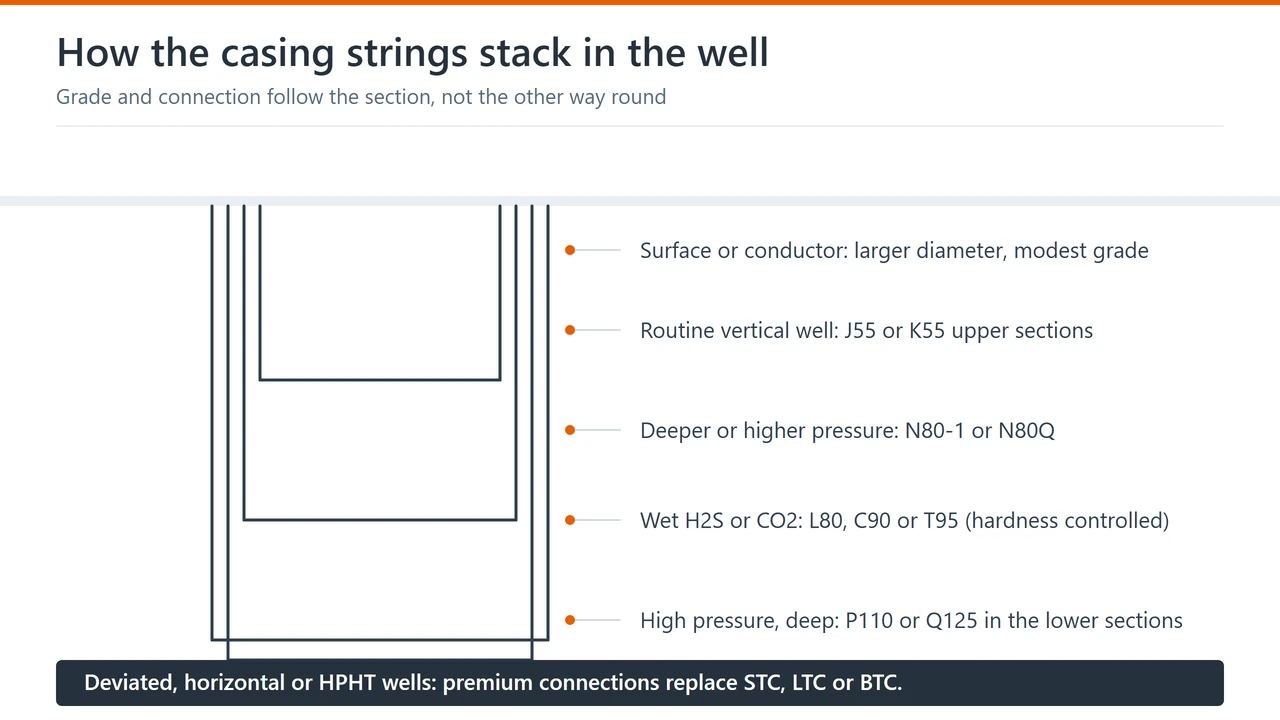
Casing is designed as a string rather than as a pipe. Depth and mud weight set the collapse and burst requirement, the presence of H2S or CO2 sets the grade family, and the connection is chosen from how the string is run. Grade and connection are two separate decisions that are often quoted as one.
| Well condition | What it drives in the string | What to state on the enquiry |
|---|---|---|
| Routine vertical well, no sour gas | J55 or K55 covers the upper sections of the string | the depth, the mud weight, and the casing programme |
| Deeper or higher pressure section | N80-1 or N80Q, depending on collapse and temperature | the design collapse and burst figures |
| Wet H2S or CO2 present | L80, C90 or T95, the restricted hardness grades | the partial pressures, and whether NACE applies |
| High pressure, deep well | P110 or Q125 in the lower sections | the design load, and whether Q125 is acceptable to the operator |
| Deviated, horizontal or HPHT | Premium connections in place of STC, LTC or BTC | the connection type, or the make-up torque requirement |
| Geothermal or thermal recovery | A thermal grade with the right yield and creep behaviour | the maximum temperature and the thermal cycle |
| Surface or conductor section | Larger diameter, frequently welded, with a modest grade | whether the pipe is driven or drilled |
What is the difference between J55 and N80 casing?
J55 has a minimum yield strength of 379 to 552 MPa and a minimum tensile strength of 517 MPa. N80 has a minimum yield strength of 552 to 758 MPa and a minimum tensile strength of 689 MPa, so it is roughly 45 percent stronger in yield. N80 is also available in two types: N80-1 is as-rolled or normalized, and N80Q is quenched and tempered with better uniformity and toughness. J55 is used for shallow and low pressure wells; N80 for medium depth and higher pressure strings.
Which casing grade should be used for sour service?
For wet H2S service you need a grade qualified to NACE MR0175 / ISO 15156. L80 Type 1 is the most widely used sour service grade and is suitable for many moderate sour applications. For more severe conditions, C90, R95, T95 and C110 offer higher strength with sour service qualification, with T95 being the commonly specified choice where higher collapse resistance is needed. Note that high strength grades such as P110 and Q125 are generally not acceptable in sour service without specific qualification and hardness control, because their higher strength makes them more susceptible to sulfide stress cracking.
Do you supply the couplings together with the casing?
Yes. Casing is normally supplied as a complete package with couplings already made up on one end, thread protectors on both ends, and the heat number marked on each joint. Couplings are seamless, of the same grade as the pipe body unless a higher grade or special material such as a low alloy or stainless coupling is specified. Where required we can supply couplings separately as spares.
Grade comparison — strength, hardness and sour service
| Grade | Yield strength range | Maximum hardness | Sour service | Where it is normally chosen |
|---|---|---|---|---|
| H40 | 276–552 MPa (40–80 ksi) | Not specified | Not a sour-service grade | Shallow, low-pressure strings |
| J55 | 379–552 MPa (55–80 ksi) | Not specified | Not a sour-service grade by itself | Intermediate strings, general service |
| K55 | 379–552 MPa (55–80 ksi) | Not specified | Not a sour-service grade by itself | Same yield as J55, higher minimum tensile |
| N80 (Type 1 and Q) | 552–758 MPa (80–110 ksi) | Not specified | Requires qualification; no hardness ceiling in the standard | Intermediate and deeper wells |
| L80 | 552–655 MPa (80–95 ksi) | 23 HRC | Qualified for sour service when specified | Wells where wet H2S is present |
| P110 | 758–965 MPa (110–140 ksi) | Not specified | Not a sour-service grade by itself | Deep, high-pressure, high-load strings |
| Q125 | 862–1,034 MPa (125–150 ksi) | No fixed maximum in the standard | Not a sour-service grade | Extreme load cases, where the connection can carry it |
Source: specified yield strength and hardness requirements per API 5CT / ISO 11960. The standard is the governing document; confirm the current edition. “Not specified” means the standard does not set a hardness ceiling, not that hardness is uncontrolled.
Sour-service suitability is not decided by the grade table alone. It depends on the H2S partial pressure, the in-situ pH, the chloride level, the temperature and the actual hardness of the finished product. That judgement belongs to the material specification and, where applicable, to NACE MR0175 / ISO 15156.
Inspection and documentation checklist for a casing order
| Item | What it covers | When to specify it |
|---|---|---|
| Drift test | Verifies the internal diameter so tools and equipment pass | Specify the drift requirement the well needs, not only the standard default |
| Hydrostatic test | Pressure integrity of each joint | State the test pressure basis if the project specifies one |
| Non-destructive examination | Body and weld discontinuities | State the scope: full body, weld only, or both |
| Thread inspection | Conformance of STC, LTC or BTC threads, checked with the applicable gauges | Always, and state who performs it |
| Make-up torque | Coupling make-up to the specified torque | State the torque basis, and whether a make-up record is required |
| Mill test certificate | Traceability from heat to joint, with chemistry and mechanical results | EN 10204 3.1; state 3.2 at the enquiry stage if a third party must countersign |
| Third-party witnessing | Inspection witnessed at the mill rather than only recorded | Must be stated before production, not after |
The certificate has to name the tests that were actually performed. If a project requires a specific test and it does not appear in the order, it will not appear in the certificate either.
Couplings, pup joints and crossovers on the same order
Casing normally arrives with a coupling made up on one end and thread protectors on both ends. Rings, hangers, centralizers, pup joints and crossovers are usually needed on the same job, and they are frequently bought in separate orders. That split creates mismatches: coupling grade versus pipe grade, accessory dimensions versus the connection actually supplied, and documentation that covers the pipe but not the accessories.
Putting them on one enquiry keeps the grades, connections and certificates consistent, and it removes a second round of thread-form questions later in the project.
What to state on the enquiry
- Grade and type: H40, J55, K55, N80 Type 1 or N80Q, L80, P110, Q125.
- Outside diameter, wall thickness or nominal weight, and length range R1, R2 or R3.
- Connection: STC, LTC, BTC or a named premium connection, with the coupling grade.
- Whether the string is sour-service qualified, and the environment details that decide it.
- Accessories required on the same shipment: couplings as spares, pup joints, crossovers, centralizers.
- Test and certificate requirements, including who witnesses which test.
- Quantity, destination port and Incoterms.
Those seven items are also what makes two quotations comparable. An enquiry that carries them can be quoted on the same basis by any API 5CT casing supplier, and the differences between the replies then sit where they belong — in the producing mill, the certificate and the delivery — rather than in the pipe itself. Leave the weight designation out and two suppliers will quote two different pipes under the same size. How an order runs from there, stage by stage, is set out on the how to order page.
Grades supplied and minimum properties
The grade fixes the minimum strength and the chemistry. The table below gives the requirements that separate the API 5CT casing grades ordered most often; the full composition and mechanical table for each grade is on its own page.
| Grade | Yield strength | Tensile strength |
|---|---|---|
| J55 | 379 – 552 MPa (55,000 – 80,000 psi) | 517 MPa min (75,000 psi) |
| K55 | 379 – 552 MPa (55,000 – 80,000 psi) | 655 MPa min (95,000 psi) |
| N80-1 | 552 – 758 MPa (80,000 – 110,000 psi) | 689 MPa min (100,000 psi) |
| N80Q | 552 – 758 MPa (80,000 – 110,000 psi) | 689 MPa (100,000 psi) |
| P110 | 758 – 965 MPa (110,000 – 140,000 psi) | 862 MPa (125,000 psi) |
| Q125 | 862 – 1,034 MPa (125,000 – 150,000 psi) | 931 MPa min (135,000 psi) |
The complete chemistry and mechanical table for each grade, with the notes that qualify it, is on the individual grade page – for example API 5CT P110 casing. L80, C90, T95 and C110 also sit in this ladder; they are the grades with a hardness limit for sour service rather than the next step up in strength. R95 is the 95 ksi strength grade, and API 5CT sets no hardness limit for it.
Source: specified minimum yield and tensile strength for each grade, per API 5CT / ISO 11960. The standard is the governing document.
What sets the wall thickness
Casing is designed as a string rather than as a length of pipe, and four load cases decide the wall. They are worked out together, which is why a heavier wall in the same size is not automatically the answer to a design problem.
| Load case | What drives it | What it changes on the order |
|---|---|---|
| Burst | Internal pressure — the reservoir, an injection well, or a pressure test at the surface | The wall, or the grade, or both: burst capacity rises with either |
| Collapse | External pressure — the mud column and formation pressure acting on the outside of the pipe | The wall is the stronger lever here, and the size and weight designation has to match it |
| Tension | The weight of the string hanging below, plus anything run on it | Grade, wall and the connection all contribute; the joint is often the limit rather than the body |
| Drift | The tools and equipment that have to pass through the string later | The internal diameter, and therefore the weight designation for a given outside diameter |
Two consequences are worth stating on the enquiry. First, the same outside diameter is supplied at several weights, and the weight is what fixes the wall — so a size on its own cannot be priced or designed against. Second, where the wall is set by handling or by drift rather than by pressure, moving to a stronger grade buys nothing and the design should say so.
The load cases are calculated by the operator’s well design, against the design code the project works to. The grade and the wall that come out of it are what we quote against.
Download API 5CT Casing Pipe — Sizes, Grades & Connections data sheet (PDF) One page: supply range, grades and key sizes, what to state on the enquiry, and the inspection documents that come with the order. The standard is the governing document.
Where to go next
- API 5CT P110 casing — the high-strength grade, its sour-service limits and its connections.
- Casing coupling — how couplings are specified and made up.
- Casing pup joint — the short joints used to land the string at the right depth.
Materials
- Carbon steel
- Alloy steel
- 13Cr stainless on request
Typical applications
- Oil and gas wellbore construction
- Production and intermediate casing strings
- Surface casing and conductor casing
- Geothermal wells
- Water and gas storage wells
Inspection & testing
- Full length ultrasonic or electromagnetic inspection
- Hydrostatic pressure test
- Thread gauging to API 5B
- Tensile, yield and elongation testing
- Charpy impact test where specified
- Third-party inspection (SGS, BV, TUV)
| Packaging | Sea-worthy export packing: bundled by size, plastic caps on both ends, corrosion protection on request, stencilled with size, grade and heat number. |
|---|---|
| MOQ | One bundle or one truckload; mixed sizes within a bundle accepted. |
| Lead time | Stock sizes: 7-15 days. Mill run / non-stock: 4-6 weeks after order confirmation. |
Payment: T/T 30% deposit with the balance before shipment; L/C at sight also accepted. Final terms are confirmed on the quotation.
How we supply: sourced through partner mills; the producing mill is named on the quotation. How we supply sets out who is accountable for the order.
Need this product? Send the size, grade, quantity and destination port and we will reply with availability and pricing.
Request a quotation