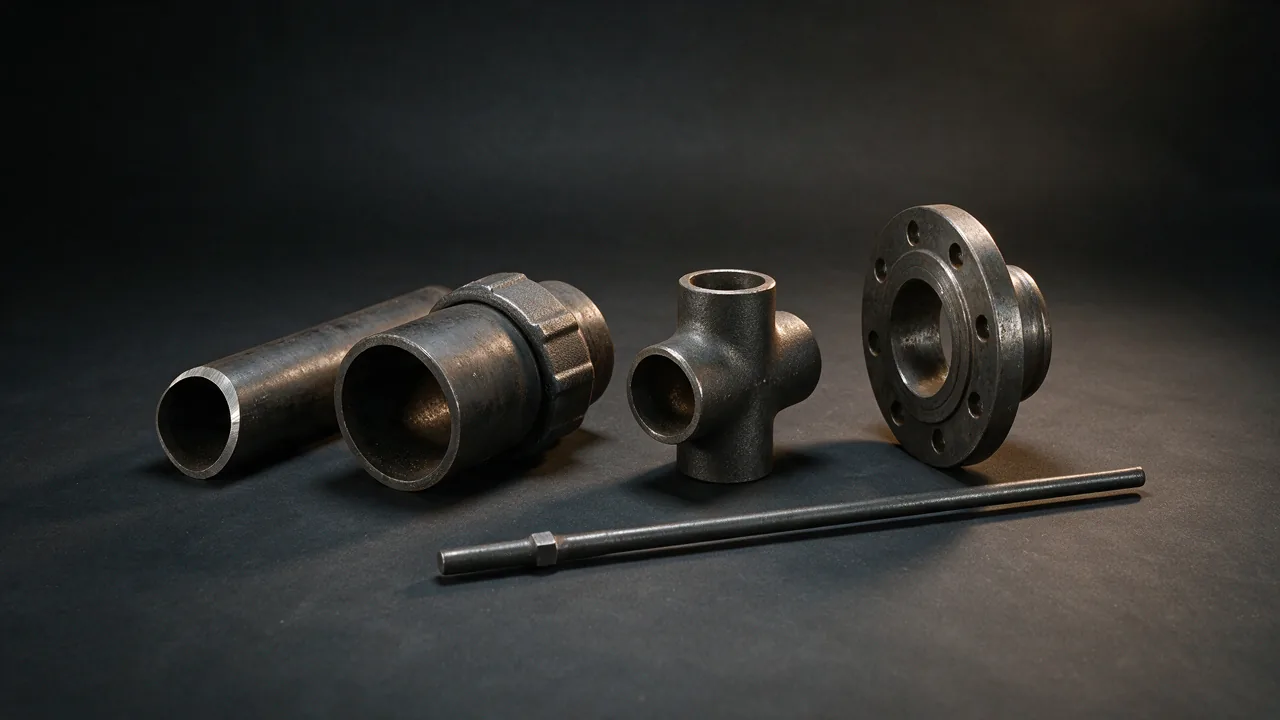
The range covers five product lines: steel pipe and line pipe, casing and tubing, pipe fittings, flanges, and sucker rods. Each line has its own page, and every item on it is bought by naming a standard and a grade — which is what the grade pages describe.
The five product lines
| Product line | What it covers |
|---|---|
| Steel Pipe & Line Pipe | Seamless, ERW, LSAW and SSAW pipe; black, galvanized and coated; carbon, alloy and stainless steel. Line pipe to API 5L and ASTM A106, A53, A333, A335 and A312. |
| OCTG: Casing & Tubing | Casing and tubing to API 5CT in grades J55 through P110 and Q125, supplied with couplings, thread protectors and accessories as a complete package. |
| Pipe Fittings | Elbows, tees, reducers, caps and couplings to ASME B16.9, B16.11, MSS SP-97 and API 6A, in carbon, alloy and stainless steel. |
| Pipe Flanges | Weld neck, slip-on, blind and threaded flanges to ASME B16.5 and B16.47. |
| Sucker Rods | API 11B sucker rods and accessories in grades C, D, K, KD, HL and HY for artificial lift. |
How the catalogue is organised
A product line page lists the items that are made in that form. A product page gives the sizes and the specification options for one item. A grade page is the third layer, and it is the one that actually fixes what the steel has to do: the standard sets the rules, the grade sets the strength and the chemistry, and the delivery condition sets how the steel was made and how it was tested.
That is why the same fitting can appear under two different grades and why two pipes of the same diameter can be different purchase items. The grade, not the shape, is what decides whether the material suits the job.
What decides the specification
- The standardFixes dimensions, test methods, tolerances and marking. API 5L, ASTM A106 and ASTM A53 are different standards even where their products overlap.
- The gradeFixes minimum yield strength, tensile strength and the chemistry limits. This is the part that is quoted and the part that is certified.
- The delivery conditionFixes heat treatment and the level of testing — PSL2 in API 5L, the Q in N80Q, and the impact-test temperature in low-temperature service.
The grade pages in the standards section take one commonly ordered grade at a time and set out what the standard actually requires of it.
Where to go next
- Steel pipe standards & grades – what each grade requires, and how to choose between them
- Applications – how the service the pipe goes into decides the specification
- Resources & tools – weight calculator, weight chart, schedule chart and size chart
- Request a quotation – send the specification, quantity and destination port
- Technical articles – how the specifications actually differ in practice
Frequently asked questions
How do I order a specific grade?
Name the standard and the grade, the size and wall thickness, the quantity, the ends, and the destination port. Those five items are enough to quote from. If you have a material requisition or a drawing, send that instead — it usually contains all five.
What is the difference between a product line and a grade?
The product line describes the form the steel is supplied in — pipe, casing, a fitting, a flange. The grade describes what the steel has to do, in terms of strength, chemistry and testing. A pipe and a fitting can be made to the same nominal strength and still be different grades, because they are made to different standards.
Which standards and grades can you supply?
Line pipe to API 5L and ASTM A106, A53, A333, A335 and A312; casing and tubing to API 5CT in grades J55 through P110 and Q125; fittings to ASME B16.9, B16.11, MSS SP-97 and API 6A; flanges to ASME B16.5 and B16.47; sucker rods to API 11B in grades C, D, K, KD, HL and HY.
Do you supply mill test certificates?
Yes. Material is supplied with EN 10204 3.1 or 3.2 mill test certificates, traceable to the heat number.
Need a price for a specific size and grade? Send the standard and grade, the size and wall thickness, the quantity and the destination port. We reply with availability and pricing.
Request a quotation