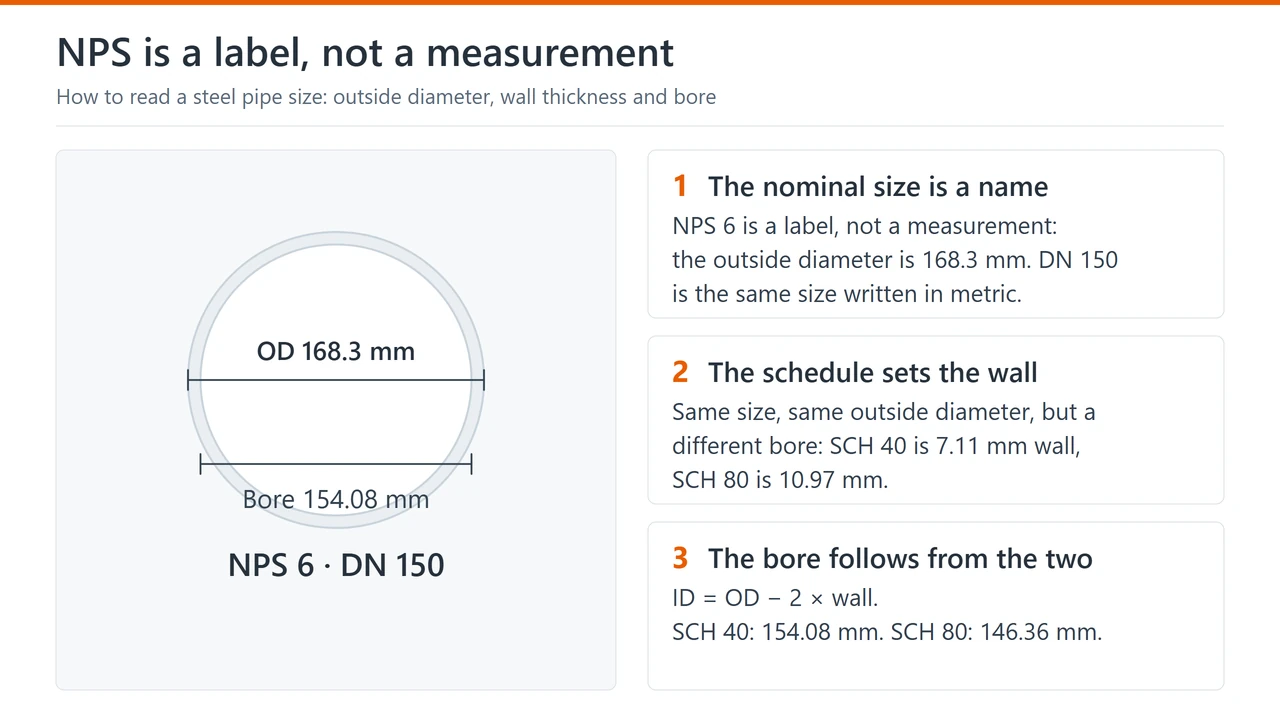
Steel pipe is specified by nominal size, and the actual outside diameter is then fixed by the standard: NPS 6 is 168.3 mm outside diameter regardless of wall thickness, while the bore changes with the schedule. This chart gives the outside diameter, the DN equivalent and the inside diameter for SCH 40 and SCH 80 pipe from NPS 1/8 to NPS 24.
Download PDF — Steel Pipe Size & Dimensions Chart
| NPS | DN | OD mm | OD inch | SCH 40 / STD WT mm | SCH 40 / STD ID mm | SCH 80 / XS WT mm | SCH 80 / XS ID mm |
|---|---|---|---|---|---|---|---|
| 1/8 | DN 6 | 10.3 | 0.406 | 1.73 | 6.84 | 2.41 | 5.48 |
| 1/4 | DN 8 | 13.7 | 0.539 | 2.24 | 9.22 | 3.02 | 7.66 |
| 3/8 | DN 10 | 17.1 | 0.673 | 2.31 | 12.48 | 3.20 | 10.70 |
| 1/2 | DN 15 | 21.3 | 0.839 | 2.77 | 15.76 | 3.73 | 13.84 |
| 3/4 | DN 20 | 26.7 | 1.051 | 2.87 | 20.96 | 3.91 | 18.88 |
| 1 | DN 25 | 33.4 | 1.315 | 3.38 | 26.64 | 4.55 | 24.30 |
| 1 1/4 | DN 32 | 42.2 | 1.661 | 3.56 | 35.08 | 4.85 | 32.50 |
| 1 1/2 | DN 40 | 48.3 | 1.902 | 3.68 | 40.94 | 5.08 | 38.14 |
| 2 | DN 50 | 60.3 | 2.374 | 3.91 | 52.48 | 5.54 | 49.22 |
| 2 1/2 | DN 65 | 73.0 | 2.874 | 5.16 | 62.68 | 7.01 | 58.98 |
| 3 | DN 80 | 88.9 | 3.500 | 5.49 | 77.92 | 7.62 | 73.66 |
| 3 1/2 | DN 90 | 101.6 | 4.000 | 5.74 | 90.12 | 8.08 | 85.44 |
| 4 | DN 100 | 114.3 | 4.500 | 6.02 | 102.26 | 8.56 | 97.18 |
| 5 | DN 125 | 141.3 | 5.563 | 6.55 | 128.20 | 9.53 | 122.24 |
| 6 | DN 150 | 168.3 | 6.626 | 7.11 | 154.08 | 10.97 | 146.36 |
| 8 | DN 200 | 219.1 | 8.626 | 8.18 | 202.74 | 12.70 | 193.70 |
| 10 | DN 250 | 273.1 | 10.752 | 9.27 | 254.56 | 15.09 | 242.92 |
| 12 | DN 300 | 323.9 | 12.752 | 10.31 | 303.28 | 17.48 | 288.94 |
| 14 | DN 350 | 355.6 | 14.000 | 11.13 | 333.34 | 19.05 | 317.50 |
| 16 | DN 400 | 406.4 | 16.000 | 12.70 | 381.00 | 21.44 | 363.52 |
| 18 | DN 450 | 457.2 | 18.000 | 14.27 | 428.66 | 23.83 | 409.54 |
| 20 | DN 500 | 508.0 | 20.000 | 15.09 | 477.82 | 26.19 | 455.62 |
| 24 | DN 600 | 610.0 | 24.016 | 17.48 | 575.04 | 30.96 | 548.08 |
Dimensions in millimetres except the outside diameter in inches. Inside diameter is calculated as OD − 2 × wall thickness.
Source: outside diameters and wall thicknesses per ASME B36.10M. Inside diameters are calculated, not tabulated.
Nominal size is a label, not a measurement
The most common error in ordering pipe is to assume that nominal size describes the outside diameter. It does not. NPS 6 pipe is 168.3 mm outside, not 152.4 mm, and NPS 2 is 60.3 mm, not 50.8 mm. The original imperial sizes were the inside diameters of the heavy-walled pipe then in use, and as thinner walls were introduced the outside diameter was held constant so that threads, fittings and flanges would stay interchangeable. The number survived as a label, which is why the relationship between the label and the actual dimension is irregular.
NPS and DN
NPS is the North American designation; DN, diamètre nominal, is the ISO equivalent used in Europe and in most project specifications outside North America. The two are not converted arithmetically — they are two labels for the same size group. NPS 6 and DN 150 are the same pipe. When a specification is written in DN, order against the DN and let the mill confirm the corresponding NPS and outside diameter.
Why the inside diameter matters
The bore sets the flow area, and flow area is what a hydraulic calculation uses, not the nominal size. Because the outside diameter is fixed, choosing a heavier schedule reduces the bore: NPS 6 SCH 40 has a 154.08 mm bore while SCH 80 has a 146.36 mm bore, a difference of about 10% in flow area for a pipe that measures the same on the outside. On a line where the pressure drop has been calculated close to the limit, that difference is the whole calculation.
From dimensions to weight
With the outside diameter and wall thickness from this chart, the nominal weight follows directly: W = 0.0246615 × t × (D − t) kg/m. The weight chart lists the weights, the weight calculator works out a size you enter, and the schedule chart carries the wall thickness for every schedule, including the stainless series.
Casing and tubing are sized differently
This chart is for line pipe, which is specified by nominal size and schedule. Casing and tubing (OCTG) are specified a different way: by outside diameter and weight per foot. A casing string is ordered as, for example, 7 in 26 lb/ft, not as a schedule. The outside diameter is fixed by the standard, and the weight per foot fixes the wall thickness and therefore the bore.
Casing outside diameters and weight range
| OD inch | OD mm | Common weights (lb/ft) |
|---|---|---|
| 4 1/2 | 114.3 | 9.5 – 15.1 |
| 5 | 127.0 | 11.5 – 18.0 |
| 5 1/2 | 139.7 | 14.0 – 23.0 |
| 6 5/8 | 168.3 | 20.0 – 32.0 |
| 7 | 177.8 | 17.0 – 38.0 |
| 7 5/8 | 193.7 | 24.0 – 39.0 |
| 8 5/8 | 219.1 | 24.0 – 49.0 |
| 9 5/8 | 244.5 | 32.3 – 58.4 |
| 10 3/4 | 273.1 | 32.75 – 60.7 |
| 11 3/4 | 298.4 | 42.0 – 60.0 |
| 13 3/8 | 339.7 | 48.0 – 72.0 |
| 16 | 406.4 | 65.0 – 84.0 |
| 18 5/8 | 473.1 | 87.5 |
| 20 | 508.0 | 94.0 – 133.0 |
How the bore and drift follow
The inside diameter follows from the wall thickness: ID = OD − 2 × wall. The drift diameter is then the ID minus a fixed allowance the standard sets, so that a cylindrical mandrel of the drift diameter passes freely through the full length — 3.18 mm (1/8 in) for casing up to 8 5/8 in, and 3.97 mm (5/32 in) for 9 5/8 in and larger.
The wall thickness for a given weight is fixed in the API 5CT tables and travels on the mill test certificate. Read the exact inside and drift diameters for a specific weight from the mill’s published table for that grade; the figures above are the nominal outside diameters and the standard weight range within each.
Frequently asked questions
What is the outside diameter of NPS 6 pipe?
168.3 mm, or 6.625 inches, for every schedule. The outside diameter is fixed by ASME B36.10M so that fittings, flanges and threads are interchangeable; only the wall thickness and the bore change between schedules.
Is DN 150 the same as NPS 6?
Yes. DN is the ISO designation and NPS the North American one, and DN 150 corresponds to NPS 6. They are labels for the same size group rather than a conversion, so a specification written in DN should be ordered by DN with the outside diameter confirmed.
How do I find the inside diameter of a pipe?
Subtract twice the wall thickness from the outside diameter. NPS 8 SCH 40 is 219.1 mm outside with an 8.18 mm wall, giving an inside diameter of 202.74 mm. The bore is what a flow calculation uses.
Which sizes are the most common in oil and gas work?
Line pipe in the transmission sizes between NPS 6 and NPS 24, and OCTG in the casing and tubing sizes — 4-1/2, 5-1/2, 7, 9-5/8 and 13-3/8 inch casing and 2-3/8 and 2-7/8 inch tubing. Those are the sizes we quote most often.
Where to go next
- Line pipe and steel pipe – seamless, ERW, LSAW and SSAW to API 5L, ASTM A106, A53, A333, A335 and A312
- Casing and tubing (OCTG) – API 5CT well casing and tubing, J55 through P110 and Q125
- API 5L X65 pipe – grade page with chemistry, mechanical properties and size range
- ASTM A106 Grade B pipe – the high-temperature seamless grade most often quoted with these charts
- Steel pipe weight calculator – work out the weight of any size and wall thickness
- Pipe schedule chart – wall thickness for every schedule
- Steel pipe size chart – outside diameter, wall thickness and inside diameter
- Steel pipe weight chart – nominal weight per metre and per foot
- Product line card – the five product lines and the standards behind each, as a one-page PDF
- All resources and tools – the calculator, the charts and the downloadable PDFs in one place
Have a specification to price? Give us the standard or grade, the size and wall thickness, the quantity you need and the port of discharge. We come back with availability and a price.
Request a quotation