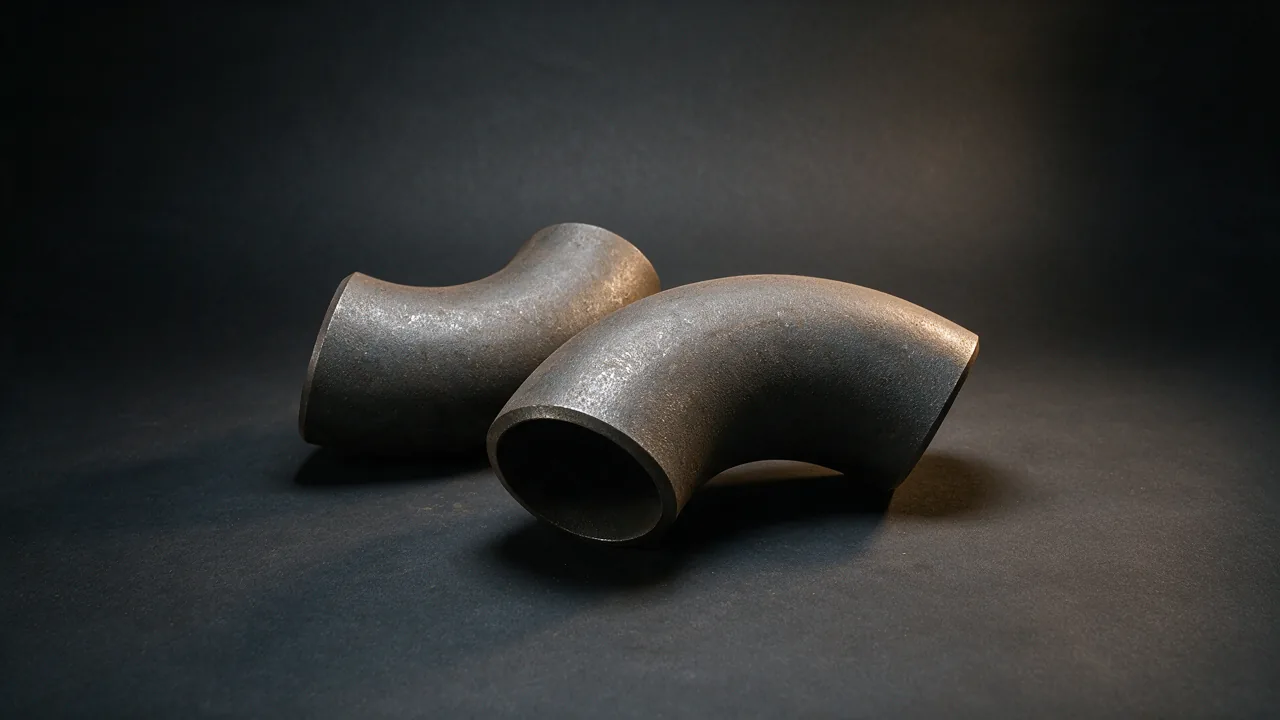
ASTM A234 WPB elbow is a wrought carbon steel butt-welding fitting for moderate and high-temperature service, with a minimum yield strength of 240 MPa (35,000 psi) and a minimum tensile strength of 415 MPa (60,000 psi). Dimensions follow ASME B16.9 for sizes from NPS 1/2 to NPS 48.
Download ASTM A234 WPB Elbow data sheet (PDF) One-page summary of the supply range, chemistry, mechanical properties and inspection documents on this page. The standard is the governing document.
Mejor Steel is the export agent for the mills that make your material: one contract, one delivery date, and the mill named on the quotation. How we supply
We reply within one business day, Monday to Friday 09:00-18:00 CST. Or write to info@mejorsteel.com / WhatsApp.
Size range and specification
- Size range NPS 1/2 – NPS 48 (DN 15 – DN 1200), seamless or welded
- Types 45 degree elbow, 90 degree elbow, 180 degree return bend
- Radius Long radius R = 1.5 D, short radius R = 1.0 D, and 3D / 5D on request
- Wall thickness SCH 10 – SCH XXS, matched to the connecting pipe schedule
- Ends Beveled to ASME B16.25 for butt welding; plain end on request
- Surface treatment Shot blasted, black painted, anti-rust oil, or with 3PE / FBE coating
- Manufacturing process Seamless (hot formed from pipe) or welded (formed from plate and welded)
- Heat treatment WPB supplied normalized, or in the as-formed condition when the forming temperature is above the upper critical temperature
- Delivery standard ASTM A234 / ASME SA234, dimensions to ASME B16.9
How this grade is supplied
- Inspection Inspected by the producing mill’s own inspection department, which is independent of production, against the delivery standard above. Third-party inspection — SGS, BV or TUV, or an inspector you send yourself — can be arranged at the mill or before shipment; give us the dates and the scope at the order stage.
- Certificate A mill test certificate to EN 10204 3.1 showing the heat number, the chemical composition and the mechanical results is standard on every order. EN 10204 3.2, countersigned by the inspector you nominate, is available on request.
- Documents with the goods The mill test certificate and the packing list travel with the shipment, and the heat number is traceable from cast through to the finished product.
- Packing Sea-worthy export packing: bundled by size with end protection, corrosion protection on request, stencilled with the size, grade and heat number.
- MOQ One bundle or one truckload; mixed sizes within a bundle accepted.
- Lead time Counted from order confirmation, not from the enquiry. Stock sizes 5–10 days; mill run or non-stock 3–5 weeks. The delivery window is fixed on the quotation.
- How we supply Sourced through partner mills; the producing mill is named on the quotation.
ASTM A234 chemical composition (maximum unless a range is given, %)
| Element | WPB | WPC |
|---|---|---|
| Carbon, C | 0.30 max | 0.35 max |
| Manganese, Mn | 0.29 – 1.06 | 0.29 – 1.06 |
| Phosphorus, P | 0.050 max | 0.050 max |
| Sulphur, S | 0.058 max | 0.058 max |
| Silicon, Si | 0.10 min | 0.10 min |
| Chromium, Cr | 0.40 max | 0.40 max |
| Molybdenum, Mo | 0.15 max | 0.15 max |
| Nickel, Ni | 0.40 max | 0.40 max |
| Copper, Cu | 0.40 max | 0.40 max |
| Vanadium, V | 0.08 max | 0.08 max |
| Carbon equivalent | 0.50 max | 0.50 max |
Carbon equivalent is calculated as C + Mn/6 + (Cr + Mo + V)/5 + (Ni + Cu)/15 and shall be reported on the mill certificate. Note that A234 permits a sulphur content up to 0.058%, which is higher than the 0.035% allowed by ASTM A106. WPB and WPC have identical chemistry requirements except for carbon, and that single difference is what separates their strength levels.
Source: chemical composition requirements of ASTM A234 / ASME SA234, Table 1. The standard is the governing document.
ASTM A234 WPB and WPC tensile requirements
| Grade | Tensile strength | Yield strength min | Elongation min | Hardness max |
|---|---|---|---|---|
| WPB | 415 – 585 MPa (60,000 – 85,000 psi) | 240 MPa (35,000 psi) | 22% | 197 HBW |
| WPC | 485 – 655 MPa (70,000 – 95,000 psi) | 275 MPa (40,000 psi) | 22% | 197 HBW |
Elongation values are the longitudinal values, 22% for both WPB and WPC; the transverse requirement is 14% for both grades. Fittings produced from plate have a lower minimum elongation, 17%. A deduction of 1.5 percentage points longitudinal and 1.0 point transverse applies for each 1/32 inch of wall thickness below 5/16 inch. Hardness need not be reported unless specified in the purchase order.
Source: tensile requirements of ASTM A234 / ASME SA234, Table 1. The standard is the governing document.

What Does A234 WPB Mean?
ASTM A234 is the specification for wrought carbon steel and alloy steel fittings of seamless and welded construction, intended for moderate and high-temperature service. WPB is the grade designation for the carbon steel grade: the W stands for wrought, the P indicates that the material is suitable for pressure service, and the B denotes the strength level, which matches ASTM A106 Grade B and A53 Grade B at 415 MPa minimum tensile and 240 MPa minimum yield. WPC is the same material with a higher carbon limit and therefore 485 MPa minimum tensile and 275 MPa minimum yield.
Elbow Geometry – Angle, Radius and Dimensions
Butt weld elbows are supplied as 45 degree, 90 degree and 180 degree returns, and in two standard radii. Long radius elbows use a centreline radius of 1.5 times the nominal diameter, which is the default because it produces a lower pressure loss and is easier to pig. Short radius elbows use 1.0 times the nominal diameter and are used where space is restricted. All these dimensions and their tolerances are set by ASME B16.9, which also specifies the bevel geometry by reference to ASME B16.25. Sizes above 48 inch, and elbows for specialised service, follow ASME B16.49 or are made to drawing.
WPB, WPC and the Alloy Grades
ASTM A234 covers carbon steel grades WPB and WPC and a family of alloy grades: WP1, WP12, WP11, WP22, WP5, WP9 and WP91. The carbon grades are used for general process, utility and steam service. The alloy grades are chosen when the pipe they join is alloy pipe, because the fitting must match the creep and oxidation performance of the connecting pipe at temperature. Chromium-molybdenum grades such as WP11 and WP22 are typical for refinery and power plant piping, and WP91 for high-temperature high-pressure steam lines. Where the connecting pipe is stainless steel, ASTM A403 fittings should be specified instead.
How WPB Elbows Are Made
A WPB elbow is either seamless or welded. Small sizes and many large sizes are made seamless by hot forming a length of pipe over a mandrel to the required radius. Larger sizes and those where a seamless shell is not economic are made from two pressed halves welded together, and the weld is then inspected. WPB may be supplied normalized, and is normally so when it has not been hot formed above the upper critical temperature. Where a fitting is welded from plate, the minimum elongation is reduced to 17% and radiographic examination of the weld is required.
Inspection and Certificates
A234 fittings are supplied with a mill certificate showing heat number, chemistry, tensile results and carbon equivalent. Dimensional inspection verifies wall thickness at the extrados and crown, ovality, centre-to-end dimensions and bevel angle. Welded fittings receive radiographic or ultrasonic examination of the weld, and hardness testing is available on request. Positive material identification is available for alloy grades. Marking on the fitting shows the grade, size, wall thickness, heat number and the manufacturer’s symbol, which allows traceability back to the heat.
Where the dimensions come from
An A234 WPB elbow is not dimensioned by ASTM A234. The material specification fixes the chemistry and the mechanical properties; the dimensions come from a separate standard, and that is where most ordering mistakes start.
| Feature | Dimension source | What it means on the order |
|---|---|---|
| 45°, 90° and 180° fittings | ASME B16.9 | Centre-to-end dimension is read from the B16.9 table for the nominal size |
| Long radius (LR) | ASME B16.9 | Radius is 1.5 × nominal pipe size |
| Short radius (SR) | ASME B16.28 | Radius is 1.0 × nominal pipe size; dimensions are not interchangeable with B16.9 |
| Welding ends | ASME B16.25 | Bevel geometry is fixed by the end standard, not by the elbow supplier |
| Wall thickness | Matched to the pipe | Order the elbow to match the pipe schedule or the exact wall on the line |
| Size range | Manufacturing limit | Seamless is typical up to about NPS 24; larger sizes are welded |
Source: ASME B16.9, B16.28 and B16.25 for dimensions; ASTM A234 for material. Confirm the applicable table against the current edition of each standard.
The practical point: a “90° elbow” is not enough information. Long radius and short radius have different centre-to-end dimensions and different pressure behaviour, and a spool drawn to one will not fit the other.
A234 WPB, A105 and A106 — which one belongs on the drawing
The three specifications are often welded to each other on the same spool, so they are read as if they were interchangeable. They are not: each one describes a different product form.
| Specification | Covers | Where it appears |
|---|---|---|
| ASTM A234 WPB | Wrought carbon steel butt-welding fittings — elbows, tees, reducers, caps | The fitting on the spool |
| ASTM A105 | Forged carbon steel piping components — flanges, forged fittings, valves | The flange or the forged item |
| ASTM A106 | Seamless carbon steel pipe for high-temperature service | The pipe itself |
If a drawing calls for an “A105 elbow”, it is describing a fitting that is not normally made to that specification. Confirm whether the designer meant an A105 flange with an A234 WPB elbow, or a forged fitting to another specification such as ASTM A105 with the appropriate dimensional standard.
Ordering mistakes that cost a spool
- Short radius ordered as long radius. Different centre-to-end dimension; the elbow will not fit the cut length on the drawing.
- Wall thickness left open. The elbow has to match the pipe wall, otherwise the bevel does not align and the welder has to build up the joint.
- Seamless assumed. Welded fittings are permitted by A234; if the project requires seamless fittings, write it on the order.
- Grade confused with marking symbol. WPB is a marking symbol inside A234, not a grade level above or below WPC; the two are different chemistry routes, not a quality ranking.
- Heat treatment or hardness requirement left off. A234 does not settle every project requirement; where the line specification adds a hardness cap or a specific heat treatment, it must appear on the order and in the certificate.
What to state on the enquiry
- Fitting type and angle: 45°, 90° or 180°, long radius or short radius.
- Nominal size and the matching pipe wall thickness or schedule.
- Material: ASTM A234 WPB, WPC, or another grade in the A234 family.
- End preparation and whether seamless fittings are required.
- Quantity, plus any test and certificate requirement: EN 10204 3.1, or 3.2 with third-party countersignature.
- Any additional project requirement: hardness limit, heat-treatment record, marking, or third-party witnessing.
Typical applications
- Oil and gas process piping
- Refinery and petrochemical piping
- Power plant and steam lines
- Water and utility piping
- General industrial piping systems
Standards covered
Frequently asked questions
What is the difference between A234 WPB and WPC?
The chemical requirements are identical except for carbon: WPB has a maximum of 0.30% and WPC a maximum of 0.35%. That difference raises the minimum tensile strength from 415 MPa to 485 MPa and the minimum yield strength from 240 MPa to 275 MPa. Both have the same maximum hardness of 197 HBW. WPC is used where higher strength is needed, but it has slightly lower elongation.
What is the standard for A234 WPB elbow dimensions?
Dimensions are governed by ASME B16.9, which covers factory-made wrought butt-welding fittings from NPS 1/2 to NPS 48. It sets the centre-to-end dimensions, wall thickness, ovality and tolerance requirements. The bevel is specified to ASME B16.25. Sizes above NPS 48 follow ASME B16.49 or are manufactured to drawing.
What is long radius and short radius for an elbow?
Long radius means the centreline radius of the bend is 1.5 times the nominal pipe diameter, written as R = 1.5 D. Short radius means the centreline radius is equal to the nominal diameter, R = 1.0 D. Long radius is the standard choice because it gives lower pressure loss and allows pipeline pigs to pass. Short radius is used where installation space is limited.
Where to go next
- Butt Weld Elbow – butt weld elbows to ASME B16.9
- Butt Weld Tee – butt weld tees to ASME B16.9
- Butt Weld Reducer – butt weld reducers to ASME B16.9
- Alloy Steel Fittings – alloy fittings for high-temperature service
- ASTM A105 Flange – the forged carbon steel flange material and its ratings
- Get a Quote – send the grade, size, quantity and destination port
Need a price for a specific size and grade? Send the standard and grade, the size and wall thickness, the quantity and the destination port. We reply with availability and pricing.
Request a quotation