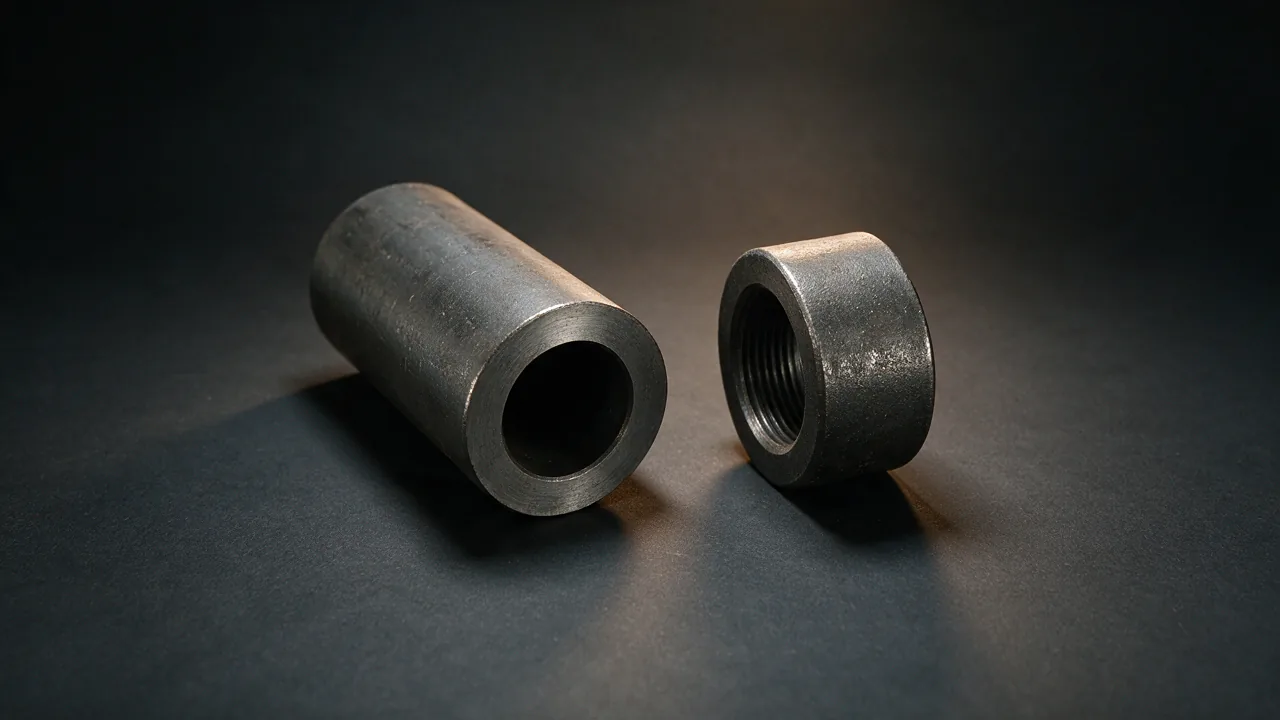
Sour service means a wellstream or process stream containing hydrogen sulphide. Hydrogen sulphide promotes hydrogen embrittlement and sulphide stress cracking in high-strength steel, so the material is not chosen by strength but by hardness: the steel must be soft enough and clean enough that it will not crack in the presence of H2S and water. The governing document is NACE MR0175 / ISO 15156.
Mejor Steel is the export agent for the mills that make your material: one contract, one delivery date, and the mill named on the quotation. How we supply
We reply within one business day, Monday to Friday 09:00-18:00 CST. Or write to info@mejorsteel.com / WhatsApp.
Why ordinary high-strength pipe is the wrong answer
Cracking in sour service is driven by hardness and by the presence of water with the H2S. As yield strength rises, so does hardness, and above a threshold the steel becomes susceptible to sulphide stress cracking. The practical consequence is counter-intuitive to anyone used to buying on strength: for a sour well, a higher grade can be the wrong grade, and a maximum hardness of 22 HRC is what actually governs the material selection.
The grades that are used
For casing and tubing to API 5CT, the sour-service grades are L80 type 1, C90, T95 and C110, each defined with a specific heat treatment and a hardness limit. Ordinary N80 is not a sour-service grade: it can meet the hardness requirement in some product forms, but the standard does not qualify it, which is why enquiries for sour wells are quoted against L80 or C90 rather than N80.
For line pipe, the answer is API 5L PSL2 with additional requirements. A sour line pipe specification normally adds a hardness limitation, a restricted carbon equivalent, limits on sulphur and phosphorus, and one or both of two tests: NACE TM0284 for hydrogen induced cracking, which is measured as crack length and crack thickness ratios, and NACE TM0177 for sulphide stress cracking under load.
What is normally called out
| Service need | Product | Standard and grade |
|---|---|---|
| Sour well casing | API 5CT Casing Pipe | API 5CT L80 type 1, C90 or T95 to NACE MR0175 / ISO 15156 |
| Sour well tubing | API 5CT Tubing Pipe | API 5CT L80 type 1, C90, T95; EUE or premium connections |
| Gas-tight sour completions | Premium Connection Casing and Tubing | API 5CT sour grades with metal-to-metal seal connections |
| Sour gathering and flowlines | API 5L Seamless Steel Pipe | API 5L PSL2 with hardness and CE limits, HIC tested to NACE TM0284 |
| Sour transmission lines | API 5L LSAW Welded Steel Pipe | API 5L PSL2, sour service specification, HIC and SSC tested |
| Alloy process piping in sour service | ASTM A335 Alloy Steel Pipe | ASTM A335 P11, P22, P91 where the temperature also demands an alloy |
| Stainless for severe sour service | ASTM A312 Stainless Steel Pipe | ASTM A312 TP316L, duplex and super duplex to ISO 15156 limits |
| Sour-service fittings | Alloy Steel Fittings | ASTM A234 WP11 / WP22 / WP91, or A403 stainless, hardness controlled |
| Sour-service flanges | Pipe Flanges | ASTM A105 with hardness limit, or A182 F316 to ISO 15156 |
What has to be on the enquiry
A sour service enquiry is meaningless without the partial pressure of H2S, because ISO 15156 divides service into regions by H2S partial pressure, total pressure, pH and chloride content, and the permitted material follows from which region the well falls in. Supply the H2S partial pressure and the temperature at minimum, and the grade and hardness limits follow.
- Give the H2S partial pressure. Everything else is secondary, and a specification without it cannot be qualified.
- State the hardness limit required. 22 HRC maximum is the usual figure and has to be tested, not assumed.
- Ask for the test, not the claim. HIC to NACE TM0284 and SSC to NACE TM0177 are test reports, and they belong in the documentation list.
- Watch the welds as well as the pipe body. Seam and weld hardness limits are separate from the parent metal limits and are often missed.
- Think about the temperature. Sour service limits are given for a temperature range, and a material qualified at 20 °C may not be qualified at 120 °C.
- Documentation matters more here. Material traceability to EN 10204 3.1 or 3.2 and the test reports travel with the pipe.
The threshold that makes a service sour
Sour service is defined by the presence of hydrogen sulphide in a water-bearing environment, not by a single concentration number. For material qualification, ISO 15156 / NACE MR0175 works from the H2S partial pressure together with pH, chloride content, temperature and total pressure.
A commonly used screening value is an H2S partial pressure of about 0.3 kPa (0.05 psi); above this the service is normally treated as sour. Below it, the service may still require qualification under the full ISO 15156 rules, so the screening value is a flag, not a substitute for the standard.
The numbers that decide the material
Two sets of numbers come up on every sour enquiry: the hardness ceiling the material has to meet, and the acceptance ratios for the hydrogen induced cracking test. Both are worth having on the specification rather than discovering them at the inspection stage.
Hardness limits by material class
| Material class | Hardness limit | Where it comes from |
|---|---|---|
| Carbon and low-alloy steel — most API 5CT and API 5L grades | 22 HRC maximum (≈ 250 HV) | ISO 15156-2 |
| 41XX-type low-alloy steels, quenched and tempered tubulars (restricted conditions) | up to 26 HRC | ISO 15156-2, Section A.2.2.3.3 and Table A.3 |
| Martensitic stainless (13Cr class) | 22–23 HRC, depending on grade | ISO 15156-3 |
| Duplex stainless | 36 HRC maximum (≈ 350 HV), with ferrite content and microstructure controls | ISO 15156-3 |
| Austenitic stainless | 22 HRC, solution annealed and free of cold work | ISO 15156-3 |
Hardness is the number that governs selection, not yield strength: a higher-strength grade that exceeds the ceiling is the wrong material for a sour well, however strong it is. The 22 HRC figure is the general ceiling for carbon and low-alloy steel; the standard lists a small set of exceptions, and anything outside those has to be qualified against the specific service conditions.
HIC acceptance ratios
Hydrogen induced cracking is tested to NACE TM0284: a coupon is held in a sour solution, then sectioned and measured. The result is reported as three ratios, and the purchase specification sets the maximum allowed for each.
| Ratio | What it measures | Commonly specified limit |
|---|---|---|
| CLR — crack length ratio | The cracked length as a share of the section width | ≤ 15% |
| CTR — crack thickness ratio | The cracked thickness as a share of the section thickness | ≤ 5% |
| CSR — crack sensitivity ratio | The cracked area as a share of the section area | ≤ 2% |
NACE TM0284 is the test method; it does not fix the pass mark. The 15 / 5 / 2 values are the limits most project specifications write in, and your specification can be tighter. SSC to NACE TM0177 is the companion test under load, and the same point applies: the method is standard, the acceptance criterion is yours.
Material selection in five steps
- Establish the H2S partial pressure, temperature, pH and chloride content.
- Decide whether the service is sour under ISO 15156 / NACE MR0175.
- Choose the material class: carbon or low-alloy steel with a hardness cap, martensitic stainless (13Cr class), duplex stainless or austenitic stainless.
- Add the required tests: hardness, SSC to NACE TM0177 and HIC to NACE TM0284 where they apply.
- Write the hardness limit, test methods and acceptance values into the purchase order and the mill certificate.
The most expensive mistake is to select a grade first and check the sour rules afterwards; the order is the other way round.
API 5L Annex H: sour service for line pipe
Annex H is the part of API 5L that applies when PSL2 line pipe is ordered for sour service – that is, where the produced or transported fluid contains hydrogen sulphide in the presence of water. It is a different route from the one used for casing and tubing: line pipe is ordered to API 5L with the annex called out, while casing and tubing are ordered to API 5CT and qualified against NACE MR0175 / ISO 15156 as described above.
| Question | What decides it | Where it is written |
|---|---|---|
| Is the service sour at all? | H2S partial pressure, total pressure, pH, chloride content and temperature | ISO 15156 / NACE MR0175, and the project’s own corrosion assessment |
| Is the pipe line pipe, or casing and tubing? | The product form and the standard it is ordered to | API 5L for line pipe, API 5CT for casing and tubing |
| Which sour requirement applies? | Whether the project orders line pipe to API 5L Annex H, or specifies a material qualified to ISO 15156 | The purchase order, referencing the standard edition |
| What testing comes with it? | The annex sets the chemical, hardness and cracking test requirements; the project may add to them | API 5L Annex H in the edition named on the order |
| What proves it on delivery? | Marking, and a mill certificate that states the annex and the test results | The certificate and the marking requirement on the order |
What calling Annex H changes in the order
- Chemistry and hardness. Annex H adds limits on composition and hardness on top of the normal PSL2 requirements, and those limits apply to the pipe body and to the weld. The values follow the edition named on the order, so the edition is fixed before the heat is rolled.
- Cracking tests. Hydrogen induced cracking and sulphide stress cracking testing is specified against the annex rather than left to the mill’s routine programme, and the acceptance ratios belong on the purchase order rather than being settled at the inspection stage.
- Welding. A sour line pipe order carries requirements on the weld and on the heat affected zone, which is why the pipe is normally ordered with the weld procedure and the inspection scope agreed in advance.
- Documents. The certificate has to state the annex, the edition and the test results; if a third party inspects, the scope has to be agreed before production rather than before shipment.
Where a project cites Annex H without naming an edition, ask before the order is placed. The requirements are set by the edition, and a certificate cannot be re-written to a different edition after the pipe has been tested and marked.
Frequently asked questions
What makes a service sour?
The presence of hydrogen sulphide in the produced or process stream, in the presence of water. It is normally quantified as the partial pressure of H2S rather than as a concentration, because the partial pressure is what governs which materials are permitted under NACE MR0175 / ISO 15156.
Is N80 suitable for sour service?
Not as a qualification. The sour-service grades for casing and tubing are L80 type 1, C90, T95 and C110. N80 is a standard API 5CT grade without a sour-service qualification, so a sour well should be quoted against one of the qualified grades instead.
What is the 22 HRC limit for?
It is the maximum hardness commonly specified for carbon and low-alloy steels in sour service. Hardness correlates with susceptibility to sulphide stress cracking, so capping hardness is the practical way of ensuring the steel will not crack in the presence of H2S and water.
What do HIC and SSC testing involve?
HIC, hydrogen induced cracking, is tested to NACE TM0284 and reported as crack length and crack thickness ratios after exposure to a sour solution. SSC, sulphide stress cracking, is tested to NACE TM0177 and applies a tensile load to the specimen while it is exposed. Both are destructive coupon tests run on the heat.
Where to go next
- Steel pipe weight calculator – work out the weight of any size and wall thickness
- Pipe schedule chart – wall thickness for every schedule, carbon and stainless
- Request a quotation – send the specification, quantity and destination port
- API 5CT L80 tubing – a sour-service grade in detail
- API 5CT N80Q casing – the standard grade, and why it is not the sour answer
- Casing and tubing (OCTG) – API 5CT well casing and tubing, J55 through P110 and Q125
- ASTM A790 Duplex Pipe – duplex stainless pipe where sour service meets chlorides
Ready to price your enquiry? Tell us the specification, the dimensions, how much you need and where it is going. We reply with what is available and what it costs.
Request a quotation