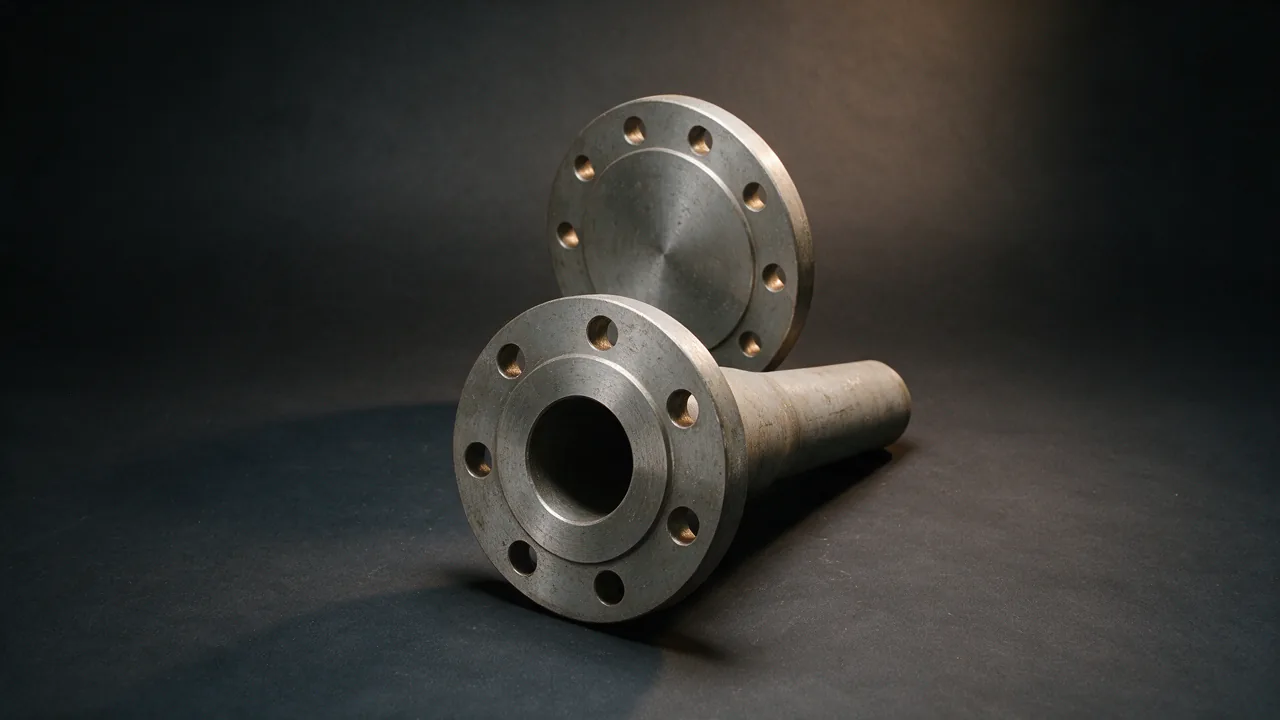
Weld neck, slip on, socket weld, threaded, lap joint and blind flanges to ASME B16.5 and B16.47, class 150 to 2500, in carbon, alloy and stainless steel.
- Standard: ASME B16.5, ASME B16.47, ASTM A105, ASTM A182, ASTM A350, MSS SP-44
- Grades: A105, A350 LF2, A694 F52, F304, F304L, F316, F316L, F321, F11, F22, F91
- Certificate: EN 10204 3.1 with every order, 3.2 on request
Mejor Steel is the export agent for the mills that make your material: one contract, one delivery date, and the mill named on the quotation. How we supply
We reply within one business day, Monday to Friday 09:00-18:00 CST. Or write to info@mejorsteel.com / WhatsApp.
Specifications
| Outer diameter | 1/2" - 60" (DN15 - DN1500) |
|---|---|
| Schedule | Per ASME B16.5 bore and schedule |
| Length | Flange thickness and hub per ASME B16.5 / B16.47 |
| Ends | Raised face, flat face, ring joint, or tongue and groove |
| Surface treatment | Black, galvanized, or machined |
| Manufacturing process | Forged and machined |
| Pressure rating | Class 150, 300, 400, 600, 900, 1500, 2500 |
| Connection type | Weld neck, slip on, socket weld, threaded, lap joint, blind |
Flange Types and Where Each Is Used
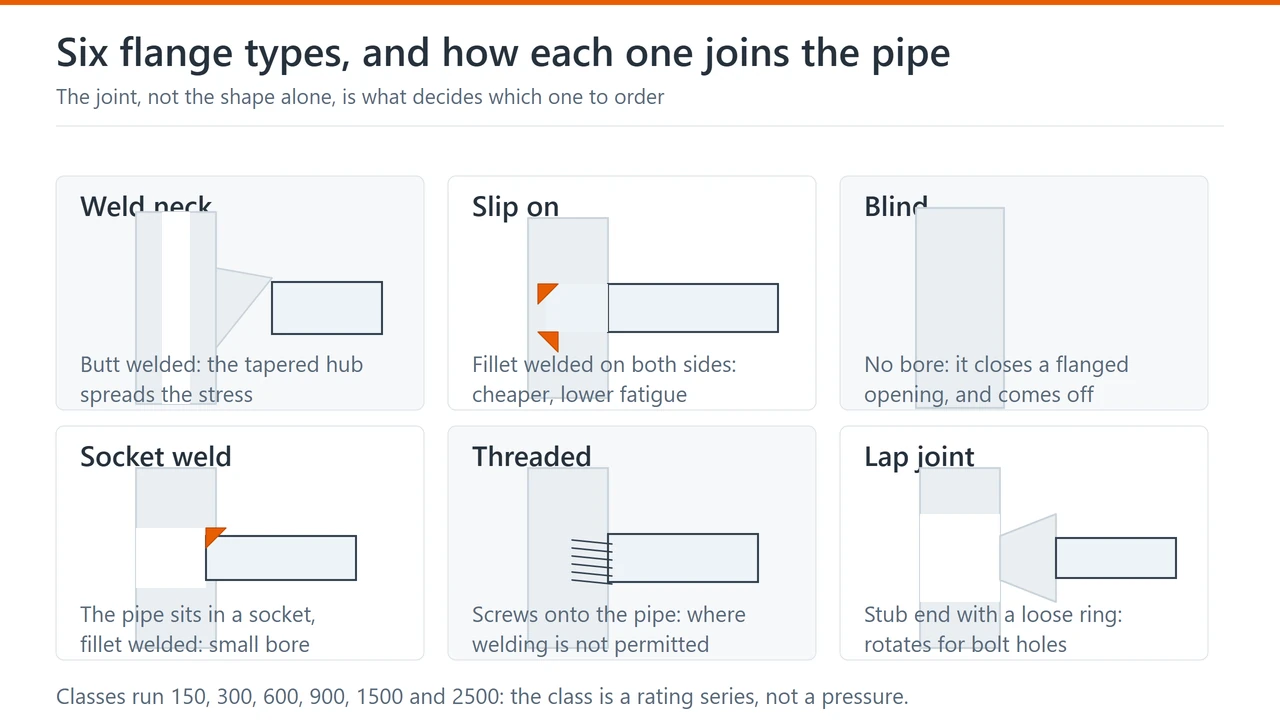
The weld neck flange has a tapered hub that transfers stress from the flange to the pipe smoothly and is the standard choice for high pressure, high temperature and severe cyclic service, and for all applications where radiography of the weld is required. The slip on flange is slipped over the pipe and fillet welded at both sides; it is cheaper and easier to align but has lower fatigue life and is not used for severe cyclic service. The socket weld flange is used for small bore lines in the same way as a socket weld fitting. The threaded flange is used where welding is not permitted, typically on small bore utility lines. The lap joint flange uses a stub end, so the flange rotates for bolt hole alignment and the wetted surface is the stub end material, which makes it economical in stainless or exotic material. The blind flange closes a flanged opening and is removable. Selection is governed by the design code, the pressure and temperature class, and whether the joint will be radiographed.
Understanding Flange Classes
The classes 150, 300, 600, 900, 1500 and 2500 in ASME B16.5 are not pressure ratings in psi. They are class designations that define a set of dimensions, and the actual permissible working pressure depends on both the class and the material and the design temperature. For example a class 150 carbon steel flange rated for roughly 19 bar at 38 degrees Celsius derates to about 13 bar at 200 degrees Celsius, and the derating factor differs for stainless steel. The correct procedure is to select the class from the applicable pressure temperature rating table in ASME B16.5 for the specific material and design temperature, then confirm the pipe schedule matches the flange bore. ASME B16.47 covers larger flanges, series A for sizes 26 to 60 inch in the MSS SP-44 tradition and series B for sizes 26 to 60 inch in the API 605 tradition; the two series are not dimensionally interchangeable.
Flanges: what the class and the facing have to match
A flange is not specified by size alone. The pressure class sets the wall and the bolt circle, the facing has to match the gasket and the flange it is bolted to, the bore has to suit the pipe, and the material follows the line. Below the size, those four are the whole specification.
| Joint condition | What it fixes | What to state on the enquiry |
|---|---|---|
| Standard process connection, Class 150 or 300 | Weld neck for high pressure, slip on for utility service | the class, the facing, the pipe schedule, and the material |
| High pressure or high temperature | Weld neck, bored to match the pipe schedule | the class, and the pipe wall |
| Small bore tie-in | Threaded or socket weld flange | the thread standard, or the pipe size |
| Large diameter line above 24 in | ASME B16.47 Series A or Series B, which are not interchangeable | which series, and the bolt circle |
| Ring joint or flat face | The facing changes the gasket and the bolt load | the facing, and the gasket |
| Sour or cryogenic service | Material and bolting both have to suit the temperature and the fluid | the temperature, and the NACE requirement |
| Joint that is broken often | Slip on or lap joint rather than weld neck | how often the joint is opened |
| Coated or lined line | The flange face has to stay bare, or be coated to suit | the coating or lining system |
What is the difference between a weld neck and a slip on flange?
A weld neck flange has a long tapered hub that is butt welded to the pipe, so stress transfers smoothly from pipe to flange, and the joint can be radiographed. It has the best fatigue performance and is used for high pressure, high temperature and severe cyclic service. A slip on flange slides over the pipe and is fillet welded on both sides. It is cheaper and easier to align but has lower fatigue strength and cannot be radiographed for full penetration, so it is not used for severe cyclic service.
How do I know which flange class to order?
Use the pressure temperature rating table in ASME B16.5 for your specific material and design temperature. The class alone does not give a pressure: a class 150 flange in carbon steel holds a different pressure at 38 degrees Celsius than at 200 degrees Celsius, and the rating changes again if the material is stainless. State the design pressure, design temperature and material, and the class follows from the table. Also confirm the flange bore matches the pipe schedule.
EN 1092-1 Flanges and PN Ratings
In Europe, flanges are most often specified to EN 1092-1 rather than ASME B16.5. The standard covers circular flanges in sizes DN10 to DN4000, and pressure is named as a PN (nominal pressure) value: PN6, PN10, PN16, PN25 and PN40 are the ratings most commonly used on carbon and stainless steel lines. A PN16 flange is not a direct substitute for a Class 150 flange; the bolt circles and drilling can match on common sizes, but the two systems are not dimensionally interchangeable, so the standard must be stated on the enquiry.
EN 1092-1 designates flange types by number. The types most often supplied here are Type 01 plate flange for welding, Type 05 blind flange and Type 11 weld neck flange, with facing forms A (flat face) and B1/B2 (raised face). These have replaced the older DIN 2501, DIN 2527 and DIN 2633 designations that are still named on many drawings.
Plate flanges are flat discs welded to the pipe and used for low pressure, non-critical services such as water, air and general utility lines, typically at PN6, PN10 or PN16. Materials range from carbon steel P235GH and P250GH (1.0460) to stainless 1.4301, 1.4404 and 1.4571.
| PN rating | Common European applications | Carbon steel grades | Stainless grades |
|---|---|---|---|
| PN6 / PN10 | Water, air and low-pressure utility | P235GH, P250GH | 1.4301 |
| PN16 | General process, water and building services | P250GH, P265GH | 1.4404 |
| PN25 / PN40 | Higher-pressure process lines | P250GH, P265GH | 1.4404, 1.4571 |
Enquiry: state the standard (EN 1092-1), DN size, PN rating, flange type number, facing form and material. Flanges are supplied with EN 10204 3.1 certificates, with 3.2 on request.
Grades supplied and minimum properties
The grade fixes the minimum strength and the chemistry. The table below gives the requirements that separate the flange material grades ordered most often; the full composition and mechanical table for each grade is on its own page.
| Grade | Yield strength | Tensile strength |
|---|---|---|
| A105 (forged carbon steel) | 250 MPa (36,000 psi) | 485 MPa (70,000 psi) |
| F316 (forged stainless steel) | 205 MPa min (30,000 psi) | 515 MPa min (75,000 psi) |
The complete chemistry and mechanical table for each grade, with the notes that qualify it, is on the individual grade page – for example ASTM A105 flange. The stainless grade has the higher tensile requirement but the lower minimum yield strength, which is why flange wall thickness is set from the rating rather than from the material table alone.
Source: specified minimum yield and tensile strength for each grade, per ASTM A105 / ASME SA105 and ASTM A182 / ASME SA182. The standard named against each grade is the governing document.
Download Pipe Flange Supplier – ASME B16.5 & B16.47 data sheet (PDF) One page: supply range, grades and key sizes, what to state on the enquiry, and the inspection documents that come with the order. The standard is the governing document.
Materials
- Forged carbon steel
- Forged alloy steel
- Forged stainless steel
Typical applications
- Pipeline and process piping connections
- Pump, valve and vessel connections
- Refinery and petrochemical plant
- Power generation piping
- Water and gas distribution
Inspection & testing
- Dimensional inspection per ASME B16.5 / B16.47
- Chemical and mechanical testing per ASTM
- PMI on alloy and stainless steel
- Hardness testing
- Radiographic or ultrasonic examination on request
- Third-party inspection (SGS, BV, TUV)
| Packaging | Sea-worthy export packing: wooden cases or pallets, tagged with size, grade and heat number; corrosion protection on request. |
|---|---|
| MOQ | By piece - mixed sizes accepted; no minimum on standard items. |
| Lead time | Stock items: 5-10 days. Made to order: 3-5 weeks after order confirmation. |
Payment: T/T 30% deposit with the balance before shipment; L/C at sight also accepted. Final terms are confirmed on the quotation.
How we supply: sourced through partner mills; the producing mill is named on the quotation. How we supply sets out who is accountable for the order.
Need this product? Send the size, grade, quantity and destination port and we will reply with availability and pricing.
Request a quotation