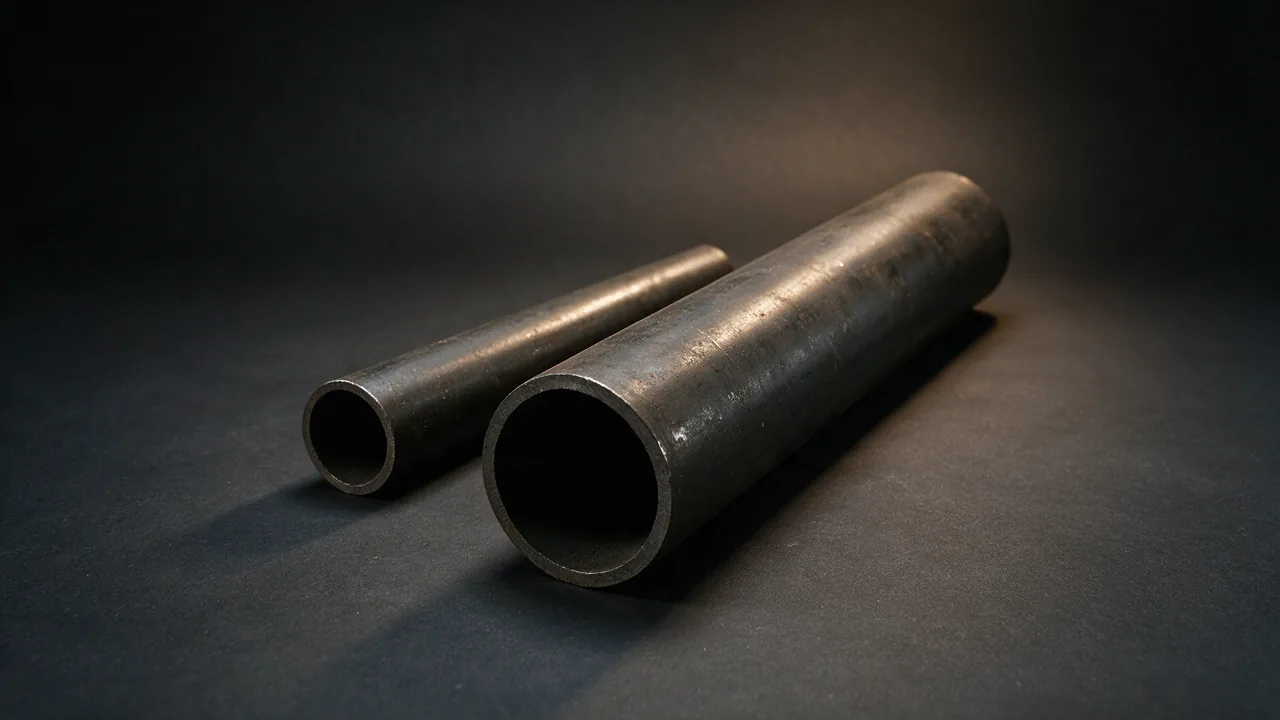
ASTM A106 Grade B is the standard specification for seamless carbon steel pipe for high-temperature service. It has a minimum yield strength of 240 MPa (35,000 psi) and a minimum tensile strength of 415 MPa (60,000 psi), and is the default material for boiler, refinery and process piping.
Download ASTM A106 Grade B Pipe data sheet (PDF) One-page summary of the supply range, chemistry, mechanical properties and inspection documents on this page. The standard is the governing document.
Mejor Steel is the export agent for the mills that make your material: one contract, one delivery date, and the mill named on the quotation. How we supply
We reply within one business day, Monday to Friday 09:00-18:00 CST. Or write to info@mejorsteel.com / WhatsApp.
Size range and specification
- Outside diameter 1/2 inch – 24 inch (12.7 – 610 mm), seamless
- Wall thickness SCH 10 – SCH 160 and heavier; typically 2.11 – 40 mm
- Length SRL 5.8 m, DRL 11.8 m, 20 FT, 40 FT, or random 4 – 12 m
- Ends Plain end, beveled end, threaded with coupling
- Surface treatment Black varnish, bare, oiled, hot dip galvanized on request
- Manufacturing process Hot rolled seamless only – welded pipe is not permitted by A106
- Heat treatment No heat treatment required as supplied; normalizing or stress relieving available on request
- Delivery standard ASTM A106 / ASME SA106
How this grade is supplied
- Inspection Inspected by the producing mill’s own inspection department, which is independent of production, against the delivery standard above. Third-party inspection — SGS, BV or TUV, or an inspector you send yourself — can be arranged at the mill or before shipment; give us the dates and the scope at the order stage.
- Certificate A mill test certificate to EN 10204 3.1 showing the heat number, the chemical composition and the mechanical results is standard on every order. EN 10204 3.2, countersigned by the inspector you nominate, is available on request.
- Documents with the goods The mill test certificate and the packing list travel with the shipment, and the heat number is traceable from cast through to the finished product.
- Packing Sea-worthy export packing: bundled by size with end protection, corrosion protection on request, stencilled with the size, grade and heat number.
- MOQ One bundle or one truckload; mixed sizes within a bundle accepted.
- Lead time Counted from order confirmation, not from the enquiry. Stock sizes 5–10 days; mill run or non-stock 3–5 weeks. The delivery window is fixed on the quotation.
- How we supply Sourced through partner mills; the producing mill is named on the quotation.
ASTM A106 chemical composition (maximum unless a range is given, %)
| Element | Grade A | Grade B | Grade C |
|---|---|---|---|
| Carbon, C | 0.25 max | 0.30 max | 0.35 max |
| Manganese, Mn | 0.27 – 0.93 | 0.29 – 1.06 | 0.29 – 1.06 |
| Phosphorus, P | 0.035 max | 0.035 max | 0.035 max |
| Sulphur, S | 0.035 max | 0.035 max | 0.035 max |
| Silicon, Si | 0.10 min | 0.10 min | 0.10 min |
| Chromium, Cr | 0.40 max | 0.40 max | 0.40 max |
| Molybdenum, Mo | 0.15 max | 0.15 max | 0.15 max |
| Nickel, Ni | 0.40 max | 0.40 max | 0.40 max |
| Copper, Cu | 0.40 max | 0.40 max | 0.40 max |
| Vanadium, V | 0.08 max | 0.08 max | 0.08 max |
For Grade B the carbon maximum is 0.30%, and A106 requires the steel to conform to a carbon equivalent (CE) of 0.50% maximum, calculated as CE = C + Mn/6 + (Cr + Mo + V)/5 + (Ni + Cu)/15. Manganese is 0.29 – 1.06% for Grades B and C; where the carbon is reduced below the grade maximum, the manganese maximum may be raised by 0.06% for each 0.01% of carbon reduction, up to 1.35%. The minimum silicon of 0.10% is a specific requirement of A106 and is one of the main practical differences from ASTM A53.
Source: chemical composition requirements of ASTM A106 / ASME SA106, Table 1. The standard is the governing document.
ASTM A106 tensile requirements
| Grade | Tensile strength min | Yield strength min | Elongation min | Maximum hardness |
|---|---|---|---|---|
| Grade A | 330 MPa (48,000 psi) | 205 MPa (30,000 psi) | 35% | not specified |
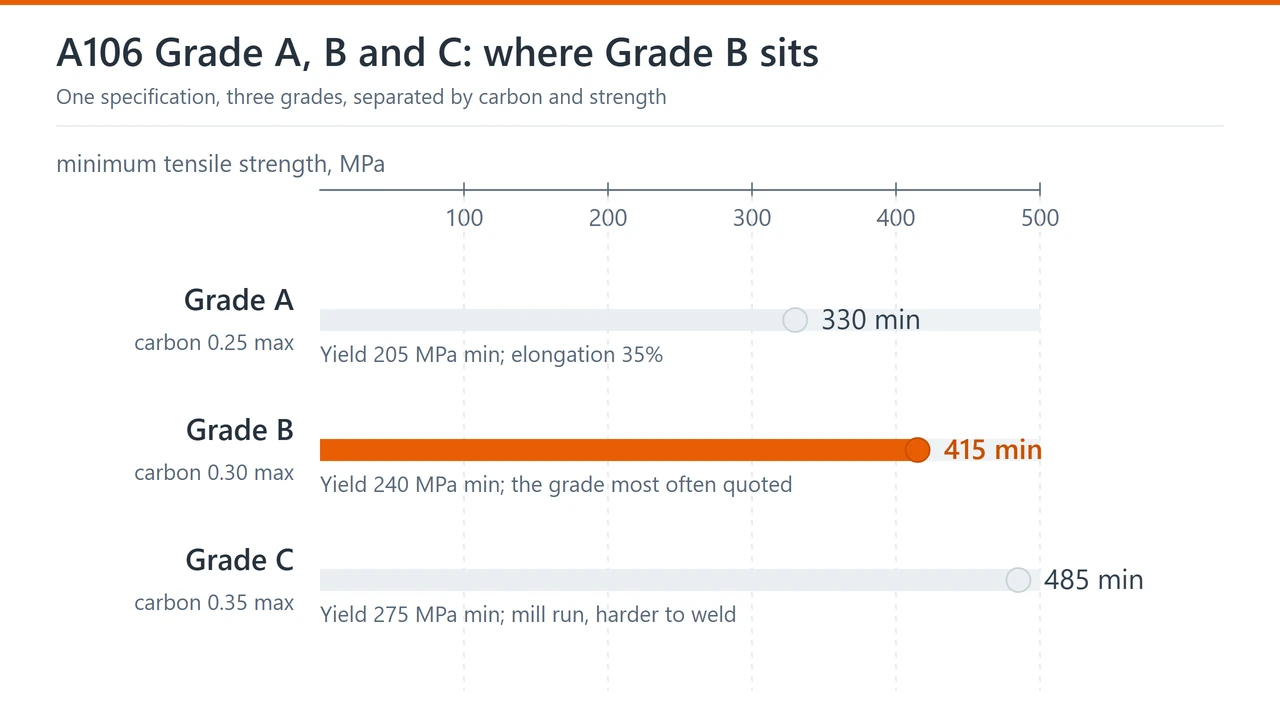
| Grade B | 415 MPa (60,000 psi) | 240 MPa (35,000 psi) | 30% | not specified |
| Grade C | 485 MPa (70,000 psi) | 275 MPa (40,000 psi) | 30% | not specified |
A106 does not specify a maximum tensile or yield strength. Elongation values are for the standard round test specimen and are adjusted for smaller or strip specimens in accordance with the standard. Hydrostatic testing is required, and a non-destructive electric test may be substituted when agreed.
Source: tensile requirements of ASTM A106 / ASME SA106, Table 1. The standard is the governing document.
What Is ASTM A106 Grade B Pipe?
ASTM A106 covers seamless carbon steel pipe intended for high-temperature service, and Grade B is by far the most commonly ordered of its three grades. The specification is written for pipe that will carry steam, hot process fluids and similar media at elevated temperature, so it mandates tight control of phosphorus and sulphur, requires a minimum silicon content for high-temperature oxidation resistance, and permits only seamless construction. A106 Grade B has a minimum yield strength of 240 MPa and a minimum tensile strength of 415 MPa, and is the default material for boiler, refinery and general process piping.
Seamless Only – Why It Matters
A106 permits only seamless pipe. Welded pipe cannot be certified to A106 because the specification assumes a homogeneous wall with no longitudinal weld seam, which matters when the pipe operates at high temperature where creep and thermal cycling can act on a weld. This is the single most important thing to check when a customer asks for A106 Grade B: ERW or LSAW pipe cannot be supplied under an A106 certificate. If the application does not require high-temperature service, ASTM A53 or API 5L allow welded construction and are usually cheaper.
A106 B, A53 B and API 5L B – the Three Standards Pipe
A106 Grade B, A53 Grade B and API 5L Grade B share exactly the same minimum tensile strength of 415 MPa and minimum yield strength of 240 MPa. The requirements do not conflict, so the same heat of seamless pipe can be produced and certified to all three at once. That is why the trade refers to three standards pipe. The practical differences are chemical rather than mechanical: A106 caps phosphorus and sulphur at 0.035% each and requires 0.10% minimum silicon, while A53 allows 0.05% phosphorus and 0.045% sulphur with no silicon requirement. Buying the dual or triple certified material is normally the cheapest way to satisfy any one of them.
When to move up from Grade B
Grade B is the default, but it is not a ceiling. Move up when one of these applies:
- Higher strength is needed but the service stays within carbon steel: A106 Grade C raises the minimum tensile strength to 485 MPa (70,000 psi) and the minimum yield to 275 MPa (40,000 psi).
- The service is elevated-temperature and creep or oxidation becomes the limiting factor: the alloy grades ASTM A335 P11, P22 and P91 are specified instead of a higher A106 grade.
- The service is low-temperature: switch from strength to toughness and use ASTM A333 Grade 6, which carries the Charpy requirement A106 does not.
The change is driven by the design code and the service conditions, not by availability alone.
Sizes, Wall Thickness and Heat Treatment
A106 Grade B is dimensionally governed by ASME B36.10M, so the outside diameters and wall thicknesses follow the standard schedule system. Common sizes run from NPS 1/2 to NPS 24, with schedules from SCH 10 to SCH 160 and heavier on request. A106 Grade B may be supplied in the as-rolled condition without heat treatment, and this is the normal supply condition. Normalizing is available when the pipe will be hot formed or when the application calls for a uniform ferrite-pearlite structure. Post-weld heat treatment requirements come from the applicable construction code rather than from A106 itself.
Permissible variations to check on receipt
A106 does not promise a perfect cylinder; it permits normal mill variation. The two values buyers check most often are wall thickness and outside diameter:
- Wall thickness: not less than 87.5% of the nominal wall.
- Outside diameter, NPS 1-1/2 and smaller: ±1/64 in (0.4 mm).
- Outside diameter, NPS 2 and larger: ±1%.
Weights per length and length tolerances are ordered separately where the project needs them.
Testing and Certificates
Each length is hydrostatically tested, and tensile, yield and elongation tests are taken from the heat. Chemical composition is reported against the limits in the table above. Non-destructive electric testing can replace the hydrostatic test when permitted by the purchase order. Mill test certificates to EN 10204 3.1 are standard; 3.2 certification with an independent inspector and third-party inspection by SGS, BV or TUV can be arranged. Pipe intended for sour service should be ordered against NACE MR0175 / ISO 15156 requirements in addition to A106.
Typical applications
- Boiler and steam piping
- Refinery and petrochemical process piping
- Heat exchanger and furnace piping
- Power plant piping systems
- General high-temperature service
Standards covered
What to state on the enquiry
- ASTM A106 Grade B, which is seamless only.
- Nominal size and schedule, or outside diameter and wall.
- Length and end finish.
- Quantity and destination port.
- Certificate type and any additional testing.
Frequently asked questions
What is the difference between ASTM A106 Grade B and ASTM A53 Grade B?
Their mechanical properties are identical at 415 MPa minimum tensile and 240 MPa minimum yield. The differences are chemical and in scope. A106 caps phosphorus and sulphur at 0.035% each, requires at least 0.10% silicon, and permits seamless construction only. A53 allows 0.05% phosphorus and 0.045% sulphur, has no silicon requirement, and covers welded as well as seamless pipe. A106 is specified for high-temperature service; A53 for general mechanical and lower-pressure use.
Can welded pipe be certified to A106 Grade B?
No. ASTM A106 permits only seamless pipe. ERW, LSAW or SSAW pipe cannot be supplied with an A106 certificate. If the application does not demand high-temperature service, ASTM A53 Grade B or API 5L Grade B allow welded construction and are usually more economical.
What is three standards pipe?
It is seamless pipe produced and certified to ASTM A106 Grade B, ASTM A53 Grade B and API 5L Grade B at the same time. Because all three require 415 MPa minimum tensile and 240 MPa minimum yield, one heat can satisfy the requirements of all three, with A106 setting the tightest chemistry limits. It is a common way to buy pipe that can be used against any of the three specifications.
Where to go next
- ASTM A106 Seamless Carbon Steel Pipe – seamless pipe for process and boiler service
- ASTM A53 Steel Pipe – general-purpose carbon steel pipe
- Boiler & Heat Exchanger Tube – tube specified by outside diameter and wall
- ASTM A53 Grade B Pipe – the general-purpose pipe specification
- ASTM A335 P91 Pipe – 9Cr-1Mo-V pipe for main steam and reheat lines
- API 5L Grade B Pipe – the low-strength line pipe grade, PSL1 and PSL2
- Pipe Schedule Chart – wall thickness for every schedule
- Get a Quote – send the grade, size, quantity and destination port
- ASTM A333 Grade 6 Pipe – the low temperature carbon pipe grade
- ASTM A333 Low Temperature Steel Pipe – pipe for low-temperature service
- ASTM A106 vs A53 – which one the design code lets you use, and what changes on the order
- A106 Grade B vs Grade C – strength, the carbon ceiling and the welding procedure each one needs
Ready to price your enquiry? Tell us the specification, the dimensions, how much you need and where it is going. We reply with what is available and what it costs.
Request a quotation