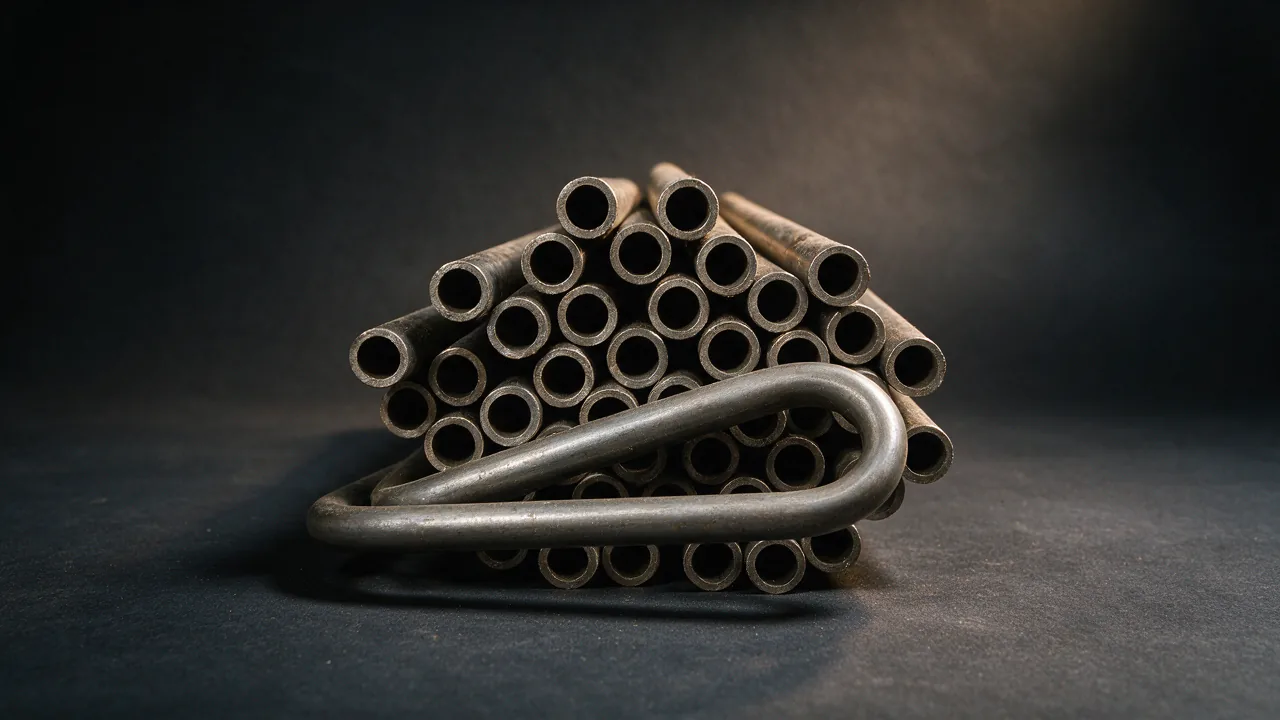
Seamless boiler, superheater and heat exchanger tubes to ASTM A179, A192, A210 and A213, in carbon, alloy and stainless steel, in small diameters and thin walls.
- Standard: ASTM A179, ASTM A192, ASTM A210, ASTM A213, ASTM A209
- Grades: A179 Grade C, A192, A210 A-1 / C, A213 T5 / T11 / T22 / T91, A213 TP304 / TP316L
- Certificate: EN 10204 3.1 with every order, 3.2 on request
Mejor Steel is the export agent for the mills that make your material: one contract, one delivery date, and the mill named on the quotation. How we supply
We reply within one business day, Monday to Friday 09:00-18:00 CST. Or write to info@mejorsteel.com / WhatsApp.
Specifications
| Outer diameter | 1/2" - 6" (12.7 - 152.4 mm), or as tube 6 - 127 mm |
|---|---|
| Wall thickness | 1.2 - 25 mm |
| Length | Up to 25 m as U-bend, or straight up to 12 m |
| Ends | Plain end, for U-bending, suitable for tube sheets |
| Surface treatment | Pickled, passivated, bright annealed |
| Manufacturing process | Cold drawn seamless, hot finished seamless |
| Pressure rating | High pressure, high temperature service |
Which Standard Applies to Your Tube?
Boiler and heat exchanger tubes are covered by a family of standards distinguished by service conditions. ASTM A179 covers cold drawn low carbon steel heat exchanger and condenser tubes, the most economical option for non-corrosive, non-critical duty. ASTM A192 covers seamless carbon steel boiler tubes for high pressure service and carries a minimum wall requirement. ASTM A210 covers seamless medium carbon steel boiler and superheater tubes in grades A-1 and C, used where higher strength is needed. ASTM A213 covers seamless ferritic and austenitic alloy steel boiler, superheater and heat exchanger tubes, including the chrome moly grades T5, T11, T22, T91 and the austenitic grades TP304, TP316L and TP347. Selecting the right standard first, then the grade, is the correct sequence.
| Service condition | Standard / grade to start with | Why |
|---|---|---|
| Low-pressure, non-corrosive heat exchanger or condenser duty | ASTM A179 | Cold-drawn low-carbon tube, the most economical option where corrosion and elevated temperature are not the limiting factors. |
| High-pressure boiler tube with a minimum-wall requirement | ASTM A192 | Seamless carbon steel boiler tube for high-pressure service. |
| Boiler or superheater needing higher strength than A179/A192 | ASTM A210 Grade A-1 or C | Seamless medium-carbon steel boiler and superheater tube. |
| Elevated-temperature, corrosive or alloy service | ASTM A213 T5, T11, T22, T91; TP304, TP316L or TP347 | Seamless ferritic and austenitic alloy tube for boiler, superheater and heat exchanger service. |
This table is a starting point, not a material selection by itself. Final grade selection follows the design metal temperature, pressure, corrosion allowance, heat-treatment and impact requirements in the project specification. Source: the standard scopes in ASTM A179, A192, A210 and A213 / ASME SA179, SA192, SA210 and SA213; those standards govern.
Stating a boiler or heat exchanger tube size
A boiler or heat exchanger tube is ordered by its actual outside diameter and a minimum wall, not by a nominal pipe size or a schedule. Schedule is a pipe convention: on these tube specifications the thinnest point of the tube must meet the stated wall, which is why the order is written as outside diameter × minimum wall, straight length or U-bend with the bend radius, and the standard and grade.
| What the enquiry names | What it fixes | The range we supply |
|---|---|---|
| Outside diameter | The tube itself, distinct from a nominal pipe size | 1/2–6 in (12.7–152.4 mm) |
| Minimum wall | The thinnest wall the tube may have anywhere along its length | 1.2–25 mm |
| Straight or U-bend | How the bundle is built, and whether bending follows | straight up to 12 m, U-bend up to 25 m |
Leaving the wall out is the usual reason a boiler or heat exchanger tube enquiry comes back with questions: the same outside diameter is supplied in several walls, and the minimum wall is the figure that tells the mill what to roll. The bend side of the size — the radius, the legs and the stress relief — is set out in the U-bend section below.
U-Bend Tubes and Minimum Wall
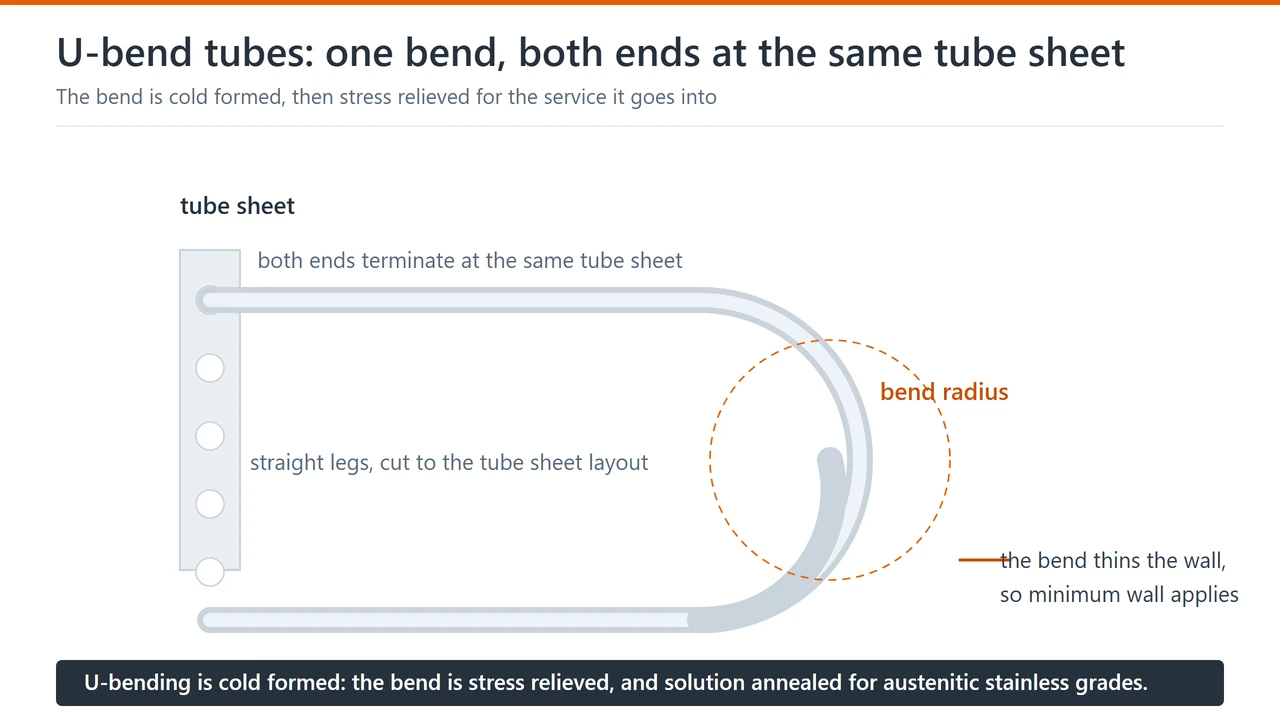
Heat exchanger tubes are frequently supplied bent into a U shape to form the tube bundle, with both ends terminating at the same tube sheet. U-bending is performed cold, and the bend must be stress relieved and, for austenitic stainless grades, solution annealed after bending to avoid residual stress and sensitization. The bend radius is normally a minimum of 1.5 to 2 times the outside diameter, and ovality at the bend must be controlled. Note also that many boiler tube standards specify a minimum wall rather than a nominal wall with tolerance, meaning the thinnest point of the tube must not fall below the specified value. When ordering, specify the tube diameter, minimum wall, length, straight or U-bend with radius, standard and grade.
Heat exchanger tube: the tube metal temperature sets the specification
Boiler and heat exchanger tube is bought against a different set of specifications from pipe, and the figure that decides which one is the tube metal temperature rather than the fluid temperature. Wall and diameter follow the thermal design, so the enquiry usually starts from the tube sheet layout rather than from a pipe size.
| Service condition | What it decides | What to state on the enquiry |
|---|---|---|
| Water wall or economiser, moderate temperature | A179 or A192 seamless carbon steel tube | the tube size and wall, and the straight length or U bend |
| Superheater or reheater, higher temperature | A210 for carbon steel, A213 for the alloy grades | the design tube metal temperature |
| Alloy superheater, high temperature | A213 T11, T22 or T91 | the grade, and the minimum wall |
| Stainless heat exchanger | A213 TP304 or TP316L, or a duplex grade | whether a pickled and passivated finish is required |
| Condenser or air cooler | Corrosion resistance matters more than temperature | the cooling medium, so the grade can be set from it |
| U bend or serpentine | Bending is carried out after the tube is made | the bend radius, and whether stress relief is required |
| Tube rather than pipe | A179, A192, A210 and A213 are tube specifications, not pipe | the specification number, so the correct product is quoted |
What usually goes wrong on a tube enquiry
| What goes wrong | Why it happens | What prevents it |
|---|---|---|
| The wall is given as a schedule instead of a minimum wall | Schedule is a pipe convention; tube is bought to an actual outside diameter and a minimum wall, so a schedule figure is read against the wrong product. | Write the tube as outside diameter × minimum wall, straight length or U-bend with the bend radius. |
| The grade is named without the design metal temperature | The tube metal temperature is what separates carbon steel from the alloy and austenitic grades, so the grade cannot be checked without it. | State the design tube metal temperature alongside the standard and grade. |
| A U-bend is ordered without the bend radius or the stress relief | Bending is a separate operation that thins the wall at the bend and changes the heat treatment, so it must be specified before the order is placed. | Give the bend radius, the leg lengths and whether stress relief or solution annealing is required. |
| Boiler tube and heat exchanger tube are treated as the same item | The two duties drive different grade selection: boiler tube runs hot and under pressure, heat exchanger tube is selected for the fluids on both sides of the wall. | Say which duty the tube serves, and choose the standard from that duty rather than from a pipe size. |
What is the difference between a boiler tube and a heat exchanger tube?
Boiler tubes carry the working fluid that is heated to produce steam, so they operate at the highest temperature and pressure in the system and must resist creep, oxidation and steam-side scaling. Heat exchanger tubes carry a fluid that is being heated or cooled by another fluid on the outside, so the temperature difference across the wall is the design driver and corrosion resistance to both fluids matters more than creep strength. In practice the same standard family is used, but the grade selection differs: boiler tubes lean toward chrome moly grades, heat exchanger tubes toward the appropriate corrosion resistant grade.
Can you supply U-bent tubes for heat exchangers?
Yes. U-bent tubes can be supplied to a specified bend radius with the legs of equal or unequal length as required. They are supplied in wooden crates with the ends capped, and the bend area is normally stress relieved. For austenitic stainless grades solution annealing after bending is available on request. Please provide the tube diameter, minimum wall, bend radius, straight leg lengths, quantity and the applicable standard and grade.
Grades supplied and minimum properties
The grade fixes the minimum strength and the chemistry. The table below gives the requirements that separate the boiler and heat exchanger tube grades ordered most often; the full composition and mechanical table for each grade is on its own page.
| Grade | Yield strength | Tensile strength |
|---|---|---|
| A179 | 180 MPa min (26,000 psi) | 325 MPa min (47,000 psi) |
| A192 | 180 MPa min (26,000 psi) | 325 MPa min (47,000 psi) |
| A210 Grade A-1 | 255 MPa min (37,000 psi) | 415 MPa min (60,000 psi) |
| A213 T11 | 205 MPa min (30,000 psi) | 415 MPa min (60,000 psi) |
The complete chemistry and mechanical table for each grade, with the notes that qualify it, is on the individual grade page – for example ASTM A213 T11 tube. A179 and A192 carry the same tensile and yield requirements and differ in the service each is written for; the first three grades are carbon steel, and A213 T11 is the chrome moly tube used where the metal temperature rules the carbon grades out.
Source: specified minimum yield and tensile strength for each grade, per the standard named against that grade: ASTM A179, A192, A210 and A213 (ASME SA179, SA192, SA210 and SA213). That standard is the governing document.
- A179 Grade C
- A192
- A210 A-1 / C
- A213 T5 / T11 / T22 / T91
- A213 TP304 / TP316L
Download Boiler & Heat Exchanger Tube data sheet (PDF) One page: supply range, grades and key sizes, what to state on the enquiry, and the inspection documents that come with the order. The standard is the governing document.
Materials
- Carbon steel
- Chrome-moly alloy steel
- Stainless steel
Typical applications
- Boiler water wall, economizer and superheater tubes
- Shell and tube heat exchangers
- Condensers in power plants
- Petrochemical fired heaters
- Air coolers and cooling towers
Inspection & testing
- 100% eddy current or ultrasonic testing
- Hydrostatic pressure test
- Flaring and flattening test
- Hardness and tensile testing
- Grain size and microstructure examination
- Third-party inspection (SGS, BV, TUV)
| Packaging | Sea-worthy export packing: bundled by size, plastic caps on both ends, corrosion protection on request, stencilled with size, grade and heat number. |
|---|---|
| MOQ | One bundle or one truckload; mixed sizes within a bundle accepted. |
| Lead time | Stock sizes: 7-15 days. Mill run / non-stock: 4-6 weeks after order confirmation. |
Payment: T/T 30% deposit with the balance before shipment; L/C at sight also accepted. Final terms are confirmed on the quotation.
How we supply: sourced through partner mills; the producing mill is named on the quotation. How we supply sets out who is accountable for the order.
Need this product? Send the size, grade, quantity and destination port and we will reply with availability and pricing.
Request a quotation