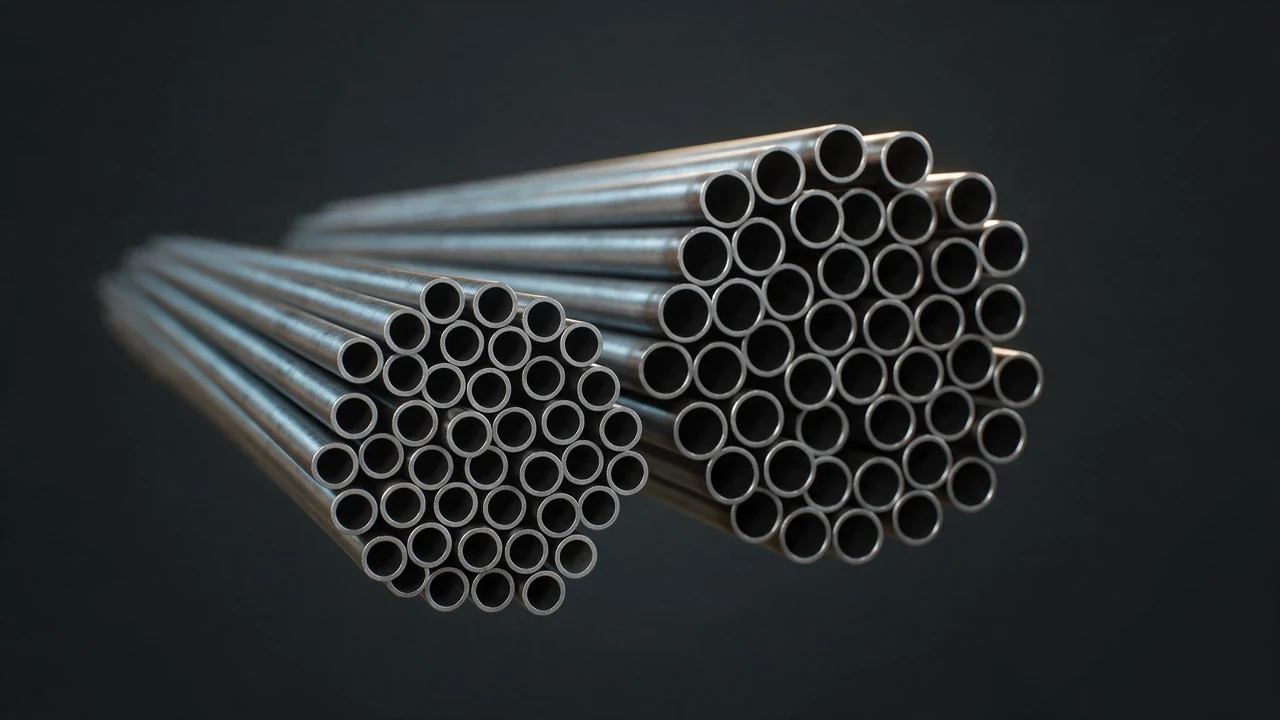
Boiler tubes and heat exchanger tubes both move heat, but they are bought against different standards, tolerances and order dimensions. The practical difference is not the material; it is what the tube has to survive and how the size is written on the purchase order.
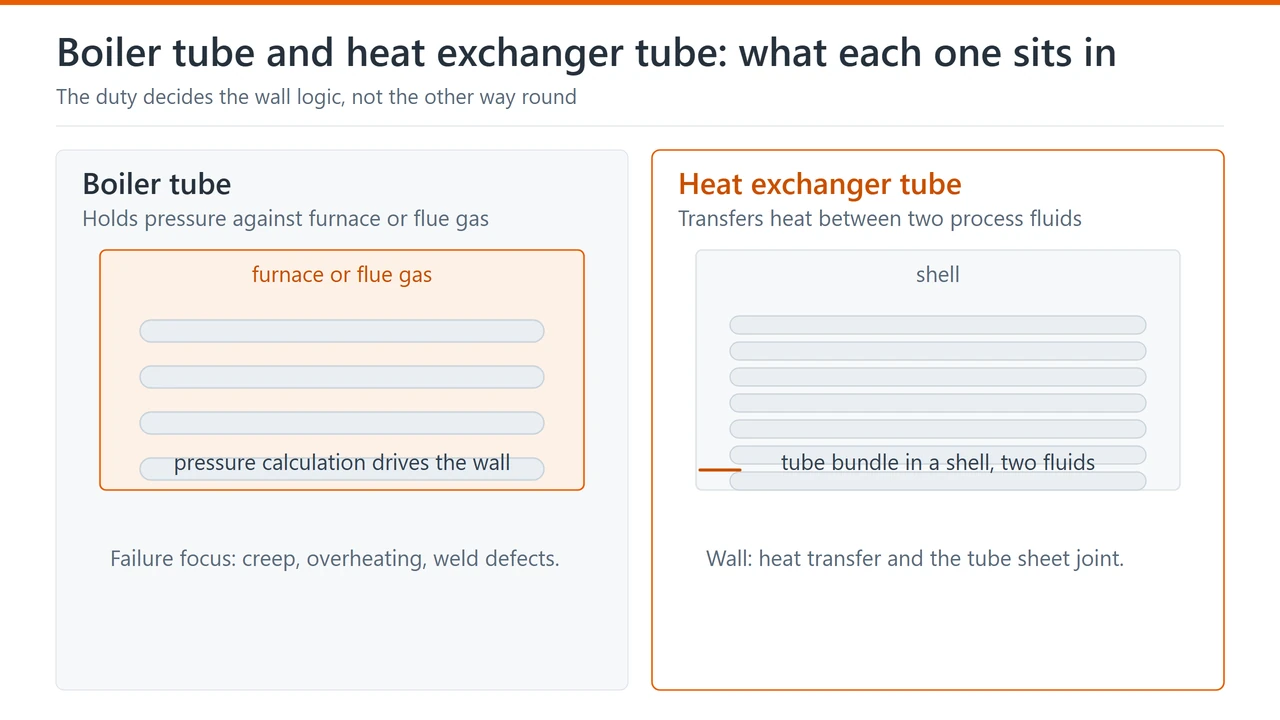
Which one you are buying. If the tube contains pressure while it is exposed to furnace or flue gas, and the wall comes out of a pressure calculation, it is a boiler tube. If it transfers heat between two process fluids in a bundle, and the wall is set by heat transfer, the tube sheet joint and corrosion allowance, it is a heat exchanger tube. The materials overlap – A179 and A213 appear in both services – so the duty and the ordering dimensions, not the grade alone, are what separate the two.
Quick answer
A boiler tube is specified for a pressure-containing heat-transfer surface in a boiler or superheater, where it must carry steam or hot water under pressure. A heat exchanger tube is specified for a bundle that transfers heat between two fluids without the tube itself having to contain the same boiler-side conditions. The two terms overlap in materials such as ASTM A179 and A213, but the service limits and the ordering dimensions separate them.
The practical differences
| Point | Boiler tube | Heat exchanger tube |
|---|---|---|
| Primary duty | Contains pressure while exposed to furnace or flue gas | Transfers heat between two process fluids in a bundle |
| Common standards | ASTM A192, A210, A213, EN 10216-2 | ASTM A179, A213, A249, EN 10216-5 |
| Ordering dimension | Outside diameter and minimum wall or schedule | Outside diameter and minimum wall, often BWG for thin wall |
| Typical wall logic | Pressure calculation drives the wall | Heat transfer, tube sheet joint and corrosion allowance drive the wall |
| Failure focus | Creep, overheating, corrosion fatigue, weld defects | Fouling, erosion, tube-to-tubesheet joint leakage, vibration |
Where the specification changes
The same outside diameter can appear in both services, but the purchase order asks for different proof. A boiler tube order usually calls for the design pressure, design temperature, hydrostatic test or non-destructive examination level, and the applicable section of the pressure code. A heat exchanger tube order usually calls for the outside diameter, wall thickness or BWG, length, whether U-bend is required, and the tube-to-tubesheet joint type.
Tolerances are not interchangeable
Cold-drawn heat exchanger tube is often bought to tighter outside diameter and wall tolerances than a pipe product because it must fit a drilled tube sheet and receive an expanded or welded joint. A tube ordered only as “pipe” can arrive with a wall tolerance that is acceptable for pipe but too wide for a tube sheet. That is why the standard and the manufacturing process belong on the enquiry, not just the nominal size.
Materials to specify
- Carbon steel ASTM A179 for low-carbon heat exchanger and condenser tubes; ASTM A192 for high-pressure boiler tubes; ASTM A210 for medium-carbon boiler and superheater tubes.
- Alloy steel ASTM A213 T11, T22, T5 and T9 for elevated-temperature boiler and heat exchanger service.
- Stainless steel ASTM A213 TP304, TP316, TP316L, TP321 and TP347 for corrosion-resistant tube bundles.
How to write the enquiry
- Standard and grade Example: ASTM A179, ASTM A192, ASTM A213 T11 or TP316L.
- Dimensions Outside diameter, minimum wall or BWG, length and quantity.
- Form Straight or U-bend; state bend radius and leg lengths for U-bend.
- Service Design temperature and pressure, fluid, and whether sour or chloride-containing.
- Tests Hydrostatic, eddy current, flattening, flaring, hardness or additional impact tests.
- Documents EN 10204 3.1 or 3.2, with heat traceability.
Frequently asked questions
Can the same tube be used for both duties?
The materials overlap – A179 and A213 appear in both services – but the service limits and the ordering dimensions separate them. State the duty on the enquiry rather than assuming it from the grade.
Why does a heat exchanger tube need tighter tolerances?
It has to fit a drilled tube sheet and take an expanded or welded joint. A tube ordered only as pipe can arrive with a wall tolerance that is acceptable for pipe but too wide for a tube sheet, which is why the standard and the manufacturing process belong on the enquiry, not just the nominal size.
Where to go next
- Boiler & Heat Exchanger Tube – product supply range
- EN 10204 3.1 vs 3.2 – certificate types and who signs
- Quality Control – inspection and testing scope
- Get a Quote – send the specification and destination port
Need a tube or pipe for a boiler or heat exchanger? Send the standard, grade, outside diameter, wall thickness, length and quantity, and we will reply with availability and pricing.
Request a quotation