An order runs through eight stages, from the first specification to the Bill of Lading. This page sets out each one — what we need from you, what you get back, when the lead time starts to run, and what travels with the goods. It is written so that nothing about the commercial side of an order is a surprise after the goods have shipped.
The eight stages
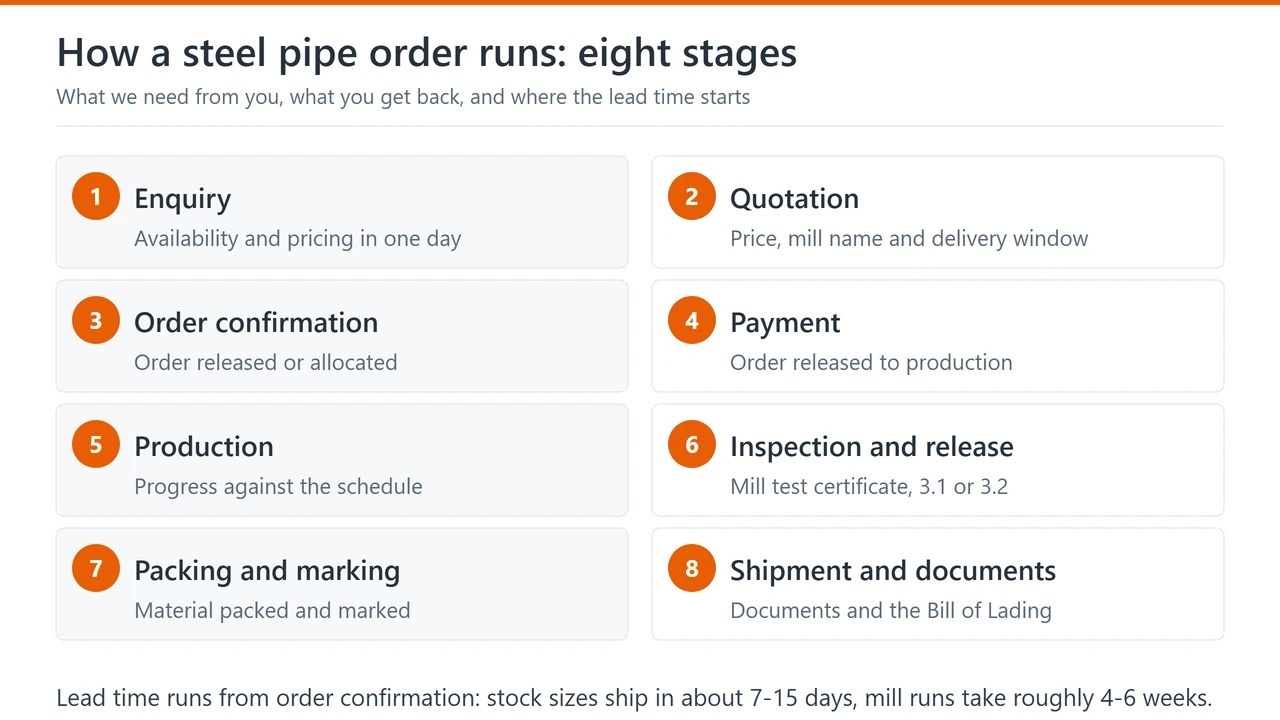
| Stage | What we need from you | What you get back |
|---|---|---|
| 1. Enquiry | The five items in the specification — or a requisition or drawing that already contains them | Availability and pricing, within one business day |
| 2. Quotation | Anything to clarify: the certificate type you need, whether you are appointing an inspector, the destination port | A price, the producing mill named, and a delivery window |
| 3. Order confirmation | A purchase order accepting the specification and the quoted terms | The order released — either to a partner mill for production, or allocated against stock |
| 4. Payment | A deposit by T/T, or a letter of credit, on the terms written on the quotation | Order released to production or to allocation |
| 5. Production or allocation | Shipping instructions once you know them | Progress against the delivery schedule |
| 6. Inspection and release | The dates and the scope, if you or an agency you appoint are witnessing testing | The mill test certificate, EN 10204 3.1 or 3.2, carrying the heat number |
| 7. Packing and marking | Any packing requirement beyond the standard export packing | Material export-packed and marked, ready for loading |
| 8. Shipment and documents | Confirmed destination port and consignee details | The shipping documents, and the Bill of Lading once the cargo is loaded |
1. Send the specification
Send us the specification and we will come back with availability and pricing within one business day. The more of the five items below you can give us, the faster and more accurate the answer — but if you only have some of them, send what you have.
- Standard and gradeFor example API 5L X65 PSL2, ASTM A106 Grade B, API 5CT N80Q, or ASME B16.9 WPB.
- Size and wall thicknessOutside diameter and wall thickness, or nominal size and schedule.
- QuantityPieces, metres or tonnes — whichever you buy in.
- Ends and connectionsPlain, bevelled or threaded; STC, LTC, BTC, EUE, NUE or a premium connection.
- Destination portSo the quotation can include delivery to where you need it.
Already have paperwork? A material requisition, a drawing, or a mill certificate from a previous order is usually faster to quote from than a list of sizes — and it contains most of the five items already. Email it to info@mejorsteel.com or send it on WhatsApp and we will quote from it directly. If you are not yet sure which grade or standard applies, the standards and grades pages cover the common specifications; if you are working from the service rather than from a specification, start from applications.
2. Review the quotation
We match the specification to a partner mill and come back with a price, the producing mill named, and a delivery window. The quotation is the document the rest of the order is measured against, so it is worth reading past the price line: the certificate type, the inspection arrangement, the packing and the delivery terms are all fixed there.
Final terms are confirmed on the quotation. If something on it does not match what you asked for, say so before the order is confirmed — that is the point at which it is still free to change.
3. Confirm the order
Confirm the specification and the quoted terms in a purchase order. From that point the item either goes to a partner mill for production or is allocated against stock.
Lead times are counted from order confirmation, not from the enquiry. A quotation that has been sitting for a fortnight is not holding a production slot, so the delivery window on it is worth re-checking before you commit if any time has passed.
4. Payment
T/T 30% deposit with the balance before shipment; L/C at sight is also accepted. Final terms are confirmed on the quotation.
Payment terms are agreed per order, and the terms that apply to your order are the ones written on its quotation. Nothing on this page overrides the quotation.
If you buy against a letter of credit, tell us at the enquiry stage rather than at the shipping stage. L/C terms — the documents required, the presenting bank, the shipment and expiry dates — are easier to reconcile with the specification and the delivery schedule while the quotation is being put together than after the goods are ready to load.
5. Production, or allocation from stock
Whether an item comes out of stock or has to be made depends on the size, the grade and the quantity. Stock sizes ship in about 5–10 days. Mill runs and made-to-order items take roughly 3–5 weeks after order confirmation. The lead time for the exact items quoted is stated on the quotation.
Minimum order, lead time and packing differ by product line:
| Product line | Minimum order | Lead time | Packing |
|---|---|---|---|
| Steel pipe and casing & tubing | One bundle or one truckload; mixed sizes within a bundle accepted. | Stock sizes: 5–10 days. Mill run / non-stock: 3–5 weeks after order confirmation. | Sea-worthy export packing: bundled by size, plastic caps on both ends, corrosion protection on request, stencilled with size, grade and heat number. |
| Pipe fittings and flanges | By piece — mixed sizes accepted; no minimum on standard items. | Stock items: 5–10 days. Made to order: 3–5 weeks after order confirmation. | Sea-worthy export packing: wooden cases or pallets, tagged with size, grade and heat number; corrosion protection on request. |
| Sucker rods | One bundle (by set); mixed sizes accepted. | Stock sizes: 5–10 days. Made to order: 3–5 weeks after order confirmation. | Sea-worthy export packing: bundled in steel-strapped racks, thread protectors fitted, tagged with size, grade and heat number. |
Several sizes that would not fill a container on their own can be combined into one shipment against a single set of documents and one set of packing marks; the supply scenarios page describes how that works.
6. Inspection and release
Before the goods are packed, you or an inspector you appoint can witness testing at the mill. Send the dates and the inspection scope and we arrange it with the mill while your order is in production. Inspectors are welcome at the mill.
Every order is released with a mill test certificate showing the heat number, the chemical composition and the mechanical results. Non-destructive examination and hydrostatic testing are carried out to the level the specification requires.
The certificate comes in two grades, and which one you need is worth settling at the order stage:
- EN 10204 3.1 — issued by the mill’s own inspection department, independent of production.
- EN 10204 3.2 — the same certificate countersigned by an independent third-party inspector you nominate, typically SGS, BV or TUV.
The heat number follows the steel from billet or coil through to the finished pipe, and is printed or stencilled on the material when required. What is verified on every order, and which tests apply to which specification, is set out on the quality control page.
7. Packing and marking
Material is export-packed to the standard in the table above: bundled by size or cased, with the ends protected where the line calls for it, and corrosion protection on request. Every bundle or case is stencilled or tagged with the size, the grade and the heat number, so what arrives can be matched to its certificate without opening the packing.
If your site or your customs broker needs a particular marking, tell us before packing starts — marks are applied at the mill, and re-marking after the goods are packed is not practical.
8. Shipment and documents
We book the shipment and prepare the documents that travel with the goods, and the Bill of Lading is issued by the carrier once the cargo is loaded. The packing marks on the goods match the documents they travel with.
What is on the material itself is fixed by the specification: every order is released with the mill test certificate — EN 10204 3.1 or 3.2 — showing the heat number, the chemical composition and the mechanical results, and the heat number travels on the packing marks as well as on the certificate.
Beyond that, an export shipment carries the documents that your bank and your customs broker need in order to clear the goods. Some of those are the standard set for any shipment; others depend on the destination and on how you are paying. Name anything specific when you send the enquiry — a certificate of origin, legalised or consular documents, a third-party inspection report, or a particular invoice or packing list format — so that it is quoted, prepared and issued correctly, rather than added after the goods have sailed.
If something is not right
Because the heat number is on the material and on its certificate, anything that arrives can be traced back to the cast it came from. That traceability is what a claim is built on: if material does not match the specification, the heat number and the packing marks are the reference.
How long you have to raise a claim
Tell us in writing as soon as a problem is found — do not wait for a formal inspection report, or the deadline can pass while the report is still being written. The clock runs from the day the goods arrive at the destination port:
- Quality objections — 30 days. A wrong grade supplied, a dimension out of tolerance, or material that does not match the specification.
- Quantity or weight objections — 15 days. Short-shipment, or a weight discrepancy against the packing list.
Who carries the freight if goods are returned
- Where the fault is ours — a wrong grade supplied, a dimension out of tolerance, or material that does not match — we carry the return freight and the costs that go with it, and replace the goods free of charge.
- Where the specification was the buyer’s — if the wrong size was ordered, the return freight is the buyer’s. Cut-to-length and made-to-order pipe is generally not returnable once it has been cut to the order.
Replacement, not just credit
Where the fault is ours we bear the cost and the risk of making it right: compliant goods are replaced free of charge, and the replacement ships within five days of the claim being accepted. Where the wrong grade was supplied, the replacement or a full credit note is arranged immediately.
What a claim is built on
The third-party inspection certificate is the core evidence; the bill of lading, the packing list and the mill test certificate are the supporting documents. Photographs or video help: shoot the pipe stencil — size, grade, heat number — and the defect in the same frame so the two are tied together. Send them with the written notice.
Common questions
- When does the lead time start?
- From order confirmation. Stock sizes ship in about 5–10 days; mill runs and made-to-order items take roughly 3–5 weeks after order confirmation. The lead time for the exact items quoted is stated on the quotation.
- Can I order against a letter of credit?
- Yes. L/C at sight is accepted, alongside T/T 30% deposit with the balance before shipment. The terms that apply to your order are the ones written on its quotation.
- Can several sizes go in one shipment?
- Yes. Pipe, casing and tubing are quoted by the bundle or truckload with mixed sizes accepted; fittings and flanges are quoted by the piece with no minimum on standard items. Mixed-size container consolidation is described on the supply scenarios page.
- Who do I deal with once the order is placed?
- One contact, in English, who answers for the order. How an order is sourced, and who is accountable for it, is set out on the how we supply page.
Where to go next
- Request a quotation — the enquiry form, and the five items that make a specification quotable
- Pricing — what determines the price, and why we quote per order rather than publish a price list
- HS codes — the tariff headings for steel pipe, fittings, flanges and sucker rods
- Quality control — what is verified, what is tested, and what the certificate says
- How we supply — how an order is sourced, and who is accountable for it
- Certifications and documents — the documents that can travel with an order, and who issues each one
- Supply scenarios — the patterns most orders fall into
- Market guides — the Incoterms rule and the import documents that apply in a destination market
- Products — the five product lines and what each one covers
- About Mejor Steel — the company, what we supply, and who is accountable for an order
- Payment terms: T/T vs L/C — how the money moves, and the clauses worth writing into an L/C
- Incoterms for steel pipe — which Incoterms rule fits an export order, and what changes with it
- Steel pipe delivery time — what sets the lead time, and what to fix on the order to hold it
- Inspection before shipment — the buyer-side checklist, and what to witness
- Third party inspection — who inspects, when, and what the report covers
- Mill test certificate — what the MTC has to show, and how to read it
- EN 10204 3.1 vs 3.2 — the certificate types, and which one a project actually needs
- Contact — email, telephone and WhatsApp
The quotation page carries the enquiry form and the five items that make a specification quotable. Ready to send a specification?