Steel pipe is not priced from a shelf. The price is built for each order from the specification, the quantity and the delivery terms, and it moves with the cost of the steel it is made from. This page sets out what goes into the number, why we do not publish a price list, and how to get a firm figure for what you are buying.
What the price is built from
| Factor | How it moves the price |
|---|---|
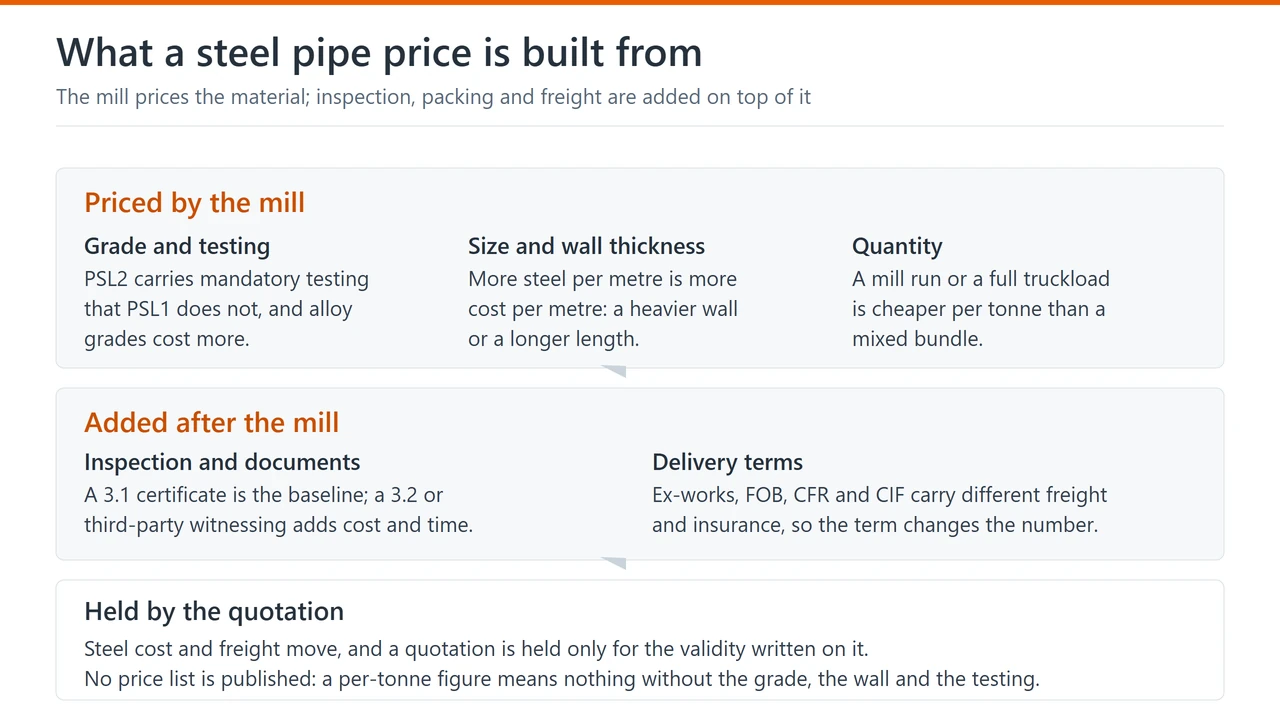
| Standard and grade | A PSL2 line pipe carries mandatory testing that a PSL1 does not; an alloy or stainless grade costs more than a plain carbon grade. The grade fixes the chemistry and the testing, which fixes the mill cost. |
| Size and wall thickness | More steel per metre is more cost per metre. The same outside diameter in a heavier schedule, or a longer length, changes the tonnage and therefore the price. |
| Quantity | A full truckload or a mill run is cheaper per tonne than a mixed bundle. The unit cost falls as the quantity rises and the set-up and logistics are spread over more material. |
| Delivery terms | Ex-works, FOB, CFR and CIF carry different freight and insurance. The destination port and the Incoterm change what the number includes. |
| Inspection and documents | EN 10204 3.2, third-party witnessing, and extra tests such as HIC or SSC each add cost because they add testing and time. A 3.1 certificate is the baseline. |
| Steel cost | The raw material and freight markets move, and a quotation is held for a stated validity. A figure quoted this month is not a figure for next month. |
Why there is no price list here
A published price list for steel pipe is a list that is wrong the week after it is written, because the material cost, the freight and the exchange rate all move, and because the price depends on the specification — a “per tonne” figure is meaningless without the grade, the wall thickness and the testing behind it. What we do instead is quote each order against its specification, and hold that figure for the validity written on the quotation.
What to send to get a number
The five items below are what turn a request into a quotation. The more of them you send, the firmer the number — but a specification with only some of them still gets a price, with the rest stated as assumptions.
- Standard and grade — API 5L X65 PSL2, ASTM A106 Grade B, API 5CT N80Q, ASME B16.9 WPB.
- Size and wall thickness — outside diameter and wall, or nominal size and schedule.
- Quantity — pieces, metres or tonnes, whichever you buy in.
- Ends and connections — plain, bevelled or threaded; STC, LTC, BTC, EUE, NUE or a premium connection.
- Destination port — so the freight can be included.
Already have paperwork? A material requisition, a drawing, or a mill certificate from a previous order is usually faster to quote from than a list of sizes.
How a quotation is measured
Price is only one line on a quotation, and not always the decisive one. The producing mill, the certificate type, the inspection arrangement, the packing and the delivery window are fixed on the same document, and two quotations at different prices are often not quoting the same thing. Worth checking alongside the number: which mill is named, whether the certificate is 3.1 or 3.2, and whether the delivery window fits your schedule. Those are set out under how to order.
How a quotation is held: a figure is quoted against a specification and held for the validity stated on the quotation. After that, it is re-priced against the steel cost and freight on the day.
Frequently asked questions
- Do you publish a price list?
- No. Steel pipe is quoted per order against the specification, because the price depends on the grade, the wall thickness, the quantity, the testing and the delivery terms, and because the steel cost moves. A published list would be out of date within a month.
- What is the minimum order quantity?
- It depends on the line. Pipe, casing and tubing are quoted by the bundle or truckload with mixed sizes accepted; fittings and flanges are quoted by the piece with no minimum on standard items.
- How long is a quotation valid?
- The validity is stated on the quotation. Because the steel and freight markets move, a figure is re-confirmed if it is accepted after the validity has passed.
- Why do two quotations for the same size differ?
- Because they are usually not quoting the same thing: the grade, the certificate type (3.1 or 3.2), the testing, the mill, the packing and the delivery window all differ. Check those lines against each other, not just the price.
Send the five items above and we will come back with availability and pricing within one business day.
Request a quotation