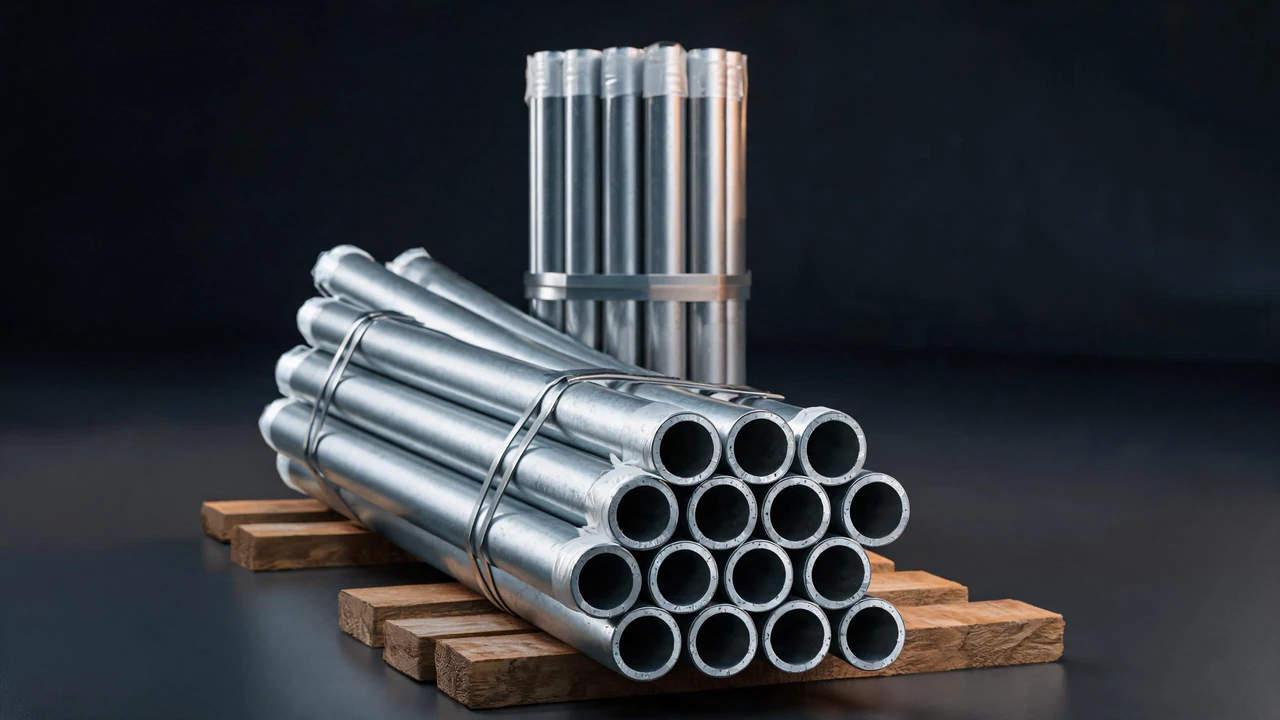
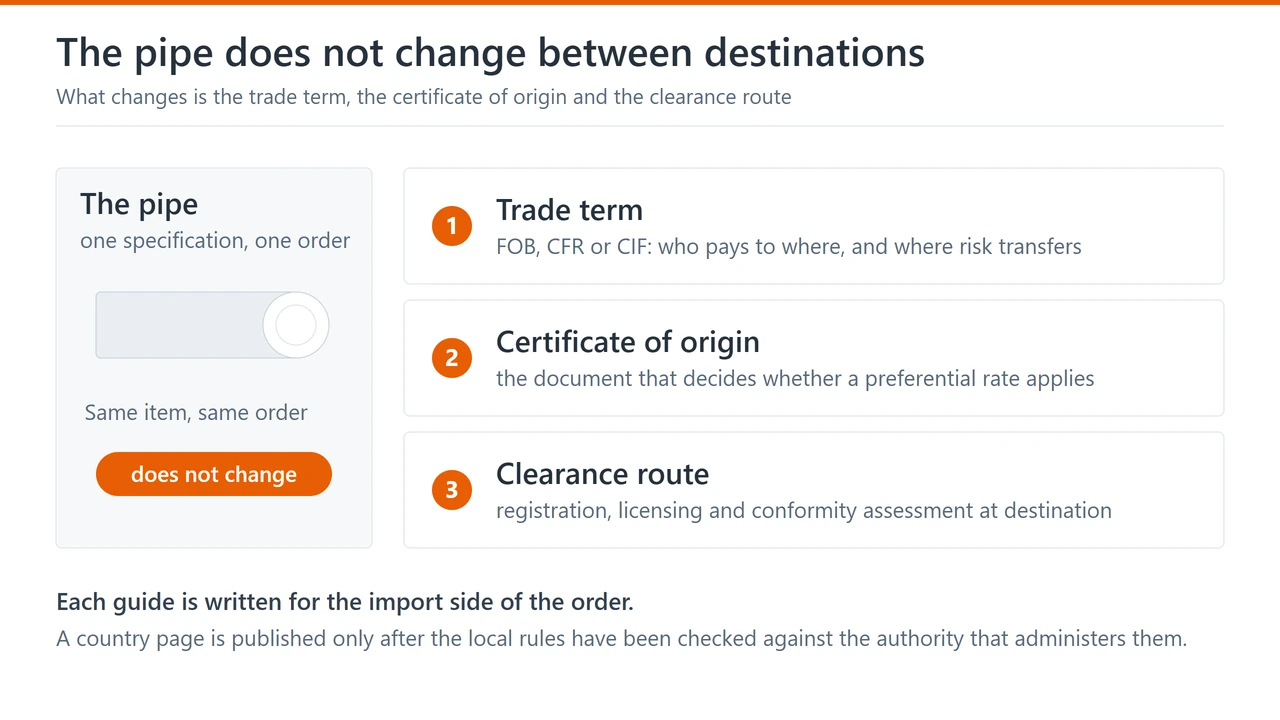
A steel pipe order is priced one way in China and landed another way. The pipe does not change between destinations; what changes is the trade term, the certificate of origin, the clearance route and the product rules the buyer has to satisfy on arrival. These country guides set out those differences market by market, so that an enquiry and a quotation can be compared on the same basis.
Each guide is written for the import side of the order — the person who has to clear the cargo, match the invoice to the documents that travel with it, and confirm what the local rules require before the shipment leaves.
Market guides
- Vietnam – what Vietnamese buyers order from China, which Incoterms rule fits, and the documents that decide the duty.
- Brazil – what Brazilian buyers order from China, how the import registration works, and what the invoice has to carry.
- Guyana – the same guide for the Guyanese market.
- South-East Asia – the regional index: what changes by country.
- Chile – the same guide for the Chilean market.
- Peru – the same guide for the Peruvian market.
- Mexico – the import route through VUCEM and NOM-251-SE-2025.
- Venezuela – the SENIAT entry and the documents that have to agree.
- API 5L line pipe for Argentina – grades, PSL and the process choice.
- Bangladesh – the same Southeast Asia route through Chittagong.
- API 5L line pipe for Mexico – grades and the NOM route.
- Nigeria – the SONCAP, Form M and PAAR route, and the Lagos and Onne ports.
- API 5L line pipe for Nigeria – grades, PSL and delivery.
What a country guide answers
- Which trade term fits the shipment. FOB, CFR and CIF move the same cargo but not the same cost or the same point at which risk transfers; the Vietnam guide tabulates where each rule hands over and what is left to the buyer.
- Which document decides the duty. For Vietnam that is the certificate of origin and the tariff heading it carries; the guide sets out what has to appear on it and who issues it.
- What clearance asks for. The Brazil guide covers the importer registration required to operate in foreign trade, the single-window route the declaration goes through, and the role of INMETRO in product regulation and conformity assessment.
- What to put on the enquiry. Both guides end with the fields that decide the quotation: standard and grade, outside diameter and wall thickness, quantity and length, destination port, and the trade term the price is wanted on.
Markets we quote into that do not have a guide yet
A country guide is published only after its rules have been checked against the authority that administers them, so some markets we quote into do not have one yet. For those, three questions have to be answered before a quotation is comparable with the others on the table:
- Who files the declaration, and under which local registration — the buyer’s tax number, or a broker’s.
- Whether the end use brings the pipe inside a standards or conformity requirement, and which body issues that document.
- Which port and which trade term, and whether the cargo moves in containers or as breakbulk.
These are the markets in that position today: Bangladesh, Kuwait, Malaysia, Oman, the Philippines and Thailand. Send the three answers with the enquiry and the document set is confirmed with the quotation, in the same way the country guides do it.
Nothing in this list is a claim about a tariff rate or a licensing requirement: those are confirmed against the rules in force on the day of import, by the importer’s broker.
How a market page is qualified
A country guide is not written from memory or copied from a neighbouring market. Before one is published, the rules that decide cost and risk in that market are checked against the authority that administers them — Vietnam Customs for classification and import procedure, Receita Federal with Portal Único Siscomex for Brazilian import operations, and INMETRO for Brazilian product regulation and conformity assessment. Anything that moves with each shipment, such as duty rates, quota treatment or a product-specific measure, is written as conditional and confirmed against the rules in force on the day of import.
More markets are added as the content is verified against the local customs and standards authorities; a country page is published only after that check, not before.
The rules quoted in these guides are published by the authorities named in each one; rates and licensing requirements change, and the importer’s broker confirms them at the time of entry.
Shipping to Vietnam or Brazil? Send the specification, the quantity and the port. We quote the pipe, the term and the documents together, so the quotation can be compared with the others on the table.
Request a quotation