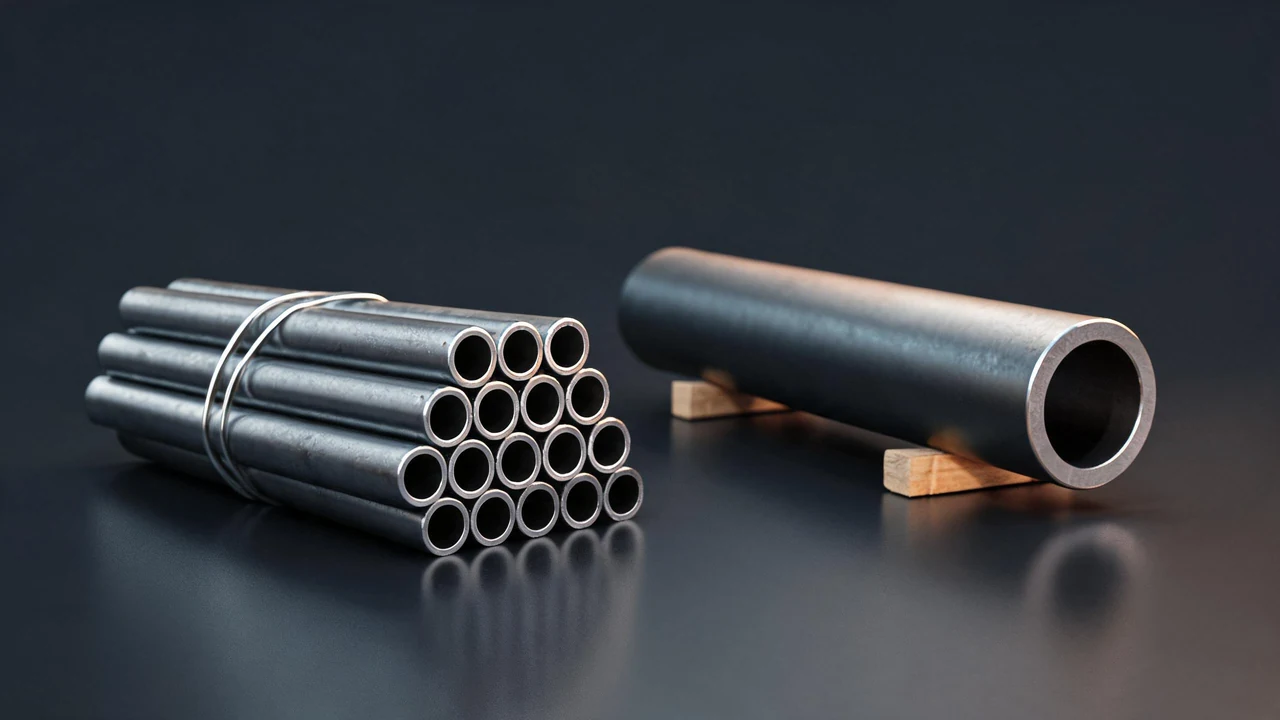
Vietnam buys steel pipe from China on an established route, so the question is not whether the pipe is available but which trade term fits the shipment and which document decides the duty. This page covers what Vietnamese buyers order, how FOB, CFR and CIF split the risk, and what the certificate of origin has to carry.
Vietnam is one of the two markets in our plan where buying from China is an established route: Chinese suppliers already have content pages ranking for Vietnamese pipe enquiries. What those pages leave out is the part that decides money and risk – which trade term fits a pipe shipment, and which document decides the duty. This page covers both.
Mejor Steel is the export agent for the mills that make your material: one contract, one delivery date, and the mill named on the quotation. How we supply
We reply within one business day, Monday to Friday 09:00-18:00 CST. Or write to info@mejorsteel.com / WhatsApp.
What Vietnamese buyers order from China
The enquiries we quote into Vietnam fall into four groups:
- Line pipe to API 5L, most often Grade B and X42 to X65 in PSL1 or PSL2, for gas and water transmission and for gathering lines.
- Seamless pipe to ASTM A106 / A53, for steam, process and general high-temperature service.
- OCTG to API 5CT – J55, K55, N80, L80 and the sour service grades – for workovers and for new completions.
- Large diameter welded pipe (SSAW and LSAW) for water transmission, piling and structural work, where the diameter range decides the process.
The specification set that matters is the same one that matters everywhere: grade, outside diameter, wall thickness, length, end preparation, coating, and the inspection scope. What changes in Vietnam is how the shipment is put together, and what the importer has to hand to customs.
Trade terms: what FOB, CFR and CIF actually change
The Incoterms® rules are published by the International Chamber of Commerce: eleven three-letter terms that allocate cost, risk and obligations between seller and buyer. FOB, CFR and CIF are the three that apply to sea and inland waterway transport, which is how steel pipe normally moves.
| Term | Who pays the main carriage | Where risk passes to the buyer | What the buyer keeps control of |
|---|---|---|---|
| FOB | Buyer | When the goods are on board the vessel at the port of shipment | Freight rate, shipping line, sailing schedule, insurance |
| CFR | Seller, to the named destination port | When the goods are on board at the port of shipment | Insurance, and everything after arrival |
| CIF | Seller, to the named destination port, plus insurance | When the goods are on board at the port of shipment | Nothing before arrival – but the cover is the minimum the rules require, not full cover |
Two points decide which one a buyer should ask for. Risk and cost do not move together: under CFR and CIF the seller pays the freight, but the buyer carries the risk from the moment the pipe is on board, so the buyer’s own cover is what protects the cargo. And CIF insurance is a minimum cover, not a promise to make the buyer whole – the ICC rules set different minimum cover levels for CIF and CIP, so a CIF quotation tells you nothing about the cover level unless it says so.
Where the pipe moves in containers rather than as breakbulk, the picture changes: the ICC guidance associates FOB, CFR and CIF with sea and inland waterway transport, and the “any mode” rules where the goods are handed to a carrier at a terminal before loading. For a containerised order, ask the forwarder which rule matches how the cargo is actually handed over – a term copied from an old contract is not a reason to keep it.
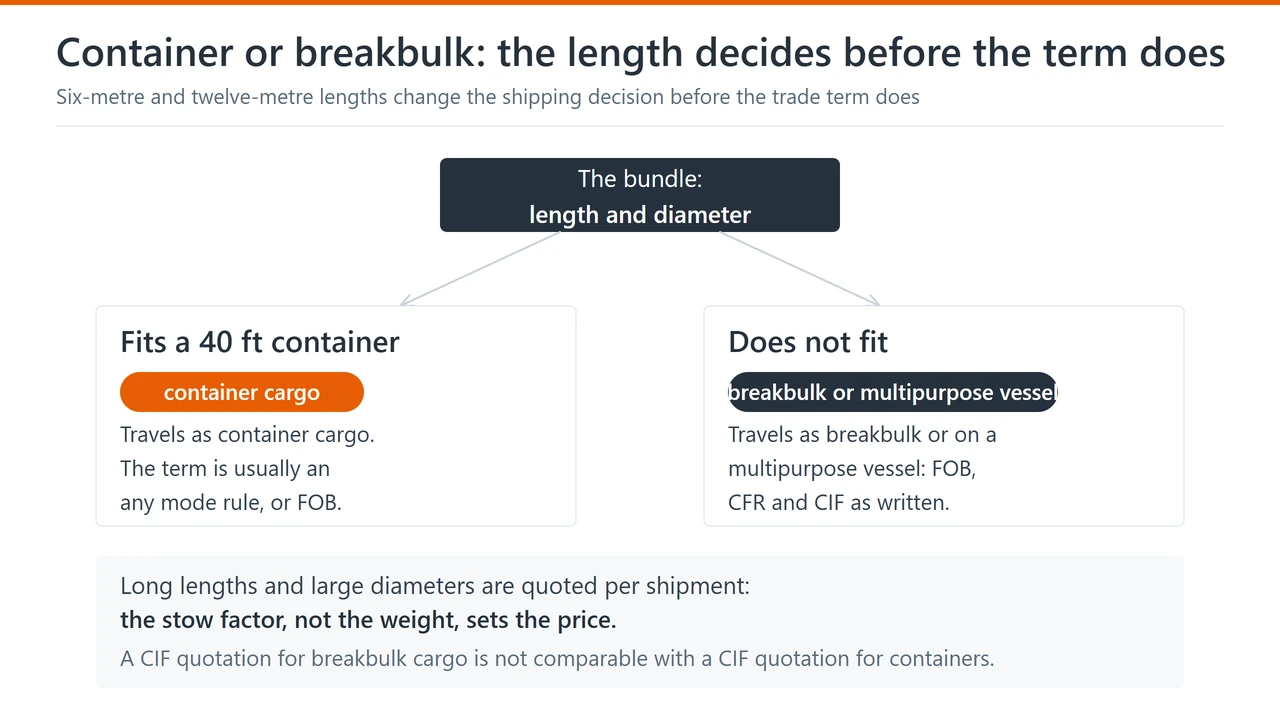
Pipe is not a container cargo in every case
Six-metre and twelve-metre lengths change the shipping decision before the trade term does:
- Bundles that fit a 40 ft container travel as container cargo, and the term is usually an “any mode” rule, or FOB with the buyer arranging the box.
- Bundles that do not fit travel as breakbulk or on a multipurpose vessel, which is where FOB, CFR and CIF are used as written.
- Long lengths and large diameters are quoted per shipment rather than per container, because the stow factor, not the weight, sets the price.
Say which of the three the order is, and the term follows. A quotation issued as CIF for a cargo that ships as breakbulk is not comparable with one issued CIF for containers.
The documents that decide the duty
Vietnam Customs administers import procedures and classification, and the classification is what fixes the duty and the VAT that apply. Steel pipe falls in HS chapter 73 – seamless pipe, welded pipe and line pipe are separate headings – so the classification has to match what is actually in the bundle, not what the enquiry assumed.
For preferential treatment under the ASEAN-China Free Trade Area, the shipment needs a valid certificate of origin (Form E). A Form E that does not match the invoice, or that is issued in the wrong form after shipment, is the most common reason a preferential rate is refused at destination. Two practices avoid it:
- Issue the Form E against the same description, quantity and invoice value as the shipping documents, and check it before the documents go to the bank.
- Where the order is quoted with a preferential rate built in, state on the purchase order who issues the Form E and by when.
The rates themselves, and whether any product-specific measure currently applies to the code, are confirmed with the importer’s customs broker against the rules in force on the date of import.
What to put in the enquiry
- Grade and standard: API 5L grade and PSL, or ASTM A106 / A53, or API 5CT grade.
- Outside diameter, wall thickness and length, with the end preparation required.
- Coating or lining, if the line is buried or carries potable water.
- Inspection scope: mill certificate only, or third party inspection, and whether EN 10204 3.2 is required.
- Trade term: FOB, CFR or CIF, the port, and whether the cargo ships in containers or as breakbulk.
- Certificate of origin requirement, and who is to issue it.
- Quantity, delivery window and the destination port in Vietnam.
Frequently asked questions
Which Incoterm is better for importing steel pipe into Vietnam, FOB or CIF?
FOB if you have a freight forwarder you trust and want to see the freight separately: you book the vessel, you insure the cargo, and you keep control of the sailing schedule. CIF if you want one delivered-port price and do not want to manage freight – but read the cover level, because the insurance the rules require under CIF is a minimum, not full cover. Under both terms the risk passes when the pipe is on board, so arrange your own cover from that moment.
Do we need a Form E?
Only if you want the preferential rate under the ASEAN-China Free Trade Area. Without a valid Form E the shipment is assessed at the general rate. The document has to match the invoice and the shipping documents, and it has to be ready before the goods are cleared – so it belongs on the purchase order as a deliverable, not as an afterthought.
Can you supply to a Vietnamese standard instead of API or ASTM?
Where a project cites a Vietnamese standard (TCVN) or a specification derived from one, send the document with the enquiry. We quote against it if the requirement can be met with the grades and dimensions we supply, and we say so plainly if it cannot, rather than quoting something adjacent to it.
Where to go next
- API 5L line pipe – the grades and product specification levels quoted most often.
- API 5CT casing and tubing – OCTG grades and connections.
- Incoterms for steel pipe – the terms compared for steel cargo specifically.
- Third party inspection – the inspection nodes and the certificate types.
- Get a quote – send the specification, the port and the term.
- South-East Asia – the regional index: what changes by country.
Quoting into Vietnam? Send the grade and standard, the diameter and wall, the length and end preparation, the trade term and the port. We confirm availability, the documents and the certificate of origin requirement before the order is released.
Request a quotation