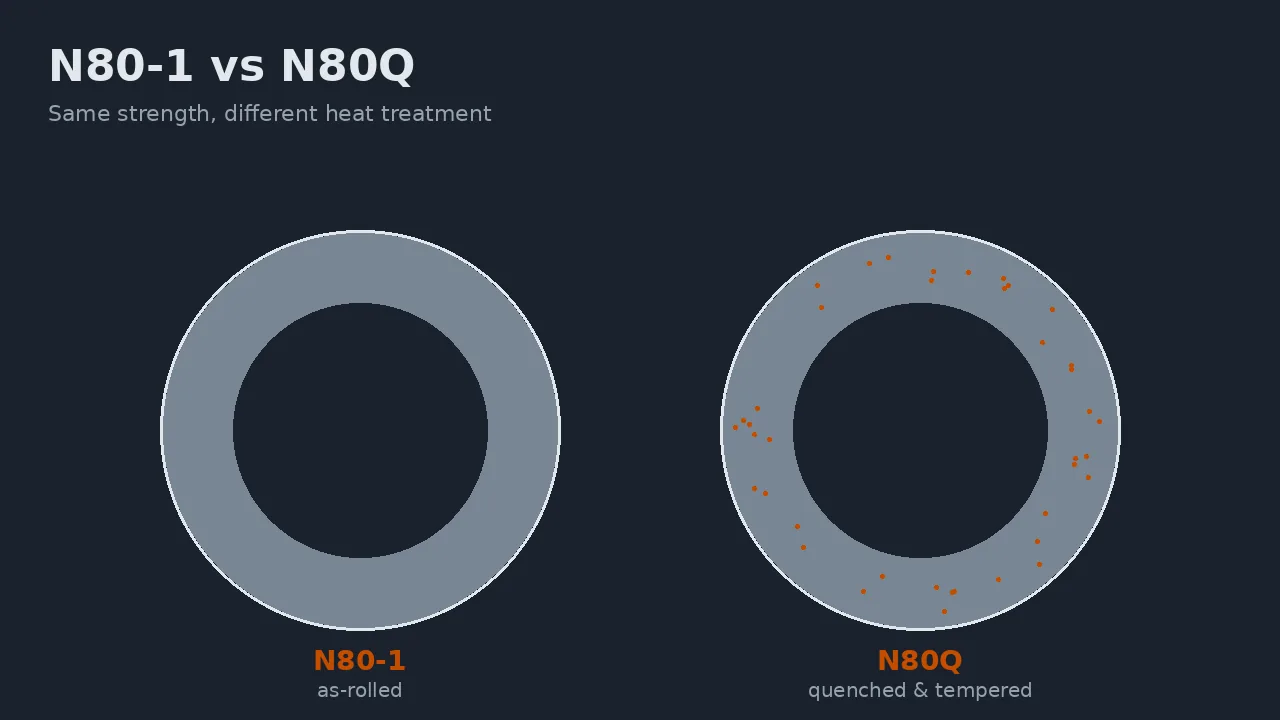
N80-1 and N80Q have identical strength requirements: 552 to 758 MPa yield and a minimum tensile strength of 689 MPa. The difference is the heat treatment. N80-1 is supplied as-rolled; N80Q is quenched and tempered, which gives a more uniform structure and better toughness. Impact testing is not imposed by the grade – it is brought in by the purchase order.
Which one to order. The strength is identical – 552 to 758 MPa yield and a minimum tensile strength of 689 MPa – so the suffix is a delivery condition, not a grade difference, and a certificate showing 600 MPa yield does not tell you which one you have. N80Q is quenched and tempered, which gives greater uniformity along the length and better low-temperature toughness and collapse resistance, and that is why it is the default for deeper wells, deviated trajectories and any string where the collapse load is close to the limit. Impact testing is not imposed by either one: it comes in through PSL2/PSL3 or API 5CT SR16 on the purchase order. Neither type is a sour-service grade – where hydrogen sulphide is present the controlled-hardness grades, usually L80, are used instead.
One grade, two delivery conditions
API 5CT writes N80 as a single grade with a single set of tensile requirements. The suffix distinguishes how the steel was treated to reach them. N80-1 is as-rolled, normalised or normalised and tempered. N80Q is quenched and tempered.
Because the strength requirement is the same, a certificate showing 600 MPa yield does not tell you which one you have. The delivery condition has to be ordered explicitly and stated on the mill certificate.
What quenching and tempering actually changes
Quenching and tempering produces a tempered martensitic structure rather than the ferrite and pearlite of an as-rolled pipe. The practical consequences are greater uniformity along the length, better low-temperature toughness and better collapse resistance for the same wall thickness.
That uniformity is why N80Q is the default for deeper wells, for deviated well trajectories and for any string where the collapse load is close to the limit.
Where impact testing on N80Q comes from
Charpy V-notch impact testing is not imposed by the N80Q grade. It is brought in by the purchase order, through PSL2/PSL3 or through API 5CT supplementary requirement SR16 (A.9), which fixes the test temperature and the acceptance energy. For N80-1 the same route applies. If toughness matters to the design, that single line in the specification is the difference.
Neither one is a sour service grade
This is the point most often missed. N80 of either type reaches a yield strength that implies a hardness well above the ceiling for sour service. Where hydrogen sulphide is present, the controlled-hardness grades are used instead: API 5CT caps L80 at 23 HRC and NACE MR0175 / ISO 15156 applies a 22 HRC limit for carbon steel.
So on a sour well the choice is not between N80-1 and N80Q. It is usually L80, or a corrosion-resistant alloy, with the connection and the metallurgy both reviewed.
| N80-1 | N80Q | |
|---|---|---|
| Delivery condition | As-rolled, normalised, or normalised and tempered | Quenched and tempered |
| Yield strength | 552 – 758 MPa | 552 – 758 MPa |
| Tensile strength, min | 689 MPa | 689 MPa |
| Charpy impact testing | Not imposed by the grade | Not imposed by the grade; required when PSL2/PSL3 or SR16 (A.9) is specified |
| Microstructure | Ferrite and pearlite | Tempered martensite |
| Typical use | Straightforward wells, lower collapse loads | Deeper wells, deviated wells, high collapse loads |
| Suitable for sour service | No | No – use L80 instead |
| Pipe body marking | One red band | One red band and one bright green band |
How to order it so you get what you asked for
Write the delivery condition into the line item: ‘API 5CT N80Q’ means quenched and tempered, and ‘N80-1’ means as-rolled or normalised. Ask for the delivery condition to be stated on the mill certificate, and ask which type of connection and coupling is being supplied with it.
The pipe body markings also differ: N80-1 carries a single red band, while N80Q carries one red band and one bright green band. On a site receiving both, that is the quickest way to tell them apart.
Frequently asked questions
Are N80-1 and N80Q interchangeable?
They have the same strength, so they will both carry the same load in simple tension. They are not interchangeable where toughness or collapse resistance governs, because N80Q’s quenched and tempered structure is more uniform, and because it is impact tested when the order requires it. A substitution should be approved by the engineer.
Why is N80Q more expensive?
Because of the heat treatment. Quenching and tempering adds a process step, more furnace capacity and tighter process control, and it is the condition in which impact testing can be specified and certified on the order.
Can N80 be used in sour service?
Not as a controlled-hardness grade. Its strength implies a hardness above the limit applied to carbon steel in sour service. Where hydrogen sulphide is present, L80 or a corrosion-resistant alloy is used instead.
Where to go next
- API 5CT N80Q casing – chemistry, mechanical properties and the N80-1 comparison
- API 5CT L80 tubing – the controlled-hardness grade for sour service
- API 5CT P110 casing – the next step up in strength
- API 5CT casing pipe – casing in grades J55 to Q125
- API 5CT tubing pipe – production tubing with EUE and NUE ends
- Casing vs tubing – how the two strings differ
- Heat treatment of steel pipe – what quenching and tempering changes
- Sour service – what changes when hydrogen sulphide is present
- Request a quotation – send the size, weight, grade and quantity
Have a specification to price? Give us the standard or grade, the size and wall thickness, the quantity you need and the port of discharge. We come back with availability and a price.
Request a quotation