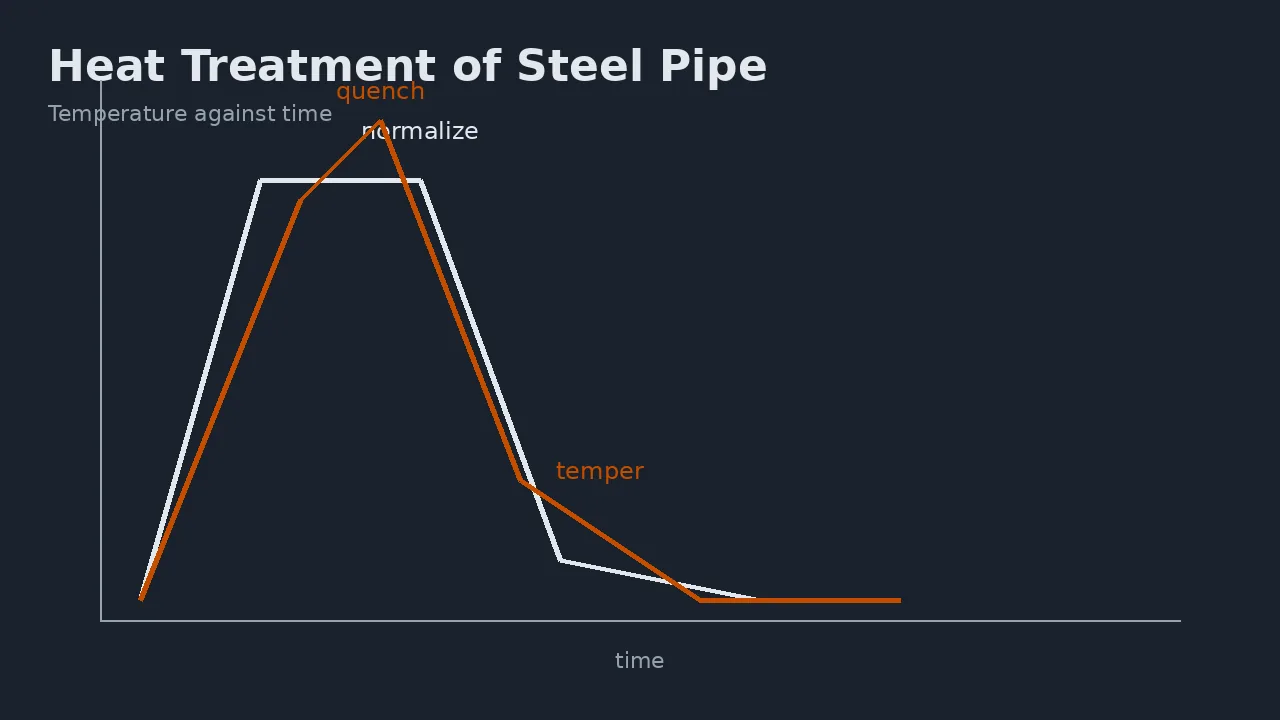
Normalising, annealing, quenching and tempering, and stress relieving all use heat, but they do different jobs. Normalising refines the grain and evens out the structure, annealing makes the steel as soft and ductile as it can be, quenching and tempering raises strength and then restores toughness, and stress relieving removes residual stress without changing the structure.
Why a pipe is heat treated at all
A pipe is heat treated for one of four reasons: to reach the mechanical properties the grade requires, to make the weld seam consistent with the pipe body, to meet an impact requirement for low temperature service, or to relieve the residual stress left by welding, forming and straightening.
There is a fifth reason that is easy to overlook. Where hydrogen sulphide is present, resistance to cracking depends on hardness rather than strength, and hardness is controlled by heat treatment. That is why the sour service grades are defined by their heat treatment as much as by their strength.
Normalising and annealing, and how they differ
Normalising heats the steel above its upper critical temperature, holds it long enough for the structure to become uniform, and then cools it in still air. The result is a finer grain and a more even ferrite and pearlite structure than the same steel has as-rolled. On API 5CT N80 pipe the delivery condition may be as-rolled, normalised, or normalised and tempered; it is the same grade and the same strength requirement either way, which is why the condition has to be ordered.
Annealing uses a similar temperature and then cools the steel slowly inside the furnace. Slow cooling gives a coarser and softer structure. Annealing is chosen when the pipe has to be as ductile as possible, or when it will be cold formed or machined further, rather than because it is a better condition in service.
Quenching and tempering
Quenching and tempering also starts above the upper critical temperature, but the steel is then cooled rapidly – in water or a polymer quench – which transforms it into martensite, a hard and brittle structure. It is then reheated to a lower temperature and held, which is the tempering step, and that restores toughness while keeping most of the strength.
The property that matters for pipe is uniformity. A quenched and tempered pipe has a tempered martensitic structure that is consistent along the length, which gives better toughness and better collapse resistance for a given wall thickness than an as-rolled pipe of the same strength. It is why the deeper wells, the deviated wells and the grades carrying the highest pressures are quenched and tempered.
The four processes side by side
The table below sets the four out together, because the useful comparison is not which process is best in the abstract but which one a given job needs. Three of them change the microstructure of the steel and one does not, and that single distinction explains most of what follows in the table.
| Normalising | Annealing | Quenching and tempering | Stress relieving | |
|---|---|---|---|---|
| What it is for | Refine the grain and even out the structure | Make the steel as soft and ductile as possible | Raise the strength, then restore the toughness | Remove residual stress without changing the structure |
| Temperature | Above the upper critical temperature | Above the upper critical temperature | Above the upper critical temperature, then held lower for the temper | Below the lower critical temperature |
| Cooling | Still air | Slowly, in the furnace | Rapid quench, then a tempering hold | Air |
| Structure afterwards | Refined ferrite and pearlite | Coarser ferrite and pearlite | Tempered martensite | Unchanged |
| Effect on strength | Set to the grade requirement | Lowest of the four | Highest of the four | Unchanged |
| Effect on toughness | Good | Best | Good, and consistent along the length | Unchanged |
| On pipe, where it appears | Normalised line pipe and N80-1 casing | Pipe that will be cold formed or machined further | N80Q, and the grades carrying the highest pressures | After welding and forming, and at the pipe ends after weld preparation |
Stress relieving
Stress relieving is the odd one out. The steel is heated to a temperature below its lower critical temperature – it never re-austenitises – held, and cooled. Because the microstructure does not change, the strength does not change either. What changes is the residual stress locked into the pipe by welding, forming, expansion or straightening.
That matters where the pipe will be machined or welded later and has to stay dimensionally stable, and it matters where a hardness limit applies, because the temperature of the stress relief has to stay low enough not to undo the heat treatment the pipe already had. It is normally done to the pipe ends after weld preparation, or to the finished pipe.
The delivery condition is part of the order
API 5CT writes N80 with an explicit suffix, N80-1 for the as-rolled, normalised or normalised and tempered condition and N80Q for quenched and tempered, precisely because the strength requirement alone does not say which you have. Other grades in the specification are quenched and tempered, and their delivery condition is stated in the standard rather than in the grade name.
A mill certificate showing a yield strength inside the grade band does not by itself tell you the delivery condition. If the condition matters to your design, write it into the line item and ask for it to be stated on the certificate.
Frequently asked questions
What is the difference between normalising and annealing?
Both heat the steel above its critical temperature. Normalising cools it in air, annealing cools it slowly in the furnace. Slow cooling produces a coarser, softer and more ductile structure, and air cooling a finer and slightly stronger one. For pipe, normalising is the common delivery condition because it refines the grain without the extra furnace time that annealing costs.
What does the Q in N80Q mean?
Quenched and tempered. N80-1 is the same grade and the same strength supplied as-rolled, normalised, or normalised and tempered. N80Q is supplied quenched and tempered, which gives a more uniform structure, better toughness and, unless the purchase order agrees otherwise, mandatory impact testing.
Does heat treatment change the grade?
It is how the grade is reached and demonstrated, not a separate grade. The grade and the delivery condition are written as two separate things on the order, which is why API 5CT writes N80Q rather than leaving it to the mill. Ordering N80 without stating the delivery condition leaves something open that does not need to be open.
Where to go next
- N80-1 vs N80Q – the same strength from two different heat treatments
- API 5CT N80Q casing – the quenched and tempered workhorse grade
- API 5CT L80 tubing – the controlled hardness grade for sour service
- API 5CT P110 casing – the next step up in strength
- API 5CT casing pipe – casing in grades J55 to Q125
- ASTM A333 low temperature steel pipe – where impact toughness drives the order
- Low temperature service – what changes below the ductile to brittle range
- Seamless vs welded steel pipe – where the seam argument starts
- Request a quotation – send the grade, the delivery condition and the size
Have a specification to price? Give us the standard or grade, the size and wall thickness, the quantity you need and the port of discharge. We come back with availability and a price.
Request a quotation