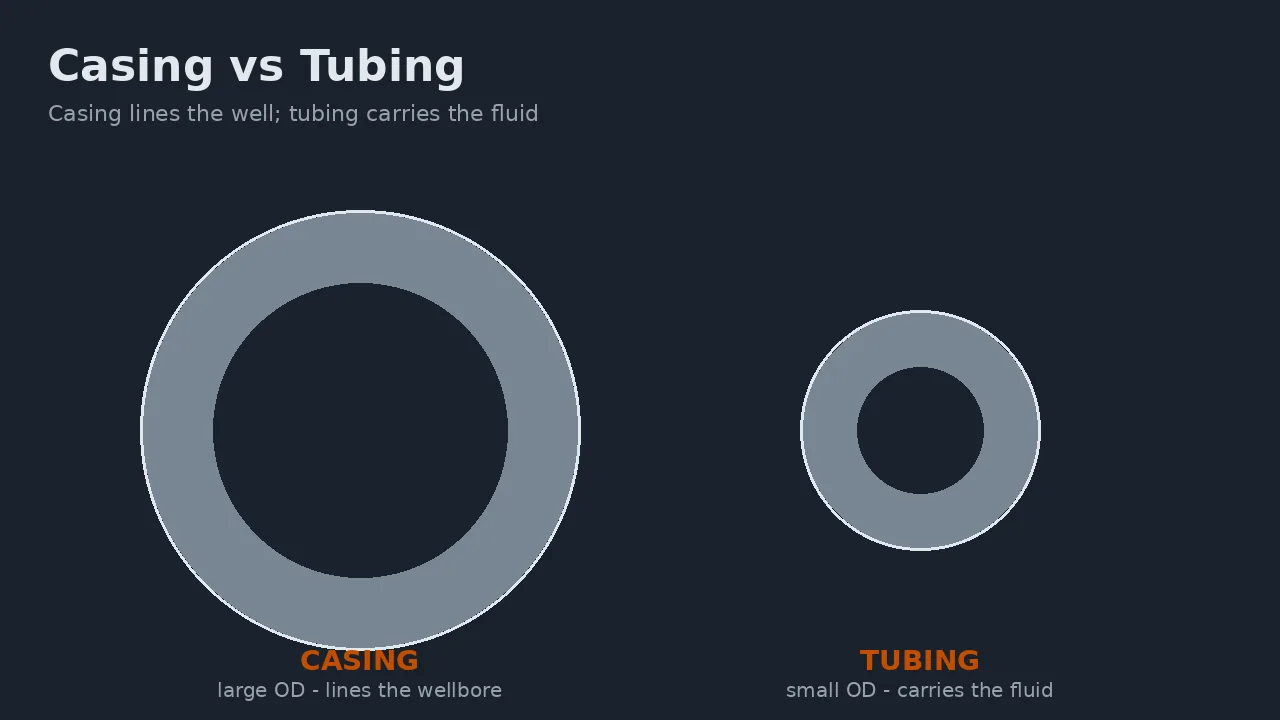
Casing is the pipe that lines the borehole and stays there for the life of the well. Tubing is the smaller pipe that hangs inside the casing and carries the produced fluid to surface. Casing is sized to the hole and the formation; tubing is sized to the flow rate and the completion.
Which string you are ordering. If the pipe is run into the hole, cemented in place and sized from the hole and the formation, it is casing. If it hangs inside the production casing, carries the produced fluid and is sized from the flow rate and the completion, it is tubing. Both are API 5CT and both are written as outside diameter plus weight per foot, so a quotation that does not say which string it is for cannot be compared like for like.
| Casing | Tubing | |
|---|---|---|
| Position in the well | Lines the borehole, cemented in place | Hangs inside the casing, carries the fluid |
| Sizing basis | Hole size and formation pressure | Flow rate and completion design |
| Typical outside diameter | 4-1/2 inch to 20 inch and above | 1.05 inch to 4-1/2 inch |
| Dimension written as | Outside diameter and weight per foot | Outside diameter and weight per foot |
| Common grades | J55, K55, N80, L80, P110, Q125 | J55, N80, L80, P110 |
| Connections | STC, LTC, BTC, premium | EUE, NUE, premium |
| Replaced during well life | Rarely | Regularly |
Two strings with two jobs
Casing is run and cemented in place. Its job is to hold the borehole open, isolate formations from one another and protect groundwater, so it is designed around the hole size, the collapse and burst pressures and the loads it will see over the well’s life. Surface, intermediate and production casing make up the string, each smaller than the last.
Tubing is run inside the production casing and is the conduit the well actually produces through. It is designed around flow rate, pressure and the completion hardware, and it is pulled and replaced far more often than casing is.
Why the specifications look similar
Both are API 5CT, both are specified by outside diameter, wall thickness and grade, and both use the same grade names. That is why quotations for the two look alike at first glance and why the differences are easy to miss.
How each one is specified
The dimensions come from the well design rather than from a pipe schedule. Wall thickness is written as a weight per foot rather than as a schedule, and the same outside diameter is available in several weights.
Grades, and where they sit
The lower grades, J55 and K55, cover ordinary service. N80 is the workhorse grade for deeper and higher-pressure wells, and it comes in two forms, as-rolled and quenched and tempered, which behave quite differently. L80 is the controlled-hardness grade used where hydrogen sulphide is present. P110 and Q125 cover the highest pressures. The choice is driven by pressure, temperature and whether the wellstream is sour.
Connections are half the purchase
Casing is normally joined with short, long or buttress threads, written STC, LTC and BTC. Tubing uses external upset or non-upset ends, EUE and NUE. Where a gas-tight seal is required, or where the well is deviated or thermally loaded, premium connections with a metal-to-metal seal are used instead of the standard threads.
Couplings, pup joints, centralisers, thread protectors and crossovers are bought with the string, and it is worth ordering them together so that the threads and the couplings are matched from the same mill.
Frequently asked questions
Can casing be used as tubing?
Physically yes, and it is done on some low-pressure wells, but the two are designed against different loads. Tubing is sized and threaded for repeated running and pulling and for the production flow; casing is sized for the borehole. Using one where the other was designed is an engineering decision, not a substitution.
What does OCTG mean?
OCTG stands for oil country tubular goods. It covers casing, tubing and the accessories that go with them, which is to say the tubular products used in the well itself, as distinct from line pipe, which is used to transport what comes out of it.
Which grade for a sour well?
The controlled-hardness grades, principally L80, because resistance to sulphide stress cracking is a function of hardness rather than of strength. API 5CT caps L80 at 23 HRC while NACE MR0175 / ISO 15156 applies a 22 HRC limit for carbon steel in sour service.
What to state on the order
- String Casing or tubing. They are not interchangeable, and the quotation is priced against one of them.
- Size and weight Outside diameter and weight per foot, not a nominal pipe size.
- Grade J55, K55, N80 (as-rolled or quenched and tempered), L80, P110 or Q125, and whether the wellstream is sour.
- Length range R1, R2 or R3.
- Connection STC, LTC, BTC, EUE or NUE, or a named premium connection, with the coupling grade.
- Accessories Couplings, pup joints, crossovers, centralisers and thread protectors, ordered with the string so the threads and couplings are matched from the same mill.
- Documents and inspection Mill test certificate to EN 10204 3.1 or 3.2, and whether third-party inspection is required.
Where to go next
- API 5CT casing pipe – well casing in grades J55 to Q125
- API 5CT tubing pipe – production tubing with EUE and NUE ends
- Premium connection casing and tubing – gas-tight metal-to-metal seal connections
- Casing couplings and tubing couplings – API 5CT couplings matched to the string
- API 5CT N80Q casing – the quenched and tempered workhorse grade
- API 5CT L80 tubing – the controlled-hardness grade for sour service
- Heat treatment of steel pipe – normalising, annealing, quenching and tempering, and stress relieving
- Oil and gas pipe – how casing, tubing and line pipe fit together
- Request a quotation – send the size, weight, grade and quantity
Need a price for a specific size and grade? Send the standard and grade, the size and wall thickness, the quantity and the destination port. We reply with availability and pricing.
Request a quotation