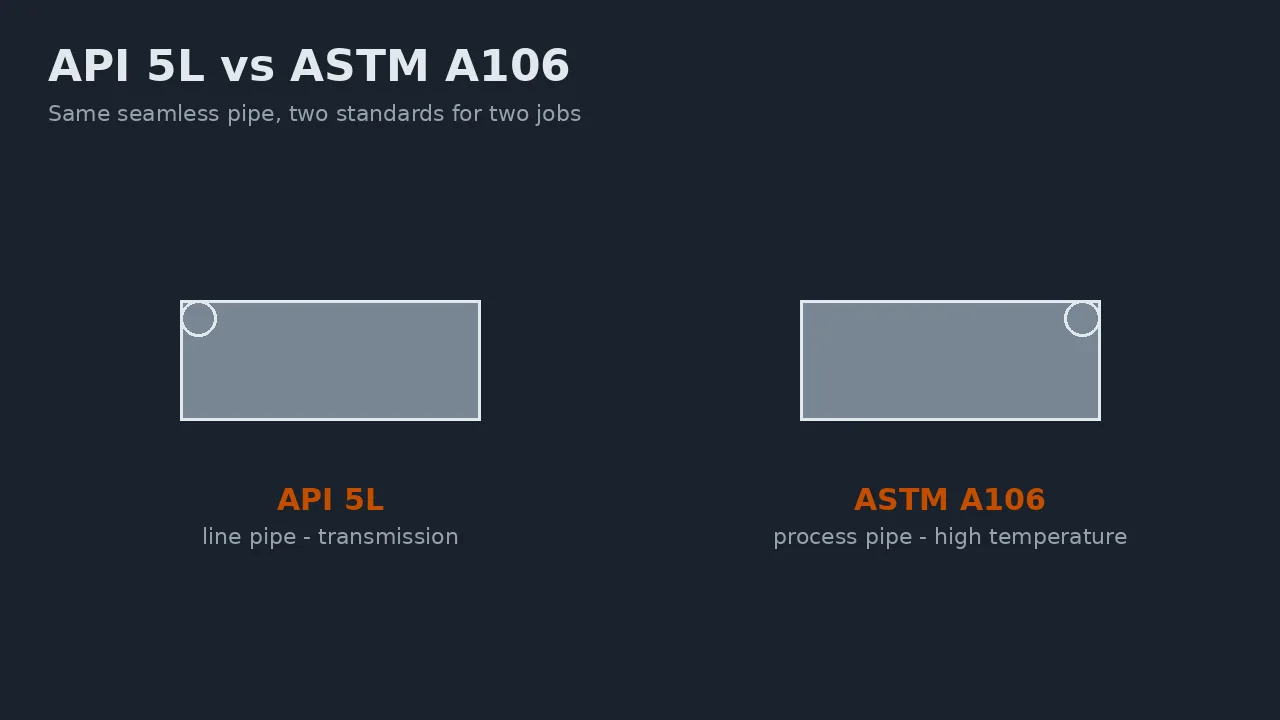
API 5L is the specification for line pipe, written for pipe that transports fluid over distance. ASTM A106 is the specification for seamless carbon steel pipe for high-temperature service, written for pipe inside a plant. They overlap in size and in grade letter, which is why they are so often confused, but they are bought for different jobs.
Which specification to buy against. Match the specification to the code that governs the line, then confirm any substitution in writing before the material is rolled. Inside a plant the governing code is normally ASME B31.3 and the default carbon steel is A106, which demonstrates high-temperature properties as part of its specification. For a pipeline the governing code is ASME B31.4 for liquids or B31.8 for gas, and the pipe is API 5L line pipe specified by grade and wall thickness, with the grade chosen from the hoop stress calculation. The grade letters are not comparable: X52 and X65 do not exist in A106 at all, which stops at Grade C.
Two specifications, two jobs
API 5L governs line pipe: gathering lines, transmission pipelines and the pipe that carries oil, gas and water between facilities. Its grades run from B up through X42, X52, X65, X70 and beyond, and it is written in two product specification levels, PSL1 and PSL2.
ASTM A106 governs seamless carbon steel pipe for high-temperature service: process piping, boiler piping and general industrial piping inside a plant. It covers three grades, A, B and C, and is normally ordered in sizes and schedules to ASME B36.10M.
The chemistry is where they part company
For the ordinary Grade B the two specifications are close but not identical. A106 Grade B caps carbon at 0.30% with manganese between 0.29% and 1.06%, requires a minimum silicon of 0.10%, and limits carbon equivalent to C + Mn/6 of 0.50%. A53 Grade B, the general-purpose specification often quoted alongside it, allows carbon up to 0.30% with manganese up to 1.20% but has no silicon minimum.
API 5L PSL2 goes considerably further than any of them. For X65 PSL2 the phosphorus limit is 0.025% and sulphur 0.015%, a maximum yield-to-tensile ratio of 0.93 is imposed, and impact testing is mandatory. That is a different class of requirement from the basic grades, and it is the reason PSL2 pipe costs more.
Strength grades are not comparable by letter
An ‘A’ or ‘B’ in API 5L and an ‘A’ or ‘B’ in ASTM A106 are unrelated designations. API 5L Grade B has a minimum yield strength of 241 MPa and a minimum tensile strength of 414 MPa. A106 Grade B requires a minimum tensile strength of 415 MPa and a minimum yield of 240 MPa. Those are numerically almost the same, which is a coincidence of history rather than a rule – the two letter systems simply do not map onto each other.
Where API 5L goes further is the higher grades. X52 and X65 do not exist in A106 at all; A106 stops at Grade C.
Temperature and pressure decide the code
Inside a plant the governing code is normally ASME B31.3, process piping, and the pipe is specified by material and schedule rather than by grade letter alone. A106 is the default carbon steel for that world because it is qualified for high temperature and is available in every schedule.
For pipelines the governing code is ASME B31.4 for liquids or B31.8 for gas, and the pipe is specified as API 5L line pipe by grade and wall thickness. The grade is chosen from the hoop stress calculation at the design pressure, which is why pipeline grades climb as pressure and diameter rise.
| ASTM A106 Grade B | API 5L Grade B | API 5L X65 PSL2 | |
|---|---|---|---|
| Typical use | Process and boiler piping | Line pipe, lower pressure | High-pressure transmission pipelines |
| Product form | Seamless | Seamless or welded | Seamless, ERW, LSAW, SSAW |
| Carbon, max | 0.30% | 0.28% | 0.12% (X65M) / 0.18% (X65Q) |
| Silicon, min | 0.10% | not specified | not specified |
| Yield strength, min | 240 MPa | 241 MPa | 448 MPa |
| Tensile strength, min | 415 MPa | 414 MPa | 531 MPa |
| Impact testing | Not required by the base spec | Not required at PSL1 | Mandatory at PSL2 |
| Carbon equivalent | C + Mn/6 max 0.50% | Not required | CE(IIW) max 0.43%, or CE(Pcm) max 0.25% when C is 0.12% or below |
Can one be substituted for the other?
In practice they are sometimes interchangeable and sometimes emphatically not. A106 Grade B demonstrates high-temperature properties as part of its specification, so substituting API 5L Grade B for it is a change to be agreed with the engineer, not assumed. Going the other way, A106 is accepted by many line pipe specifications as a seamless alternative at the lower grades, but it does not carry the PSL2 carbon equivalent, impact testing or yield-to-tensile ratio that a PSL2 line pipe order requires.
The practical rule is to match the specification to the code that governs the line, then confirm any substitution in writing before the material is rolled.
Frequently asked questions
Is API 5L Grade B the same as ASTM A106 Grade B?
They are close in chemistry and almost identical in strength, and A106 Grade B is often accepted as an alternative, but they are separate specifications with different requirements. A106 requires a minimum silicon of 0.10% and is qualified for high-temperature service; API 5L is written for line pipe. Any substitution should be agreed in writing.
Which is better for a gas pipeline?
API 5L, and at higher pressures API 5L PSL2. PSL2 brings the carbon equivalent limit, the maximum yield-to-tensile ratio and mandatory impact testing that a pipeline design code expects. A106 does not carry those requirements.
What is the difference between PSL1 and PSL2?
PSL1 is the basic level: one set of tensile requirements and looser limits on phosphorus and sulphur. PSL2 adds a mandatory carbon equivalent limit, tighter phosphorus and sulphur limits, a maximum yield-to-tensile ratio of 0.93, mandatory impact testing and non-destructive inspection. For line pipe, PSL2 is the normal choice.
Where to go next
- ASTM A106 seamless steel pipe – the high-temperature seamless grade in every schedule
- API 5L seamless steel pipe – seamless line pipe from Grade B to X70
- ASTM A53 steel pipe – the general-purpose carbon steel specification
- ASTM A106 Grade B pipe – chemistry, mechanical properties and size range
- ASTM A53 Grade B pipe – how A53 differs from A106
- API 5L X52 pipe – the mid-range line pipe grade
- API 5L X65 pipe – the high-strength line pipe grade
- Request a quotation – send the specification, quantity and destination port
Ready to price your enquiry? Tell us the specification, the dimensions, how much you need and where it is going. We reply with what is available and what it costs.
Request a quotation