ASTM A350 LF2 is a forged carbon steel flange for low-temperature service, Charpy V-notch impact tested at −46 °C (−50 °F), with a minimum yield strength of 250 MPa (36,000 psi) and a minimum tensile strength of 485 MPa (70,000 psi). Sizes follow ASME B16.5 for NPS 1/2–24 and ASME B16.47 for NPS 26–60.
Mejor Steel is the export agent for the mills that make your material: one contract, one delivery date, and the mill named on the quotation. How we supply
We reply within one business day, Monday to Friday 09:00-18:00 CST. Or write to info@mejorsteel.com / WhatsApp.
Size range and specification
- Size range NPS 1/2 – NPS 60 (DN 15 – DN 1500)
- Classes Class 150 / 300 / 600 / 900 / 1500 / 2500 to ASME B16.5; Class 75 – 900 to ASME B16.47 above NPS 24
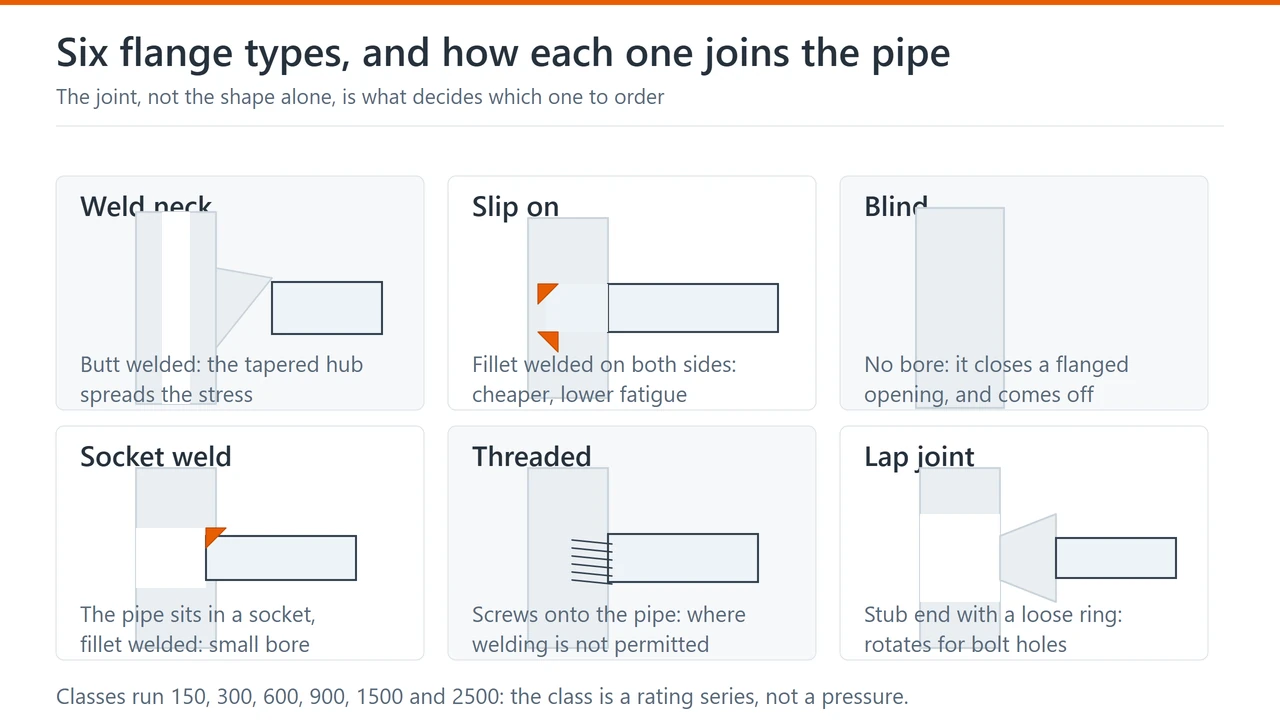
- Types Weld neck, slip-on, blind, socket weld, threaded, lap joint and large-diameter flanges
- Facing Raised face (RF), flat face (FF), ring joint (RTJ)
- Heat treatment Normalized, normalised and tempered, or quenched and tempered as required to meet the impact requirement
- Delivery standard ASTM A350 / ASME SA350, dimensions to ASME B16.5 / B16.47
How this grade is supplied
- Inspection Inspected by the producing mill’s own inspection department, independent of production. Third-party inspection — SGS, BV or TUV, or an inspector you send yourself — can be arranged at the mill or before shipment.
- Certificate A mill test certificate to EN 10204 3.1 showing the heat number, chemical composition, tensile results and Charpy impact results is standard. EN 10204 3.2, countersigned by the inspector you nominate, is available on request.
- Documents with the goods The mill test certificate and the packing list travel with the shipment, and the heat number is traceable from cast through to the finished flange.
- Packing Sea-worthy export packing with end and facing protection, stencilled with the size, class and heat number.
- MOQ One pallet or one truckload; mixed sizes and classes accepted.
- Lead time Counted from order confirmation. Stock sizes 5–10 days; mill run or non-stock 3–5 weeks. The delivery window is fixed on the quotation.
- How we supply Sourced through partner mills; the producing mill is named on the quotation.
ASTM A350 LF2 chemical composition (maximum unless a range is given, %)
| Element | LF2 Class 1 |
|---|---|
| Carbon, C | 0.30 max |
| Manganese, Mn | 0.60 – 1.35 |
| Phosphorus, P | 0.035 max |
| Sulphur, S | 0.040 max |
Silicon, nickel, chromium, molybdenum, copper and vanadium are also limited by ASTM A350 Table 1. Source: chemical composition requirements of ASTM A350 / ASME SA350. The standard is the governing document.
ASTM A350 LF2 tensile and impact requirements
| Property | Requirement |
|---|---|
| Tensile strength | 485 – 655 MPa (70,000 – 95,000 psi) |
| Yield strength, min | 250 MPa (36,000 psi) |
| Elongation, min | 22% longitudinal |
| Impact test | Charpy V-notch at −46 °C (−50 °F), mandatory |
The Charpy test is the point of LF2: the flange is supplied with measured low-temperature toughness rather than an assumed value. The test temperature is a test condition, not a use temperature. Confirm the absorbed-energy acceptance against the current edition and the order. Source: ASTM A350 / ASME SA350. The standard is the governing document.
What LF2 means, and why the impact test is the whole point
In ASTM A350 the L marks low-temperature and the F marks forged; the 2 is the carbon-steel grade, matched to the carbon-manganese forging chemistry. Ordinary carbon steel becomes brittle below about −29 °C (−20 °F), so a low-temperature line needs a flange whose toughness has been measured, not assumed. LF2 closes that gap by making a Charpy V-notch test at −46 °C mandatory on every heat.
A105, A350 LF2 and A694 — which one belongs on the drawing
| Specification | What it is | Impact test |
|---|---|---|
| ASTM A105 | Forged carbon steel flange for general and high-temperature service | Not required unless specified |
| ASTM A350 LF2 | Forged carbon steel flange for low-temperature service | Mandatory Charpy at −46 °C |
| ASTM A694 | Forged carbon and alloy steel flange for high-pressure transmission service | Not required unless specified |
The practical rule: a flange that has to work below about −29 °C is specified as A350 LF2; a standard process flange is A105; a high-yield pipeline flange is A694. Below about −46 °C, LF2 is no longer enough — the drawing normally moves to A350 LF3, the 3.5% nickel grade.
Where the class comes from
ASTM A350 fixes the material and the impact test; it does not dimension the flange. Dimensions come from ASME B16.5 for NPS 1/2–24 and ASME B16.47 for NPS 26–60. The class is a design rating, not a pressure in psi: the allowable pressure is read from the pressure–temperature table for the material group. Name size, class and facing on the enquiry, because two flanges of the same size but different class do not bolt together.
Ordering mistakes that cost a flange
- A105 specified when the line is low-temperature. The flange will be dimensionally identical but untested; if the design minimum is below about −29 °C, specify LF2.
- Impact temperature left open. State the test temperature and the energy acceptance if the project sets a stricter value than the standard.
- Class left off. The class sets the wall and the bolt circle; two flanges of the same size but different class will not mate.
- Facing not named. RF, FF and RTJ take different gaskets and must match the flange they bolt to.
- Certificate requirement left off. Low-temperature lines usually need EN 10204 3.1 as a minimum and often 3.2 with third-party countersignature.
What to state on the enquiry
- Nominal size, pressure class and facing (RF / FF / RTJ).
- Flange type, and for a weld neck the pipe schedule.
- Material: ASTM A350 LF2, and the impact temperature if the project requires a value below −46 °C.
- Certificate: EN 10204 3.1, or 3.2 with third-party countersignature.
- Quantity and destination port.
Typical applications
- LNG and cryogenic transfer lines
- Low-temperature process and storage piping
- Refrigeration and cold-climate utility lines
- Low-temperature flanges on A333 Grade 6 piping
Standards covered
Frequently asked questions
What is the difference between A105 and A350 LF2?
A105 is the standard forged carbon steel flange with no mandatory impact test. A350 LF2 has the same strength but adds a mandatory Charpy V-notch test at −46 °C, so it is specified where the flange must stay tough at low temperature.
What temperature is A350 LF2 good for?
The standard impact test temperature is −46 °C (−50 °F). The actual minimum service temperature is set by the design code and the project specification. Below about −46 °C, A350 LF3, the 3.5% nickel grade, is normally specified instead.
Does A350 LF2 come with a mill test certificate?
Yes. A mill test certificate to EN 10204 3.1, showing the heat number, chemistry, tensile results and Charpy impact results, is standard. EN 10204 3.2 with third-party countersignature is available on request.
Where to go next
- ASTM A105 Flange – the standard forged carbon steel flange
- ASTM A694 F52–F70 – the high-yield transmission flange
- ASTM A333 Grade 6 – the low-temperature pipe that LF2 flanges join
- Pipe Flanges – flange types, classes and facings
- Get a Quote – send the grade, size, class and destination port
Need a price for a specific size and class? Send the grade, size, class, facing, the impact temperature and the destination port. We reply with availability and pricing.