T/T is usually cheaper and faster. L/C is usually safer for a first large order because payment is tied to documents rather than to trust. The right choice for a steel pipe order depends on order value, supplier risk, bank costs and how tightly payment is linked to inspection and shipment.
Which terms to open with. T/T is usually cheaper and faster. L/C is usually safer for a first large order, because payment is tied to documents rather than to trust. For a steel pipe order the choice follows four things: order value, supplier risk, bank cost, and how tightly payment is linked to inspection and shipment. A verified supplier with third-party inspection can work on a 30/70 T/T structure; where the supplier is new to the buyer and the order is large, a documentary L/C at sight is the normal starting point.
T/T and L/C at a glance
| Factor | T/T | L/C at sight |
|---|---|---|
| Buyer risk | Deposit is at risk before shipment | Payment is tied to complying documents |
| Supplier risk | Low, because a deposit is paid first | Document discrepancy risk |
| Cost | Lower bank transfer cost | Issuance, advising and negotiation charges |
| Speed | Faster and simpler | Slower to issue and requires strict compliance |
| Best for | Established suppliers, mid-value orders | First large orders or project purchases |
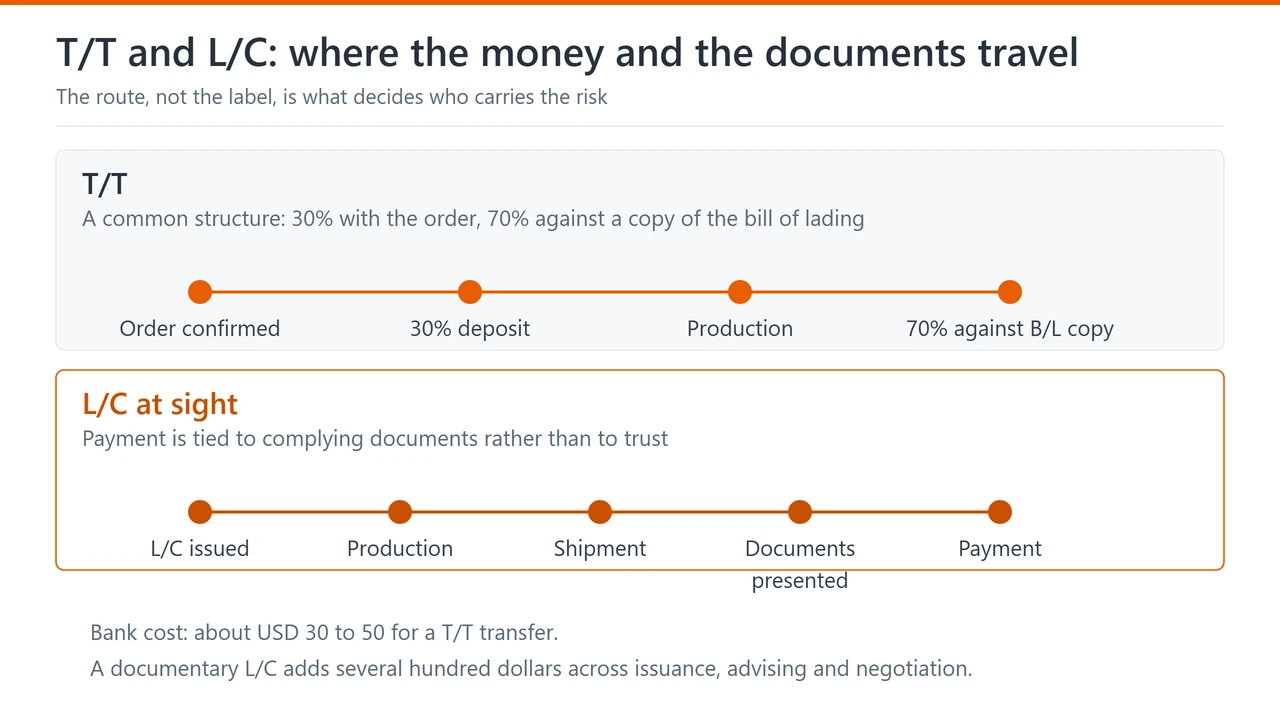
A common T/T structure is 30% deposit with the order and 70% against a copy of the bill of lading. The exact split is negotiable and should be written in the proforma invoice or contract.
Bank costs compared
Commonly cited ranges are about USD 30 to 50 per T/T transfer, while a documentary L/C can add several hundred dollars across issuance, advising, negotiation and possible confirmation. These numbers vary by bank and country and must be checked with the issuing bank. The point is not the exact fee; it is that L/C is a documentation service as well as a payment method.
L/C clauses worth writing in the order
- Latest shipment date and expiry date.
- Partial shipment and transshipment: allowed or not allowed.
- Quantity and amount tolerance, commonly plus/minus 10%.
- The exact document list: commercial invoice, packing list, bill of lading, certificate of origin, MTC, inspection certificate.
- The beneficiary name exactly as registered, without abbreviations.
- The port of loading and port of discharge.
Common discrepancies and how to avoid them
- Bill of lading not marked on board with a date.
- Invoice amount exceeding the L/C amount.
- Packing list details not matching the invoice.
- Inspection certificate dated after the bill of lading.
- Beneficiary name or address not matching the L/C.
- Missing endorsement or signatory on a required document.
Have the documents checked by the advising bank before presentation. A small delay in document review costs less than a rejected presentation.
Payment tied to inspection and shipping milestones
For larger orders, payment can be staged with production and shipment evidence: deposit, payment on production completion, payment against the bill of lading, and a final payment after delivery acceptance. Each stage must be defined by documents the buyer can verify, not by a promise.
Before you remit money
- Verify the supplier’s bank details through a second official channel.
- Confirm the beneficiary name exactly.
- Use a verified supplier or arrange pre-shipment inspection.
- Write the payment terms and document list into the order.
- Keep every payment instruction and confirmation on file.
Frequently asked questions
Should a first order always use L/C?
Not always. L/C is safer for a first large order, but a verified supplier with third-party inspection can also work with a 30/70 T/T structure. The decision should follow the order value and the supplier risk, not a fixed rule.
Is 100% T/T in advance normal?
It is uncommon for large steel pipe orders because the buyer carries all the pre-shipment risk. Partial T/T or L/C is the normal starting point.
Can L/C be used for small orders?
It can, but the fixed documentation cost is higher as a share of the order. For small orders, T/T is often more practical.
Where to go next
- Steel Pipe Inspection Before Shipment – the buyer-side checklist
- How to Order – the information needed to start a quotation
- Incoterms for steel pipe – FOB or CIF changes which costs and risks sit on which side
- Steel pipe delivery time – the payment milestone that has to line up with the shipment date
- Get a Quote – send the grade, size, quantity and destination port
Four details and we can quote. The standard or grade, the size and wall thickness, the tonnage, and the destination port. Send them together and we answer with availability and pricing.
Request a quotation