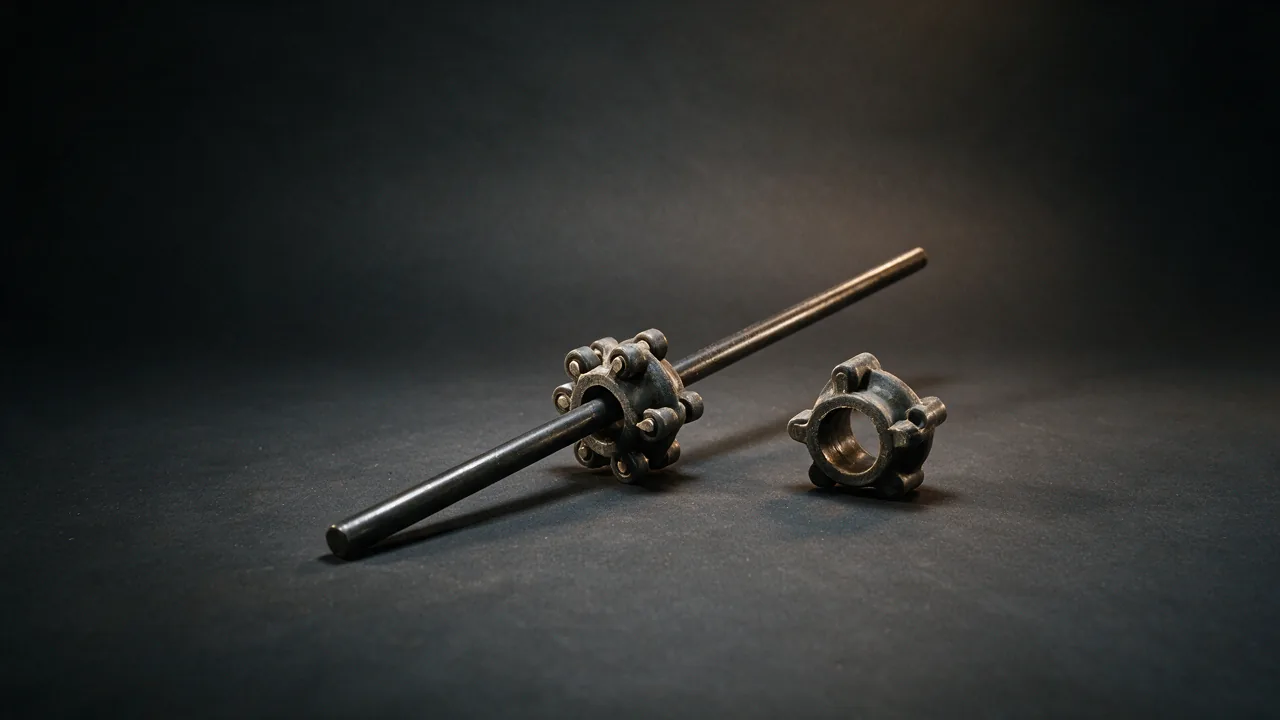
Sucker rod guides and centralizers in wheeled, fluted and snap-on designs to reduce rod and tubing wear in deviated and horizontal wells.
- Standard: API 11B, API 11BR
- Grades: N/A - accessory item
- Certificate: EN 10204 3.1 with every order, 3.2 on request
Mejor Steel is the export agent for the mills that make your material: one contract, one delivery date, and the mill named on the quotation. How we supply
We reply within one business day, Monday to Friday 09:00-18:00 CST. Or write to info@mejorsteel.com / WhatsApp.
Specifications
| Outer diameter | For 5/8" - 1-1/4" rods |
|---|---|
| Length | 100 - 300 mm depending on type |
| Ends | Snap on, slip on, or with a metal body |
| Surface treatment | Molded polymer, or metal with polymer coating |
| Manufacturing process | Injection molded polymer, or machined with molded insert |
| Connection type | Fits over the rod body or coupling |
Types of Rod Guide
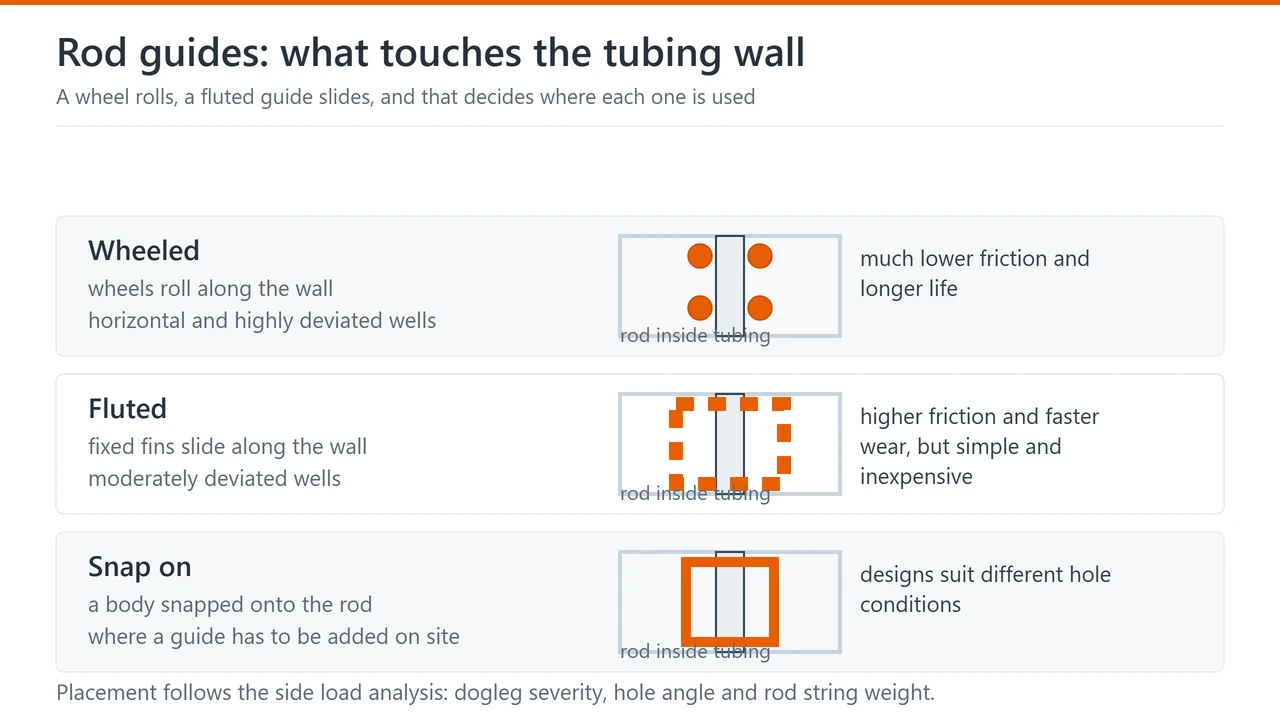
Three designs are in common use. The fluted guide is a molded polymer sleeve with longitudinal fins that centralize the rod, so the fins contact the tubing rather than the rod or the coupling, and they are simple, cheap and widely used in moderately deviated wells. The wheeled guide has metal or polymer wheels set in a cage, so the guide rolls along the tubing wall rather than sliding, giving much lower friction and longer life, and it is the standard choice in horizontal and highly deviated wells where sliding wear would be severe. The snap-on guide is a split design that can be fitted to the rod body without removing the coupling, which makes it quick to install in the field, and it is used where the guide must be added or replaced during servicing. The choice depends on the dogleg severity, the well inclination and the expected side load.
Material Selection
Rod guide material is selected for wear resistance, friction and compatibility with the well fluid. Nylon is the most common general purpose material, with good wear resistance and moderate cost. Ultra high molecular weight polyethylene, UHMWPE, has lower friction and better resistance to abrasion and to impact, and is used in deviated wells and where the produced fluid is heavier. Polyurethane gives high wear resistance and is used in abrasive conditions. Where the well is sour, the guide material must be resistant to H2S and to the produced fluids, because a degraded guide can come loose, fall into the pump and cause a costly failure. Where the well is hot, the temperature limit of the polymer matters, since a guide that softens at downhole temperature will deform and lose its centralizing function. Confirm the fluid composition and the downhole temperature before selecting the material.
Rod guides: wear follows the dogleg severity
A guide keeps the rod body off the tubing wall where the string runs against it, and how much wear occurs depends on how sharply the well deviates rather than on the well depth. Wheeled, fluted and snap on designs suit different hole conditions, and the material has to suit the produced fluid.
| Well or string condition | What it drives | What to state on the enquiry |
|---|---|---|
| Vertical well, little contact | Guides are used sparingly, or not at all | the well trajectory |
| Deviated well | Guides at a spacing set by the dogleg severity | the deviation survey |
| Horizontal or high angle section | Denser spacing, and a different body design | the build rate through the section |
| Wear already occurring | Guides, plus a change of coupling class | the wear pattern that has been observed |
| Sour service | The guide material has to be compatible | the H2S level |
| High fluid temperature | Polymer selection follows the temperature | the bottom hole temperature |
| Buckling in the lower string | Partly solved by sinker bars rather than by guides | whether buckling is the actual cause of the wear |
| Rod size and coupling | Guides fit either the rod body or the coupling | the rod size, and the coupling type |
How do I decide where to place rod guides?
Placement is normally determined by a side load analysis that identifies the intervals where the rod contacts the tubing with enough force to cause wear, and guides are concentrated in those intervals and, in particular, across the build section of the well. In a vertical well, few or no guides are needed. In a deviated well, spacing may be one per rod in the build section. The calculation should account for dogleg severity, hole angle and the rod string weight, and it is best done as part of the overall rod string design.
What is the difference between wheeled and fluted rod guides?
A fluted guide has fixed fins that slide along the tubing, so it has higher friction and wears faster but is simple and inexpensive, and is suitable for moderately deviated wells. A wheeled guide rolls along the tubing wall, giving much lower friction and longer life, and is used in horizontal and highly deviated wells where sliding wear would be severe. Wheeled guides cost considerably more, so the choice is normally made from a wear prediction rather than by default.
Matching the guide to the well
The guide has to do two jobs at once: keep the rod off the tubing, and survive the produced fluid. Rod load and dogleg severity decide the design; the fluid decides the material.
| Guide | Contact with the tubing | Where it is the right answer | What it costs you |
|---|---|---|---|
| Fluted | Fixed fins slide along the tubing | Moderately deviated wells, general purpose | Lowest cost, highest friction, so it wears sooner |
| Wheeled | Wheels roll instead of sliding | Horizontal and high angle wells, and wells with high side load | Higher cost per guide, much longer life, less torque |
| Snap on | Clips onto the rod without dismantling the string | Short intervals and field repairs where the string is already made up | Fast to install; retention depends on correct sizing to the rod |
Guides are placed where the side load analysis shows contact, which is normally the build section rather than the deepest part of the well. Placing guides evenly along the whole string wastes money and does not protect the intervals that actually wear.
What to send with a rod guide enquiry
- Rod diameter, and the coupling size if the guide has to pass over couplings.
- Guide type, or the well condition and the side load analysis if the type is still open.
- Material: nylon, UHMWPE or the material named in the well programme, and the produced fluid with its temperature.
- Quantity per rod and the total number of rods, so the guides can be packed with the rods rather than shipped separately.
- Whether the guides are fitted at the mill or supplied loose for field installation.
- Certification and inspection requirements, including any third party inspection.
Material and design are matched to the well programme supplied by the buyer. Placement follows the side load analysis; where no analysis is provided, guides are supplied to the buyer’s count and interval.
Standards, inspection and delivery
| Item | Detail |
|---|---|
| Standard | API 11B, API 11BR |
| Inspection | Dimensional inspection; Material hardness and durability testing; Fit and retention test; Material certification; Visual inspection |
| Documents | Mill test certificate to EN 10204 3.1 with the heat number, chemical analysis and mechanical results; EN 10204 3.2 on request. Packing list travels with the shipment. |
| Packing | Cartons or sacks on pallets |
| MOQ | 500 pieces depending on size |
| Lead time | 15 – 30 days |
| Supply | Sourced through partner mills; the producing mill is named on the quotation. |
Download Sucker Rod Guide data sheet (PDF) One page: supply range, grades and key sizes, what to state on the enquiry, and the inspection documents that come with the order. The standard is the governing document.
Where to go next
- API 11B sucker rod – the rod grades every accessory below is matched to
- Continuous sucker rod – the continuous option and where it removes a joint
- Pony rod – the short rod that sets the string length
Materials
- Nylon
- Ultra high molecular weight polyethylene
- Polyurethane
- Steel
- Composites
Typical applications
- Reducing rod and tubing wear in deviated wells
- Horizontal and highly deviated wellbores
- Wells with high dogleg severity
- Sour service with compatible material
- Wells with rod buckling in the lower string
Inspection & testing
- Dimensional inspection
- Material hardness and durability testing
- Fit and retention test
- Material certification
- Visual inspection
| Packaging | Sea-worthy export packing: bundled in steel-strapped racks, thread protectors fitted, tagged with size, grade and heat number. |
|---|---|
| MOQ | One bundle (by set); mixed sizes accepted. |
| Lead time | Stock sizes: 7-15 days. Made to order: 4-6 weeks after order confirmation. |
Payment: T/T 30% deposit with the balance before shipment; L/C at sight also accepted. Final terms are confirmed on the quotation.
How we supply: sourced through partner mills; the producing mill is named on the quotation. How we supply sets out who is accountable for the order.
Need this product? Send the size, grade, quantity and destination port and we will reply with availability and pricing.
Request a quotation