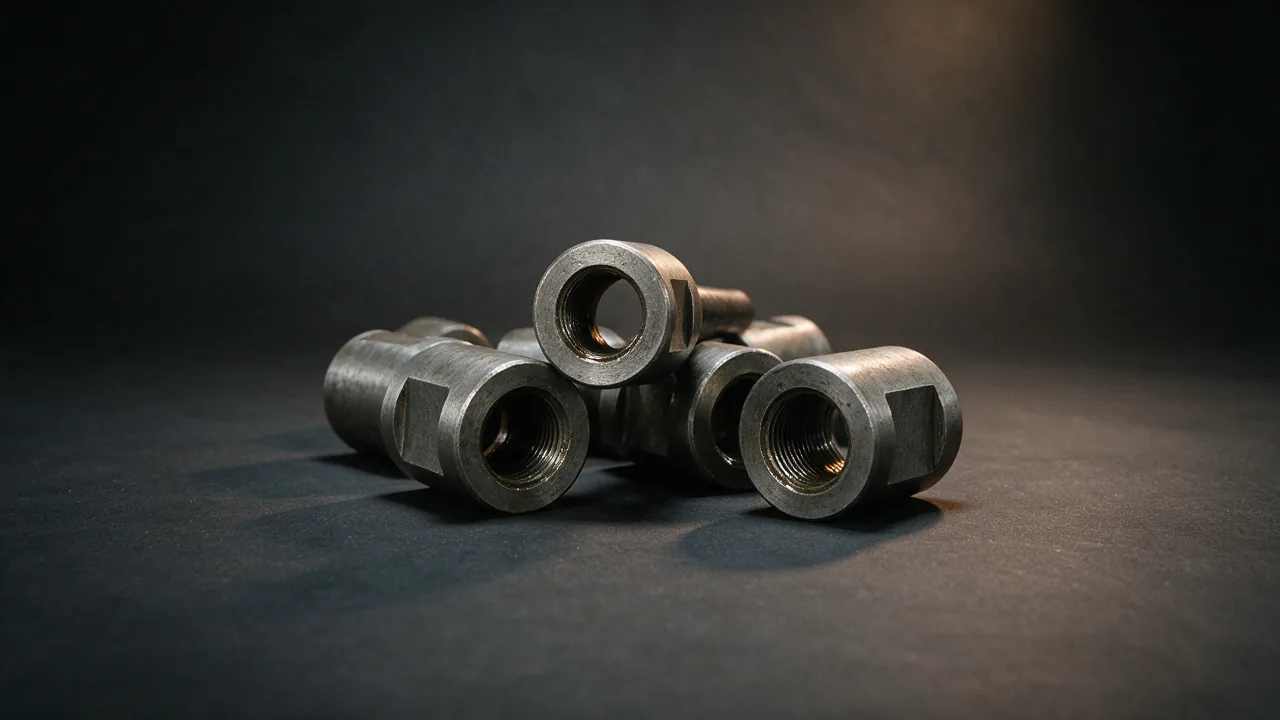
Sucker rod couplings to API 11B in class T and class SM, full size and slim hole, for sizes from 5/8 inch to 1-1/4 inch.
- Standard: API 11B, API 11BR, NACE MR0175, ASTM A29
- Grades: C, D, K, KD, HL, HY
- Certificate: EN 10204 3.1 with every order, 3.2 on request
Mejor Steel is the export agent for the mills that make your material: one contract, one delivery date, and the mill named on the quotation. How we supply
We reply within one business day, Monday to Friday 09:00-18:00 CST. Or write to info@mejorsteel.com / WhatsApp.
Specifications
| Outer diameter | For 5/8" - 1-1/4" rods |
|---|---|
| Length | Per API 11B, typically 4" - 5-1/2" |
| Ends | Internally threaded both ends, sucker rod thread |
| Surface treatment | Phosphate coated, or spray metal coated for class SM |
| Manufacturing process | Forged and machined, threads rolled or cut |
| Connection type | Sucker rod thread |
| Grade | Class T, Class SM |
Class T and Class SM Couplings
API 11B defines two coupling classes distinguished by surface treatment and intended wear performance. Class T is the standard coupling, made of the same material as the rod and phosphate or otherwise treated for corrosion protection. Class SM is a spray metal coupling: a hard, wear resistant metal coating, typically a nickel based or tungsten carbide alloy, is applied to the outside diameter. The purpose is to resist the abrasive wear that occurs where the coupling rubs against the tubing wall, particularly in deviated or horizontal wells, and to reduce the risk of galling when the coupling is repeatedly made up and broken out. Class SM couplings are longer than class T for the same rod size, and they wear the tubing less than a bare coupling in most circumstances, but they cost more. In a horizontal well the choice between them is often driven by a wear prediction based on dogleg severity and the number of pumping cycles.
Full Size and Slim Hole
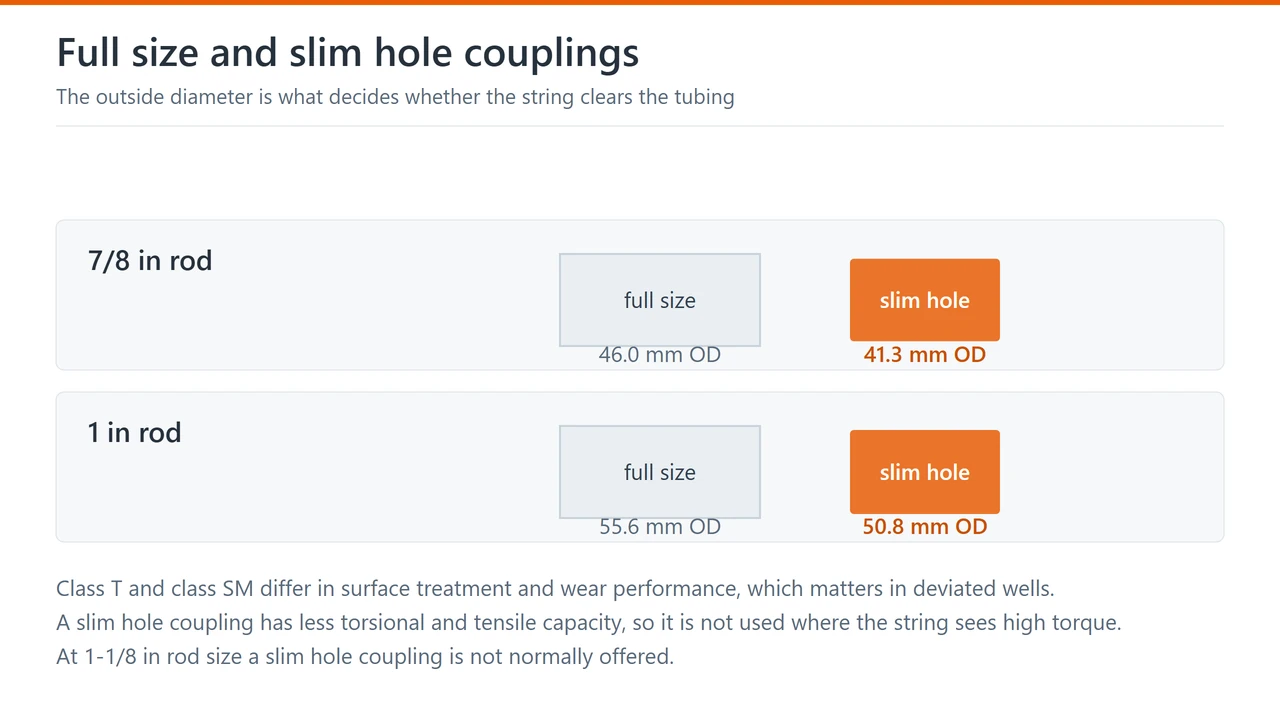
Sucker rod couplings are supplied in full size and slim hole, also called slim line. A full size coupling has its outside diameter at or slightly above the API specified value and gives the greatest thread engagement and strength. A slim hole coupling has a reduced outside diameter, which increases the annular clearance between the coupling and the tubing wall. This matters in two situations: in wells with small clearance between the rod string and the tubing, where the larger coupling would rub and cause wear, and in wells where the annulus carries the produced fluid and a larger coupling increases the flow restriction. The trade-off is that a slim hole coupling has less wall thickness and therefore lower torsional and tensile capacity, so it should not be used where the rod string experiences high torque or heavy load. Confirm the required type when ordering, since the two are not interchangeable.
Rod couplings: class T or class SM
A coupling is where a rod string normally fails, and the two classes differ in wear protection rather than in strength. Class T is the standard coupling; class SM has a spray metal finish for wells where the string rubs against the tubing. Full size and slim hole versions exist where clearance matters.
| Well or string condition | What it drives | What to state on the enquiry |
|---|---|---|
| Straight well, normal wear | Class T, full size | the rod size and the grade |
| Deviated or wear prone well | Class SM with the sprayed surface | the dogleg severity and the rod size |
| Clearance in the tubing | A slim hole coupling reduces the outside diameter | the tubing drift |
| Sour service | Material and hardness restrictions apply | NACE MR0175 |
| Tapered string | Crossover couplings at the size change | both rod sizes |
| Replacement during a workover | Only the size, the class and the thread form | the quantity |
| Grade matching | The coupling grade should match the rod grade | the rod grade on the string |
What is the difference between class T and class SM sucker rod couplings?
Class T is the standard coupling, untreated except for corrosion protection, and is used in straight vertical wells with normal wear conditions. Class SM has a hard spray metal coating on the outside diameter, typically nickel based or tungsten carbide, which resists abrasive wear against the tubing and reduces galling. Class SM is used in deviated and horizontal wells, in wells with high dogleg severity, and where the tubing wear is a known problem. It costs more and is longer than class T for the same rod size.
When should I use a slim hole coupling?
Use a slim hole coupling where the annular clearance between the coupling and the tubing is tight, so that rod centralization is improved and wear is reduced, or where the produced fluid flows up the annulus and a smaller coupling reduces the flow restriction. Do not use a slim hole coupling where the rod string sees high torque or heavy tensile load, because its reduced wall thickness gives lower capacity than a full size coupling.
Coupling size and thread, by rod size
A coupling is identified by its thread size, not by the rod size it connects. That is the source of the “1 in × 7/8 in” confusion on requisitions: the two numbers in a quotation may be a rod size and a thread size, or two different rod sizes in a combination coupling.
| Rod size | Coupling thread | Full size coupling OD | Slim hole coupling OD |
|---|---|---|---|
| 5/8 in | 15/16 in | 38.1 mm | 31.8 mm |
| 3/4 in | 1-1/16 in | 41.3 mm | 38.1 mm |
| 7/8 in | 1-3/16 in | 46.0 mm | 41.3 mm |
| 1 in | 1-3/8 in | 55.6 mm | 50.8 mm |
| 1-1/8 in | 1-9/16 in | 60.3 mm | Not normally offered |
Source: API 11B coupling dimension and thread tables, cross-checked against published supplier catalogues. Confirm the current edition of API 11B, and confirm availability, before the sizes are written into a contract — slim hole availability in particular varies by size.
Combination couplings — for example 5/8 in × 3/4 in or 7/8 in × 1 in — are used to change rod size within a string. On a requisition, state both ends, because a combination coupling ordered as a single size will be made wrong.
Wear, failures and what actually prevents them
A coupling is a wear part as well as a connector. It rubs against the tubing on every stroke, and what fails first tells you which fix is needed.
| What is seen | Likely cause | What changes the outcome |
|---|---|---|
| Coupling OD worn, tubing worn in the same interval | Side loading and lack of centralization | Rod guides or centralizers before a more expensive coupling |
| Coupling worn, tubing acceptable | Coupling material or surface not matched to the fluid and load | A different coupling class, or a surface-treated coupling |
| Thread damage or slip | Make-up torque or handling | Correct make-up, thread protectors, and inspection on arrival |
| Cracking at the last engaged thread | Fatigue under a load the joint was not sized for | Re-check the string design rather than the coupling |
| Corrosion-assisted failure | Wet H2S or CO2 in the produced fluid | A sour-service qualified grade, with the documentation that goes with it |
This is why we ask what failed first. If the tubing is worn and the couplings are intact, changing the coupling class does not fix the wear — it moves it.
Packing, marking and what to state on the enquiry
- Rod size at each end, and both ends for a combination coupling.
- Coupling thread size, full size or slim hole.
- Class: T or SM, or the sour-service qualified equivalent where wet H2S is present.
- Quantity, and whether the couplings must match an existing string’s marking.
- Certificate: EN 10204 3.1 with heat number and mechanical results; EN 10204 3.2 where third-party countersignature is required.
- Packing requirement, since couplings are handled and stored before they reach the wellsite.
- Destination port and Incoterms.
Grades supplied
| Grade | Minimum tensile strength | Where it is chosen |
|---|---|---|
| K | 586 MPa (85,000 psi) | Corrosive produced fluids, where cyclic stress and corrosion act together |
| C | 620 MPa (90,000 psi) | Moderate loads — the middle step between K and D |
| D | 793 MPa (115,000 psi) | High rod loads: deeper wells, larger pumps, heavier or more viscous fluid |
| KD | Sour service grade | Where wet H2S is present and NACE MR0175 applies |
| HL | — | Supplied to order; the requirement is confirmed on the quotation |
| HY | — | Supplied to order; the requirement is confirmed on the quotation |
Standards, inspection and delivery
| Item | Detail |
|---|---|
| Standard | API 11B, API 11BR, NACE MR0175, ASTM A29 |
| Inspection | Thread gauging to API 11B; Dimensional and hardness testing; Tensile testing; Spray metal coating thickness check for class SM; Material certification; Third-party inspection on request |
| Documents | Mill test certificate to EN 10204 3.1 with the heat number, chemical analysis and mechanical results; EN 10204 3.2 on request. Packing list travels with the shipment. |
| Packing | Cartons or wooden cases on pallets |
| MOQ | 200 pieces depending on size |
| Lead time | 20 – 35 days depending on grade and size |
| Supply | Sourced through partner mills; the producing mill is named on the quotation. |
Download Sucker Rod Coupling data sheet (PDF) One page: supply range, grades and key sizes, what to state on the enquiry, and the inspection documents that come with the order. The standard is the governing document.
Where to go next
- API 11B sucker rod – the rod grades every accessory below is matched to
- Polished rod – the surface rod at the top of the string
- Sucker rod guide – how centralisation is chosen for the well
Materials
- Carbon steel
- Alloy steel
- Spray metal coated
Typical applications
- Joining sucker rods in a rod string
- Tapered string size change with crossover couplings
- Sour service with appropriate grade
- Wear resistant service with class SM
- Spare and replacement couplings
Inspection & testing
- Thread gauging to API 11B
- Dimensional and hardness testing
- Tensile testing
- Spray metal coating thickness check for class SM
- Material certification
- Third-party inspection on request
| Packaging | Sea-worthy export packing: bundled in steel-strapped racks, thread protectors fitted, tagged with size, grade and heat number. |
|---|---|
| MOQ | One bundle (by set); mixed sizes accepted. |
| Lead time | Stock sizes: 7-15 days. Made to order: 4-6 weeks after order confirmation. |
Payment: T/T 30% deposit with the balance before shipment; L/C at sight also accepted. Final terms are confirmed on the quotation.
How we supply: sourced through partner mills; the producing mill is named on the quotation. How we supply sets out who is accountable for the order.
Need this product? Send the size, grade, quantity and destination port and we will reply with availability and pricing.
Request a quotation