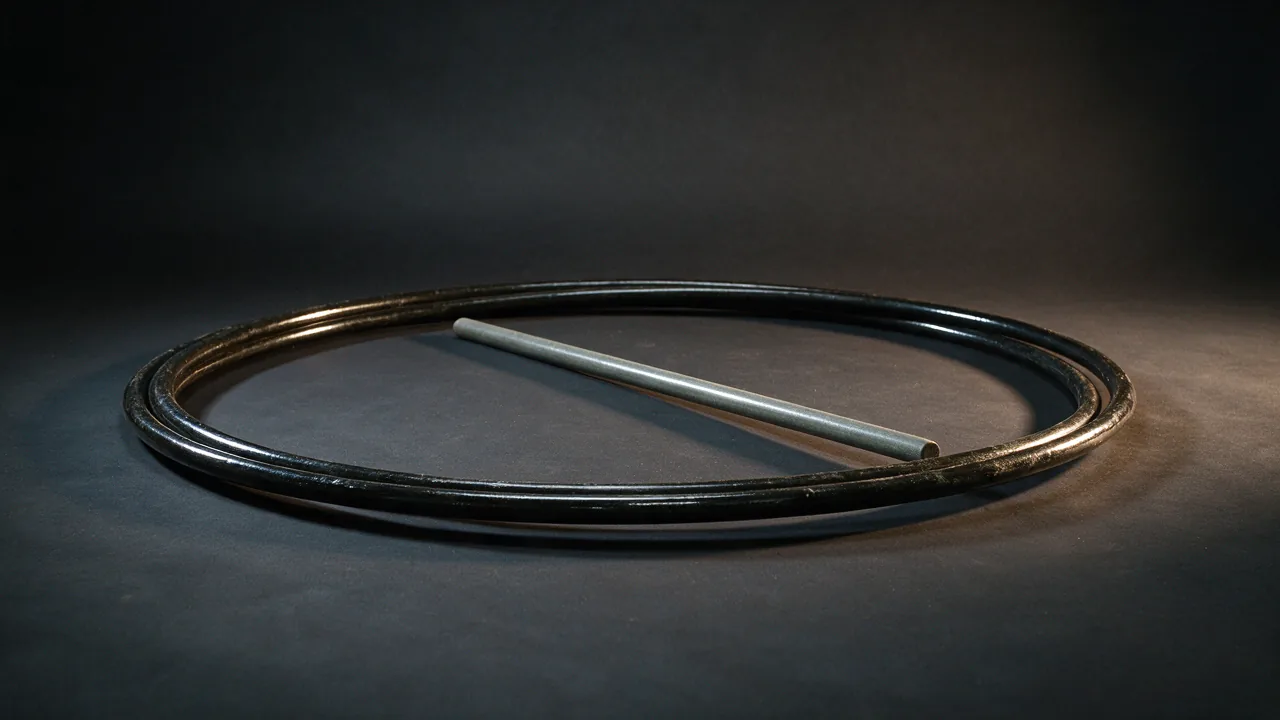
Continuous steel sucker rod and fiberglass reinforced plastic sucker rods for reduced connection failures and reduced rod string weight.
- Standard: API 11B, API 11BR, API 15HR, NACE MR0175
- Grades: D, KD, FRP standard, FRP high load
- Certificate: EN 10204 3.1 with every order, 3.2 on request
Mejor Steel is the export agent for the mills that make your material: one contract, one delivery date, and the mill named on the quotation. How we supply
We reply within one business day, Monday to Friday 09:00-18:00 CST. Or write to info@mejorsteel.com / WhatsApp.
Specifications
| Outer diameter | Continuous rod 3/4" - 1-1/4"; FRP rod 5/8" - 1" |
|---|---|
| Length | Continuous rod up to several thousand metres; FRP rod 30 ft - 37.5 ft |
| Ends | Continuous rod: no couplings; FRP rod: molded or forged steel end fitting |
| Surface treatment | Continuous rod: coated or bare; FRP rod: protective coating |
| Manufacturing process | Continuous: rolled and coiled; FRP: pultruded glass fiber in epoxy |
| Connection type | Continuous rod: welded or joined ends; FRP rod: steel end fitting with sucker rod thread |
Why Continuous Rod
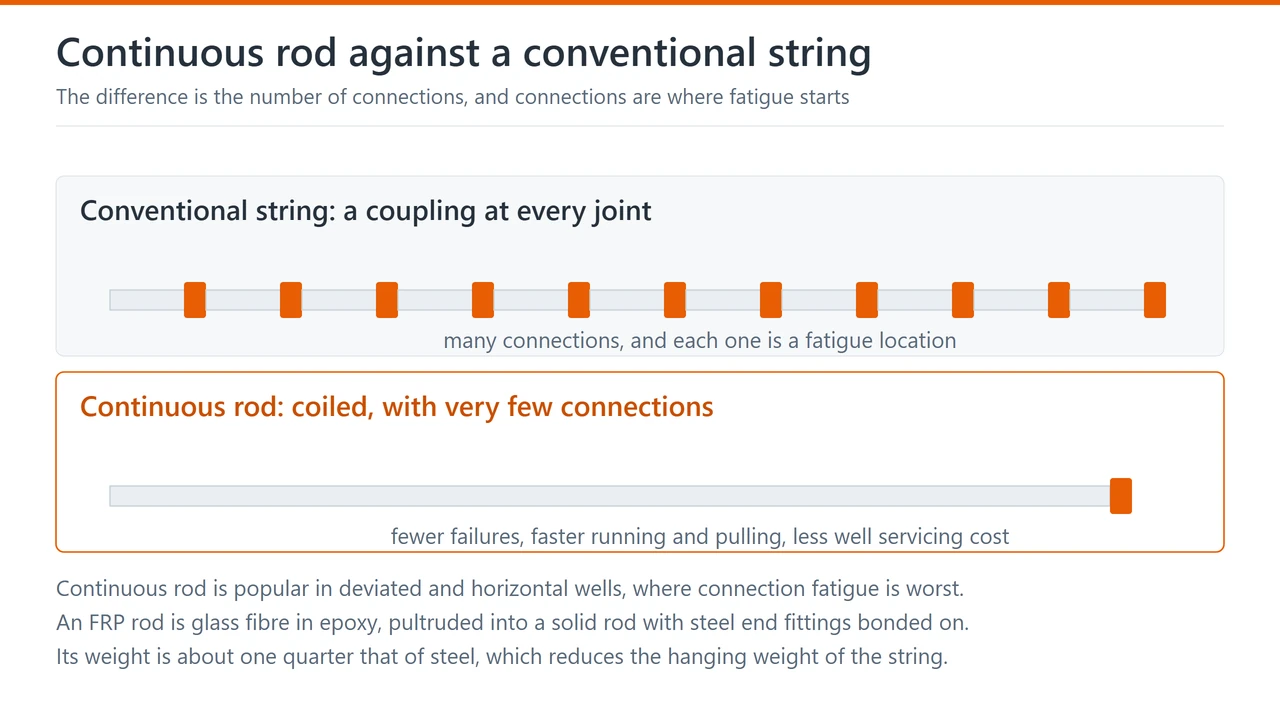
In a conventional sucker rod string, the great majority of failures occur at the couplings, not in the rod body, because the connection is where the stress concentration is highest and where the thread can be damaged during make-up. A continuous sucker rod eliminates most of these connections: the rod is manufactured in a long coil and run into the well with only the two end connections, so a string that would have had several hundred couplings has only a handful. The practical benefits are fewer failures, faster running and pulling, and less well servicing cost, which is why continuous rod is popular in deviated and horizontal wells where connection fatigue is worst. The trade-offs are that continuous rod requires special handling equipment and a service rig that can handle the coil, and that a break requires cutting and rejoining rather than simply replacing a coupling.
FRP Sucker Rods
A fiberglass reinforced plastic sucker rod is made of glass fibers embedded in an epoxy resin, pultruded into a solid rod, with steel end fittings bonded or molded onto each end. Its advantages are a very low density, roughly one quarter that of steel, which significantly reduces the hanging weight of the rod string and therefore the load on the pumping unit and on the upper rods, and complete resistance to corrosion by produced fluids, since the body contains no metal. Its limitations are a much lower modulus of elasticity than steel, so the rod stretches more under load and the effective stroke at the pump is reduced, and a lower temperature limit, typically around 100 to 120 degrees Celsius depending on the resin. FRP rods are used in corrosive wells and in wells where rod weight is a constraint, most often in combination with steel rods in a mixed string, with steel at the top for load and FRP lower down for weight and corrosion resistance.
Continuous and FRP rod: taking the connection out of the string
Continuous rod is supplied in a coil and has no couplings, so the connection failures that dominate rod pumped well downtime are removed altogether. FRP rod answers a different problem: it is much lighter, which reduces the load on the pumping unit, but the end fittings are steel and the load path still has to be checked.
| Well or string condition | What it drives | What to state on the enquiry |
|---|---|---|
| Well with a high connection failure rate | Continuous rod, with no couplings in the string | the rod size, and the load |
| Deviated or horizontal well | Continuous rod tolerates the trajectory considerably better | the well profile |
| Corrosive well | FRP rod, for corrosion resistance | the produced fluid and the temperature |
| Deep well, rod weight critical | FRP rod reduces the load on the pumping unit | the polished rod load and the pump depth |
| Sour service | Grade and material compatibility | the H2S level |
| Retrofit to an existing well | Handling equipment is needed at the wellsite for a coiled rod | whether the wellsite can take a coiled rod |
| End fittings | FRP rod ends are steel and are tested | whether a pull test certificate is required |
| Length and transport | Continuous rod is coiled for transport to site | the wellsite access |
What are the advantages of continuous sucker rod over conventional sucker rod?
The main advantage is the elimination of most connections. In a conventional string most failures occur at the couplings, so replacing several hundred couplings with a handful greatly reduces the failure rate, and it also speeds up running and pulling. Continuous rod is particularly effective in deviated and horizontal wells where connection fatigue is the dominant failure mode. The trade-offs are the need for special handling equipment and a higher cost if a break occurs, since the rod must be cut and rejoined.
Should I use FRP sucker rods in a corrosive well?
FRP rods have the advantage of being immune to corrosion by produced fluids because the body contains no metal, and they are much lighter than steel, which reduces rod string weight. The limitations are lower stiffness, which reduces the effective stroke, and a temperature limit of roughly 100 to 120 degrees Celsius. They are often used in a mixed string, with steel rods at the top to carry the load and FRP rods lower down for weight reduction and corrosion resistance. Note that the steel end fittings still require corrosion protection and grade selection.
Grades supplied
| Grade | Minimum tensile strength | Where it is chosen |
|---|---|---|
| D | 793 MPa (115,000 psi) | High rod loads: deeper wells, larger pumps, heavier or more viscous fluid |
| KD | Sour service grade | Where wet H2S is present and NACE MR0175 applies |
| FRP standard | — | Supplied to order; the requirement is confirmed on the quotation |
| FRP high load | — | Supplied to order; the requirement is confirmed on the quotation |
Standards, inspection and delivery
| Item | Detail |
|---|---|
| Standard | API 11B, API 11BR, API 15HR, NACE MR0175 |
| Inspection | Tensile and fatigue testing; Diameter and ovality inspection; End fitting pull test for FRP rod; Material certification; Ultrasonic or visual inspection of continuous rod; Third-party inspection on request |
| Documents | Mill test certificate to EN 10204 3.1 with the heat number, chemical analysis and mechanical results; EN 10204 3.2 on request. Packing list travels with the shipment. |
| Packing | Continuous rod: coiled on reels; FRP rod: bundled on pallets with end protection |
| MOQ | One reel or agreed quantity |
| Lead time | 30 – 60 days depending on type |
| Supply | Sourced through partner mills; the producing mill is named on the quotation. |
Download Continuous Sucker Rod and FRP Sucker Rod data sheet (PDF) One page: supply range, grades and key sizes, what to state on the enquiry, and the inspection documents that come with the order. The standard is the governing document.
Where to go next
- API 11B sucker rod – the rod grades every accessory below is matched to
- Sucker rod coupling – coupling class, thread and the rod sizes it fits
- Polished rod clamp – how the rod string is carried and how the load is taken
Materials
- Alloy steel
- Fiberglass reinforced plastic
- Epoxy resin with glass fiber
Typical applications
- Deviated and horizontal rod pumping wells
- Wells with high connection failure rate
- Corrosive wells with FRP rod
- Deep wells where rod weight is critical
- Sour service with compatible grade
Inspection & testing
- Tensile and fatigue testing
- Diameter and ovality inspection
- End fitting pull test for FRP rod
- Material certification
- Ultrasonic or visual inspection of continuous rod
- Third-party inspection on request
| Packaging | Sea-worthy export packing: bundled in steel-strapped racks, thread protectors fitted, tagged with size, grade and heat number. |
|---|---|
| MOQ | One bundle (by set); mixed sizes accepted. |
| Lead time | Stock sizes: 7-15 days. Made to order: 4-6 weeks after order confirmation. |
Payment: T/T 30% deposit with the balance before shipment; L/C at sight also accepted. Final terms are confirmed on the quotation.
How we supply: sourced through partner mills; the producing mill is named on the quotation. How we supply sets out who is accountable for the order.
Need this product? Send the size, grade, quantity and destination port and we will reply with availability and pricing.
Request a quotation