API 5CT T95 casing is a quenched and tempered, hardness controlled grade: a yield strength range of 655 to 758 MPa (95,000 to 110,000 psi), a minimum tensile strength of 724 MPa (105,000 psi) and a maximum hardness of 25.4 HRC, the figure that qualifies it for sour service under NACE MR0175 / ISO 15156.
T95 is the hardness controlled casing grade that sits between C90 and C110 in API 5CT: more capacity than L80 or C90 in sour service, without the higher hardness ceiling that C110 brings. This page sets out what the grade is, how it differs from C90, and what has to be on the order.
Mejor Steel is the export agent for the mills that make your material: one contract, one delivery date, and the mill named on the quotation. How we supply
We reply within one business day, Monday to Friday 09:00-18:00 CST. Or write to info@mejorsteel.com / WhatsApp.
API 5CT T95 and C90: mechanical properties and hardness
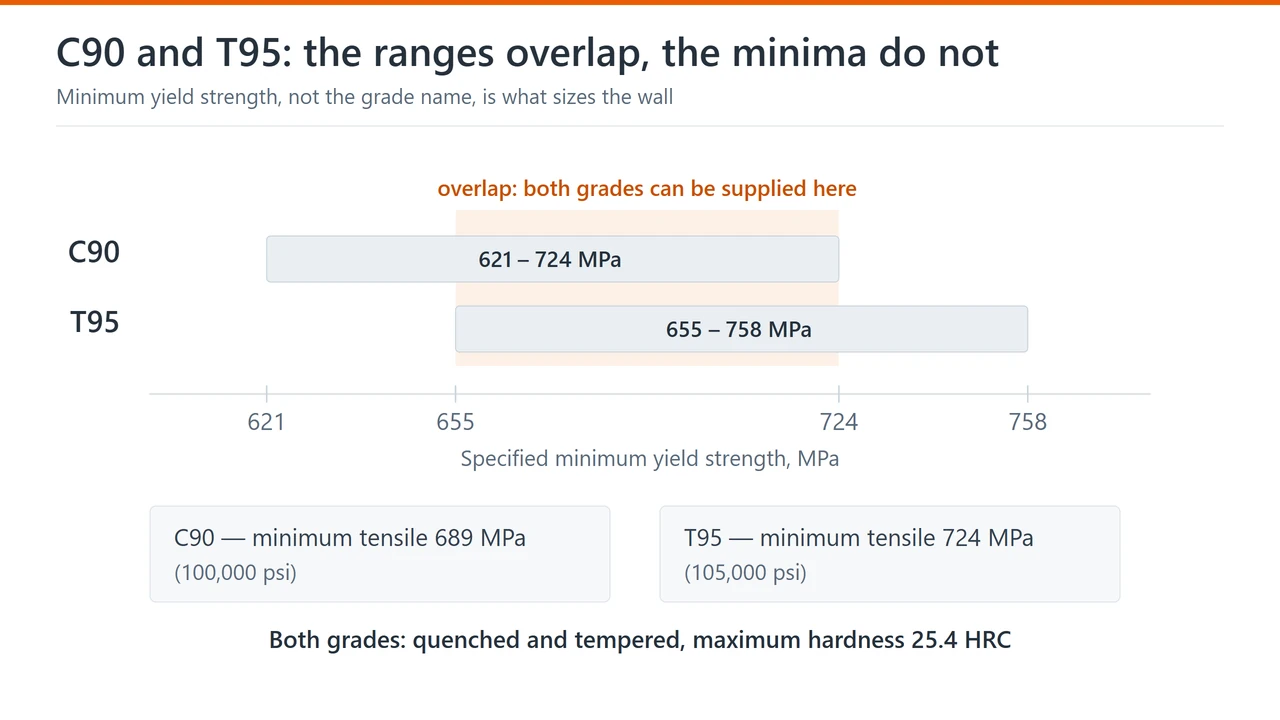
Both grades are supplied in the quenched and tempered condition with a hardness ceiling, which is what qualifies them for sour service under NACE MR0175 / ISO 15156. The figures below are the API 5CT requirements for the grades; the edition named on the order governs.
| Grade | Yield strength | Tensile strength | Maximum hardness | Delivery condition |
|---|---|---|---|---|
| C90 | 621 – 724 MPa (90,000 – 105,000 psi) | 689 MPa min (100,000 psi) | 25.4 HRC | Quenched and tempered |
| T95 | 655 – 758 MPa (95,000 – 110,000 psi) | 724 MPa min (105,000 psi) | 25.4 HRC | Quenched and tempered |
The strength range is the point to notice: T95 starts where C90 ends, so the two are not interchangeable in a design that has been sized against a minimum yield. A string designed on C90 will not automatically be satisfied by C90 again if the load case has been uprated – it is the specified minimum yield, not the grade name, that sizes the wall.
T95, C90 or L80 Type 1: which one to specify
| Service condition | What it rules out | What to specify |
|---|---|---|
| Sweet service, no H2S | Nothing – sour grades are simply more expensive | N80 or P110 to API 5CT, or L80 where a hardness ceiling is imposed by the project |
| Sour service, moderate loads | N80 and P110, neither of which is hardness controlled | L80 Type 1, or C90 where L80 does not carry the load |
| Sour service, loads beyond L80 | N80, P110 and – in the view of most operators – L80 | C90 or T95, chosen on the specified minimum yield the design needs |
| Sour service with high loads | The three grades above | C110 or C125, both with a higher allowed hardness and a correspondingly tighter welding and handling regime |
| H2S present only in traces, CO2 dominant | Carbon steel grades | L80 9Cr or 13Cr, where the controlling mechanism is CO2 corrosion rather than sulphide cracking |
The practical rule is to size the wall from the load case first and then pick the lowest grade that satisfies both the load and the service environment. Choosing a higher grade “for margin” raises hardness and cost and, in sour wells, moves the string closer to the cracking risk rather than further from it.
Heat treatment, hardness and the mill certificate
The heat treatment is what makes the grade, so the certificate is checked against it line by line:
- Quenched and tempered condition, stated on the certificate rather than assumed from the grade name.
- Hardness results for the pipe body, and for the coupling where the coupling is supplied with the string.
- Tensile and yield results, with the specified minimum yield of the grade shown against the test result.
- Chemistry, including the elements the specification restricts for the grade.
- Heat number and heat treatment record, so the result can be traced to the pieces that were shipped.
Where a project adds a requirement that the specification does not impose – a maximum hardness lower than the grade limit, or impact testing at a temperature of the buyer’s choosing – it has to be stated before the heat is rolled. It cannot be added to the certificate afterwards.
Connections, couplings and what to put on the order
- Outside diameter and wall, or the nominal weight and the drift requirement.
- Grade and the API 5CT edition the project works to; state C90 or T95, not “sour service grade”.
- Connection: STC, LTC, BTC or a premium connection, and whether the coupling is supplied with the pipe or ordered separately.
- Length range, and whether the string has to be tallied or matched.
- Heat treatment and hardness verification, and whether a hardness survey is required.
- Certification: mill test certificate, and whether the project asks for EN 10204 3.2 or a third party witness.
- Marking and traceability, including the purchaser’s tag where the pipe goes into a managed inventory.
Download API 5CT T95 and C90 Casing: Sour Service Grades, Heat Treatment and Hardness data sheet (PDF) One-page summary of the supply range, chemistry, mechanical properties and inspection documents on this page. The standard is the governing document.
Inspection and documentation
Each length is hydrostatically tested, and the mechanical tests are taken from the heat. Where the specification or the project calls for it, non destructive inspection is added on the pipe body and on the ends. Third party inspection – SGS, BV or TUV, or an inspector you send yourself – can be arranged at the mill or before shipment; give us the dates and the scope and it is built into the production schedule rather than added at the end.
Typical applications
- Sour service production casing and tubing where L80 does not carry the design load.
- Wells with H2S present in the produced fluid, in the presence of water.
- Gas lift and injection strings in fields where the completion is designed for a sour case from the start.
- Strings where a hardness ceiling is imposed by the project even before the reservoir is proven sour.
Standards covered
- API 5CT / ISO 11960 (casing and tubing, grades and requirements)
- API 5B (threading, gauging and inspection of threads)
- NACE MR0175 / ISO 15156 (materials for use in H2S containing environments)
Frequently asked questions
What is the difference between T95 and C90 casing?
T95 has a higher specified minimum yield – 655 MPa against 621 MPa for C90 – and a correspondingly higher minimum tensile, while both carry the same 25.4 HRC maximum hardness and the same quenched and tempered delivery condition. In practice the choice is made on which minimum yield the design needs: where C90 carries the load, T95 buys nothing; where the load case has moved past C90, T95 is the next qualified step. Both are qualified for sour service under NACE MR0175 / ISO 15156.
Is T95 suitable for sour service?
Yes. T95 is one of the hardness controlled grades of API 5CT, supplied quenched and tempered with a maximum hardness of 25.4 HRC, which is what allows it to be qualified for sour service under NACE MR0175 / ISO 15156. As with every sour application, the qualification is against the actual service conditions – H2S partial pressure, temperature, pH and chloride content – rather than against the grade name alone.
Can T95 replace L80?
Only where the design needs the extra capacity. T95 has a higher minimum yield and a slightly higher hardness ceiling than L80, so moving from L80 to T95 is a decision that has to be made with the corrosion engineer rather than by the buyer alone. Where L80 carries the load, it is the lower risk order of the two.
Where to go next
- OCTG: Casing and Tubing – which string, grade, connection and documents the well needs
- Sour service materials – how the service is defined and which grades are qualified.
- API 5CT L80 tubing – the grade T95 is usually compared against, and the L80 types.
- API 5CT P110 casing – the next step in strength, and why it is not a sour grade.
- API 5CT casing pipe – the casing range these grades are supplied in.
- Get a quote – send the size, weight, grade, connection and quantity.
Ordering sour service casing? Send the outside diameter and wall, the grade (C90, T95 or L80 Type 1), the connection, the quantity and the certificate type the project asks for. We confirm the mill availability, the heat treatment and the documents before the order is released.
Request a quotation