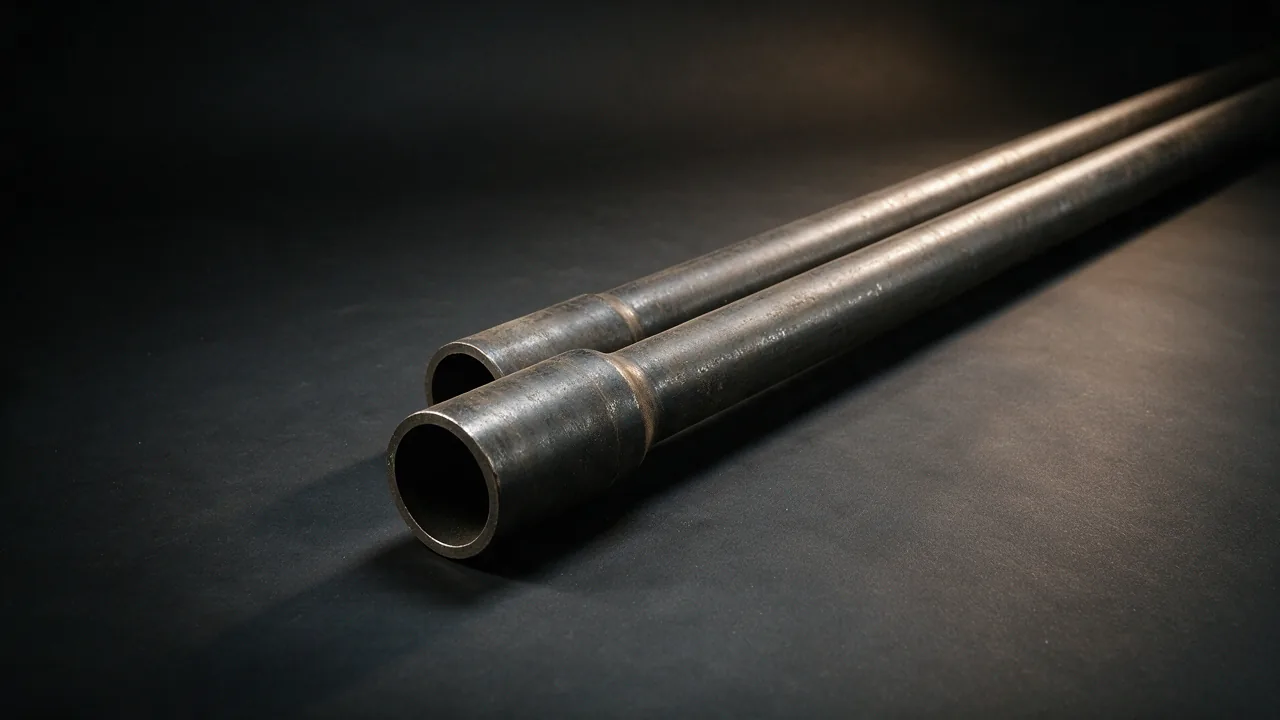
Seamless production tubing to API 5CT in grades J55, K55, N80, L80, C90, T95 and P110, from 1.05 inch to 4-1/2 inch, with NUE, EUE and premium connections.
- Standard: API 5CT, ISO 11960, API 5B
- Grades: J55, K55, N80, L80, C90, T95, P110
- Certificate: EN 10204 3.1 with every order, 3.2 on request
Mejor Steel is the export agent for the mills that make your material: one contract, one delivery date, and the mill named on the quotation. How we supply
We reply within one business day, Monday to Friday 09:00-18:00 CST. Or write to info@mejorsteel.com / WhatsApp.
Specifications
| Outer diameter | 1.05" - 4-1/2" (26.7 - 114.3 mm) |
|---|---|
| Wall thickness | 2.87 - 9.52 mm per API 5CT weight schedule |
| Size range | 1.05" to 4-1/2" outside diameter |
| Length | R1 6.10 - 7.32 m, R2 8.53 - 9.75 m, R3 11.58 - 12.80 m |
| Ends | NUE, EUE, premium connections |
| Surface treatment | Black varnish, phosphating, internal coating |
| Manufacturing process | Seamless |
| Connection type | NUE, EUE, premium gas-tight |
Tubing Versus Casing
Casing is the permanent pipe cemented into the wellbore to maintain the hole and isolate formations; it stays in the well for the life of the field. Tubing is the smaller diameter pipe run inside the casing to conduct produced fluids to surface, and it is designed to be pulled and replaced. Because tubing hangs in tension from the wellhead, often in a long string, joint tensile strength and connection seal integrity under cyclic load dominate the design. Tubing is also exposed to the produced fluid on the inside, so corrosion and erosion resistance matter more than they do for casing, and it often carries the artificial lift equipment. Tubing is normally seamless and is available from about 1.05 inch up to 4-1/2 inch.
NUE, EUE and Premium Connections
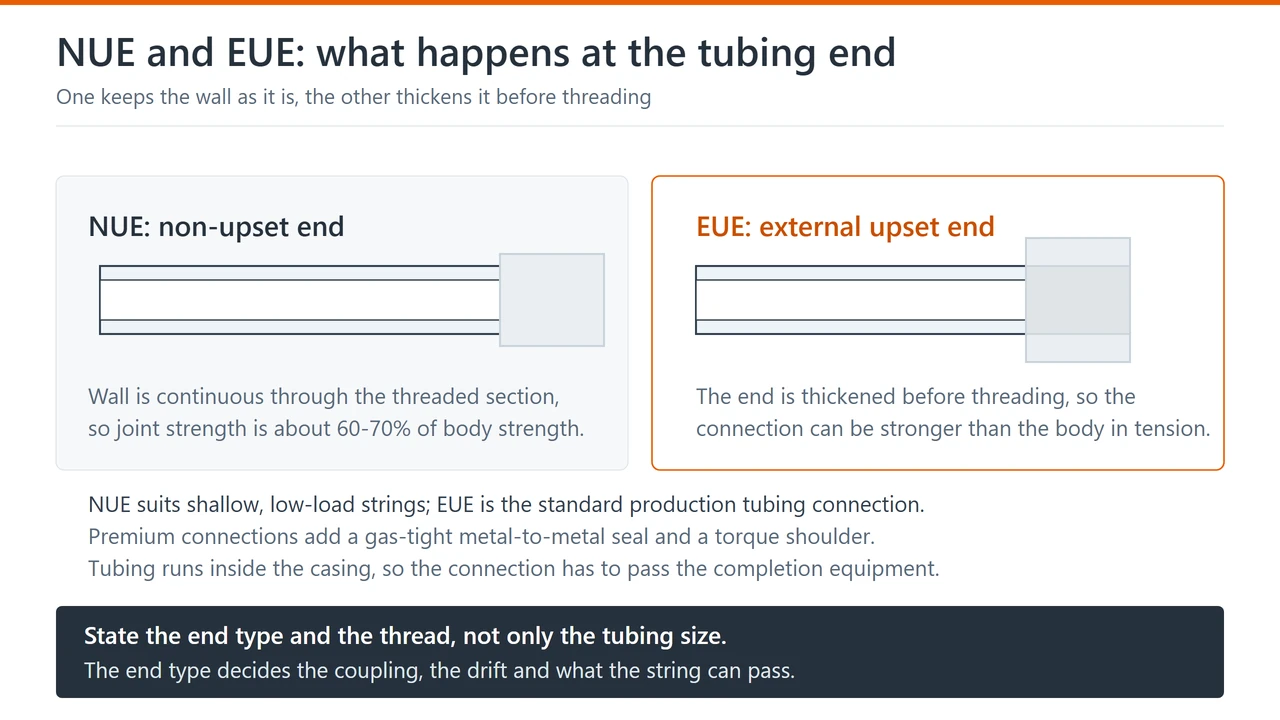
NUE stands for non-upset end. The pipe body wall thickness is continuous through the threaded section, so the connection is weaker than the pipe body and the joint strength is limited to roughly 60 to 70 percent of body strength. It is used for shallow, low load applications. EUE stands for external upset end, where the pipe end is thickened before threading so the connection can be made stronger than the pipe body under tension. EUE is the standard connection for production tubing and is what most artificial lift equipment is designed to mate with. Premium connections provide a gas-tight metal-to-metal seal and a torque shoulder, giving reliable sealing under combined tension, pressure and bending, and are specified for gas wells, HPHT wells, deviated wells and any application where leak integrity is critical.
Tubing Sizes Most Often Quoted
Tubing is ordered the same way casing is – by outside diameter plus a weight designation – but the sizes are smaller, because tubing runs inside the casing. The sizes quoted most often are:
- 2-3/8 in tubing (60.3 mm outside diameter)
- 2-7/8 in tubing (73.0 mm)
- 3-1/2 in tubing (88.9 mm)
- 4 in tubing (101.6 mm)
2-3/8 in tubing and 2-7/8 in tubing cover the great majority of completions. Where the tubing is run inside 4-1/2 in or 5-1/2 in casing, 2-3/8 in is the usual size; 2-7/8 in is chosen where the larger flow area is worth the reduced clearance. Both are normally supplied with external upset ends, because the upset carries the joint tension. As with casing, give the outside diameter and the weight designation together, not just the diameter.
Tubing: the completion decides the string, not the depth
Tubing hangs inside the casing and is designed against internal pressure, tension and the size of the tools that have to pass through it, so the drift diameter and the connection often decide the enquiry before the grade does. It is supplied in NUE, EUE and premium connections, and the connection changes the outside diameter of the joint.
| Well condition | What it drives in the string | What to state on the enquiry |
|---|---|---|
| Conventional rod pumped producer | J55 or N80 with EUE connections | the tubing size, the drift, and the connection |
| Deep or high pressure producer | L80, C90, T95 or P110 | the design pressure and the flowing temperature |
| Gas lift or artificial lift well | Internal pressure and the injection point set the wall | the injection depth and pressure |
| CO2 or H2S present | A restricted hardness grade with a gas tight connection | the partial pressures, and the NACE requirement |
| Deviated or horizontal completion | The connection has to resist bending and fatigue cycling | the dogleg severity along the planned trajectory |
| Geothermal producer | Grade selected for the temperature and the fluid | the maximum temperature |
| NUE against EUE | EUE has a larger outside diameter at the joint | the clearance in the casing, so the coupling size can be checked |
What is the difference between EUE and NUE tubing?
EUE has an externally upset (thickened) pipe end, which allows the connection to be stronger than the pipe body under tension, giving roughly 100 percent joint efficiency. NUE has no upset, so the connection is the weak point at roughly 60 to 70 percent of body strength. EUE is the standard for production tubing and for wells with artificial lift, and it is dimensionally larger at the upset, which must be accounted for when selecting packers and wellhead equipment. NUE is used only in shallow, low load service.
Can you supply tubing with internal coating for corrosion control?
Yes. Internal plastic coating or an FRP liner can be applied to the inside of tubing to protect against CO2 and H2S corrosion. A properly applied internal coating does not significantly affect the drift diameter, so standard wireline and lift tools still pass. Internal coating is commonly specified for gas lift wells and for CO2 floods. Where internal coating is used, the connection area must be coated after make-up on site, or a coating-compatible thread compound used, so the corrosion barrier is continuous. Note that coating is not a substitute for correct grade selection in severe sour service.
Grades supplied and minimum properties
The grade fixes the minimum strength and the chemistry. The table below gives the requirements that separate the API 5CT tubing grades ordered most often; the full composition and mechanical table for each grade is on its own page.
| Grade | Yield strength | Tensile strength |
|---|---|---|
| L80 Type 1 | 552 – 655 MPa (80,000 – 95,000 psi) | 655 MPa (95,000 psi) |
| N80Q (for comparison) | 552 – 758 MPa (80,000 – 110,000 psi) | 689 MPa (100,000 psi) |
| 13Cr-80 | 552 – 655 MPa (80,000 – 95,000 psi) | 655 MPa min (95,000 psi) |
The complete chemistry and mechanical table for each grade, with the notes that qualify it, is on the individual grade page – for example API 5CT L80 tubing. L80 and 13Cr-80 share the same yield range but not the same chemistry: 13Cr is the grade for CO2-bearing service where carbon steel is not adequate.
Source: specified minimum yield and tensile strength for each grade, per API 5CT / ISO 11960. The standard is the governing document.
Download API 5CT Tubing Pipe data sheet (PDF) One page: supply range, grades and key sizes, what to state on the enquiry, and the inspection documents that come with the order. The standard is the governing document.
Materials
- Carbon steel
- Alloy steel
- 13Cr stainless on request
Typical applications
- Oil and gas production wells
- Water injection wells
- Gas lift and artificial lift wells
- CO2 and H2S containing wells
- Geothermal production wells
Inspection & testing
- Full length ultrasonic or electromagnetic inspection
- Hydrostatic pressure test
- Thread gauging to API 5B
- Drift test with mandrel
- Tensile and hardness testing
- Third-party inspection (SGS, BV, TUV)
| Packaging | Sea-worthy export packing: bundled by size, plastic caps on both ends, corrosion protection on request, stencilled with size, grade and heat number. |
|---|---|
| MOQ | One bundle or one truckload; mixed sizes within a bundle accepted. |
| Lead time | Stock sizes: 7-15 days. Mill run / non-stock: 4-6 weeks after order confirmation. |
Payment: T/T 30% deposit with the balance before shipment; L/C at sight also accepted. Final terms are confirmed on the quotation.
How we supply: sourced through partner mills; the producing mill is named on the quotation. How we supply sets out who is accountable for the order.
Need this product? Send the size, grade, quantity and destination port and we will reply with availability and pricing.
Request a quotation