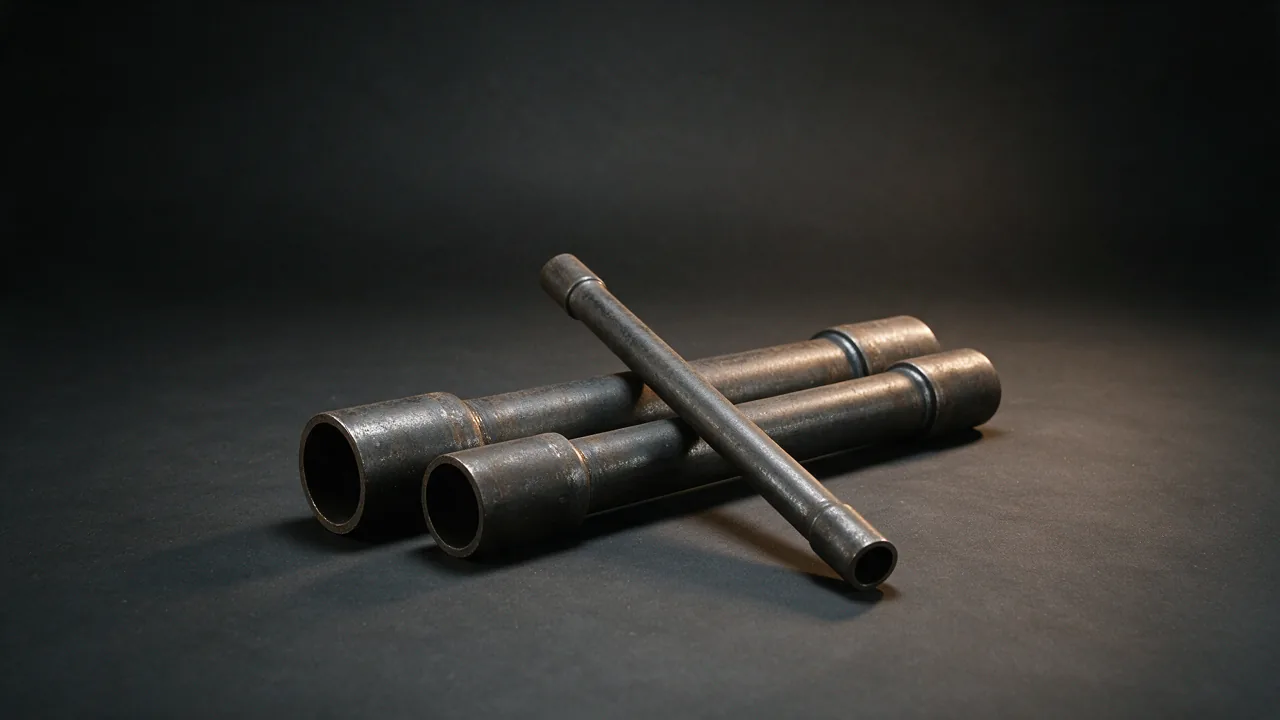
Pup joints to API 5CT in lengths from 2 to 12 feet for adjusting casing and tubing string length, in all standard grades and connections.
- Standard: API 5CT, API 5B, ISO 11960
- Grades: J55, K55, N80, L80, C90, T95, P110, Q125
- Certificate: EN 10204 3.1 with every order, 3.2 on request
Mejor Steel is the export agent for the mills that make your material: one contract, one delivery date, and the mill named on the quotation. How we supply
We reply within one business day, Monday to Friday 09:00-18:00 CST. Or write to info@mejorsteel.com / WhatsApp.
Specifications
| Outer diameter | Casing 4-1/2" - 20", Tubing 1.05" - 4-1/2" |
|---|---|
| Wall thickness | Per API 5CT weight schedule |
| Length | 2 ft, 3 ft, 4 ft, 6 ft, 8 ft, 10 ft, 12 ft, or custom |
| Ends | Pin and box, or pin and pin, in STC, LTC, BTC, EUE, NUE, premium |
| Surface treatment | Same as parent pipe, phosphate coated threads |
| Manufacturing process | Machined from seamless pipe |
| Connection type | STC, LTC, BTC, EUE, NUE, premium |
Why Pup Joints Are Needed
Casing and tubing are supplied in standard length ranges R1, R2 and R3, which means the actual string length can rarely be made to match the planned setting depth exactly. A pup joint is a short length of pipe, typically 2 to 12 feet, threaded at both ends so it can be inserted into the string to adjust the total length precisely. In tubing strings a pup joint is also used to position a packer, landing nipple or gas lift mandrel at the correct depth. Because pup joints are made from the same pipe as the string, they carry the same grade, wall thickness and connection, and must be supplied with matching heat traceability so the string tally remains complete. Ordering several lengths in advance avoids rig downtime, since a pup joint that has to be sourced after the string is already running is an expensive delay.
Pin-Box versus Pin-Pin Configurations
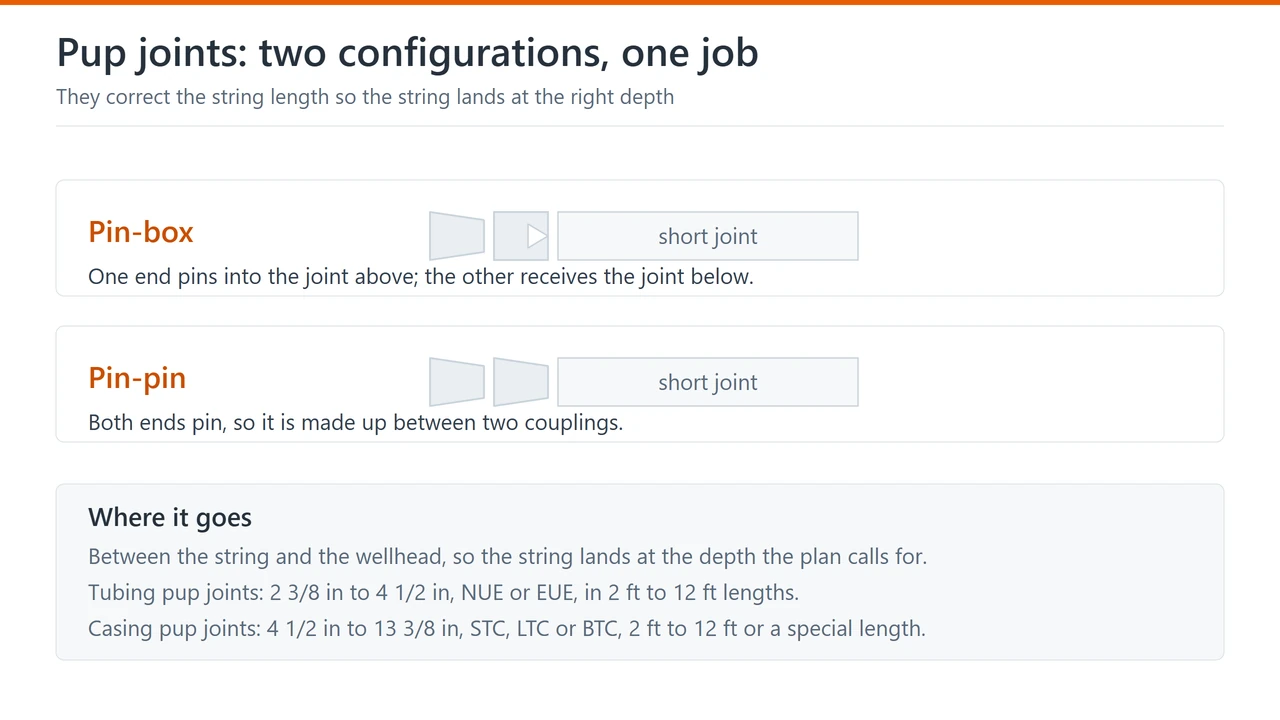
Pup joints are supplied in two configurations. Pin and box, the more common, has one external thread and one internal thread, exactly like a standard casing or tubing joint, so it can be made up directly into the string without any additional coupling. Pin and pin has external threads at both ends and requires a separate coupling, or is used where the pup joint must mate with two internals. Pin-pin configuration is common for pup joints used with couplings and for special downhole tools. When ordering, state the configuration, the length measured from shoulder to shoulder, the connection type, grade, outside diameter and weight per foot.
Pup joints: getting the string to land at the right depth
A pup joint is a short length of the same pipe used to make up the difference between the string length and the depth it actually has to land at. Length and connection are the specification; the grade follows the parent string. They are usually wanted on site quickly, so length availability matters as much as the price.
| Well condition | What it drives in the string | What to state on the enquiry |
|---|---|---|
| Casing string length correction | Short lengths of the same casing with the same connection | the OD, weight, grade, thread form, and the length needed |
| Tubing string length correction | Tubing pup joints, usually with EUE or premium threads | the length needed and the packer setting depth |
| Completion accessories | Length and thread form have to match the accessory | the accessory, and the connection it carries |
| Emergency correction on site | Available lengths decide the answer, not the ideal length | how soon the joint is needed on location |
| Sour service string | The same restricted hardness grade as the rest of the string | the NACE requirement |
| Pin and box against pin and pin | The end configuration changes how the joint is made up | the end configuration required |
| Length tolerance | Short joints are cut from the same pipe, so the tolerance still applies | whether a specific length or a maximum length is required |
What lengths of pup joint should I order?
The practical answer is a set. Most operators order a range covering 2, 4, 6, 8 and 10 feet, which allows any string length to be made up to the nearest one or two feet by combining them. If the setting depth must be matched closely for a packer or landing nipple, add a 1 foot and a 3 foot pup joint. Order the pup joints at the same time as the main string so that the same heat numbers and certification are available, and so the tally is straightforward on the rig floor.
Are pup joints as strong as standard joints?
Yes, provided they are machined from pipe of the same grade and wall thickness and use the same connection. Because a pup joint is short, it is stiffer than a standard joint but its tensile capacity is the same, being governed by the connection and the pipe body cross-section. The main practical caution is handling: short joints are easy to cross-thread and are more prone to being damaged by tongs because there is less length to grip, so make-up should follow the same torque specification as the main string.
Sizes, ends and what to state on the enquiry
| Pup joint type | Typical size range | Common connections | Length to state | Weight basis |
|---|---|---|---|---|
| Tubing pup joint | 2 3/8 in to 4 1/2 in | NUE or EUE | 2 ft, 3 ft, 4 ft, 6 ft, 8 ft, 10 ft or 12 ft | Nominal weight of the matching tubing |
| Casing pup joint | 4 1/2 in to 13 3/8 in | STC, LTC or BTC | 2 ft to 12 ft, or a specified special length | Nominal weight of the matching casing |
These are the common supply ranges, not a promise that every size, weight and thread is available at the same time. State the exact combination and we confirm against the current mill programme.
Source: the size and connection ranges follow normal API 5CT and API 5B practice. Exact availability is confirmed against the current mill programme for the ordered size, nominal weight, grade and thread.
The enquiry fields that prevent a wrong sub
- Outside diameter and nominal weight of the tubing or casing.
- Grade: J55, K55, N80, L80, P110, or another grade in the enquiry.
- Connection at each end, including NUE/EUE or STC/LTC/BTC and the pin-pin or pin-box configuration.
- Length of the pup joint.
- Quantity and any required third-party inspection or EN 10204 3.2 certificate.
Inspection and packing to ask about
- Full-body drift and straightness check.
- Hydrostatic test, or the alternative test method accepted by the order.
- Non-destructive examination: electromagnetic inspection or ultrasonic testing.
- Thread inspection with the applicable API gauge.
- Surface treatment and thread protectors, with sea-worthy bundling for export.
The mill test certificate is normally EN 10204 3.1; state EN 10204 3.2 at the enquiry stage if the third party must witness the testing.
How these products are supplied
Inspection is carried out by the producing mill’s own inspection department, which is independent of production. Third-party inspection by SGS, BV or TUV, or by an inspector you nominate, can be arranged at the mill or before shipment; the dates and scope are fixed at the order stage.
A mill test certificate to EN 10204 3.1 showing the heat number, chemical composition and mechanical results is standard on every order. EN 10204 3.2, countersigned by the inspector you nominate, is available on request.
Sea-worthy export packing is used, with thread protection on threaded products, bundles marked with size, grade and heat number, and end protection for transport.
For the standard pipe range, the confirmed company terms are one bundle or one truckload MOQ, 5–10 days for stock sizes and 3–5 weeks for mill-run or non-stock sizes. The delivery window is counted from order confirmation and fixed on the quotation.
A machined pup joint follows the same document and inspection rules, but its MOQ and lead time depend on the ordered size, grade, thread and current machining programme. The quotation states the specific MOQ and delivery window for the pup joint; do not assume the standard pipe-stock window applies to a non-standard short length.
What goes wrong when the order is incomplete
- Wrong length: the string does not land at the planned depth and an extra joint or a re-run may be needed.
- Pin/box mismatch: the joint cannot be made up on the rig floor, which can require last-minute machining or a replacement.
- Grade or heat mismatch: the pup joint no longer matches the load and traceability record of the string.
- Thread or drift mismatch: the joint fails acceptance and can delay running the string.
- Missing certificate requirement: EN 10204 3.1 or 3.2 and third-party inspection cannot be added retrospectively in every case.
Grades supplied and minimum properties
The grade fixes the minimum strength and the chemistry. The table below gives the requirements that separate the API 5CT grades ordered most often; the full composition and mechanical table for each grade is on its own page.
| Grade | Yield strength | Tensile strength |
|---|---|---|
| J55 | 379 – 552 MPa (55,000 – 80,000 psi) | 517 MPa min (75,000 psi) |
| K55 | 379 – 552 MPa (55,000 – 80,000 psi) | 655 MPa min (95,000 psi) |
| N80-1 | 552 – 758 MPa (80,000 – 110,000 psi) | 689 MPa min (100,000 psi) |
| N80Q | 552 – 758 MPa (80,000 – 110,000 psi) | 689 MPa min (100,000 psi) |
| L80 Type 1 | 552 – 655 MPa (80,000 – 95,000 psi) | 655 MPa (95,000 psi) |
| P110 | 758 – 965 MPa (110,000 – 140,000 psi) | 862 MPa (125,000 psi) |
| Q125 | 862 – 1,034 MPa (125,000 – 150,000 psi) | 931 MPa min (135,000 psi) |
The complete chemistry and mechanical table for each grade, with the notes that qualify it, is on the individual grade page – for example API 5CT P110 casing. L80, C90, T95 and C110 also sit in this ladder; they are the grades with a hardness limit for sour service rather than the next step up in strength. R95 is the 95 ksi strength grade, and API 5CT sets no hardness limit for it. A pup joint is a short length of the same casing or tubing, and it carries the grade and the connection of the string it is made up into.
Source: specified minimum yield and tensile strength for each grade, per API 5CT / ISO 11960. The standard is the governing document.
Download Casing and Tubing Pup Joint data sheet (PDF) One page: supply range, grades and key sizes, what to state on the enquiry, and the inspection documents that come with the order. The standard is the governing document.
Where to go next
To quote a pup joint, send the outside diameter, nominal weight, grade, connection at each end, pin/box configuration, length, quantity and certificate requirement. Include the destination port and required delivery date if the joint is for a live string. Request a quotation with those fields and we confirm availability against the current programme.
Related pages: casing crossover, API 5CT P110 casing and quality control.
Materials
- Seamless carbon steel
- Alloy steel
- 13Cr on request
Typical applications
- Adjusting casing string length to land at correct depth
- Adjusting tubing string length for packer setting
- Well completion and workover
- Landing nipples and completion accessories
- Emergency length correction on site
Inspection & testing
- Thread gauging to API 5B
- Dimensional and drift inspection
- Hydrostatic pressure test
- Hardness testing
- Material certification with heat traceability
- Third-party inspection (SGS, BV, TUV)
| Packaging | Sea-worthy export packing: bundled by size, plastic caps on both ends, corrosion protection on request, stencilled with size, grade and heat number. |
|---|---|
| MOQ | One bundle or one truckload; mixed sizes within a bundle accepted. |
| Lead time | Stock sizes: 7-15 days. Mill run / non-stock: 4-6 weeks after order confirmation. |
Payment: T/T 30% deposit with the balance before shipment; L/C at sight also accepted. Final terms are confirmed on the quotation.
How we supply: sourced through partner mills; the producing mill is named on the quotation. How we supply sets out who is accountable for the order.
Need this product? Send the size, grade, quantity and destination port and we will reply with availability and pricing.
Request a quotation