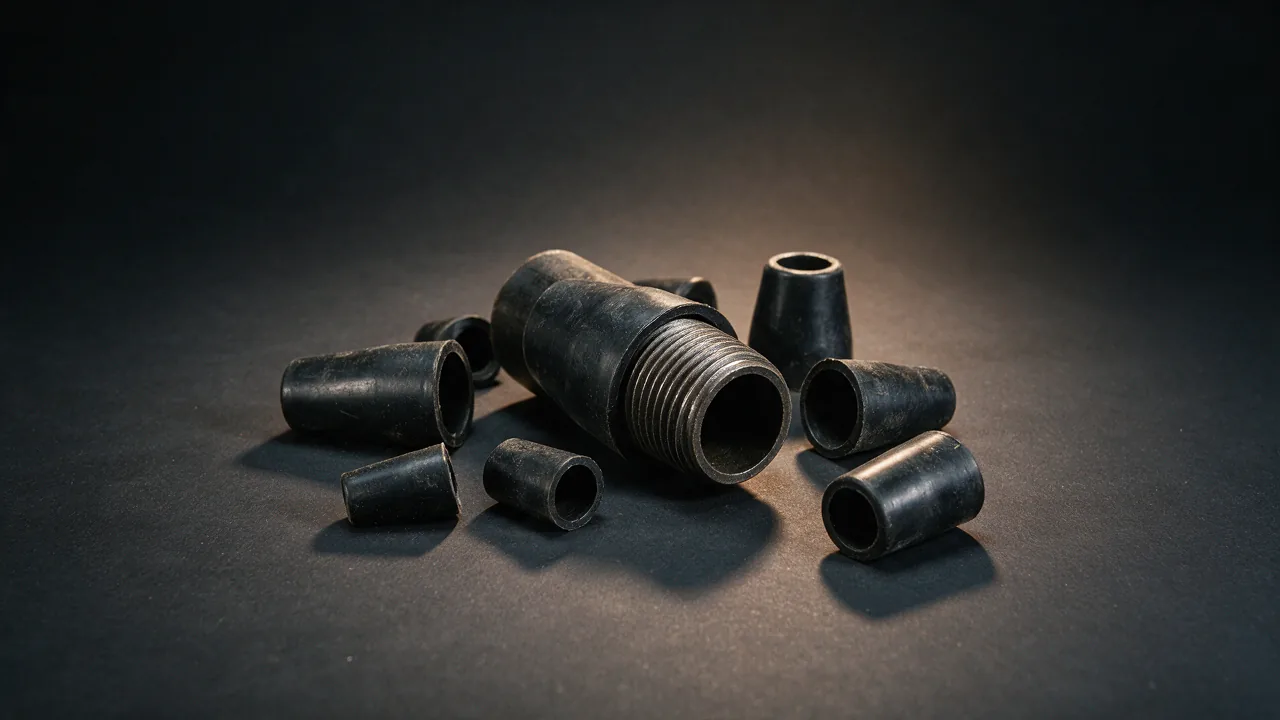
Plastic and steel thread protectors for casing, tubing, line pipe and drill pipe, protecting threads and sealing surfaces during transport and storage.
- Standard: API 5CT, API 5B, API RP 5A5
- Grades: N/A - accessory item
- Certificate: EN 10204 3.1 with every order, 3.2 on request
Mejor Steel is the export agent for the mills that make your material: one contract, one delivery date, and the mill named on the quotation. How we supply
We reply within one business day, Monday to Friday 09:00-18:00 CST. Or write to info@mejorsteel.com / WhatsApp.
Specifications
| Outer diameter | For 1.05" - 20" pipe |
|---|---|
| Wall thickness | 2 - 6 mm depending on material |
| Length | 80 - 300 mm depending on pipe size |
| Ends | Pin protector (for box end), box protector (for pin end) |
| Surface treatment | Natural, colored, or UV stabilized |
| Manufacturing process | Injection molded, or steel fabricated |
| Connection type | Threaded, snap-on, or push-fit |
Why Thread Protection Is Not Optional
A single damaged thread can prevent a connection from making up to the required torque, and on a premium connection a nick in the metal-to-metal seal can cause a leak that is not detectable until the well is on production. Most thread damage happens not in the well but in transit: during crane handling, in the pipe rack, on a flatbed truck, or during ocean shipment in a container. Thread protectors are therefore a functional requirement, not packaging. API RP 5A5 gives guidance on protection, and API 5CT requires protectors to be fitted to both ends for shipment. For premium connections, the protector is designed to protect the sealing surface specifically and must be the type approved for that connection.
Plastic versus Steel Protectors
Plastic protectors, usually polyethylene or polypropylene, are the standard for API round and buttress threaded casing, tubing and line pipe. They are lightweight, inexpensive, will not rust, and absorb impact without transferring it to the thread. Steel protectors are used where greater mechanical protection is needed, for example on drill pipe, on large diameter casing, or on premium connections with a delicate sealing surface. A steel protector must be inspected before fitment to ensure there are no burrs or debris inside that could damage the thread it is meant to protect. Some premium connection protectors combine a steel outer shell with a plastic or elastomer inner liner to give both mechanical strength and a soft contact surface.
Thread protectors: what has to survive the voyage
A protector has one job: keep the thread, and on a premium connection the sealing surface, undamaged from the mill to the rig floor. Material and fit follow the connection. A standard API thread takes a plastic protector, a premium connection normally takes a steel one, and the pin end and the box end take different types.
| Well condition | What it drives in the string | What to state on the enquiry |
|---|---|---|
| Standard API thread, ocean freight | Plastic protector, with distinct pin and box types | the pipe size, the thread form, and the quantity |
| Premium connection sealing surface | Steel protector, often with a seal and a desiccant | the connection type, so the correct protector is matched |
| Storage of more than a few months | Protection against internal corrosion as well as impact | the storage duration, and whether desiccant is required |
| UV exposure or hot climate | UV stabilised material | the destination climate |
| Repeated lifting and handling | Impact resistance rather than fit alone | the handling method on site |
| Returnable protectors | Protectors are often returned with the pipe | whether return of the protectors is expected |
| Line pipe and drill pipe | Different thread forms again from casing and tubing | the pipe type, not just the size |
Why do premium connections need special thread protectors?
Because a premium connection seals by direct metal-to-metal contact, its conical or spherical sealing surface must remain free of any nick, burr, corrosion or contamination. A standard plastic protector designed for an API round thread does not have the correct internal geometry for a premium seal and may allow the sealing surface to contact the protector body. The correct protector is one approved by the connection manufacturer, which usually has a specific internal profile and a soft liner. Using the wrong protector on a premium connection can void the connection warranty.
Should thread protectors be removed for inspection on arrival?
Yes. Thread protectors should be removed and the threads inspected as soon as the shipment is received, before the pipe is stacked for storage. Inspect for rust, mechanical damage, debris and, on premium connections, any mark on the sealing surface. Threads should be re-coated with the correct thread compound and the protectors refitted immediately after inspection. Leaving protectors in place unopened means any transit damage will not be discovered until the string is being run, when it is far more costly to resolve.
Protector duty classes and how the item is matched
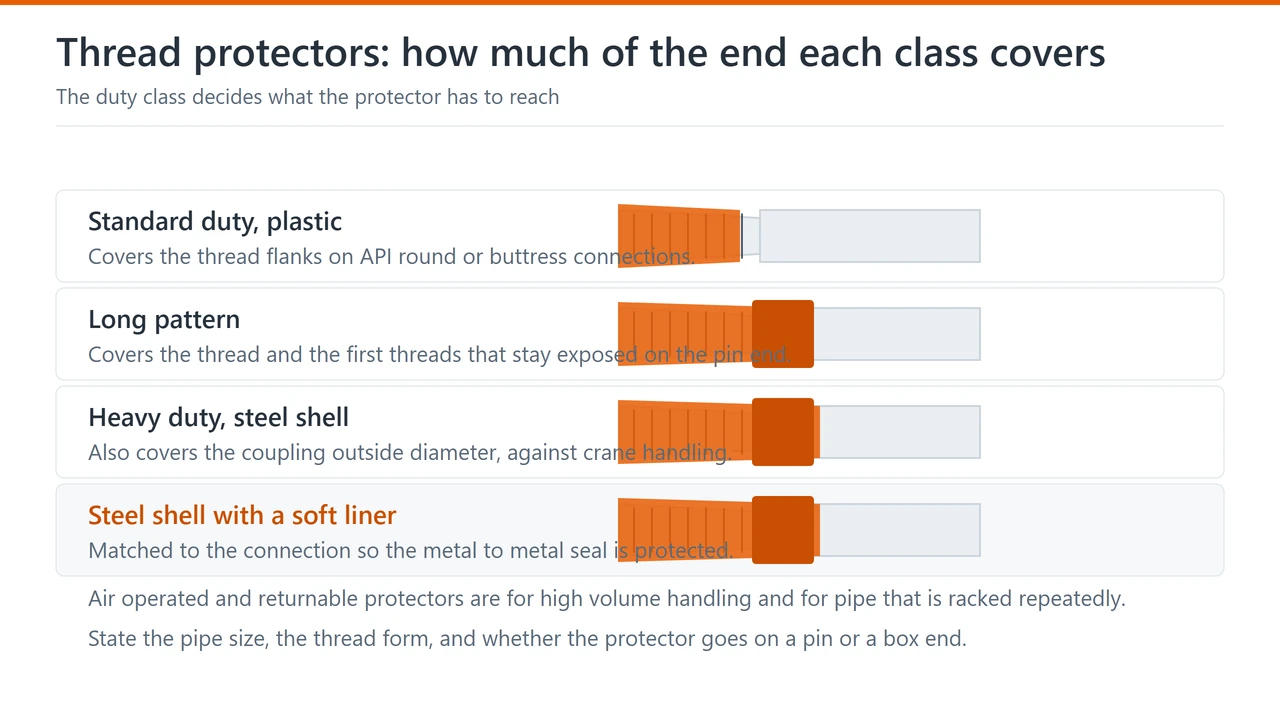
A protector is not ordered by pipe size. Two things fix the item: the connection it goes on, and the duty the pipe sees between the mill and the rig floor. The classes below describe what each duty is protecting against; the internal profile is set by the connection itself.
| Duty class | What it protects | Where it is used | What to state |
|---|---|---|---|
| Standard duty, plastic | Thread flanks on API round or buttress connections | Casing, tubing and line pipe on normal sea freight | pipe size, thread form, pin or box, quantity |
| Long pattern | The thread plus the first threads that stay exposed on the pin end | Pipe that is handled repeatedly on site or stored for longer | pipe size, thread form, pin end |
| Heavy duty, thicker wall or steel shell | Impact from crane handling and stacking; the coupling outside diameter as well as the thread | Large diameter casing, pipe rack handling, repeated lifts | pipe OD and coupling OD, and the handling method |
| Steel shell with a soft liner | The metal to metal seal on a premium connection | Premium casing and tubing | the connection type, so the internal profile is matched to it |
| Air operated or automatic | Manual fitting is replaced where the volume is high | High volume pipe handling at the mill or the yard | the pipe size and the handling line the protector is used on |
| Returnable protector | Protection of the same thread across several trips | Pipe that is racked and run repeatedly | whether the protectors are expected back with the pipe |
Source: protector duty classes as published by thread protector manufacturers (CLT and NMD ranges at caplugs.com, ProTech at ConTech, Mega and Magnum at NOV) and the protection requirement for shipment in API 5CT / API RP 5A5.
What to state on the enquiry
- The connection: casing, tubing, line pipe or drill pipe, and the thread form, whether STC, LTC, BTC or a named premium connection.
- The end it goes on. Pin and box take different protectors, and the pair is normally quoted together.
- The pipe size, and on larger sizes the coupling outside diameter as well, because the protector is matched to the coupling as much as to the thread.
- The conditions between the mill and the well: months in storage, coastal humidity, direct UV, and whether the pipe is stacked or racked.
- How the pipe is handled on site, since repeated lifting changes the duty class rather than the fit.
- Marking and packing. Export shipments often require the size, connection and heat number to be marked on the protector or the bag, and the packing list has to match the string list.
Are thread protectors supplied with couplings and pup joints?
Yes, when the order is placed as a package. If a casing or tubing order includes couplings, pup joints or crossovers, each of those items needs a protector in the pattern that matches its own connection, and we confirm the pattern against the connection list before the order is released. If the couplings come from another source, tell us, because a protector matched to our coupling may not fit a different one.
Can protectors be reused?
Plastic protectors are usually one trip items, and whether they come back depends on the programme. Steel and composite protectors are often returnable, but they have to be inspected and cleaned before they are refitted: grit or swarf left inside a steel protector will damage the thread it exists to protect. Reused protectors should be checked against the same points as new ones, including the soft liner inside a premium protector.
Standards, inspection and delivery
| Item | Detail |
|---|---|
| Standard | API 5CT, API 5B, API RP 5A5 |
| Inspection | Dimensional and fit inspection; Material certification; Impact resistance test; Visual inspection |
| Documents | Mill test certificate to EN 10204 3.1 with the heat number, chemical analysis and mechanical results; EN 10204 3.2 on request. Packing list travels with the shipment. |
| Packing | Cartons or sacks on pallets |
| MOQ | 500 pieces depending on size |
| Lead time | 15 – 25 days |
| Supply | Sourced through partner mills; the producing mill is named on the quotation. |
Download Casing, Tubing & Drill Pipe Thread Protectors data sheet (PDF) One page: supply range, grades and key sizes, what to state on the enquiry, and the inspection documents that come with the order. The standard is the governing document.
Where to go next
- Casing centralizer – how standoff is set in the hole
- Casing coupling – how couplings are specified and made up
- API 5CT casing pipe – the pipe the accessories run on
Materials
- Polyethylene
- Polypropylene
- Steel
- Composite
Typical applications
- Protecting threads during ocean transport
- Protecting premium connection sealing surfaces
- Protecting pipe threads during storage
- Preventing internal corrosion during shipment
- Rig floor handling protection
Inspection & testing
- Dimensional and fit inspection
- Material certification
- Impact resistance test
- Visual inspection
| Packaging | Sea-worthy export packing: bundled by size, plastic caps on both ends, corrosion protection on request, stencilled with size, grade and heat number. |
|---|---|
| MOQ | One bundle or one truckload; mixed sizes within a bundle accepted. |
| Lead time | Stock sizes: 7-15 days. Mill run / non-stock: 4-6 weeks after order confirmation. |
Payment: T/T 30% deposit with the balance before shipment; L/C at sight also accepted. Final terms are confirmed on the quotation.
How we supply: sourced through partner mills; the producing mill is named on the quotation. How we supply sets out who is accountable for the order.
Need this product? Send the size, grade, quantity and destination port and we will reply with availability and pricing.
Request a quotation