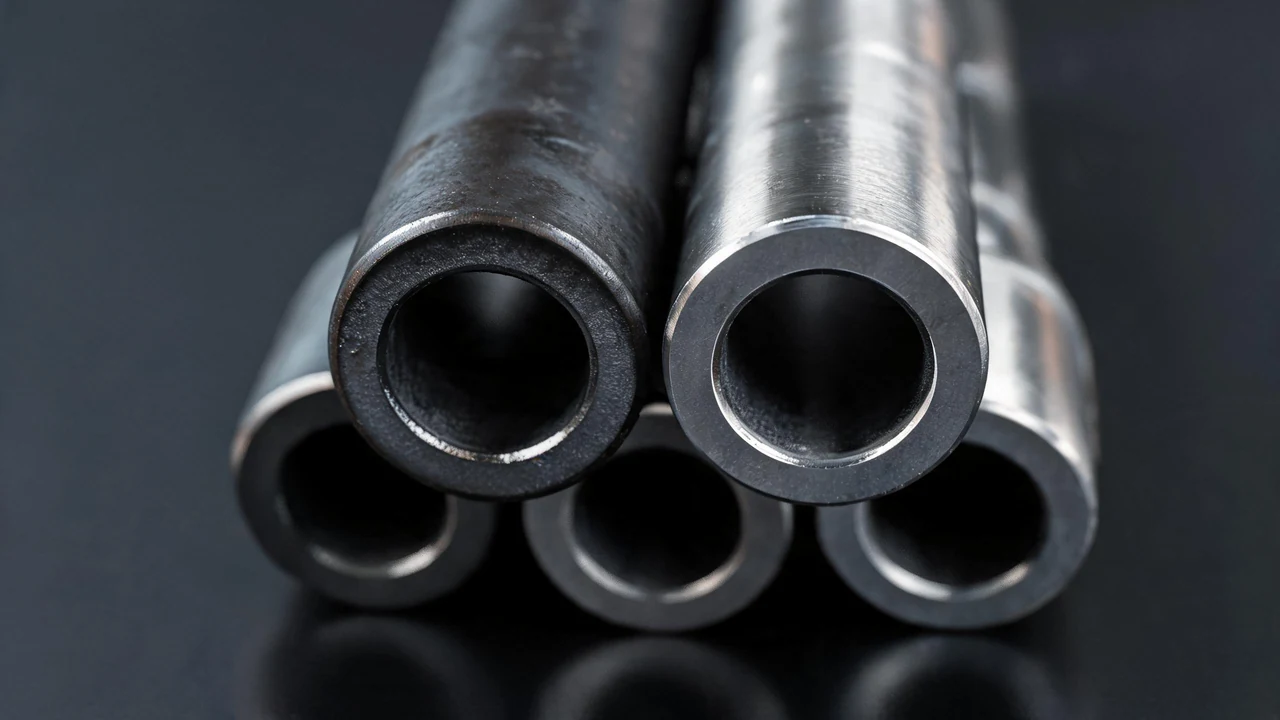
ASTM A519 covers seamless carbon and alloy steel mechanical tubing, hot-finished or cold-finished, in outside diameters up to 12-3/4 inches (323.9 mm). It is a mechanical tubing specification, not a pressure-tube specification: the grades, most often 1026, 4130 and 4140, are supplied for machining, shafts, cylinders and structural components, and their mechanical properties follow the ordered condition rather than a single fixed minimum.
Download ASTM A519 Mechanical Tubing data sheet (PDF) One-page summary of the supply range, chemistry, mechanical properties and inspection documents on this page. The standard is the governing document.
Mejor Steel is the export agent for the mills that make your material: one contract, one delivery date, and the mill named on the quotation. How we supply
We reply within one business day, Monday to Friday 09:00-18:00 CST. Or write to info@mejorsteel.com / WhatsApp.
Size range and specification
- Outside diameter Up to 12-3/4 in (323.9 mm)
- Wall thickness To the order, within the size and tolerance rules of the standard
- Length Straight lengths, cut to the ordered length
- Ends Plain end, or as specified
- Surface As-rolled, pickled and oiled, or as specified
- Manufacturing process Seamless, hot-finished or cold-finished
- Delivery condition Hot-finished, cold-finished, annealed, normalized, or quenched and tempered, as ordered
- Delivery standard ASTM A519 / A519M
How this tubing is supplied
- Inspection Inspected by the producing mill’s own inspection department, which is independent of production, against the delivery standard above. Third-party inspection — SGS, BV or TUV, or an inspector you send yourself — can be arranged at the mill or before shipment; give us the dates and the scope at the order stage.
- Certificate A mill test certificate to EN 10204 3.1 showing the heat number, the chemical composition and the mechanical results is standard on every order. EN 10204 3.2, countersigned by the inspector you nominate, is available on request.
- Documents with the goods The mill test certificate and the packing list travel with the shipment, and the heat number is traceable from cast through to the finished product.
- Packing Sea-worthy export packing: bundled by size with end protection, corrosion protection on request, stencilled with the size, grade and heat number.
- MOQ One bundle or one truckload; mixed sizes within a bundle accepted.
- Lead time Counted from order confirmation, not from the enquiry. Stock sizes 5–10 days; mill run or non-stock 3–5 weeks. The delivery window is fixed on the quotation.
- How we supply Sourced through partner mills; the producing mill is named on the quotation.
ASTM A519 chemical composition (%)
| Element | 1026 | 4130 | 4140 |
|---|---|---|---|
| Carbon, C | 0.22 – 0.28 | 0.28 – 0.33 | 0.38 – 0.43 |
| Manganese, Mn | 0.60 – 0.90 | 0.40 – 0.60 | 0.75 – 1.00 |
| Silicon, Si | – | 0.15 – 0.35 | 0.15 – 0.35 |
| Chromium, Cr | – | 0.80 – 1.10 | 0.80 – 1.10 |
| Molybdenum, Mo | – | 0.15 – 0.25 | 0.15 – 0.25 |
1026 is a plain carbon mechanical grade; 4130 and 4140 are chromium-molybdenum alloy grades, with 4140 the higher-carbon, higher-hardenability version. The chemistry differences are what drive the difference in achievable strength after heat treatment. Phosphorus, sulphur and other residual limits also apply and are read from the standard.
Source: chemical composition requirements of ASTM A519 / A519M. The standard is the governing document.
Mechanical properties follow the ordered condition
A519 does not set one tensile and yield value that applies to every grade and condition. The mechanical properties are tied to the ordered condition, and a 4130 tube supplied annealed is softer and lower-strength than the same tube quenched and tempered. The values have to be read from the order and the mill certificate rather than assumed from the grade name.
| Condition | What it gives |
|---|---|
| Hot-finished | As-rolled structure, lower cost, strength to the standard’s hot-finished requirements |
| Cold-finished | Improved surface and dimensional tolerance, some strength increase from cold work |
| Annealed | Softest and most uniform, for machining |
| Normalized | Refined grain, improved toughness |
| Quenched and tempered | Highest strength and hardness, to the range stated on the order |
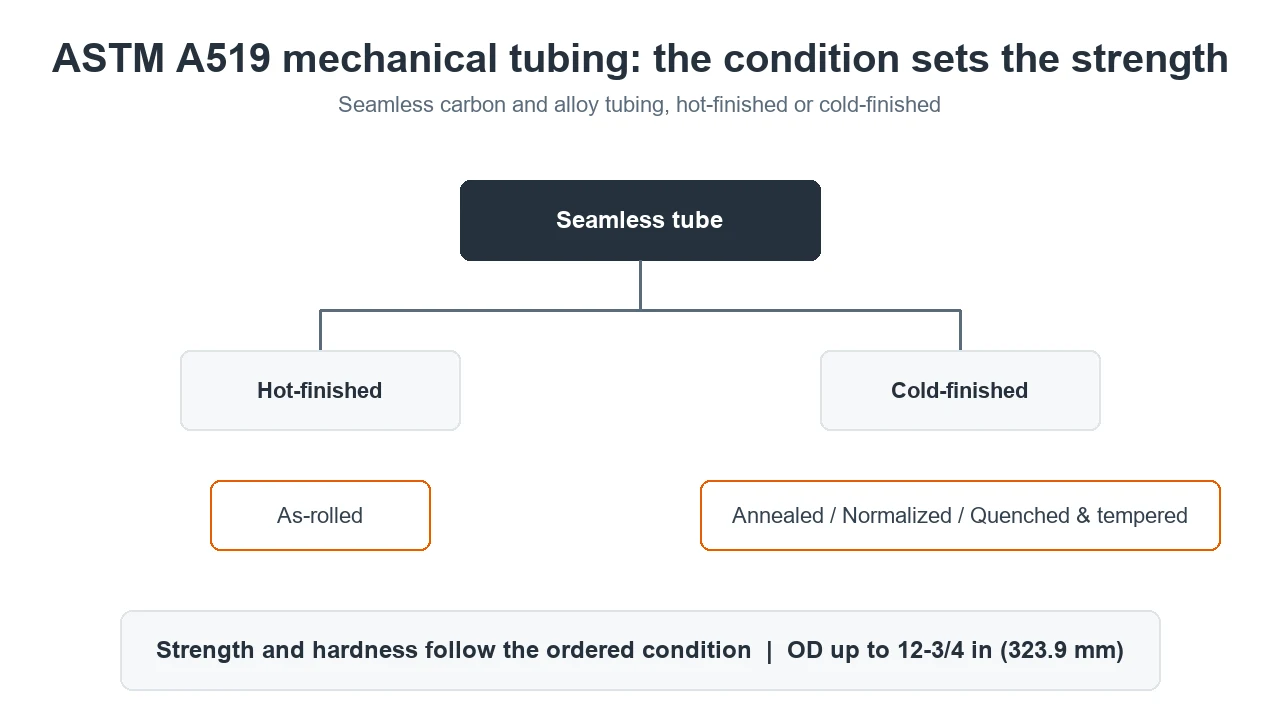
The tensile and yield values are set by the condition and the grade together, and where a specific strength or hardness is required it is written into the order and confirmed on the mill certificate. No single minimum figure applies across the whole specification.
The diagram below shows the route: a seamless tube is finished hot or cold, and the finishing condition is what sets the delivered strength and hardness.
What Is ASTM A519 Tubing?
A519 is a seamless carbon and alloy steel mechanical tubing specification. Mechanical tubing is ordered for its machinability, its strength after heat treatment, and its dimensional tolerance, not for carrying pressure. The common grades are 1026 (carbon) and 4130 and 4140 (chromium-molybdenum), and because the specification covers many grades and delivery conditions, the strength is fixed by the condition rather than by a single grade-wide minimum.
A519 is mechanical tubing, not pressure tube
This is the boundary that matters most when specifying A519. Mechanical tubing is ordered to be machined, welded into a component, or used as a structural member, and its acceptance is about chemistry, condition and dimensional tolerance. A519 can be used in pressure service only where the applicable design code and the purchaser’s requirements are met; pressure-tube duties are normally covered by A179, A192 or A213 instead.
Where A519 tubing is used
A519 tubing is specified where a seamless carbon or alloy tube has to be machined or heat-treated into a part, rather than where it has to carry pressure.
Typical applications
- Machined components and bushings
- Hydraulic cylinders
- Shafts and axles
- Downhole tools and mechanical components in 4130 / 4140
- Structural and mechanical assemblies
Standards covered
Frequently asked questions
What is the difference between A519 and A513?
A519 is seamless mechanical tubing; A513 is electric-resistance-welded mechanical tubing. The seamless route removes the weld seam, which matters where the tube is machined all the way through, where the weld would be a weakness, or where a welded product is not accepted by the specification.
What does mechanical tubing mean?
Tubing ordered for mechanical and structural use, such as machining, shafts, cylinders and components, rather than for pressure or fluid transfer. Its acceptance is on chemistry, condition and dimensional tolerance rather than on a pressure rating.
What is the difference between 1026, 4130 and 4140?
1026 is a plain carbon grade. 4130 and 4140 are chromium-molybdenum alloy grades with higher hardenability; 4140 has more carbon than 4130, so it reaches higher strength and hardness after heat treatment. The choice is made by the required strength and hardness after the planned heat treatment.
What condition should I order?
State the condition on the order, because the condition sets the strength. Annealed is softest and most uniform for machining; normalized refines the grain; quenched and tempered gives the highest strength and hardness. The exact tensile, yield and hardness you need belong on the order.
Can A519 tubing be used for pressure service?
Only where the applicable design code and the purchaser’s requirements allow it. A519 is a mechanical tubing specification; pressure-tube duties are normally covered by A179, A192 or A213 instead.
Where to go next
- Steel Pipe / Line Pipe – the main steel pipe product line
- Seamless vs Welded Steel Pipe – which route to specify and why
- Boiler & Heat Exchanger Tube – the pressure-tube specification family
- ASTM A213 T11 Alloy Steel Tube – alloy tube for elevated-temperature service
- Steel Pipe Standards & Grades – every grade page in this section
- Get a Quote – send the grade, size, quantity and destination port
Four details and we can quote. The grade or the standard the material has to meet, the size and wall thickness, the tonnage, and the destination port. Send them together and we answer with availability and pricing.
Request a quotation