Pipe entering Brazil is cleared by an importer registered to operate in foreign trade, and the declaration runs through the single-window system. What decides whether an order runs to schedule is not the grade but the registration, the invoice and the trade term. This page covers those three, together with what Brazilian buyers order from China.
Brazil is the second market where buying pipe from outside the country is an established route: importers and foreign suppliers already rank for Brazilian pipe enquiries. What they leave out is the clearance side – who has to be registered, what the invoice has to carry, and which term matches how the cargo ships. This page covers those three.
Mejor Steel is the export agent for the mills that make your material: one contract, one delivery date, and the mill named on the quotation. How we supply
We reply within one business day, Monday to Friday 09:00-18:00 CST. Or write to info@mejorsteel.com / WhatsApp.
What Brazilian buyers order from China
- Line pipe to API 5L – Grade B and X42 to X70, PSL1 and PSL2 – for gas, water and gathering lines.
- Seamless pipe to ASTM A106 / A53 for steam and process service.
- OCTG to API 5CT – J55, K55, N80, L80, C90 and T95 – for workovers and completions.
- Large diameter welded pipe for water transmission and piling, where the diameter range decides the process.
Because the import route is formal and document-driven, the specification set is only half of the order: the invoice description, the classification and the registration of the importer are what decide whether the cargo clears on schedule.
Trade terms, and the one thing buyers get wrong
The Incoterms® rules are published by the ICC: eleven three-letter terms allocating cost, risk and obligations. FOB, CFR and CIF apply to sea and inland waterway transport and are the terms used for steel pipe into Brazilian ports.
| Term | Main carriage | Risk passes | What the buyer controls |
|---|---|---|---|
| FOB | Buyer books and pays | When goods are on board at the port of shipment | Freight, sailing schedule, insurance |
| CFR | Seller pays to the named destination port | When goods are on board at the port of shipment | Insurance from loading onwards |
| CIF | Seller pays carriage and insurance to destination | When goods are on board at the port of shipment | Nothing before arrival; the cover is the rules’ minimum |
The thing buyers get wrong is assuming that CIF means the seller carries the risk to Santos. It does not: under both CFR and CIF the risk passes when the pipe is on board in China, so the importer should hold its own cargo cover from that point even where the seller arranged insurance. And where the pipe travels in containers, check with the forwarder whether an “any mode” rule fits the handover better than a sea rule, the same way you would for any containerised cargo.
Name the port – Santos, Paranaguá, Rio Grande, Suape – and the discharge arrangements with it. Steel pipe is a heavy, long cargo, and how it is discharged and stored at the port often costs more than the difference between freight quotations.
What Brazilian import clearance asks for
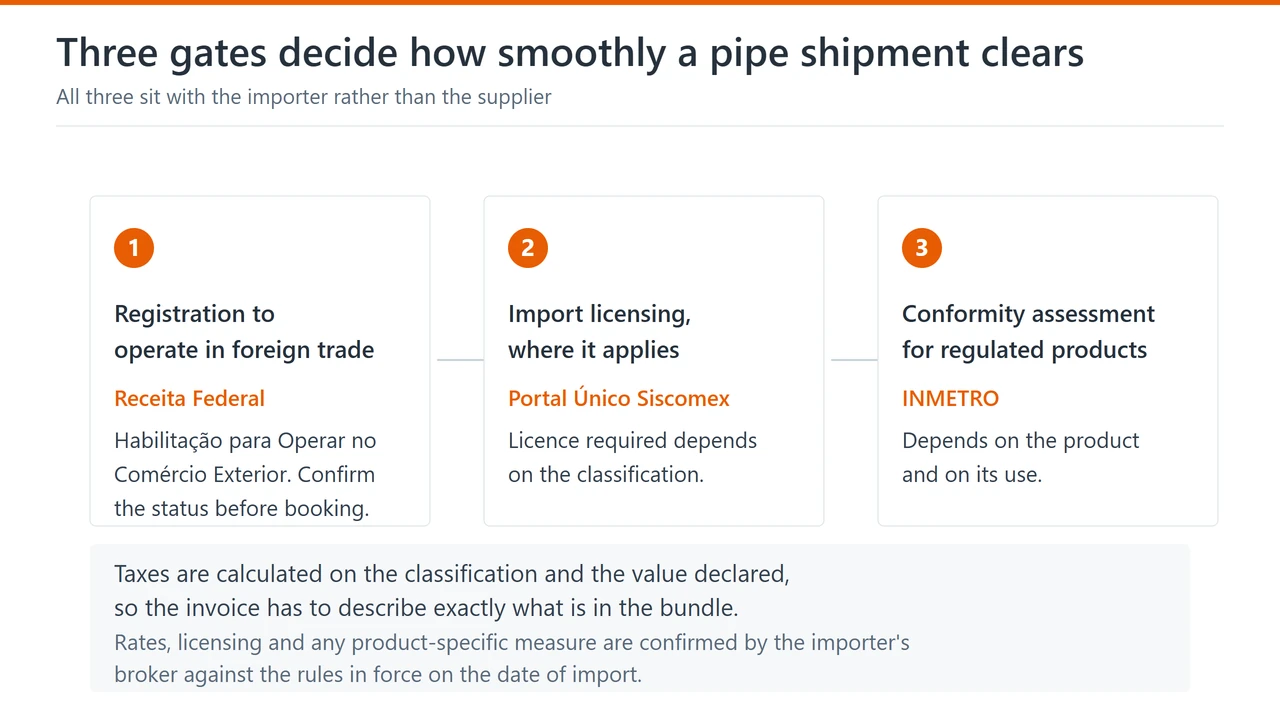
Three things decide how smoothly a pipe shipment clears, and all three sit with the importer rather than the supplier.
1. Registration to operate in foreign trade. Importing into Brazil requires the company to be enabled to operate in foreign trade with the Receita Federal; the process is described by the Receita as “Habilitação para Operar no Comércio Exterior”. A first-time importer should confirm its status before the cargo is booked, because it is not something the supplier can arrange.
2. Import licensing, where it applies. Import operations are handled through the Portal Único Siscomex, and some products require an import licence before shipment. Whether a licence is required depends on the classification of the goods, so the answer is confirmed against the Brazilian classification (NCM) and the current rules rather than assumed from the tariff chapter.
3. Conformity assessment for regulated products. INMETRO regulates products and runs Brazil’s conformity assessment system. Whether steel pipe in a given application falls under a compulsory certification requirement depends on the product and its use, so check it by NCM and application before quoting, not after the cargo arrives.
Taxes – the federal import taxes and the state ICMS – are calculated on the classification and the value declared, so the invoice has to describe exactly what is in the bundle. Freight and insurance form part of the customs value where the term includes them, which is one more reason the trade term and the invoice are decided together.
The rates, the licensing requirement and any product-specific trade measure in force are confirmed by the importer’s customs broker against the rules applicable on the date of import. We supply the documents; the importer’s broker confirms the treatment.
The documents an invoice has to match
- Commercial invoice describing the goods as they are: grade, outside diameter, wall thickness, length, quantity, and the coating or lining.
- Packing list with bundle numbers, lengths and weights, matching the invoice and the mill certificates.
- Bill of lading, or the multimodal document, matching the term – on board for FOB, CFR and CIF.
- Mill test certificates to the standard on the order, with heat numbers traceable to the bundles.
- Certificate of origin where the importer is claiming preferential treatment under an applicable agreement.
- Third party inspection report, where the project requires one.
Any mismatch between these documents is a clearance problem, not a supplier problem: it is the importer’s file that has to be consistent.
What to put in the enquiry
- Grade and standard, with the PSL or type.
- Outside diameter, wall thickness, length and end preparation.
- Coating or lining, and whether the pipe is for a buried or a potable water line.
- Inspection scope, and whether a third party report is required.
- Trade term and port: FOB, CFR or CIF, and the discharge port in Brazil.
- Whether the shipment is containerised or breakbulk.
- Documents required: mill certificates, certificate of origin, inspection report.
- Delivery window and quantity, in tonnes and in lengths.
Frequently asked questions
Can a Chinese supplier clear Brazilian customs for us?
No, and a supplier who offers to is describing something it cannot do. The registration to operate in foreign trade, the import licence where one applies, and the tax calculation all sit with the Brazilian importer. What the supplier does is provide documents that match the goods: invoice, packing list, mill certificates, and the certificate of origin where a preferential rate is claimed.
Is CIF or FOB better for Brazil?
FOB when the importer has a forwarder and wants control of the sailing schedule and the freight cost; CIF when the importer wants one delivered-port price and does not want to manage the booking. Under both, the risk passes when the goods are on board in China, so the importer should hold its own insurance from loading. For containerised cargo, check with the forwarder whether an “any mode” rule matches the handover better.
Does steel pipe need INMETRO certification to enter Brazil?
It depends on the product and its application, because INMETRO’s conformity requirements apply to regulated products rather than to everything in a tariff chapter. The check is done by NCM and by use, with the importer’s certification body or customs broker, before the order is placed. Where a certificate is required it takes time, and that time belongs in the delivery schedule rather than after the pipe has shipped.
Where to go next
- API 5L line pipe – grades and product specification levels.
- API 5CT casing and tubing – OCTG grades and connections.
- Incoterms for steel pipe – the terms compared for steel cargo specifically.
- Third party inspection – inspection nodes and certificate types.
- Get a quote – send the specification, the port and the term.
Quoting into Brazil? Send the grade and standard, the diameter and wall, the length, the trade term and the discharge port. We supply the mill certificates and the documents the invoice has to match, and confirm the loading window before the order is released.
Request a quotation