API 5L Grade B, designated L245 in ISO 3183, is the lowest line pipe grade in normal commercial use, with a minimum yield strength of 245 MPa (35,500 psi) and a minimum tensile strength of 415 MPa (60,200 psi). It is supplied in PSL1 and PSL2, seamless or welded, and is often dual certified with ASTM A106 Grade B and ASTM A53 Grade B.
Mejor Steel is the export agent for the mills that make your material: one contract, one delivery date, and the mill named on the quotation. How we supply
We reply within one business day, Monday to Friday 09:00-18:00 CST. Or write to info@mejorsteel.com / WhatsApp.
Size range and specification
- Outside diameter 1/2 inch – 48 inch (12.7 – 1219 mm); seamless normally up to 24 inch, LSAW up to 48 inch and above
- Wall thickness 3.2 – 40 mm (SCH 10 – SCH 160, or by wall thickness)
- Length SRL 5.8 m, DRL 11.8 m, 20 FT, 40 FT, or random 6 – 18 m
- Ends Plain end, beveled end, threaded with coupling
- Surface treatment Black varnish, 3PE / 3LPE, FBE, 3PP, bare
- Delivery condition As-rolled (R), normalized (N), quenched and tempered (Q), thermomechanical (M)
- Manufacturing process Hot rolled seamless, ERW, LSAW, SSAW
- Delivery standard API 5L / ISO 3183, PSL1 or PSL2
Download API 5L Grade B data sheet (PDF) One-page summary of the supply range, chemistry, mechanical properties and inspection documents on this page. The API 5L / ISO 3183 standard remains the governing document.
How this grade is supplied
- Inspection Inspected by the producing mill’s own inspection department, which is independent of production, against the delivery standard above. Third-party inspection — SGS, BV or TUV, or an inspector you send yourself — can be arranged at the mill or before shipment; give us the dates and the scope at the order stage.
- Certificate A mill test certificate to EN 10204 3.1 showing the heat number, the chemical composition and the mechanical results is standard on every order. EN 10204 3.2, countersigned by the inspector you nominate, is available on request.
- Documents with the goods The mill test certificate and the packing list travel with the shipment, and the heat number is traceable from cast through to the finished product.
- Packing Sea-worthy export packing: bundled by size with end protection, corrosion protection on request, stencilled with the size, grade and heat number.
- MOQ One bundle or one truckload; mixed sizes within a bundle accepted.
- Lead time Counted from order confirmation, not from the enquiry. Stock sizes 5–10 days; mill run or non-stock 3–5 weeks. The delivery window is fixed on the quotation.
- How we supply Sourced through partner mills; the producing mill is named on the quotation.
API 5L Grade B chemical composition, wall thickness up to 25.0 mm (maximum, %)
| Product specification level | C | Si | Mn | P | S | CE(IIW) |
|---|---|---|---|---|---|---|
| PSL1 Grade B | 0.28 | not specified | 1.20 | 0.030 | 0.030 | not required |
| PSL2 Grade B, R and N condition | 0.24 | 0.40 | 1.20 | 0.025 | 0.015 | 0.43 |
PSL1 sets only these four elements and requires no carbon equivalent. PSL2 tightens every one of them and adds a carbon equivalent limit: CE(IIW) 0.43 where carbon is above 0.12%, or CE(Pcm) 0.25 where carbon is 0.12% or below. Quenched and tempered Grade B (BQ) is a separate row in the PSL2 table, at carbon 0.18% max and manganese 1.40% max. Unless otherwise agreed, Nb + V + Ti is limited to 0.15%.
Source: chemical composition requirements of API 5L / ISO 3183, Table 4 (PSL 1) and Table 5 (PSL 2). The standard is the governing document.
API 5L Grade B mechanical properties
| Grade | ISO 3183 designation | Yield strength | Tensile strength | Yield / tensile ratio max | Elongation |
|---|---|---|---|---|---|
| Grade B PSL1 | L245 | 245 MPa min (35,500 psi) | 415 MPa min (60,200 psi) | not specified | per formula |
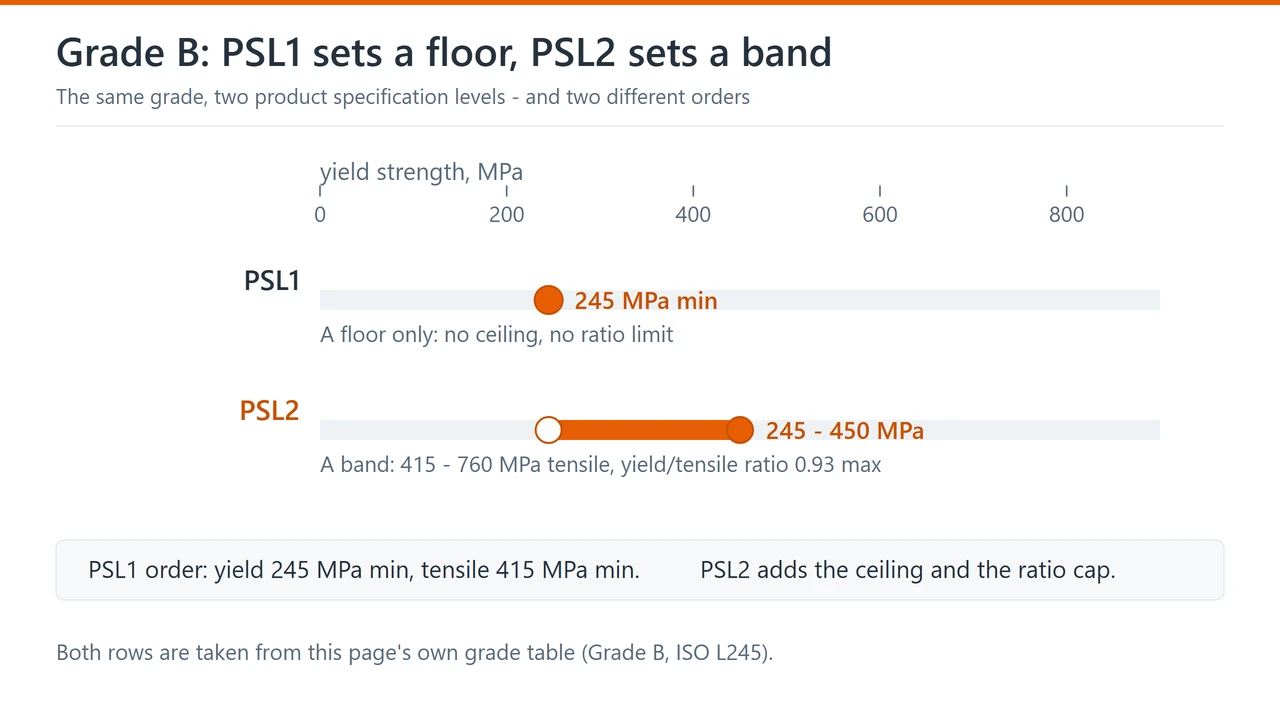
| Grade B PSL2 | L245 | 245 – 450 MPa (35,500 – 65,300 psi) | 415 – 760 MPa (60,200 – 110,200 psi) | 0.93 | per formula |
PSL1 specifies minimum values only. PSL2 adds a maximum as well, which caps how far the mill may strengthen the steel, plus a yield to tensile ratio limit of 0.93; the two together are what make PSL2 pipe deform predictably in service rather than behave unpredictably. Elongation is calculated from the API 5L formula Af = C x A^0.2 / U^0.9, where A is the applicable tensile test cross-sectional area in mm2, U is the specified minimum tensile strength in MPa, and C is 1940 in metric units (625,000 in US customary units). PSL2 also requires Charpy impact testing, which PSL1 does not.
Source: tensile requirements of API 5L / ISO 3183, Table 7. The standard is the governing document.
What Does API 5L Grade B Mean?
API 5L is the specification for line pipe, the pipe used to move oil and gas between facilities rather than inside them. Grade B is the lowest grade in normal commercial use, designated L245 in the ISO 3183 numbering, where the number is the minimum yield strength in MPa. Together with the product specification level, PSL1 or PSL2, that gives four things to state on an enquiry: grade, PSL, size and wall thickness. Saying only Grade B is not enough, because PSL1 and PSL2 pipe of the same grade are not interchangeable.
PSL1 and PSL2 – What Actually Changes
PSL stands for product specification level and it is the most commonly misunderstood part of an API 5L order. PSL1 is the basic level: chemistry limits are loose, only minimum strength is specified, and there is no impact test requirement. PSL2 tightens carbon, phosphorus and sulphur, adds a carbon equivalent limit, adds maximum yield and tensile values and a 0.93 yield to tensile ratio cap, and requires Charpy V-notch impact testing. In practice PSL2 Grade B is ordered where the line will be pressure tested at high pressure, where it will operate at low temperature, or where the project specification simply calls for impact tested pipe. For water, slurry and low pressure service, PSL1 Grade B is normally adequate and cheaper.
API 5L Grade B, ASTM A106 Grade B and ASTM A53 Grade B
The three specifications have effectively the same minimum strength, so the choice is never about strength. A106 Grade B is the high temperature seamless specification: phosphorus and sulphur capped at 0.035% each, a minimum silicon content, and seamless construction only. A53 Grade B is the general purpose specification, permitting welded pipe and higher phosphorus and sulphur. API 5L Grade B is the line pipe specification: it permits seamless, ERW, LSAW and SSAW construction, and in PSL2 it adds impact testing. Because the strength requirements coincide, pipe is frequently dual or triple certified, and the certificate will then carry all the designations.
Seamless, ERW, LSAW and SSAW Grade B Pipe
Grade B is made by every line pipe process. Seamless pipe covers the smaller sizes and is chosen where the highest integrity is needed. ERW pipe covers roughly 2 inch to 24 inch and is the most economical option in the mid range, with a longitudinal electric resistance weld. LSAW pipe covers the large diameters, formed from plate and welded longitudinally with filler metal in one or two passes. SSAW or spiral pipe is formed from coil and welded on a helix, and is used at the largest diameters where a straight longitudinal seam would be impractical. Which process is available at a given size and wall is set by the mill range rather than by the specification, and the specification does not rank one process above another.
Inspection, Testing and Documentation
API 5L pipe is supplied with a mill test certificate showing heat number, chemistry, tensile results and, for PSL2, carbon equivalent and impact test results. PSL1 pipe is hydrostatically tested, or may be non-destructively tested in place of the hydrostatic test where the standard permits. PSL2 pipe requires Charpy V-notch impact testing, and the weld seam of welded pipe is examined. Third party inspection is available, and where traceability matters the heat number on the certificate must match the marking on the pipe. Where sour service is involved, the additional requirements of NACE MR0175 / ISO 15156 apply on top of API 5L.
Typical applications
- Oil and gas gathering and flow lines
- Low pressure transmission lines
- Water, slurry and tailings pipelines
- Structural and piling pipe
- General industrial piping and fabrication
Standards covered
What to state on the enquiry
- API 5L Grade B, and whether PSL1 or PSL2 — the two levels differ in testing, not in the grade name.
- Outside diameter and wall thickness, and the length.
- Manufacturing route: seamless, ERW, LSAW or SSAW.
- Coating, if the line is buried.
- Quantity and destination port.
- Mill certificate type (EN 10204 3.1 or 3.2) and any third-party inspection.
Frequently asked questions
What is the difference between API 5L Grade B PSL1 and PSL2?
PSL2 tightens the chemistry – carbon 0.24% against 0.28%, phosphorus 0.025% against 0.030% and sulphur 0.015% against 0.030% – adds a carbon equivalent limit, adds a maximum yield strength of 450 MPa and a maximum tensile strength of 760 MPa where PSL1 specifies minimums only, caps the yield to tensile ratio at 0.93, and requires Charpy impact testing. PSL1 has none of those additional requirements.
Is API 5L Grade B the same as ASTM A106 Grade B?
They have effectively the same minimum strength, which is why they are often dual certified, but they are different specifications. A106 is written for high temperature seamless service, with phosphorus and sulphur capped at 0.035% each and a minimum silicon content. API 5L Grade B is written for pipelines and permits welded construction. Where a line will carry hot process fluid, A106 is the specification to order.
Can API 5L Grade B be used for sour service?
Sour service is governed by NACE MR0175 / ISO 15156, not by API 5L. Grade B is a low strength steel, so its hardness is in principle low enough, but that standard also imposes hardness verification, limits on sulphur and on alloying elements, and in many cases specific heat treatment. Sour service pipe is normally ordered to a dedicated specification rather than as plain Grade B, and the requirement should be stated at enquiry so it can be priced correctly.
Where to go next
- API 5L Seamless Steel Pipe – seamless line pipe to API 5L
- API 5L ERW Welded Steel Pipe – smaller diameter ERW line pipe
- API 5L LSAW Welded Steel Pipe – large diameter LSAW line pipe
- API 5L SSAW Spiral Welded Steel Pipe – spiral welded pipe for large diameter mains
- ASTM A106 Grade B Pipe – the high-temperature seamless grade most often quoted
- API 5L X52 Pipe – the mid-range line pipe grade in detail
- Steel Pipe Weight Calculator – work out the weight of any size and wall thickness
- Pipeline Transmission – line pipe for gathering and transmission
- Get a Quote – send the grade, size, quantity and destination port
Ready to price your enquiry? Tell us the specification, the dimensions, how much you need and where it is going. We reply with what is available and what it costs.
Request a quotation