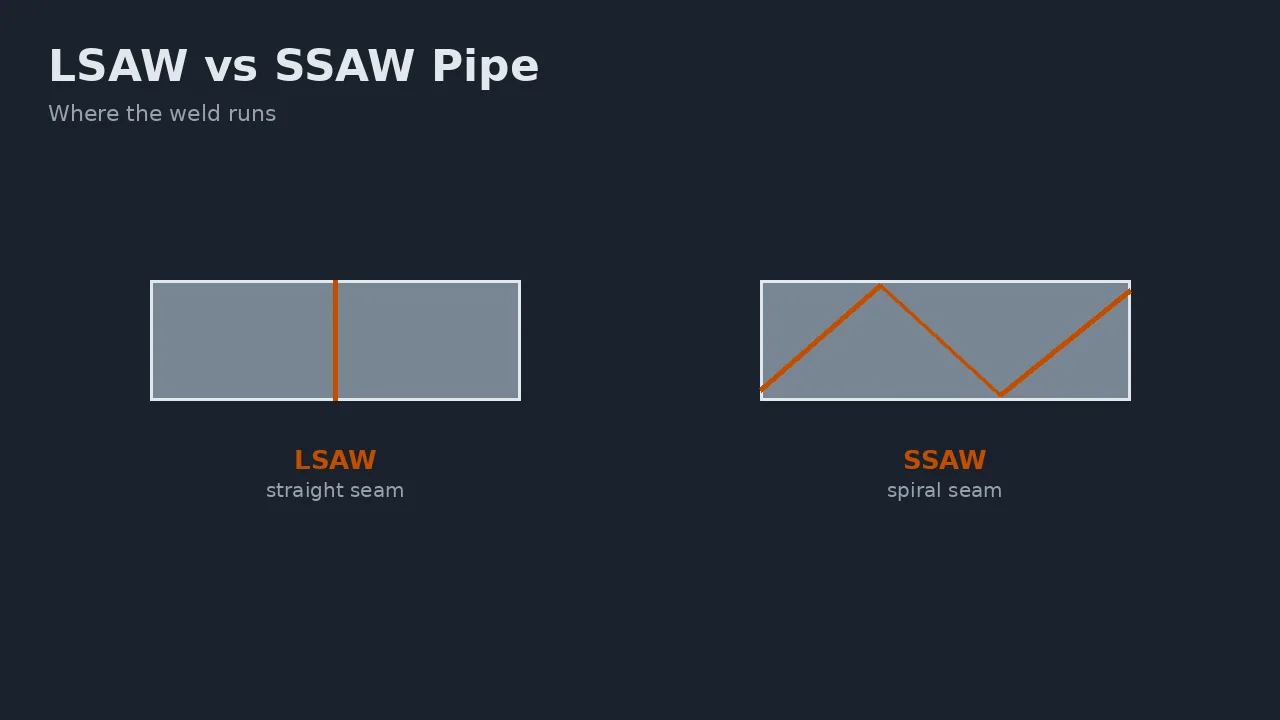
LSAW is welded along a straight seam running down the length of the pipe; SSAW along a helical seam that spirals around the body. LSAW covers 16 to 60 inch with walls up to 50 mm and holds tighter dimensional control; SSAW reaches 100 inch from a much narrower coil, which is what makes very large pipe affordable.
Which process to ask for. Between 16 inch and 60 inch outside diameter both processes can make the pipe, so the choice is commercial. Above about 25 mm of wall the spiral process drops out, because the coil it is formed from is not made that thick, and below 16 inch it stops being economical. LSAW holds tighter dimensional control and runs to X80 with walls to 50 mm; SSAW reaches 100 inch from a much narrower coil, which is what makes very large pipe affordable, and it is used in the lower pressure classes where the longer helical seam is practical to examine.
Two ways to weld a large pipe
LSAW stands for longitudinal submerged arc welding. Steel plate is pressed into a cylinder and the longitudinal seam is welded from both sides with the arc buried under a layer of granular flux. The two forming routes are UOE, where the plate is pressed into a U then an O and finally expanded, and JCOE, where it is progressively pressed into a J shape. Both start from plate, so wall thickness is not limited by the gauge of a coil.
SSAW is spiral submerged arc welding, also sold as helical seam pipe. Steel coil is fed into the forming machine at an angle, so the strip edge travels around the pipe body as a helix and the seam is welded as it goes. One coil width produces a whole range of diameters simply by changing the forming angle, which is why spiral pipe is the cheapest way to make a very large diameter.
Where the seam runs, and why it matters
The two seams do not sit at the same angle to the load. In LSAW the seam runs along the axis of the pipe, so the hoop stress that a pressurised pipe carries acts across the seam rather than along it. In SSAW the seam crosses the axis at an angle, so the hoop stress resolves into components both along and across the weld.
The second difference is length. A helical seam is longer than a straight one for the same pipe, so there is more weld metal per metre of pipe to make and to inspect. That is a cost, and it is part of why spiral pipe is used in the lower pressure classes where the trade is acceptable.
Diameter and wall thickness
LSAW runs from 16 inch to 60 inch outside diameter with wall thickness from 6 mm to 50 mm, in grades from Grade B up to X80. SSAW runs from 8 inch to 100 inch with wall thickness from 5 mm to 25.4 mm, in grades from Grade B up to X70.
The practical consequence is in the overlap. Between 16 inch and 60 inch both processes can make the pipe, so the choice is commercial. Above about 25 mm of wall the spiral process drops out, because the coil it is formed from is not made that thick. Below 16 inch it is usually not worth tooling either one, and ERW takes over.
Which one for which service
The table below is the short version of how the choice is normally made on an enquiry. It is a starting point, not a rule: the design pressure and the purchaser’s specification decide.
| LSAW | SSAW | |
|---|---|---|
| How the seam runs | Straight, along the axis of the pipe | Helical, spiralling around the body |
| Forming | Plate pressed into a U then an O (UOE), or progressively into a J (JCOE) | Coil fed into the forming machine at an angle |
| Size range we quote | 16 inch to 60 inch (406 to 1524 mm) | 8 inch to 100 inch (219 to 2540 mm) |
| Wall thickness | 6 mm to 50 mm | 5 mm to 25.4 mm |
| Grades | Grade B to X80 | Grade B to X70 |
| Pressure class | High pressure transmission | Low to medium pressure |
| Dimensional control | Tighter, because the formed shell is expanded to final size | Looser: the same coil is used across a range of diameters |
| Typical use | Oil and gas transmission mains, high pressure lines, structural pipe | Water transmission and drainage mains, piling, low pressure service |
| Relative cost per tonne | Higher | Lower |
Testing, and what is inspected
Both processes produce pipe that carries a longitudinal or helical weld, so both are subject to the weld-seam requirements of the specification in addition to the pipe body requirements. In practice that means a weld tensile test alongside the body test, non-destructive examination of the seam over its length, and a hydrostatic test of the finished pipe.
On a long spiral seam the examination covers more length than on a straight seam, and the angle of the seam makes some techniques less straightforward to apply. On a large order the acceptance criteria and the examination method are worth agreeing in writing before the pipe is rolled rather than after.
What to put in the enquiry
State the outside diameter, the wall thickness, the length, the grade, the product specification level and the standard the pipe must meet. Then state the ends – beveled or plain – and the coating, because both are applied at the mill and both change the price. If the diameter is between 16 and 60 inch, saying which process you want avoids getting the other one quoted.
Frequently asked questions
Is SSAW pipe weaker than LSAW pipe?
Not in the pipe body. Both are made to the same tensile and yield requirements for a given grade. The difference is in the seam: the helical seam is longer, it crosses the axis at an angle, and the process is used in the lower pressure classes and lighter walls. Where the pressure is high and the wall is heavy, LSAW or seamless is the normal choice.
Can spiral welded pipe be used for gas transmission?
Yes, and it is used on gas and oil lines, particularly in the lower grades. What limits it on a given project is wall thickness and pressure: spiral pipe is made from coil, and our range stops at 25.4 mm. Where the design needs a heavier wall than that, LSAW is the answer.
Why is LSAW more expensive than SSAW?
Because it starts from plate rather than coil, and the forming and expansion steps are slower and lower in output. What is bought with the extra cost is dimensional consistency, heavier wall capability and a straight seam that is simpler to examine along its full length.
Where to go next
- API 5L LSAW welded steel pipe – longitudinal seam, 16 to 60 inch
- API 5L SSAW spiral welded pipe – helical seam, 8 to 100 inch
- API 5L ERW welded steel pipe – the smaller diameter alternative below 16 inch
- API 5L seamless steel pipe – no seam at all, up to about 24 inch
- API 5L X65 pipe – the grade most often quoted on transmission lines
- ASTM A53 Grade B pipe – the general purpose pipe specification
- Pipeline transmission – how line pipe is specified for transmission service
- Seamless vs welded steel pipe – where the seam argument starts
- Request a quotation – send the diameter, wall, grade, quantity and port
Looking for a price on a specific item? We need the standard and grade, the size and wall thickness, the quantity, and the destination port. With those four we can confirm availability and give you a price.
Request a quotation