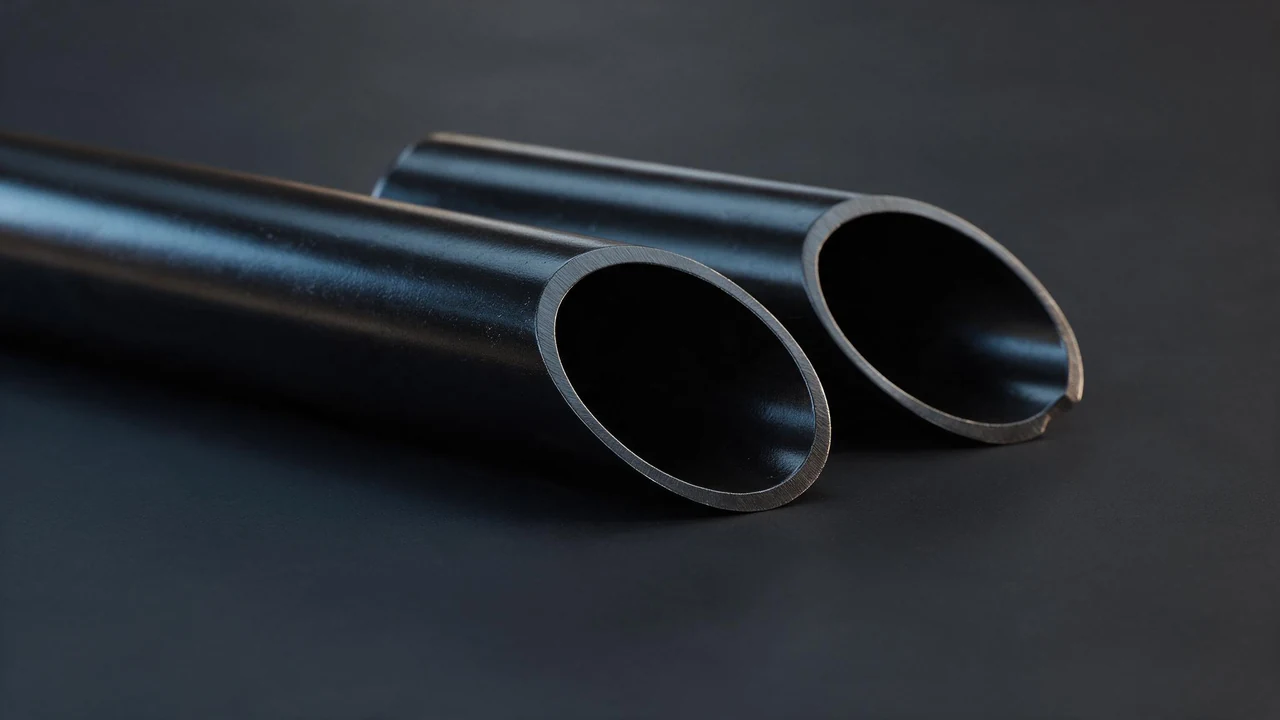
ASTM A333 Grade 3 is a 3.5 percent nickel steel pipe for low-temperature service, impact tested at minus 150 degrees Fahrenheit, which is minus 100 degrees Celsius. It has a minimum yield strength of 275 MPa (40,000 psi) and a minimum tensile strength of 485 MPa (70,000 psi). The nickel is what keeps it tough well below the temperature at which the carbon grades such as Grade 6 are accepted.
Download ASTM A333 Grade 3 Pipe data sheet (PDF) One-page summary of the supply range, chemistry, mechanical properties and inspection documents on this page. The standard is the governing document.
Mejor Steel is the export agent for the mills that make your material: one contract, one delivery date, and the mill named on the quotation. How we supply
We reply within one business day, Monday to Friday 09:00-18:00 CST. Or write to info@mejorsteel.com / WhatsApp.
Size range and specification
- Outside diameter 1/2 inch – 24 inch (12.7 – 610 mm)
- Wall thickness SCH 40 – SCH XXS, or by wall thickness
- Length SRL 5.8 m, DRL 11.8 m, or fixed length
- Ends Plain end, beveled end
- Surface treatment Black varnish, bare, rust preventive oil
- Manufacturing process Seamless, ERW, or welded
- Heat treatment Normalized
- Delivery standard ASTM A333 / ASME SA333, dimensions to ASME B36.10M
- Delivery condition Normalized; impact tested at minus 150 degrees F (minus 100 degrees C)
How this grade is supplied
- Inspection Inspected by the producing mill’s own inspection department, which is independent of production, against the delivery standard above. Third-party inspection — SGS, BV or TUV, or an inspector you send yourself — can be arranged at the mill or before shipment; give us the dates and the scope at the order stage.
- Certificate A mill test certificate to EN 10204 3.1 showing the heat number, the chemical composition and the mechanical results is standard on every order. EN 10204 3.2, countersigned by the inspector you nominate, is available on request.
- Documents with the goods The mill test certificate and the packing list travel with the shipment, and the heat number is traceable from cast through to the finished product.
- Packing Sea-worthy export packing: bundled by size with end protection, corrosion protection on request, stencilled with the size, grade and heat number.
- MOQ One bundle or one truckload; mixed sizes within a bundle accepted.
- Lead time Counted from order confirmation, not from the enquiry. Stock sizes 5–10 days; mill run or non-stock 3–5 weeks. The delivery window is fixed on the quotation.
- How we supply Sourced through partner mills; the producing mill is named on the quotation.
ASTM A333 Grade 3 chemical composition (%)
| Element | Requirement | Element | Requirement |
|---|---|---|---|
| Carbon, C | 0.19 max | Silicon, Si | 0.18 – 0.37 |
| Manganese, Mn | 0.31 – 0.64 | Nickel, Ni | 3.18 – 3.82 |
| Phosphorus, P | 0.025 max | Chromium, Cr | no requirement |
| Sulphur, S | 0.025 max | Molybdenum, Mo | no requirement |
Grade 3 is the 3.5 percent nickel grade, and the nickel range of 3.18 to 3.82 percent is the one line of the table that separates it from the carbon grades in the same specification. Nickel in solid solution lowers the temperature at which the steel changes from ductile tearing to brittle cleavage, which is why Grade 3 can be qualified at minus 100 degrees Celsius while Grade 6, a nickel-free carbon steel, stops at about minus 45 degrees Celsius. The carbon maximum is held at 0.19 percent and phosphorus and sulphur at 0.025 percent each, because all three work against toughness at low temperature. The silicon range of 0.18 to 0.37 percent is the deoxidation range used for these nickel steels rather than an alloying addition. Molybdenum is not a requirement of the grade, though some published tables list a residual limit for it.
Source: chemical composition requirements of ASTM A333 / ASME SA333, Table 1. The standard is the governing document.
ASTM A333 Grade 3 mechanical properties
| Grade | Tensile strength | Yield strength | Elongation | Impact test |
|---|---|---|---|---|
| A333 Grade 3 | 485 MPa min (70,000 psi) | 275 MPa min (40,000 psi) | 30% min | Charpy V-notch at minus 150 degrees F (minus 100 degrees C): 18 J average of three, 14 J single minimum |
Grade 3 is a higher-strength grade than Grade 6 in the same specification: the minimum yield strength is 275 MPa against 240 MPa, and the minimum tensile strength 485 MPa against 415 MPa, so stepping down in temperature does not cost strength. The impact requirement is the reason the grade is bought: three Charpy V-notch specimens, taken longitudinally, with an average of at least 18 J and no single specimen below 14 J, tested at minus 100 degrees Celsius. Where the wall will not yield a full-size 10 x 10 mm specimen, sub-size specimens are tested and the acceptance values are reduced in proportion, with the specimen size shown on the test report.
Source: tensile requirements of ASTM A333 / ASME SA333, Table 1. The standard is the governing document.
Low-temperature pipe grades: nickel content and impact test temperature
| Grade | Nickel content | Impact test temperature | Typical low-temperature service |
|---|---|---|---|
| A333 Grade 6 | none – carbon steel | minus 45 degrees C (minus 50 degrees F) | Cold process piping above about minus 45 degrees C |
| A333 Grade 3 | 3.18 – 3.82% nickel | minus 100 degrees C (minus 150 degrees F) | Cold process and refrigerated service down to about minus 100 degrees C |
| A333 Grade 8 | 8.40 – 9.60% nickel | minus 195 degrees C (minus 320 degrees F) | LNG and other cryogenic service |
These are not three points on one scale; each is a different steel. Grade 6 reaches its toughness through fine grain size and normalizing with no alloy addition at all. Grade 3 adds about 3.5 percent nickel, which is enough to qualify it about 55 degrees Celsius colder than Grade 6 while keeping the same acceptance energy and moving up one strength step. Grade 8 adds about 9 percent nickel – a different and far more expensive alloy with its own welding, heat treatment and fabrication practice – and it is the grade used for liquefied natural gas and similar cryogenic duty. The temperatures in the table are published impact test temperatures; the maximum service temperature for a given design comes from the applicable code, not from the grade.
What Is ASTM A333 Grade 3 Pipe?
ASTM A333 Grade 3 is a seamless or welded steel pipe for low-temperature service, made to a 3.5 percent nickel composition and impact tested at minus 150 degrees Fahrenheit, which is minus 100 degrees Celsius. It has a minimum yield strength of 275 MPa (40,000 psi) and a minimum tensile strength of 485 MPa (70,000 psi), which places it one strength step above the nickel-free Grade 6 in the same specification. The pipe is supplied normalized, and the impact test at the specified temperature is a mandatory requirement of the grade rather than an optional extra. In practice Grade 3 is ordered once the design temperature has fallen below the point where the carbon grades are accepted, a boundary commonly taken at about minus 45 degrees Celsius.
Why 3.5 Percent Nickel?
Toughness at low temperature is a property of the crystal structure rather than of strength. Nickel dissolved in ferrite changes the temperature at which the steel’s fracture mode changes from ductile tearing to brittle cleavage, and it does so in a fairly predictable way as the nickel content rises: a few percent of nickel covers the range down to about minus 70 to minus 100 degrees Celsius, and 9 percent nickel reaches liquid nitrogen temperatures. That is why A333 Grade 3 carries a nickel range rather than a single figure, and why the range is held as tightly as 3.18 to 3.82 percent – the lower bound is a toughness requirement and the upper bound a cost and weldability limit. The carbon, phosphorus and sulphur limits are tightened at the same time, because each of them attacks toughness in a different way.
How Grade 3 Sits Between Grade 6 and the 9 Percent Nickel Grades
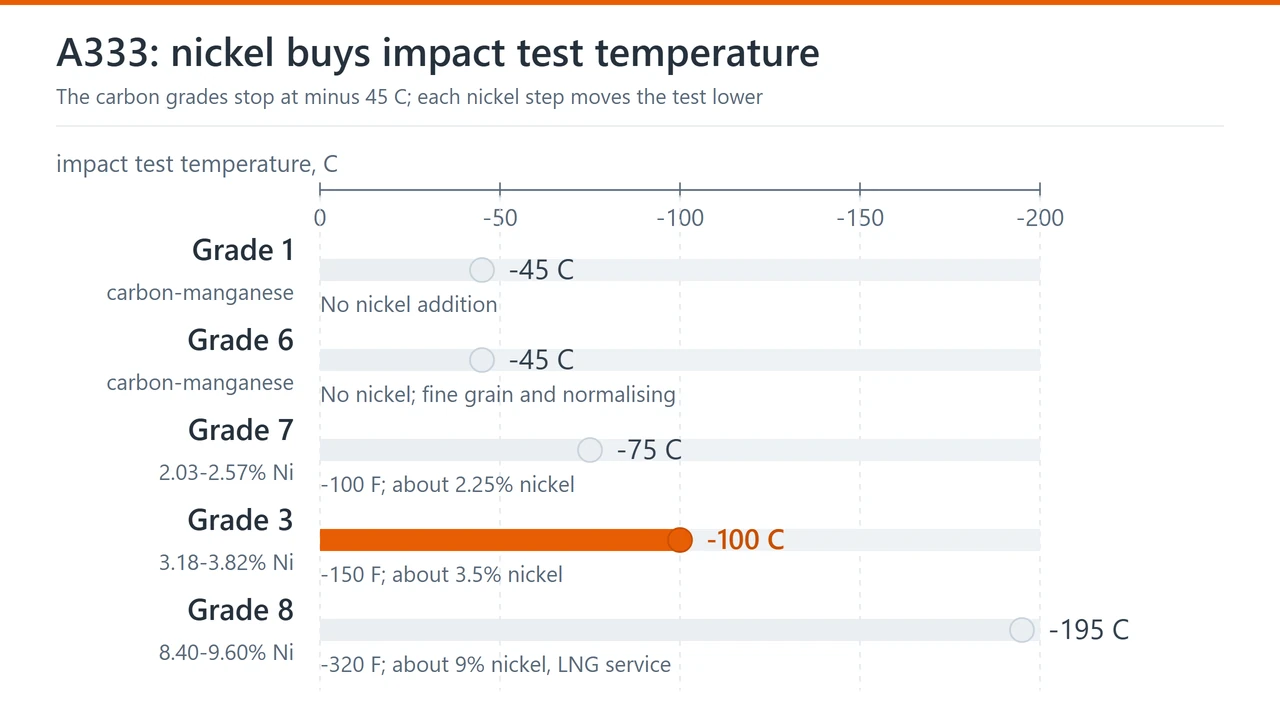
A333 Grade 6 is a fine-grain, killed carbon steel with no nickel, impact tested at about minus 45 degrees Celsius. A333 Grade 3 adds about 3.5 percent nickel and moves the impact test to minus 150 degrees Fahrenheit, or minus 100 degrees Celsius: roughly 55 degrees Celsius colder, with the same acceptance energy, and one strength step higher. A333 Grade 8 is a different metallurgy again – about 8.40 to 9.60 percent nickel, impact tested at minus 195 degrees Celsius for liquefied natural gas and similar cryogenic duty, and a much more expensive steel with its own welding and heat treatment rules. Grade 3 is therefore the middle step, and it covers the widest band of ordinary cold process service: colder than Grade 6 can go, not so cold that the 9 percent nickel cost is justified.
The low temperature grades are placed against one another on impact test temperature below.
Where A333 Grade 3 Pipe Is Used
Grade 3 is specified where a carbon steel line runs colder than about minus 45 degrees Celsius but not into the cryogenic range: low-temperature process piping in refineries, gas processing and petrochemical plants, cold box and air separation piping whose design temperature sits between what Grade 6 and the 9 percent nickel grades can take, refrigerated storage and transfer lines, liquefied gas service at moderate refrigeration temperatures, and the colder sections of ammonia and petrochemical plants. It is also used where a very low design ambient temperature governs. Because the grade is ordered for its impact test rather than its strength, the design temperature on the enquiry is the single most useful piece of information a buyer can give, and it should be stated with the size and wall.
Ordering, Heat Treatment and Certification
Grade 3 is supplied normalized, and normalizing is part of the specification rather than a mill preference, because the grain structure it produces is part of what the impact result depends on. Pipe is supplied seamless or welded, most often from 1/2 inch to about 24 inch outside diameter with dimensions to ASME B36.10M, in the usual schedules – NPS 4 SCH 40 and NPS 6 SCH 80, for example – or to a specified wall. The mill certificate should be read for three things: the chemistry, and in particular the nickel content; the tensile and yield results against the 485 MPa and 275 MPa minima; and the impact results together with the test temperature and the specimen size, since a sub-size specimen is accepted at a lower energy than a full-size one. On welded pipe the weld and heat-affected zone are impact tested as well.
Reading the impact data on an A333 Grade 3 certificate
Grade 3 is bought for its impact performance, so the certificate is where the value of the order sits. These are the fields that decide whether the pipe can be accepted without a discussion.
| Field on the certificate | What it has to show | Why it matters |
|---|---|---|
| Standard and edition | ASTM A333/A333M, with the edition year | The impact requirement, and the allowance for a sub size specimen, are those of the edition named on the order |
| Grade and heat treatment | Grade 3, with the condition the standard requires for that grade | Heat treatment is part of the grade requirement, not a finishing choice |
| Test temperature | The test temperature the standard requires for Grade 3, stated on the certificate | A certificate for Grade 6 at the same tonnage will not satisfy a Grade 3 line |
| Specimen size | Full size 10 x 10 mm, or the sub size actually tested (10 x 7.5 or 10 x 5 mm) | The accepted absorbed energy falls with specimen size. An energy value quoted without the specimen size cannot be checked against the standard |
| Results | Individual and average absorbed energy, with the notch orientation | Where both individual and average values are required, a good average does not cover one low individual result |
| Traceability | Heat number, and the testing laboratory where the order names one | A third party witness or a nominated laboratory has to be arranged before the test is run, not after |
Source: impact testing and acceptance requirements of ASTM A333/A333M. Acceptance energies are not reproduced here because the value changes with specimen size; the applicable table is the one in the edition named on the purchase order.
Availability: how Grade 3 is actually ordered
Grade 3 is a low volume grade. In most markets it is not a stock item, so the order is a mill run, and the mill run quantity is what drives both the price and the date. Four practical points decide whether the schedule holds.
- Tonnage and size mix. A single small size is the hardest order to place. Mixing sizes of the same grade into one heat is usually easier for the mill, so send the full list rather than the first size.
- Impact testing has to be planned. Specimen preparation and the laboratory test sit in the production sequence, and a witnessed test cannot be added after the pipe is made. The test requirement belongs on the enquiry, not on the purchase order.
- Third party inspection. Where the project requires a witness, the witness point is the impact test, so the inspection agency has to be appointed before production starts. Appointing it at shipment stage means a retest or a deviation.
- Grade 6 is the volume grade. Where the design temperature allows Grade 6, availability improves and the item is often stocked. That is a design decision rather than a purchasing one, because the two grades are qualified for different minimum service temperatures, and substituting one for the other changes the basis of the design.
Source: availability and scheduling described here is a purchasing judgement based on how low volume grades are produced; the tonnage, mill run quantity and lead time for a specific enquiry are confirmed against the mill programme at quotation. The conditional wording is deliberate: we do not publish stock or lead time figures we cannot verify (see 待办清单 H2).
Typical applications
- Low-temperature process piping in refineries and gas plants
- Cold box and air separation piping below the Grade 6 limit
- Refrigerated storage and transfer lines
- Liquefied gas service above the cryogenic range
- Piping in cold climates with a very low design ambient temperature
Standards covered
Frequently asked questions
At what temperature is A333 Grade 3 impact tested?
Grade 3 is impact tested at minus 150 degrees Fahrenheit, which is minus 100 degrees Celsius – about 55 degrees Celsius colder than the nickel-free Grade 6 in the same specification. Three Charpy V-notch specimens are tested longitudinally and the average must reach 18 J, with no single specimen below 14 J. Where the wall is too thin for a full-size specimen, sub-size specimens are used with proportionally reduced acceptance values.
What is the difference between A333 Grade 3 and Grade 6?
Nickel content, impact temperature and strength. Grade 6 is a nickel-free carbon steel impact tested at about minus 45 degrees Celsius with a minimum yield strength of 240 MPa and a minimum tensile strength of 415 MPa. Grade 3 contains 3.18 to 3.82 percent nickel and is impact tested at minus 100 degrees Celsius with a minimum yield strength of 275 MPa and a minimum tensile strength of 485 MPa. Grade 3 is chosen when the design temperature is below what Grade 6 is accepted for.
Can A333 Grade 3 be used for LNG service?
No. Liquefied natural gas is handled at about minus 162 degrees Celsius and is tested even colder, which is far below the minus 100 degrees Celsius at which Grade 3 is qualified. Cryogenic service of that kind requires the 9 percent nickel grade A333 Grade 8, or an austenitic stainless steel such as A312 TP304 or TP316. The design temperature and the applicable code decide the material, and Grade 3 is not the answer once the duty goes below about minus 100 degrees Celsius.
Is A333 Grade 3 supplied seamless or welded?
ASTM A333 covers both seamless and welded pipe, so the grade name alone does not say which was supplied; the manufacturing route is stated on the order and on the mill certificate. Welded pipe carries the additional weld inspection the order specifies and, because the impact requirement is the point of the grade, the weld and heat-affected zone are impact tested as well as the base metal.
Where to go next
- ASTM A333 Low Temperature Steel Pipe – pipe for low-temperature service
- ASTM A333 Grade 6 Pipe – the low temperature carbon pipe grade
- ASTM A106 Grade B Pipe – the high-temperature seamless grade most often quoted
- Low Temperature Service – impact toughness and where a grade stops being qualified
- Pipe Schedule Chart – wall thickness for every schedule
- Get a Quote – send the grade, size, quantity and destination port
- Boiler & Heat Exchanger Tube – tube specified by outside diameter and wall
- Butt Weld Elbow – butt weld elbows to ASME B16.9
Have a specification to price? Give us the standard or grade, the size and wall thickness, the quantity you need and the port of discharge. We come back with availability and a price.