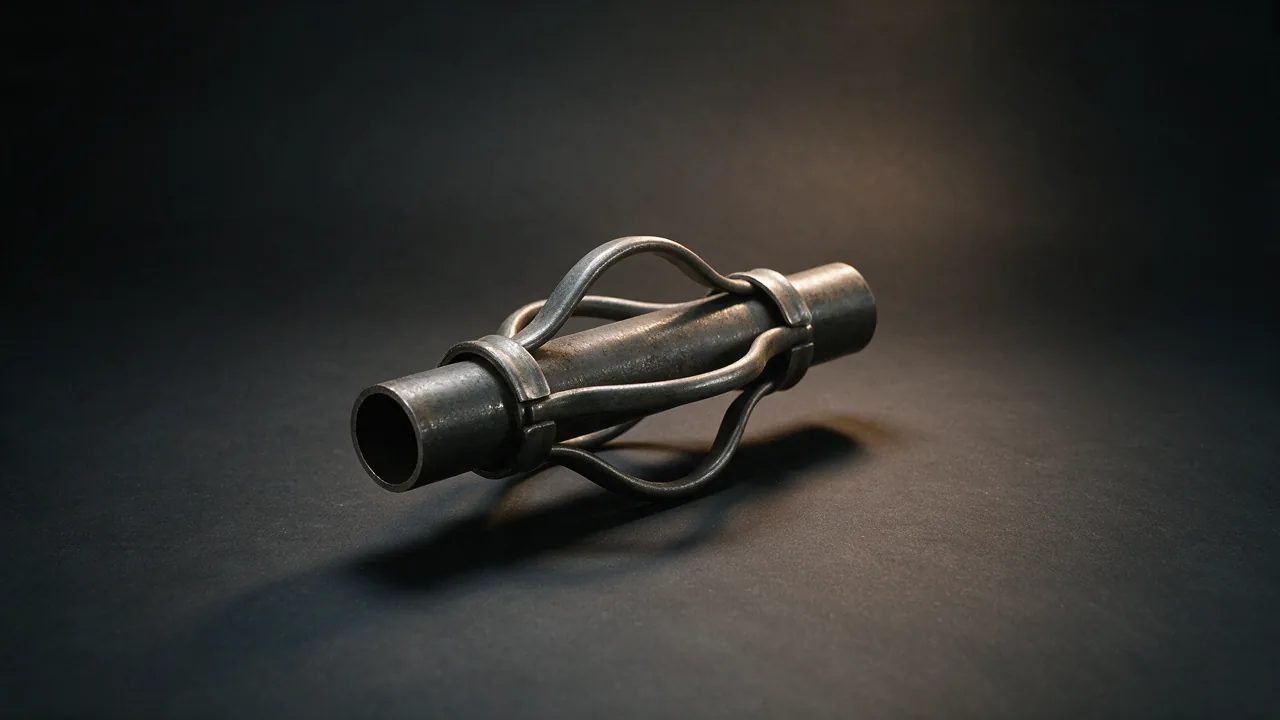
Bow spring, rigid and solid casing centralizers in sizes from 4-1/2 inch to 20 inch for improving cement coverage and reducing differential sticking.
- Standard: API Spec 10D, API 5CT
- Grades: N/A - accessory item
- Certificate: EN 10204 3.1 with every order, 3.2 on request
Mejor Steel is the export agent for the mills that make your material: one contract, one delivery date, and the mill named on the quotation. How we supply
We reply within one business day, Monday to Friday 09:00-18:00 CST. Or write to info@mejorsteel.com / WhatsApp.
Specifications
| Outer diameter | For 4-1/2" - 20" casing |
|---|---|
| Wall thickness | Steel thickness 3 - 8 mm |
| Size range | 4-1/2" to 20" casing |
| Length | Bow spring 200 - 400 mm, rigid 150 - 300 mm |
| Ends | Hinged, slip-on, or integral |
| Surface treatment | Painted, galvanized, or bare |
| Manufacturing process | Stamped and formed steel, welded or hinged |
| Connection type | Stop collar or integral |
Types of Casing Centralizer
Three designs dominate. The bow spring centralizer consists of curved steel springs welded or hinged to two end collars. It is flexible, so it compresses through tight spots and then springs back, and it is the standard choice for most vertical and moderately deviated wells. The rigid centralizer has a solid body with straight or spiral blades machined or cast into it. It provides much higher restoring force and is used in horizontal and highly deviated wells where the casing tends to lie on the low side of the hole. The solid body centralizer is a variant of the rigid type with a fully continuous body and no welded components, offering the highest strength and the best performance in the most demanding wellbores, at a higher cost. Selection depends on hole angle, dogleg severity, casing weight and the required standoff.
Spacing and Placement
Centralizer spacing is normally determined by a cementing simulation that balances standoff against drag. The general principle is that centralizers are placed most densely across the producing interval and any section where cement isolation is critical, and less densely elsewhere. In vertical wells, spacing of one centralizer per joint is typical. In deviated wells spacing must be reduced, and in horizontal sections a rigid or solid centralizer every joint or every other joint may be required. The critical check is drag: too many centralizers, or centralizers with too high a restoring force, can increase running drag to the point where the string cannot be run to depth. Always confirm the spacing calculation against the actual hole geometry before ordering quantities.
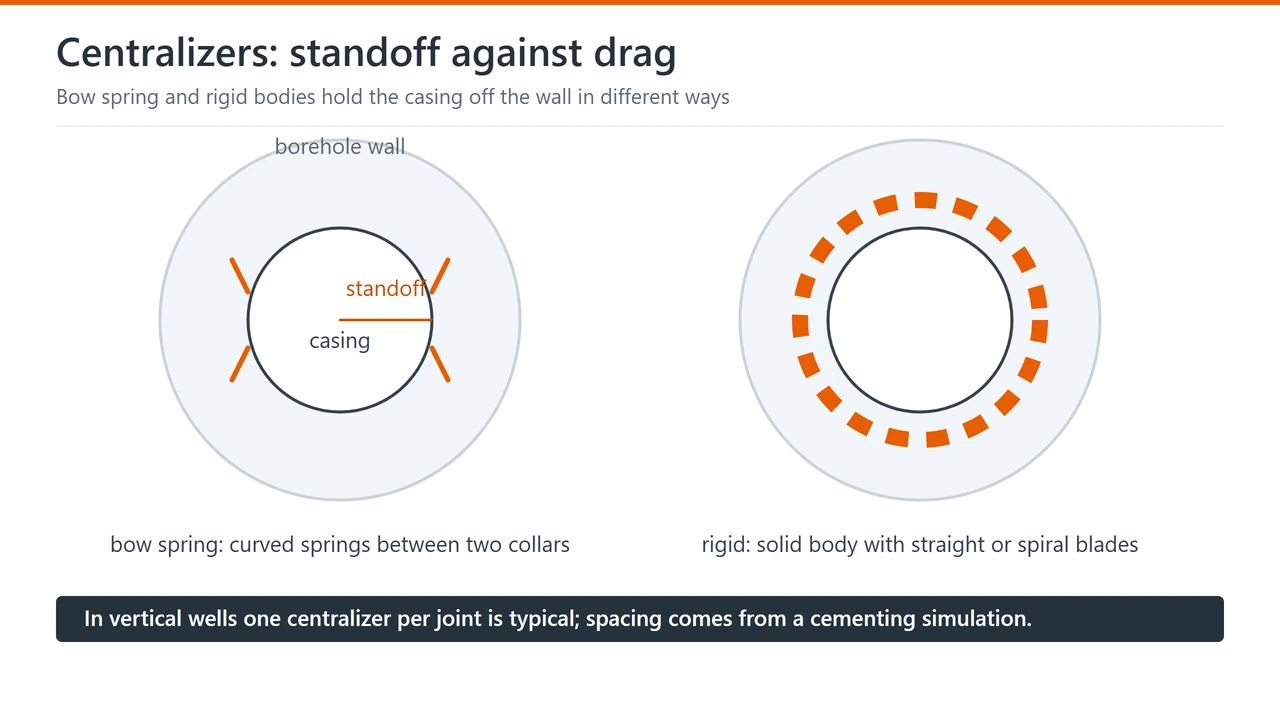
Centralizers: standoff against the hole condition
A centralizer does not carry load; it holds the casing away from the wall so cement can circulate all the way round the string. Which type is used follows from the hole condition, the deviation and whether the string has to pass a restriction, and the restoring force is the figure that has to be specified rather than the outside diameter alone.
| Well condition | What it drives in the string | What to state on the enquiry |
|---|---|---|
| Vertical well, cement coverage | Bow spring centralizer at standard spacing | the casing size, the hole size, and the spacing |
| Deviated or horizontal section | Rigid or solid body centralizer for higher standoff | the dogleg severity and the standoff required |
| Differential sticking risk | Centralizer type and spacing set the contact area | the mud weight and the differential pressure |
| Casing wear in a high dogleg | A lower contact force design, or fewer centralizers | the dogleg severity and the wear allowance |
| Stop collars and placement | The stop collar is a separate item from the centralizer | whether stop collars are included |
| Restriction in the hole | The outside diameter has to pass the restriction | the minimum restriction in the well |
| Long horizontal lateral | Spacing is much tighter than in a vertical well | the lateral length and the planned spacing |
What is the difference between bow spring and rigid centralizers?
A bow spring centralizer uses flexible curved springs, so it has a relatively low restoring force but compresses easily through tight spots and is forgiving of hole irregularities. A rigid centralizer has a solid body and provides a much higher restoring force, holding the casing away from the wall even under high side load, but it is less tolerant of tight hole. Bow spring is the default for vertical and moderately deviated wells; rigid or solid body is used in horizontal and highly deviated wells where casing tends to lie on the low side.
How many centralizers do I need per joint?
It depends on the well geometry, so there is no single answer. In vertical wells one per joint is typical across the cementing interval. In a well with 30 degrees of inclination, spacing often drops to one every half joint in the build section. In horizontal sections, a rigid centralizer per joint is common. The correct approach is to run a standoff and drag simulation for the specific hole size, casing size and trajectory, then confirm the resulting drag is within the rig’s running capability.
Standards, inspection and delivery
| Item | Detail |
|---|---|
| Standard | API Spec 10D, API 5CT |
| Inspection | Dimensional inspection; Restoring force test; Weld quality inspection; Material certification; Third-party inspection on request |
| Documents | Mill test certificate to EN 10204 3.1 with the heat number, chemical analysis and mechanical results; EN 10204 3.2 on request. Packing list travels with the shipment. |
| Packing | Cartons or sacks on pallets |
| MOQ | 100 pieces depending on size |
| Lead time | 15 – 30 days |
| Supply | Sourced through partner mills; the producing mill is named on the quotation. |
Download Casing Centralizer data sheet (PDF) One page: supply range, grades and key sizes, what to state on the enquiry, and the inspection documents that come with the order. The standard is the governing document.
What to state on the centralizer enquiry
Six things decide the type and the quantity, and they are all fixed before a mill can quote.
- Casing outside diameter and weight, so the centralizer is sized to the pipe it clamps to
- Hole size, or the inside diameter of the previous string where the centralizer runs inside casing
- Type: bow spring, rigid or solid body
- Quantity, or the spacing where the project has already run the cementing simulation
- Material and finish: the standard steel body, or a non-welded or corrosion-resistant option where the well calls for one
- Standard and certificate: whether the order has to be certified to API Spec 10D, and the certificate type
Where the project has not fixed the spacing, order against the hole geometry and the running conditions rather than a rule of thumb: the quantity that will actually run to depth is the one the simulation supports.
Frequently asked questions
Bow spring or rigid centralizer?
The bow spring centralizer is the default: it compresses through tight spots and springs back, it is lighter and it costs less, and it suits vertical and moderately deviated wells. Rigid and solid body centralizers are specified where the casing tends to lie on the low side of the hole, in horizontal and highly deviated sections, because they hold a higher restoring force. The choice follows the hole angle, the dogleg severity and the standoff the cementing design needs.
Does the centralizer have to match the casing size?
Yes. A centralizer is sized to the casing outside diameter it clamps to, and on the other side to the hole or the previous string it has to stand off from. A mismatch either fails to hold the standoff the design assumes, or adds drag without adding clearance, so the casing size and weight belong on the enquiry rather than being left to the supplier.
How is a centralizer held in position on the casing?
By stop collars set on the casing at the spacing the design gives, with the centralizer between them, or by an integral or hinged collar arrangement on the centralizer itself. Because the position is set on the pipe, the stop collar and the centralizer are ordered together rather than separately.
Where to go next
- Casing thread protector – what protects the threads to the rig floor
- Casing coupling – how couplings are specified and made up
- Casing pup joint – the short joints used to land the string
Materials
- Carbon steel
- Stainless steel
- Aluminum alloy
- Composite
Typical applications
- Improving cement placement in vertical and deviated wells
- Reducing differential sticking in directional wells
- Centralizing casing in horizontal wells
- Reducing casing wear in high dogleg sections
- Ensuring even annular clearance for cementing
Inspection & testing
- Dimensional inspection
- Restoring force test
- Weld quality inspection
- Material certification
- Third-party inspection on request
| Packaging | Sea-worthy export packing: bundled by size, plastic caps on both ends, corrosion protection on request, stencilled with size, grade and heat number. |
|---|---|
| MOQ | One bundle or one truckload; mixed sizes within a bundle accepted. |
| Lead time | Stock sizes: 7-15 days. Mill run / non-stock: 4-6 weeks after order confirmation. |
Payment: T/T 30% deposit with the balance before shipment; L/C at sight also accepted. Final terms are confirmed on the quotation.
How we supply: sourced through partner mills; the producing mill is named on the quotation. How we supply sets out who is accountable for the order.
Need this product? Send the size, grade, quantity and destination port and we will reply with availability and pricing.
Request a quotation