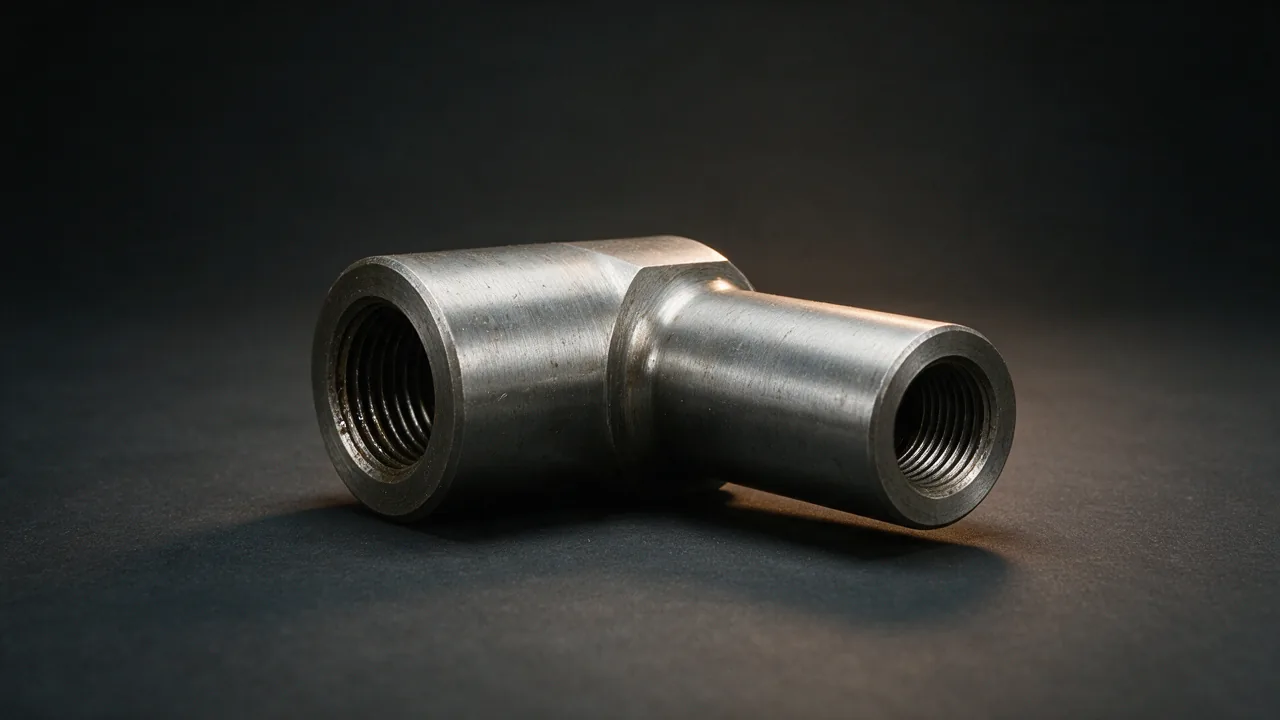
Crossover subs and casing transition adapters joining different sizes, weights, grades or thread types in a casing or tubing string.
- Standard: API 5CT, API 5B, ISO 11960
- Grades: J55, K55, N80, L80, P110, 4130, 4140
- Certificate: EN 10204 3.1 with every order, 3.2 on request
Mejor Steel is the export agent for the mills that make your material: one contract, one delivery date, and the mill named on the quotation. How we supply
We reply within one business day, Monday to Friday 09:00-18:00 CST. Or write to info@mejorsteel.com / WhatsApp.
Specifications
| Outer diameter | 2-3/8" - 20" |
|---|---|
| Wall thickness | Per connection requirement |
| Length | 300 - 1200 mm depending on size change |
| Ends | Any combination of STC, LTC, BTC, EUE, NUE, premium |
| Surface treatment | Phosphate coated threads, painted body |
| Manufacturing process | Machined from seamless tube or forged bar |
| Connection type | Combination of two different thread forms or sizes |
What a Crossover Does
A crossover, sometimes called an x-over, is a short machined sub with a different thread at each end. It is used whenever two components in a string cannot be made up directly to each other. Common situations include a tapered casing string where a smaller size is run below a larger one, an existing well where new pipe must tie into an old connection type, and wellhead or hanger interfaces where the casing thread does not match the equipment. Because the crossover is often the component that carries the full string load, its body must be sized for the tensile and pressure rating of the stronger of the two connections, and its material must be compatible with the service environment, including sour service requirements if applicable.
Specifying a Crossover Correctly
A crossover cannot be ordered from a nominal size alone. The complete specification requires, for each end: the outside diameter, weight per foot or wall thickness, thread form and type, and gender, that is whether it is pin or box. In addition, the overall length, the material grade and the drift requirement must be stated. For premium connections, the exact connection name and manufacturer are also required. Where a crossover must meet specific tensile, burst or collapse ratings, the required rating should be stated so the body wall can be sized accordingly. Because most crossovers are made to order, allow additional lead time and confirm the drawing before production begins.
Crossovers: the two thread forms decide the sub
A crossover joins two different connections, sizes or grades in one piece, machined from tube or from forged bar to suit both ends. Both thread forms have to be stated. Where the two threads are close in size, the wall left between them can be the limiting factor rather than either thread itself.
| Well condition | What it drives in the string | What to state on the enquiry |
|---|---|---|
| Two casing sizes in a tapered string | One machined sub with a different thread at each end | both sizes, both weights, and both thread forms |
| Two thread forms at the same size | The sub is short, and the wall between the threads is thin | both thread forms, and the make-up torque |
| Adapting an existing string | One end is matched to equipment already on site | the equipment connection, or a sample to work from |
| Wellhead or hanger tie-in | The connection has to match the hanger and the string | the hanger connection |
| Casing to drilling or completion equipment | Often a forged sub rather than one machined from tube | the load, and whether a forging certificate is required |
| Mismatched threads on site | Delivered quickly, so material availability matters | how soon the sub is needed |
| Sour service | Grade and hardness apply to the whole sub, not just the threads | NACE MR0175 |
| Drift requirement | The sub has to pass the same drift as the string | the required drift diameter |
Can you make a crossover between a BTC casing and a premium connection?
Yes, this is a common request. The crossover would have a BTC box or pin at one end and the specific premium connection at the other. You must provide the exact premium connection name and manufacturer, since proprietary profiles differ. Note that the crossover’s mechanical rating will be limited by the weaker of the two connections unless the body is specifically sized to match the stronger one, so state the required tensile and pressure ratings.
How long does a custom crossover take to produce?
Standard configurations combining common API threads, such as BTC to EUE or BTC to premium, typically take 15 to 30 days. Fully custom items requiring new tooling, unusual size combinations or special materials such as 13Cr take 30 to 45 days. For urgent well operations, express production is sometimes possible at a premium, so state the required date when enquiring rather than assuming a standard lead time applies.
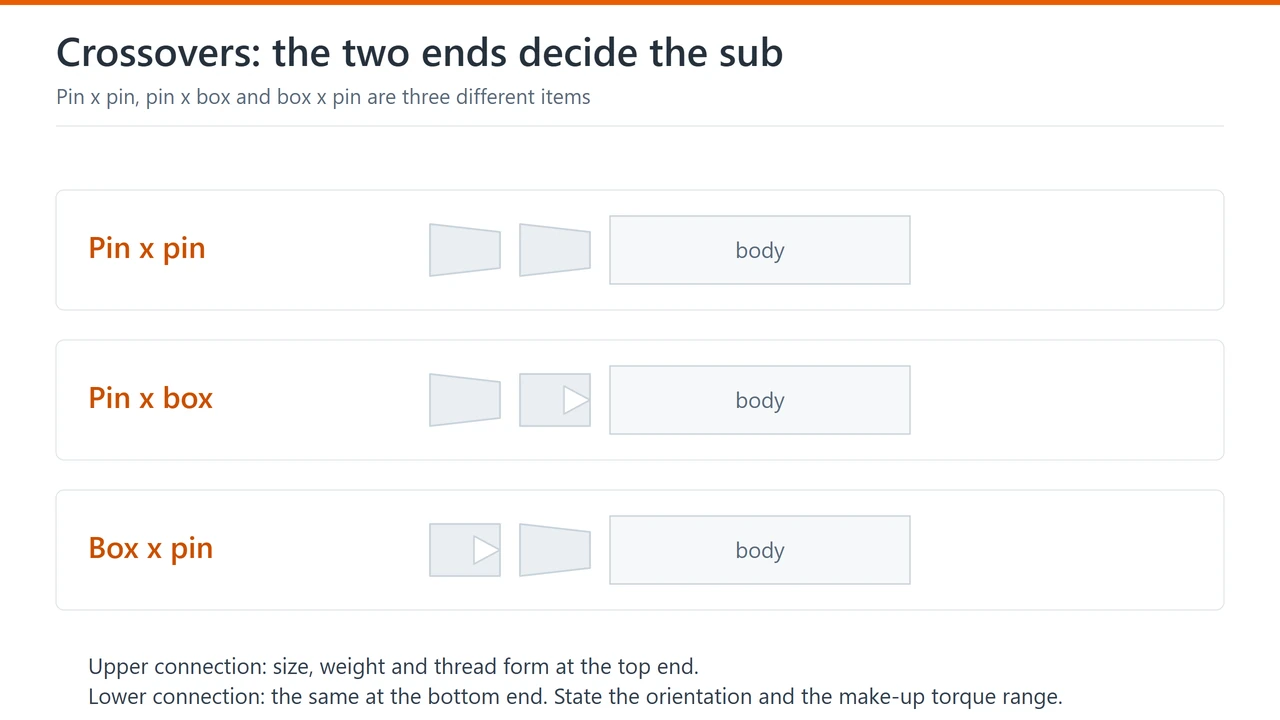
Crossover specification table
| Field | What to state |
|---|---|
| Upper connection | Size, weight and thread form at the top end |
| Lower connection | Size, weight and thread form at the bottom end |
| Orientation | Pin x pin, pin x box, or box x pin |
| Material grade | API 5CT grade such as J55, K55, N80, L80 or P110 |
| Pressure and temperature | The service conditions the crossover must hold |
| Make-up torque | The torque range required by the connection or the well plan |
| Testing and inspection | Hydrostatic test, NDE, drift, thread gauging, MTC type |
| Quantity | Number of pieces and any length tolerance |
Source: connection fields and make-up requirements refer to API 5CT and API 5B practice. Exact compatibility, premium connection data and test pressure must come from the applicable connection data sheet or the mill’s procedure.
Common mistakes that make a crossover enquiry stall
- Giving only the pipe size and not the thread form at each end.
- Omitting the pin-box orientation, which changes the finished sub.
- Assuming an API thread can replace a premium connection without checking the connection rating.
- Omitting test pressure, temperature or make-up torque when the crossover is not a standard stock combination.
If the crossover connects API threads to premium threads, send the premium connection name and the relevant data sheet; the connection owner has to confirm compatibility before the order is fixed.
How these products are supplied
Inspection is carried out by the producing mill’s own inspection department, which is independent of production. Third-party inspection by SGS, BV or TUV, or by an inspector you nominate, can be arranged at the mill or before shipment; the dates and scope are fixed at the order stage.
A mill test certificate to EN 10204 3.1 showing the heat number, chemical composition and mechanical results is standard on every order. EN 10204 3.2, countersigned by the inspector you nominate, is available on request.
Sea-worthy export packing is used, with thread protection on threaded products, bundles marked with size, grade and heat number, and end protection for transport.
For the standard pipe range, the confirmed company terms are one bundle or one truckload MOQ, 5–10 days for stock sizes and 3–5 weeks for mill-run or non-stock sizes. The delivery window is counted from order confirmation and fixed on the quotation.
A crossover with mixed or premium threads is quoted with its own MOQ and lead time. It is not treated as a stock item until the exact connection combination and material grade are confirmed.
What goes wrong when a crossover is specified loosely
- Wrong pin/box orientation: the sub cannot be made up in the planned order on site.
- Wrong thread form: the connection does not mate, even when the pipe size looks correct.
- Wrong make-up torque: the connection can leak, gall or lose preload during running.
- Premium-to-API mismatch: the proprietary profile has to be confirmed by the connection owner before machining.
- Missing test pressure or NDE scope: the crossover can fail pre-shipment acceptance and delay the string.
Grades supplied and minimum properties
The grade fixes the minimum strength and the chemistry. The table below gives the requirements that separate the API 5CT grades ordered most often; the full composition and mechanical table for each grade is on its own page.
| Grade | Yield strength | Tensile strength |
|---|---|---|
| J55 | 379 – 552 MPa (55,000 – 80,000 psi) | 517 MPa min (75,000 psi) |
| K55 | 379 – 552 MPa (55,000 – 80,000 psi) | 655 MPa min (95,000 psi) |
| N80-1 | 552 – 758 MPa (80,000 – 110,000 psi) | 689 MPa min (100,000 psi) |
| N80Q | 552 – 758 MPa (80,000 – 110,000 psi) | 689 MPa min (100,000 psi) |
| L80 Type 1 | 552 – 655 MPa (80,000 – 95,000 psi) | 655 MPa (95,000 psi) |
| P110 | 758 – 965 MPa (110,000 – 140,000 psi) | 862 MPa (125,000 psi) |
| Q125 | 862 – 1,034 MPa (125,000 – 150,000 psi) | 931 MPa min (135,000 psi) |
The complete chemistry and mechanical table for each grade, with the notes that qualify it, is on the individual grade page – for example API 5CT P110 casing. L80, C90, T95 and C110 also sit in this ladder; they are the grades with a hardness limit for sour service rather than the next step up in strength. R95 is the 95 ksi strength grade, and API 5CT sets no hardness limit for it. A crossover changes the connection or the size, so it is ordered with the grade of the heavier of the two strings it joins.
Source: specified minimum yield and tensile strength for each grade, per API 5CT / ISO 11960. The standard is the governing document.
Download Casing Crossover and Transition Adapter data sheet (PDF) One page: supply range, grades and key sizes, what to state on the enquiry, and the inspection documents that come with the order. The standard is the governing document.
Where to go next
To quote a crossover, send the upper connection, lower connection, pin/box orientation, material grade, pressure and temperature, make-up torque, test and inspection scope, quantity, certificate requirement and destination port. Request a quotation with those fields and we confirm the connection combination against the current machining programme.
Related pages: casing and tubing pup joint, premium connection casing and tubing and quality control.
Materials
- Seamless carbon steel
- Alloy steel
- Stainless steel
Typical applications
- Joining different casing sizes in a tapered string
- Adapting an existing string to a new connection type
- Wellhead and hanger tie-in
- Connecting casing to drilling or completion equipment
- Emergency field repair of mismatched connections
Inspection & testing
- Thread gauging of both ends to API 5B
- Dimensional inspection of overall length and drift
- Hydrostatic pressure test
- Hardness and tensile testing
- Material certification with heat traceability
- Third-party inspection (SGS, BV, TUV)
| Packaging | Sea-worthy export packing: bundled by size, plastic caps on both ends, corrosion protection on request, stencilled with size, grade and heat number. |
|---|---|
| MOQ | One bundle or one truckload; mixed sizes within a bundle accepted. |
| Lead time | Stock sizes: 7-15 days. Mill run / non-stock: 4-6 weeks after order confirmation. |
Payment: T/T 30% deposit with the balance before shipment; L/C at sight also accepted. Final terms are confirmed on the quotation.
How we supply: sourced through partner mills; the producing mill is named on the quotation. How we supply sets out who is accountable for the order.
Need this product? Send the size, grade, quantity and destination port and we will reply with availability and pricing.
Request a quotation