Incoterms decide where the seller’s cost and risk stop and where the buyer’s begin. For steel pipe, the term also interacts with how the goods are sold: by theoretical weight, by actual weight, or by piece. A quotation is only comparable when the Incoterm and the weight basis are the same.
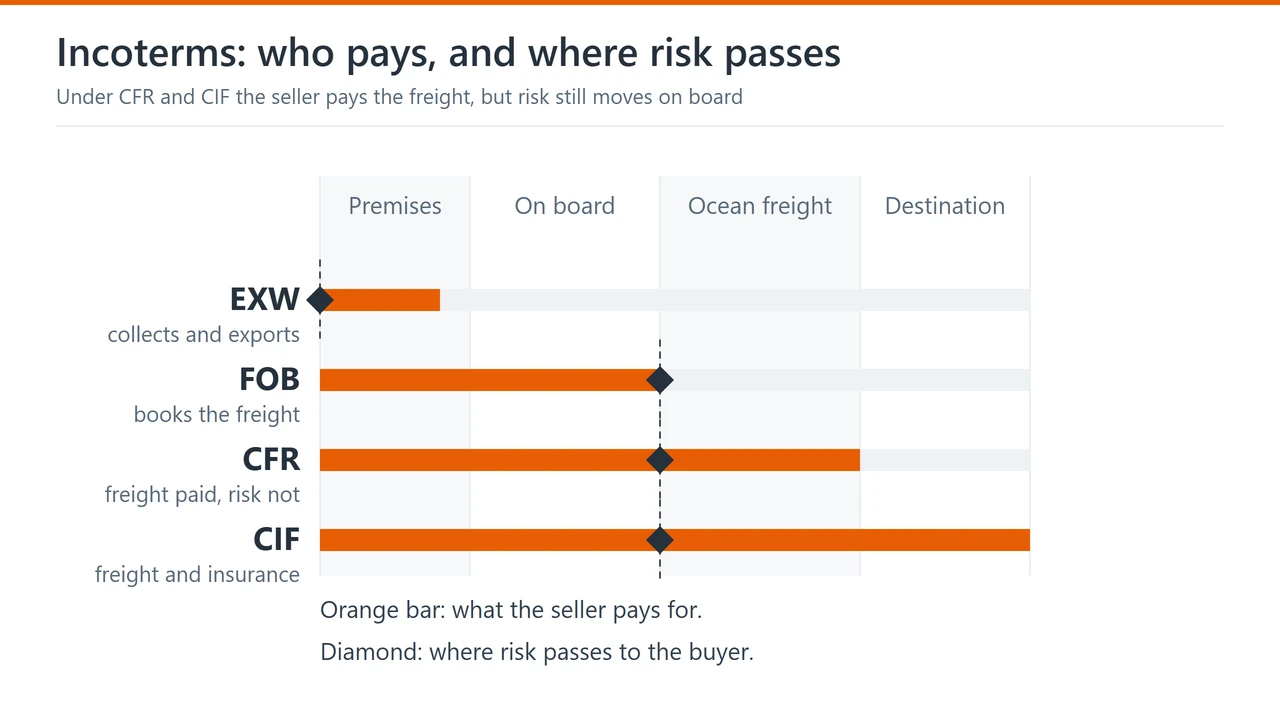
FOB, CIF, CFR and EXW compared
| Term | Seller arranges | Risk transfers | Typical steel pipe use |
|---|---|---|---|
| EXW | Goods made available at seller’s premises | At seller’s premises | Domestic pickup or buyer-managed export |
| FOB | Export clearance and delivery on board the vessel | When goods are on board | Buyer controls ocean freight and wants transparency |
| CFR | Export and ocean freight to destination port | When goods are on board | Seller books freight, buyer insures |
| CIF | Export, ocean freight and insurance | When goods are on board | Buyer wants one delivered port price with insurance |
Under CIF and CFR the risk still passes when the goods are loaded on board. The seller pays freight, but the buyer carries the in-transit risk and any cargo claim.
Weight basis matters as much as the term
Steel pipe is often quoted per tonne or per piece, but the basis changes the number. Theoretical weight uses the nominal outside diameter and wall thickness. Actual weight uses the weighed pipe, and the difference grows with wall-thickness tolerance and length tolerance. When comparing two quotations, confirm whether both are on theoretical or actual weight and whether the freight is calculated on the same tonnage.
How to choose by order type
- FOB Best when you have a freight forwarder, want to choose the carrier and need to see freight separately.
- CIF Useful when you want a delivered port price and do not want to manage freight or insurance.
- CFR A middle option when the seller books freight but you arrange insurance.
- EXW Usually only for domestic pickup or when you already control export logistics from the seller’s premises.
What to state on the enquiry
- Incoterm FOB, CIF, CFR or EXW.
- Destination port For FOB, CIF and CFR quotations.
- Weight basis Theoretical weight or actual weight.
- Size and grade Outside diameter, wall thickness, length, standard and grade.
- Quantity Pieces, metres or tonnes, with the weight basis stated.
- Packing Bundles, end protectors, coating and any export marking.
The payment route sits on top of the term
The Incoterm decides where cost and risk stop; it says nothing about when the money moves. An export order is normally settled either by payment against documents or by a documentary credit, and a credit adds a second set of documents that have to agree — this time with the bank rather than with a customs authority.
| Route | How it works | What it asks of the documents |
|---|---|---|
| Payment against documents | The buyer pays on presentation of the shipping documents, or on a deposit-and-balance split agreed on the order. | The document set named in the contract: invoice, packing list, bill of lading, mill certificates. |
| Documentary credit | A bank pays against a defined set of documents. The credit is governed by the ICC’s UCP 600, and sight or usance terms are fixed in it. | The documents must match the credit word for word, including the goods description, the ports and the certificate type. |
Bank charges, confirmation and the credit period are commercial terms; they are agreed on the order and are not part of the Incoterm.
A credit is written before the mill rolls, so it has to be written around what the mill can actually issue. These are the clauses that most often produce a discrepancy:
- A certificate type the order was not priced on – for example a credit calling for EN 10204 3.2 where the quotation was built on 3.1.
- A goods description that differs from the invoice – extra words in the credit, or a loose description in the invoice, both break the match.
- A document the supplier cannot produce – an inspection certificate from an agency that was never appointed, or an origin document issued by a body we are not a member of.
- Dates shorter than the mill needs – the latest shipment date and the presentation period have to allow for rolling, testing and inland transport.
- Partial shipment or transshipment not allowed – pipe often moves in part lots, and it transships.
- A port of loading that is not the port the goods load from – the bill of lading will not match the credit.
The credit is an arrangement between the buyer’s bank and the seller’s bank. We are a party to it, not its author: once the mill has started, a change to the credit is an amendment, and an amendment takes time.
Should the credit be sight or usance?
That is a commercial choice rather than a technical one. A usance credit gives the buyer time to pay and is usually reflected in the price, because the seller carries the cost of waiting. What matters for the schedule is that the credit period, the latest shipment date and the presentation period are consistent with each other — a 90-day usance with a shipment date two weeks away is a sign that the terms were copied from another deal.
Where to go next
- How to order – the information needed to start a quotation
- EN 10204 3.1 vs 3.2 – certificate types and who signs
- Quality Control – inspection and testing scope
- Importing into Vietnam – which Incoterms rule fits a pipe shipment, and the document that decides the duty
- Importing into Brazil – terms, clearance and what the invoice has to match
- Get a Quote – send the specification and destination port
- T/T vs L/C – payment terms, and how far each one ties payment to the documents
Need a steel pipe quotation on the right Incoterm? Send the standard, grade, outside diameter, wall thickness, length and quantity, and we will reply with availability and pricing.
Request a quotation