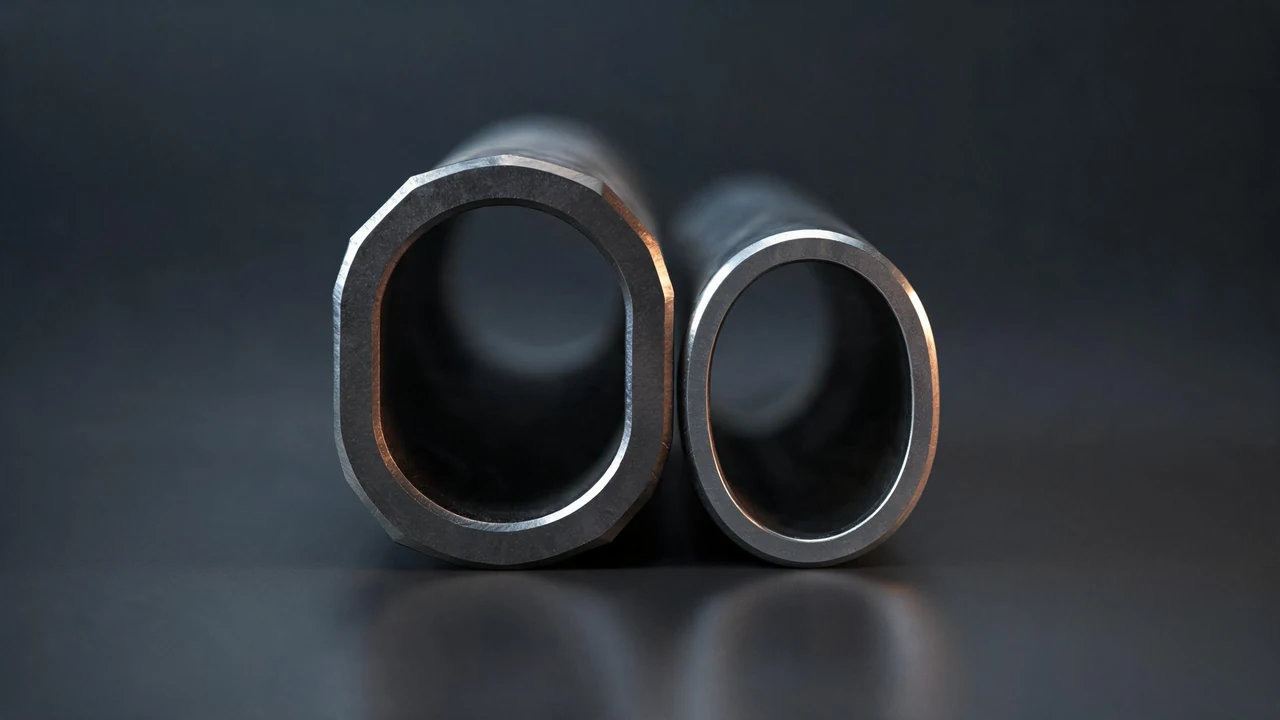
A pipe and a tube are both hollow round sections, but they are dimensioned and ordered against two different systems. A pipe is specified by a nominal size and a schedule; a tube is specified by its actual outside diameter and a wall. Report them the other way round and the quotation comes back for the wrong product.
Which system to order against. Order pipe when the item carries a fluid or gas and the specification is written as a nominal size plus a schedule – line pipe, casing, process piping. Order tube when the specification is written as an actual outside diameter plus a wall, or when the service is heat transfer, mechanical, structural or sanitary. The material does not decide it: the same seamless hollow can be described both ways, and what decides which system you buy against is the standard and the way the size is written.
The one difference that drives everything else
Pipe uses a nominal sizing system. The “2 inch pipe” is not 2 inches on the outside: a 2 in NPS pipe has a 60.3 mm outside diameter, and its wall follows the schedule, SCH 40, SCH 80 and so on. Tube uses the real number: a 2 in tube is 2.000 in (50.8 mm) outside diameter, and the wall is written directly in millimetres or thousandths of an inch.
| What decides the order | Steel pipe | Steel tube |
|---|---|---|
| Sizing | NPS + schedule | Actual outside diameter × wall |
| Outside diameter | Fixed by the standard for each NPS | The number you write |
| Wall | Follows the schedule | Stated as a value, often a minimum wall |
| Tolerances | Wider, per API 5L / ASTM A53 / A106 | Tighter, per A519 / A269 / A213 |
| Typical use | Carrying fluid or gas under pressure — line pipe, casing | Heat transfer, mechanical and structural parts, sanitary and instrumentation lines |
| Standards we supply | API 5L, ASTM A53, ASTM A106 | ASTM A179, A192, A210, A213, A269, A519 |
When to order pipe, and when to order tube
Order pipe when the item carries a fluid or gas and the specification is written by NPS and schedule — line pipe, casing, process piping. Order tube when the specification is written against an outside diameter and a wall, or when the use is heat transfer, mechanical or structural, or sanitary.
The overlap is real: a seamless hollow can be made and described both ways. What decides which system you buy against is the standard and the way the size is written, not the material. The A519 mechanical tube page carries the outside-diameter-and-wall form; the boiler and heat exchanger tube page carries the minimum-wall form, where the thinnest point of the tube must meet the stated wall.
What happens when the two are mixed up
- Reporting an NPS as an outside diameter. A “2 in pipe” read as “2 in OD tube” is the wrong dimension — 60.3 mm against 50.8 mm. The size chart lists the outside diameter that belongs to each NPS.
- Asking for a schedule on a tube. Tube specifications do not use schedule, so the line is returned unanswered and the order sits.
- Reading a tube wall as nominal when the standard wants a minimum. On boiler and heat exchanger tube the order is placed on the minimum wall, not a nominal wall with a tolerance.
What to put on the enquiry
- Pipe: standard and grade, NPS or outside diameter, schedule or wall, length, ends, quantity and destination.
- Tube: standard and grade, outside diameter, wall or minimum wall, straight or U-bend with the radius, length, quantity and destination.
State the standard either way — the standard is what tells the mill which sizing system to roll against. The seamless and welded comparison covers the manufacturing side if that is the next question.
Frequently asked questions
Is 2 inch pipe the same as 2 inch tube?
No. A 2 in NPS pipe has a 60.3 mm outside diameter and its wall follows the schedule, SCH 40, SCH 80 and so on. A 2 in tube is 2.000 in (50.8 mm) on the outside and the wall is written directly, in millimetres or thousandths of an inch.
Can the same seamless hollow be sold as either?
Yes, the overlap is real. What decides which system you buy against is the standard and the way the size is written, not the material.
Which tolerances apply?
Pipe follows the wider tolerances of API 5L, ASTM A53 and A106. Tube follows the tighter tolerances of A519, A269 and A213, which is what makes it fit a drilled tube sheet.