
X65, X70 and X80 are three strength levels of the same product, ordered to the same specification, and the difference between them is paid for twice: once at the mill, and again in the welding procedure. This page sets out what actually changes, when the design forces a step up, and what to fix on the enquiry.
The three grades side by side
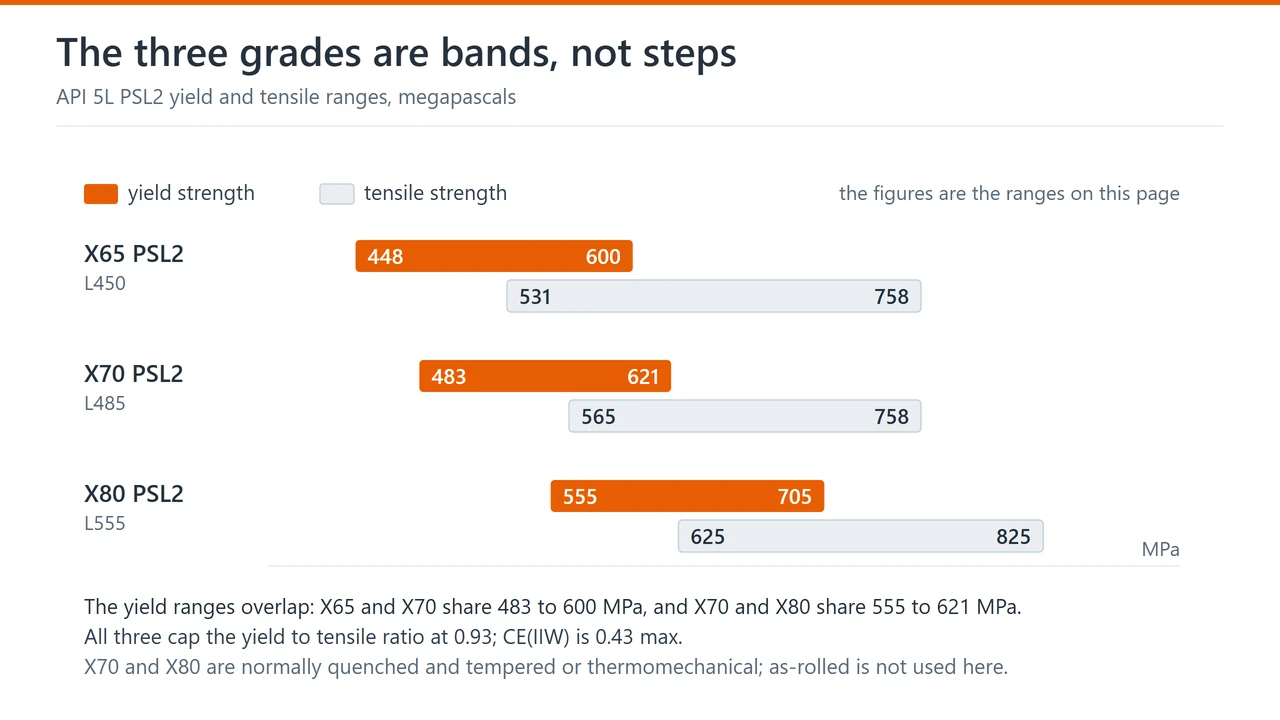
The values below are the API 5L PSL2 requirements for the grades as we supply them, and they match the tables on our own grade pages, so the same figures are used across the site.
| Grade | ISO 3183 designation | Yield strength | Tensile strength | Chemical equivalent |
|---|---|---|---|---|
| X65 PSL2 | L450 | 448 – 600 MPa (65,000 – 87,000 psi) | 531 – 758 MPa (77,000 – 110,000 psi) | CE(IIW) 0.43 max |
| X70 PSL2 | L485 | 483 – 621 MPa (70,000 – 90,000 psi) | 565 – 758 MPa (82,000 – 110,000 psi) | CE(IIW) 0.43 max |
| X80 PSL2 | L555 | 555 – 705 MPa (80,500 – 102,300 psi) | 625 – 825 MPa (90,600 – 119,700 psi) | CE(IIW) 0.43 (TMCP) or as agreed |
All three are PSL2 only in the strength range where a step up is considered, and all three carry a maximum yield to tensile ratio of 0.93. That ratio matters more than it looks: it caps how far the mill may strengthen the steel, and it is the reason a higher grade is not simply “a stronger version of the same pipe”.
When the design forces a step up
The step is normally driven by one of three things, and it is worth knowing which one applies before the enquiry goes out.
1. Wall thickness has to come down. For a fixed design pressure and diameter, moving from X65 to X70 or X80 reduces the required wall, which reduces weight and sometimes the welding cost per joint. On a long line this is where the higher grade pays for itself.
2. The specification has already moved. Some project specifications set a minimum grade by terrain, class location or operator standard, in which case the grade is a requirement rather than an optimisation.
3. The mill cannot supply the combination. Availability is the constraint nobody plans for: a grade may exist in the standard but not in the diameter, wall and delivery condition the project needs, and the answer is confirmed per order rather than assumed.
What the step up changes in the order
- Chemistry and carbon equivalent. The carbon equivalent limit is what keeps field welding inside a workable preheat range, and at higher strength the mill has less room to add alloying elements without breaking it.
- Delivery condition. X70 and X80 are normally supplied quenched and tempered (Q) or thermomechanical (M); as-rolled delivery is not used at these strength levels. The condition is written into the order because it affects both the properties and the weldability.
- Impact testing. Higher grade line pipe is ordered with toughness requirements; where the design temperature is low, the impact test temperature and the acceptance criteria belong on the order, not on the mill’s routine programme.
- Welding procedure. A step up in grade usually means a re-qualified welding procedure, and on X80 it can mean changes to the consumables and the heat input window. That cost lands on the construction side and is easy to miss when the grade is chosen on steel price alone.
PSL2 chemical composition limits for X65 and X70
When the enquiry asks for the governing PSL2 limits, API 5L / ISO 3183 Table 5 sets them by grade and delivery condition. The values below are the maximum percentages for wall thickness up to 25.0 mm; thicker wall can carry different limits, so the purchase order should state the wall thickness.
| Grade and delivery condition | C max | Si max | Mn max | P max | S max | CE(IIW) max |
|---|---|---|---|---|---|---|
| X65Q — quenched and tempered | 0.18 | 0.45 | 1.70 | 0.025 | 0.015 | 0.43 |
| X65M — thermomechanical (TMCP) | 0.12 | 0.45 | 1.60 | 0.025 | 0.015 | 0.43 |
| X70Q — quenched and tempered | 0.18 | 0.45 | 1.80 | 0.025 | 0.015 | 0.43 |
| X70M — thermomechanical (TMCP) | 0.12 | 0.45 | 1.70 | 0.025 | 0.015 | 0.43 |
When carbon is 0.12% or below, the applicable carbon equivalent limit is CE(Pcm) 0.25 instead of CE(IIW) 0.43; that is the condition under which X65M and X70M are normally ordered. Niobium, vanadium and titanium are permitted only within the combined limits of the standard, and manganese may be raised above the tabulated maximum when carbon is reduced, within the grade limit. Source: API 5L / ISO 3183 Table 5; the standard is the governing document. For the full tables see API 5L X65 chemical composition and API 5L X70 chemical composition.
Which one to specify
- Stay on X65 where the wall thickness is already governed by something other than pressure – buckling, handling, or a specification floor – because a higher grade then buys nothing.
- Move to X70 where the wall reduction is worth having across a long line, and where the contractor has a qualified procedure for the grade, which in most markets is routine.
- Consider X80 where the wall reduction is significant and the project can carry the welding discipline it needs; treat it as a change of construction process, not only a change of steel grade.
- Do not mix grades across a line section without a transition plan; a change of grade mid-line has to be welded and inspected as a transition, and that has to be designed, not decided at site.
What to send with the enquiry
- Grade, and whether PSL1 or PSL2 is required, with the standard edition the project works to.
- Outside diameter, wall thickness and length, or the design pressure and permissible stress if the wall is still open.
- Delivery condition: as-rolled, normalised, quenched and tempered or thermomechanical.
- Impact test temperature and acceptance criteria, and whether a third party witnesses the tests.
- Coating, end preparation and whether the pipe has to match a specific welding procedure.
- Quantity, destination and the certificate wording required.
We supply API 5L line pipe in PSL1 and PSL2 across the common grades, X65, X70 and X80 included, with the grade, delivery condition and inspection scope confirmed against the mill before the order is released.
Choosing a line pipe grade? Send the grade, the outside diameter and wall thickness or the design pressure, the delivery condition, the impact test requirement and the certificate wording the project asks for. We confirm the mill availability and the delivery condition before the order is released.
Request a quotation