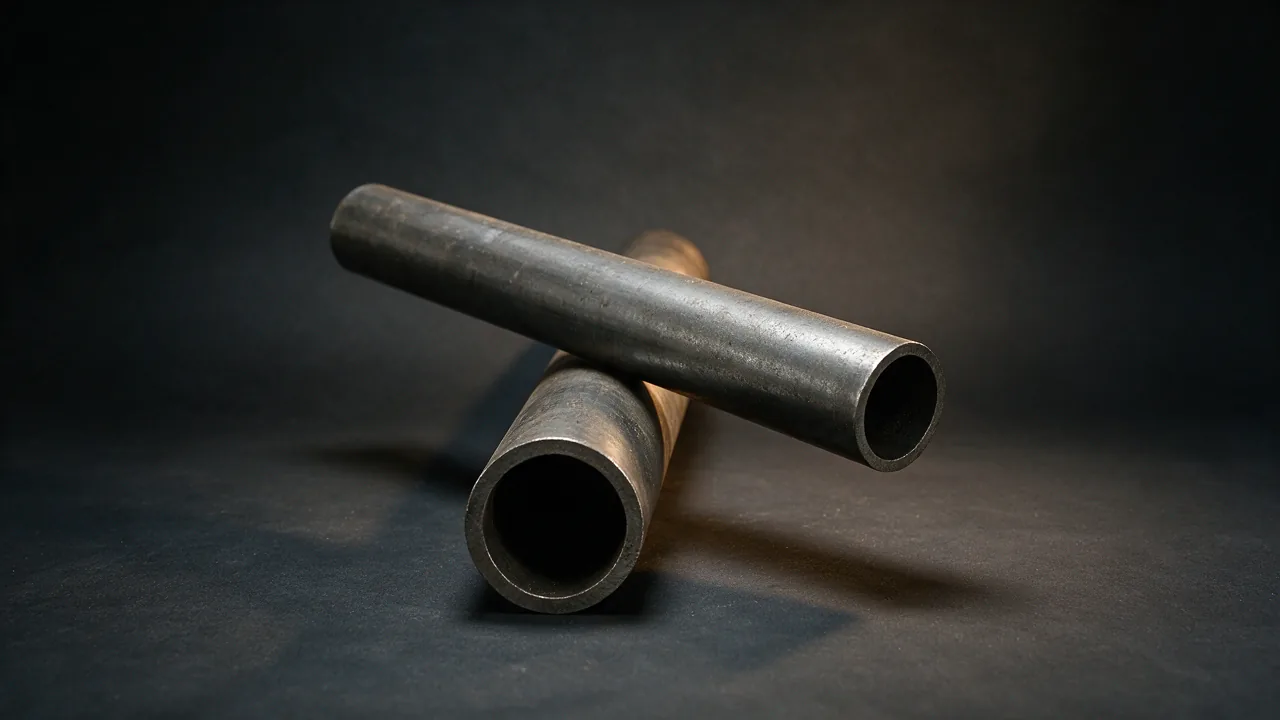
API 5L X70 pipe is a high-strength line pipe grade with a minimum yield strength of 483 MPa (70,000 psi) and a minimum tensile strength of 565 MPa (82,000 psi). ISO 3183 designates the same grade L485. It is used for large-diameter, high-pressure gas and crude oil transmission lines, where the higher allowable stress lets the designer hold wall thickness down and save on steel weight.
Download API 5L X70 Pipe data sheet (PDF) One-page summary of the supply range, chemistry, mechanical properties and inspection documents on this page. The standard is the governing document.
Mejor Steel is the export agent for the mills that make your material: one contract, one delivery date, and the mill named on the quotation. How we supply
We reply within one business day, Monday to Friday 09:00-18:00 CST. Or write to info@mejorsteel.com / WhatsApp.
Size range and specification
- Outside diameter 1/2 inch – 48 inch (12.7 – 1219 mm); seamless normally up to 24 inch
- Wall thickness 3.2 – 40 mm (SCH 10 – SCH 160, or by wall thickness)
- Length SRL 5.8 m, DRL 11.8 m, 20 FT, 40 FT, or random 6 – 18 m
- Ends Plain end, beveled end, threaded with coupling
- Surface treatment Black varnish, 3PE / 3LPE, FBE, 3PP, bare
- Manufacturing process Hot rolled seamless, ERW, LSAW, SSAW
- Delivery standard API 5L / ISO 3183, PSL1 or PSL2
- Delivery condition Quenched and tempered (Q), thermomechanically rolled (M)
How this grade is supplied
- Inspection Inspected by the producing mill’s own inspection department, which is independent of production, against the delivery standard above. Third-party inspection — SGS, BV or TUV, or an inspector you send yourself — can be arranged at the mill or before shipment; give us the dates and the scope at the order stage.
- Certificate A mill test certificate to EN 10204 3.1 showing the heat number, the chemical composition and the mechanical results is standard on every order. EN 10204 3.2, countersigned by the inspector you nominate, is available on request.
- Documents with the goods The mill test certificate and the packing list travel with the shipment, and the heat number is traceable from cast through to the finished product.
- Packing Sea-worthy export packing: bundled by size with end protection, corrosion protection on request, stencilled with the size, grade and heat number.
- MOQ One bundle or one truckload; mixed sizes within a bundle accepted.
- Lead time Counted from order confirmation, not from the enquiry. Stock sizes 5–10 days; mill run or non-stock 3–5 weeks. The delivery window is fixed on the quotation.
- How we supply Sourced through partner mills; the producing mill is named on the quotation.
API 5L X70 chemical composition, PSL2, wall thickness up to 25.0 mm (maximum, %)
| Grade / Delivery condition | C | Si | Mn | P | S | CE(IIW) |
|---|---|---|---|---|---|---|
| X70Q – quenched and tempered | 0.18 | 0.45 | 1.80 | 0.025 | 0.015 | 0.43 |
| X70M – thermomechanical (TMCP) | 0.12 | 0.45 | 1.70 | 0.025 | 0.015 | 0.43 |
X70 is normally supplied in one of the two PSL2 delivery conditions shown above; as-rolled delivery is not used at this strength level. When carbon is 0.12% or below, the CE(Pcm) limit of 0.25 applies instead of CE(IIW), and that is the condition in which X70M is normally ordered. Additions of niobium, vanadium and titanium are permitted only within the combined limits set by the standard. The standard also permits manganese to be raised above the tabulated maximum when carbon is reduced below its maximum, within a limit set by the grade, so a mill may supply manganese above the figure shown.
Source: chemical composition requirements of API 5L / ISO 3183, Table 4 (PSL 1) and Table 5 (PSL 2). The standard is the governing document.
API 5L X70 mechanical properties
| Grade | ISO 3183 designation | Yield strength | Tensile strength | Yield / tensile ratio max | Elongation |
|---|---|---|---|---|---|
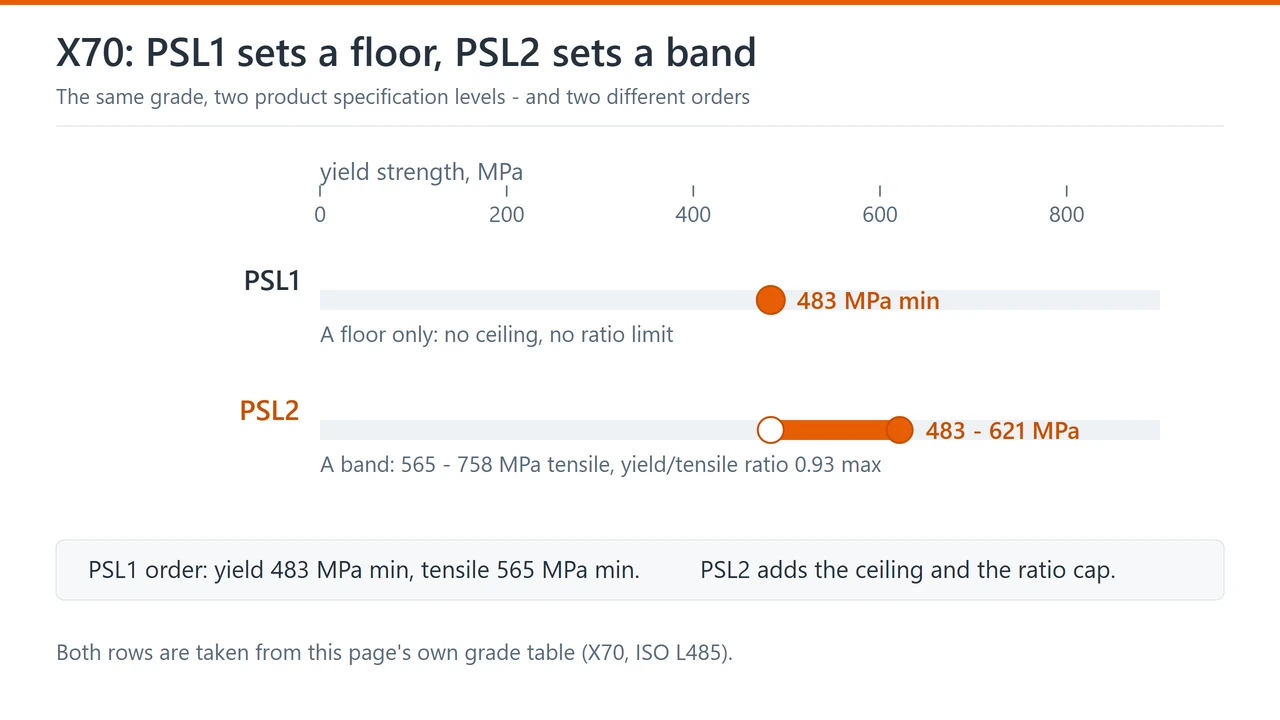
| X70 PSL1 | L485 | 483 MPa min (70,000 psi) | 565 MPa min (82,000 psi) | not specified | per formula |
| X70 PSL2 | L485 | 483 – 621 MPa (70,000 – 90,000 psi) | 565 – 758 MPa (82,000 – 110,000 psi) | 0.93 | per formula |
Elongation is calculated from the API 5L formula Af = C x A^0.2 / U^0.9, where A is the applicable tensile test cross-sectional area in mm2, U is the specified minimum tensile strength in MPa, and C is 1940 in metric units (625,000 in US customary units). API 5L Table 7 is published in both SI and US customary units; the ranges above are the US customary table converted to MPa, the same convention used on the other grade pages on this site. PSL1 grades specify minimum yield and tensile strength only; phosphorus and sulphur are capped at 0.030% each and no carbon equivalent is required.
Source: tensile requirements of API 5L / ISO 3183, Table 7. The standard is the governing document.
What Is API 5L X70 Pipe?
API 5L X70 is a high-strength line pipe grade with a minimum yield strength of 70,000 psi, equal to 483 MPa. ISO 3183 designates the same grade L485. Because the allowable stress is high, X70 lets a designer hold the wall thickness down on a large-diameter, high-pressure line, and that saving in steel weight is what pays for the higher price per tonne and for the tighter welding and inspection procedures the grade requires.
Why X70 Is Quenched and Tempered or TMCP
X70 is supplied in two PSL2 delivery conditions. X70Q is quenched and tempered, with carbon up to 0.18% and manganese to 1.80%. X70M is thermomechanically rolled, with carbon at 0.12% and manganese at 1.70%. As-rolled delivery is not used at this strength level, because a steel that reaches 485 MPa of yield without a controlled rolling or heat treatment schedule also loses the toughness and weldability a transmission line needs. The low carbon and the micro-alloying additions are what let the pipe be welded in the field with a procedure that does not require preheating to a high temperature.
Where X70 Pipe Is Used
X70 is used for long-distance, high-pressure gas transmission lines, large-diameter crude oil trunklines, and offshore export lines. It is the grade most often named in specifications for lines of 36 inch and above where the design pressure is high enough that wall thickness governs the tonnage. Because the steel is micro-alloyed and the welding window is narrower than for X60, X70 projects normally carry a qualified welding procedure specification and a defined preheat and interpass temperature.
X70 versus X60 and X65
Going from X60 to X70 raises the guaranteed yield strength by about 17%, which lets a designer cut wall thickness on a pressure-controlled line by roughly the same proportion, and the tonnage with it. The trade is that the higher grade costs more per tonne, needs tighter welding control, and tolerates less variation in field conditions, so it is a poor choice where the wall is fixed by handling, stability or corrosion allowance rather than by pressure. X65 is often the fallback when X70 is not available in the required wall thickness.
Sizes, Ends and Coatings
X70 is produced seamless up to about 24 inch and welded in ERW, LSAW and SSAW in larger diameters; large-diameter X70 is normally LSAW or SSAW made from plate or coil. Standard lengths are single random at 5.8 m and double random at 11.8 m, with 20 ft and 40 ft for export. Ends are plain, beveled or threaded with coupling. External coatings include black varnish, three-layer polyethylene (3PE/3LPE), fusion bonded epoxy (FBE) and three-layer polypropylene (3PP). Field joints are coated with a compatible system after the girth welds are made.
CE and CVN — the two numbers that decide whether X70 is accepted
X70 is a PSL2 grade in practice, and PSL2 turns two items from “mill practice” into order requirements: carbon equivalent and impact testing.
| Item | What API 5L requires for PSL2 | What you must write on the order |
|---|---|---|
| Carbon equivalent | A maximum CE(IIW) and a maximum CE(Pcm); the IIW formula applies when carbon is above 0.12% and the Pcm formula applies at or below that limit | The CE method you want reported, and the limit that applies to your grade and wall thickness |
| Manganese | With each reduction in carbon, manganese may be increased above the table value, up to a ceiling that depends on the grade | Nothing — but it explains why two mills’ chemistry sheets for the same grade can differ |
| Impact (CVN) | Required for PSL2. Seamless pipe is tested in the body; welded pipe is tested in the body, the weld and the heat-affected zone | The test temperature, the specimen orientation and size, and the minimum absorbed energy |
| Test frequency | Defined by the standard and by any supplementary requirement | Whether you need one test per heat, per lot, or per coil, and whether a third party must witness it |
Source: API 5L / ISO 3183 chemistry and testing tables for PSL2 pipe. For seamless pipe above roughly 20 mm wall thickness the standard leaves the carbon equivalent limits to agreement, so they must be stated. Confirm the exact limits against the current edition.
The CVN temperature is not fixed by PSL2. It comes from the design code or the line specification. If it is left off the enquiry, the mill has to come back and ask, which is a common reason an X70 quotation takes longer than expected.
Which delivery conditions X70 is actually supplied in
In PSL2 the delivery condition is part of the grade designation, and the designation is not decoration. It fixes the rolling route, the heat treatment, the achievable impact values and the price.
| Designation | Delivery condition | Notes for X70 |
|---|---|---|
| X70Q | Quenched and tempered | Available; commonly specified where strength and toughness are both demanding |
| X70M | Thermomechanical rolled | Available; the usual route for large-diameter, high-toughness line pipe |
| X70N | Normalized | Not listed as a standard PSL2 designation — the normalized route in the standard runs up to X60N |
Source: API 5L delivery condition designations for PSL1 and PSL2. Confirm the list against the current edition before refusing or accepting an “X70N” offer.
This is the detail that resolves most “X70N” arguments. If a specification writes X70N for PSL2 pipe, the mill has to confirm what it can actually certify: either the grade is supplied as X70Q or X70M, or the requirement has to be moved to a grade whose normalized route is listed. Settling that at the enquiry stage is much cheaper than settling it at the mill test certificate stage.
What to state on the enquiry
- Grade, PSL and delivery condition suffix: X70Q, X70M, or the equivalent L485 designation.
- Outside diameter, wall thickness, length and end finish.
- Carbon equivalent method and limit, if the project specifies one.
- CVN test temperature, specimen size and minimum absorbed energy.
- Non-destructive examination scope: full-body ultrasonic testing, weld-seam examination, or the project requirement.
- Certificate: EN 10204 3.1, or 3.2 with third-party countersignature.
- External coating and internal lining, if any, and the cutback for the field joint.
- Quantity, destination port and Incoterms.
Typical applications
- Long-distance gas transmission
- Large-diameter crude oil trunklines
- Offshore export lines
- High-pressure gathering and transmission
- Pipeline projects where wall thickness governs tonnage
Standards covered
Frequently asked questions
Is API 5L X70 the same as L485?
Yes. L485 is the ISO 3183 designation for the same grade, where 485 is the minimum yield strength in megapascals. X70 and L485 describe the same steel, and the choice of designation only affects which units the mechanical table on the purchase order is written in.
Why is a maximum yield strength specified for X70?
PSL2 places a ceiling as well as a floor on yield strength, 621 MPa for X70, and caps the yield-to-tensile ratio at 0.93. The ceiling exists because an over-strength pipe welded to a lower-strength one creates a mismatch that concentrates strain at the girth weld. In pipeline service a pipe that is stronger than specified is therefore a defect, not a bonus.
Can X70 pipe be welded in the field?
Yes, but with a qualified procedure. X70 has a narrower welding window than X52 or X60: heat input, preheat and interpass temperature, and consumable selection all have to be controlled, and most specifications require a procedure qualification record before production welding begins. On large projects the pipeline contractor holds the procedure and the pipe mill supplies material to a chemistry that supports it.
Where to go next
- API 5L LSAW Welded Steel Pipe – large diameter LSAW line pipe
- API 5L SSAW Spiral Welded Steel Pipe – spiral welded pipe for large diameter mains
- API 5L Seamless Steel Pipe – seamless line pipe to API 5L
- API 5L X80 Pipe – the highest-strength line pipe grade in routine use
- API 5L X60 Pipe – the most widely specified transmission grade
- API 5L X65 PSL2 Pipe – the high-strength line pipe grade in detail
- API 5L X52 Pipe – the mid-range line pipe grade in detail
- API 5L X42 Pipe – the low-strength line pipe grade above Grade B
- Steel Pipe Weight Calculator – work out the weight of any size and wall thickness
- Pipeline Transmission – line pipe for gathering and transmission
- Get a Quote – send the grade, size, quantity and destination port
- API 5L ERW Welded Steel Pipe – smaller diameter ERW line pipe
Four details and we can quote. The grade or the standard the material has to meet, the size and wall thickness, the tonnage, and the destination port. Send them together and we answer with availability and pricing.
Request a quotation