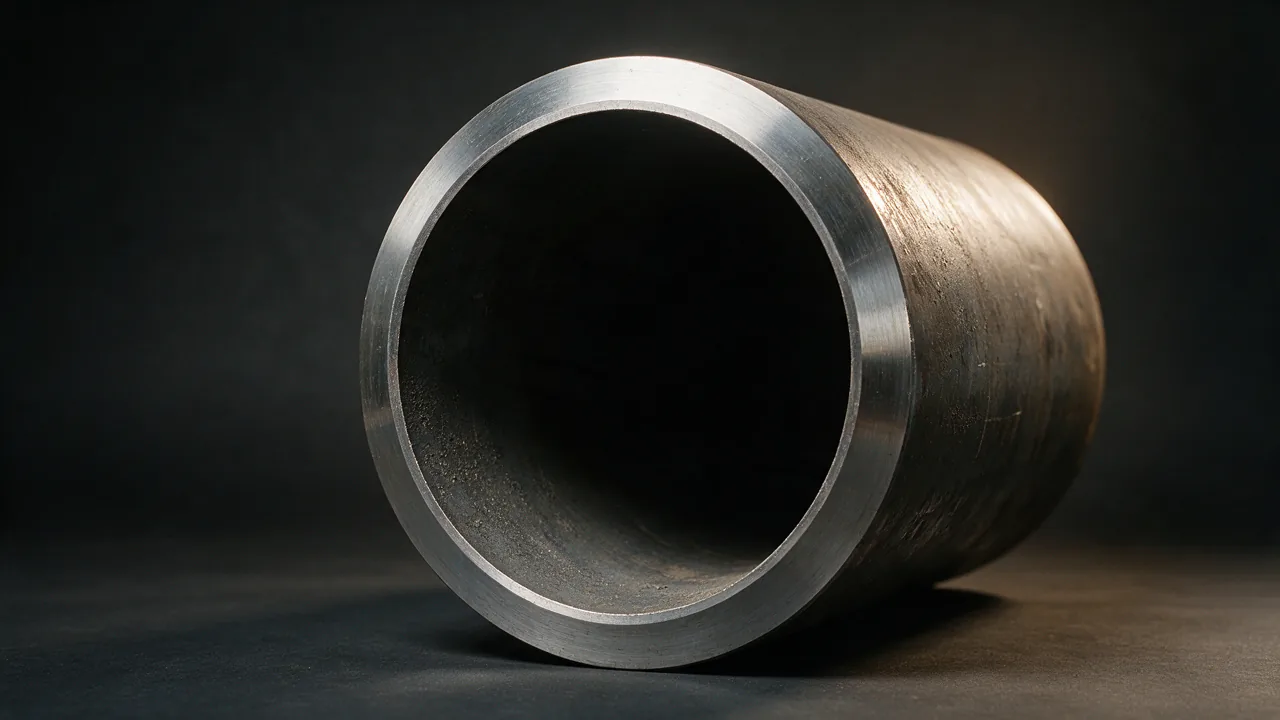
API 5L X80 is the highest-strength line pipe grade routinely ordered for onshore transmission mains, with a minimum yield strength of 555 MPa (80,500 psi) and the ISO 3183 designation L555 (API 5L’s US-customary column gives the same grade as 80,000 psi, or 551 MPa). It is a PSL2-only grade and is supplied in two delivery conditions, quenched and tempered (X80Q) and thermomechanically rolled (X80M), most often as large-diameter LSAW or SSAW pipe for high-pressure gas transmission.
Download API 5L X80 Pipe data sheet (PDF) One-page summary of the supply range, chemistry, mechanical properties and inspection documents on this page. The standard is the governing document.
Mejor Steel is the export agent for the mills that make your material: one contract, one delivery date, and the mill named on the quotation. How we supply
We reply within one business day, Monday to Friday 09:00-18:00 CST. Or write to info@mejorsteel.com / WhatsApp.
Size range and specification
- Outside diameter 20 inch – 48 inch (508 – 1219 mm); seamless on request at smaller sizes
- Wall thickness 6.0 – 40 mm
- Length SRL 5.8 m, DRL 11.8 m, 20 FT, 40 FT, or random 6 – 18 m
- Ends Plain end, beveled end
- Surface treatment Black varnish, 3PE / 3LPE, FBE, 3PP, bare
- Manufacturing process LSAW, SSAW spiral welded; seamless on request
- Delivery standard API 5L / ISO 3183, PSL2 only
- Delivery condition Quenched and tempered (Q), thermomechanically rolled (M)
How this grade is supplied
- Inspection Inspected by the producing mill’s own inspection department, which is independent of production, against the delivery standard above. Third-party inspection — SGS, BV or TUV, or an inspector you send yourself — can be arranged at the mill or before shipment; give us the dates and the scope at the order stage.
- Certificate A mill test certificate to EN 10204 3.1 showing the heat number, the chemical composition and the mechanical results is standard on every order. EN 10204 3.2, countersigned by the inspector you nominate, is available on request.
- Documents with the goods The mill test certificate and the packing list travel with the shipment, and the heat number is traceable from cast through to the finished product.
- Packing Sea-worthy export packing: bundled by size with end protection, corrosion protection on request, stencilled with the size, grade and heat number.
- MOQ One bundle or one truckload; mixed sizes within a bundle accepted.
- Lead time Counted from order confirmation, not from the enquiry. Stock sizes 5–10 days; mill run or non-stock 3–5 weeks. The delivery window is fixed on the quotation.
- How we supply Sourced through partner mills; the producing mill is named on the quotation.
API 5L X80 chemical composition, PSL2, wall thickness up to 25.0 mm (maximum, %)
| Grade / Delivery condition | C | Si | Mn | P | S | CE(IIW) |
|---|---|---|---|---|---|---|
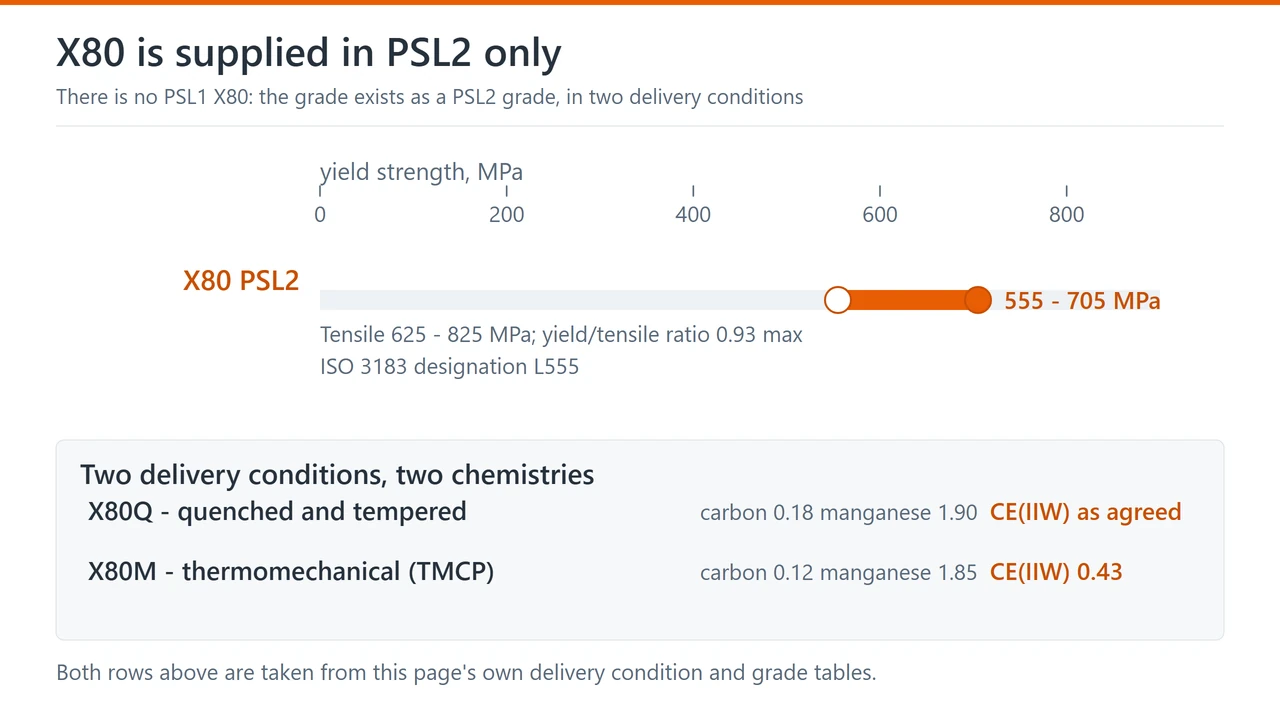
| X80Q – quenched and tempered | 0.18 | 0.45 | 1.90 | 0.025 | 0.015 | as agreed |
| X80M – thermomechanical (TMCP) | 0.12 | 0.45 | 1.85 | 0.025 | 0.015 | 0.43 |
X80 is a PSL2-only grade, so both sets of limits above are mandatory rather than order-specific. The carbon equivalent limit that applies follows the carbon content: at 0.12% carbon or below the CE(Pcm) limit of 0.25 governs and the CE(IIW) column does not apply, which is the condition in which X80M is normally ordered. Niobium, vanadium and titanium may be added only within the combined limit set by the standard. The standard also permits manganese to be raised above the tabulated maximum when carbon is reduced below its maximum, up to 2.00% for X80, so a mill may supply manganese above the figure shown.
Source: chemical composition requirements of API 5L / ISO 3183, Table 4 (PSL 1) and Table 5 (PSL 2). The standard is the governing document.
API 5L X80 mechanical properties
| Grade | ISO 3183 designation | Yield strength | Tensile strength | Yield / tensile ratio max | Elongation |
|---|---|---|---|---|---|
| X80 PSL2 | L555 | 555 – 705 MPa (80,500 – 102,300 psi) | 625 – 825 MPa (90,600 – 119,700 psi) | 0.93 | per formula |
Elongation is calculated from the API 5L formula Af = C x A^0.2 / U^0.9, where A is the applicable tensile test cross-sectional area in mm2, U is the specified minimum tensile strength in MPa, and C is 1940 in metric units (625,000 in US customary units). API 5L Table 7 is published in both SI and US customary units; the range above is the US customary table converted to MPa, the same convention used on the other grade pages on this site. There is no PSL1 version of X80, so no PSL1 row appears.
Source: tensile requirements of API 5L / ISO 3183, Table 7. The standard is the governing document.
What Is API 5L X80 Pipe?
API 5L X80 pipe is steel line pipe for the transportation of oil and natural gas, defined by a minimum yield strength of 80,000 psi – 555 MPa – and designated L555 under the equivalent ISO 3183 standard. X80 belongs to Product Specification Level 2 only, which means every length is delivered with a full set of test results and the chemistry, tensile and impact requirements are mandatory rather than order-specific. On a strength-per-tonne basis it is the most efficient grade routinely ordered for high-pressure onshore transmission mains, and it is almost always supplied in large diameters as LSAW or SSAW pipe.
Why X80 Is Limited to PSL2
Although most API 5L grades are available at both PSL1 and PSL2, X80 is offered at PSL2 only. PSL1 sets minimum yield and tensile strength with a simple carbon and manganese chemistry, and does not extend to the controlled rolling and accelerated cooling routes that X80 depends on for its strength and toughness. X80 is produced in two delivery conditions: quenched and tempered (X80Q), and thermomechanically rolled (X80M, also written TMCP). Both are low-carbon steels with careful niobium, vanadium and titanium additions, because toughness at this strength cannot be reached by chemistry alone – the rolling practice is part of the specification, not a mill preference. The carbon equivalent limit that applies then follows the carbon level, with CE(Pcm) 0.25 governing up to 0.12% carbon and CE(IIW) 0.43 above it.
Where X80 Pipe Is Used
X80 is specified mainly on high-pressure, long-distance onshore gas transmission pipelines, where moving up from X70 to X80 allows a thinner wall and therefore less steel tonnage and less welding on the line. It is also used on large-diameter water transmission mains and, less often, on high-pressure gathering lines and offshore export lines. Because the grade is ordered by pipeline projects rather than by individual fabricators, sizes are concentrated in large outside diameters and in wall thicknesses between 6 mm and 40 mm.
X80 versus X70 and X65
Moving from X65 to X70 to X80 raises the minimum yield strength from 448 MPa to 483 MPa to 555 MPa, which allows the same operating pressure to be carried with a thinner wall. The trade-off is on weldability and toughness: the higher the strength, the tighter the carbon equivalent and the more the grade depends on controlled rolling, so X80 needs qualified welding procedures and is less forgiving than X70 where field conditions are difficult. In practice many operators stay at X70 unless a project’s length or pressure justifies the change, and X80 tends to be ordered where the wall-thickness saving is real over a long line.
Sizes, Ends and Coatings
X80 is supplied most often as LSAW pipe from 20 inch to 48 inch outside diameter and as SSAW spiral welded pipe in the same range, with seamless X80 available on request at smaller diameters. Ends are normally plain or beveled for field welding. External coatings are chosen for burial and for the pipeline’s cathodic protection: three-layer polyethylene (3PE / 3LPE) is the most common, fusion bonded epoxy (FBE) is used where only corrosion resistance is required, and three-layer polypropylene (3PP) is selected for higher operating temperatures. The coating is applied over a blasted surface so that it bonds directly to the steel.
What X80 changes on site
The pipe itself is not the difficult part of an X80 project. The welding programme is. X80 buys a thinner wall for the same pressure and diameter, and it takes the saving back in qualification, welding control and repair.
| Area | What changes with X80 | Why it matters to the programme |
|---|---|---|
| Welding procedure | Higher yield strength calls for a qualified procedure with controlled heat input, preheat, interpass temperature and hydrogen control | A procedure qualified on X65 or X70 is not automatically valid for X80; qualification and any procedure qualification record take time and have to be planned before mobilisation |
| Field welding and repair | Repair rates rise when the procedure is not tuned to the grade, and a repair needs its own procedure | Repair is where X80 projects lose schedule, because a cut out and re weld in the field costs far more than the tonnage saved |
| Wall thickness | For the same pressure and diameter the required wall is thinner than X65, so the tonnage falls | Thinner wall high grade pipe needs handling, stacking and ovality control, and it tolerates less abuse on site |
| Inspection and acceptance | Higher grades are more sensitive to weld defects, so the acceptance criteria and the NDT method have to be agreed before welding starts | A change of acceptance criteria after welding means cut outs |
| Coating and field joints | The coating cutback and the field joint coating interact with the heat input allowed for the grade | The field joint specification belongs with the line pipe order, not with the coating order alone |
Source: engineering practice for high grade line pipe. The chemical, carbon equivalent and impact requirements themselves are in API 5L and are tabulated on this page; welding procedure qualification is governed by the project specification.
When X80 is not the answer
X80 is a project specific choice, and there are four situations where a lower grade usually gives the better result overall.
- Small tonnage or small diameter. The material saving scales with tonnage and wall thickness; the welding cost does not. On short lengths and small diameters, X65 or X70 frequently comes out cheaper once procedure qualification and welding time are counted.
- Sour service. NACE MR0175 / ISO 15156 applies to the material and the weld, and higher strength grades carry hardness and welding limits that have to be respected. Confirm the grade against the actual partial pressure and the hardness requirement before X80 is written into the line class.
- Low temperature service. X80 is a line pipe grade, not a low temperature grade. Where the design temperature is low, the low temperature specifications with impact requirements for that temperature apply instead.
- A contractor without a qualified welding programme. If the welding contractor cannot show a procedure and welders qualified for the grade, the project is buying a schedule risk as well as pipe.
Does a lower tonnage always mean a lower cost?
No. X80 reduces the wall thickness and therefore the tonnage for the same design pressure, but it also moves cost into procedure qualification, welding control, inspection and repair. The comparison that decides the grade is the installed cost of the line, not the price per ton of the pipe.
Typical applications
- High-pressure gas transmission mains
- Long-distance onshore trunk lines
- Large-diameter water transmission mains
- High-pressure gathering lines
- Offshore export lines
Standards covered
Frequently asked questions
Is X80 available in PSL1?
No. X80 is a PSL2-only grade. PSL1 does not extend to this strength level, so X80 pipe should always come with PSL2 documentation – a full set of mechanical tests on each length plus the chemistry and impact results.
What is the difference between X80Q and X80M?
X80Q is quenched and tempered: the pipe is austenitized and then rapidly cooled and tempered, giving a uniform fine-grained structure. X80M is thermomechanically rolled (TMCP) and is not subsequently re-austenitized, relying on controlled rolling and accelerated cooling for its properties. Both meet the same minimum yield and tensile strength; the choice depends on the mill route, the diameter and wall, and the project specification.
What pressure can X80 pipe carry?
The pressure is not fixed by the grade. It is calculated from the wall thickness, outside diameter and design factor in the pipeline design code, normally ASME B31.4 or B31.8. X80’s advantage is that its higher yield strength allows the same pressure at a thinner wall, or a higher pressure at the same wall, compared with X70.
Where to go next
- API 5L X70 Pipe – high-strength pipe for large diameter lines
- API 5L X65 PSL2 Pipe – the high-strength line pipe grade in detail
- API 5L Grade B Pipe – the low-strength line pipe grade, PSL1 and PSL2
- API 5L LSAW Welded Steel Pipe – large diameter LSAW line pipe
- API 5L SSAW Spiral Welded Steel Pipe – spiral welded pipe for large diameter mains
- API 5L Seamless Steel Pipe – seamless line pipe to API 5L
- Steel Pipe Weight Calculator – work out the weight of any size and wall thickness
- Pipeline Transmission – line pipe for gathering and transmission
- Get a Quote – send the grade, size, quantity and destination port
- Anti-Corrosion Coated Steel Pipe – 3PE, FBE and 3PP coated pipe
Need a price for a specific size and grade? Send the standard and grade, the size and wall thickness, the quantity and the destination port. We reply with availability and pricing.
Request a quotation