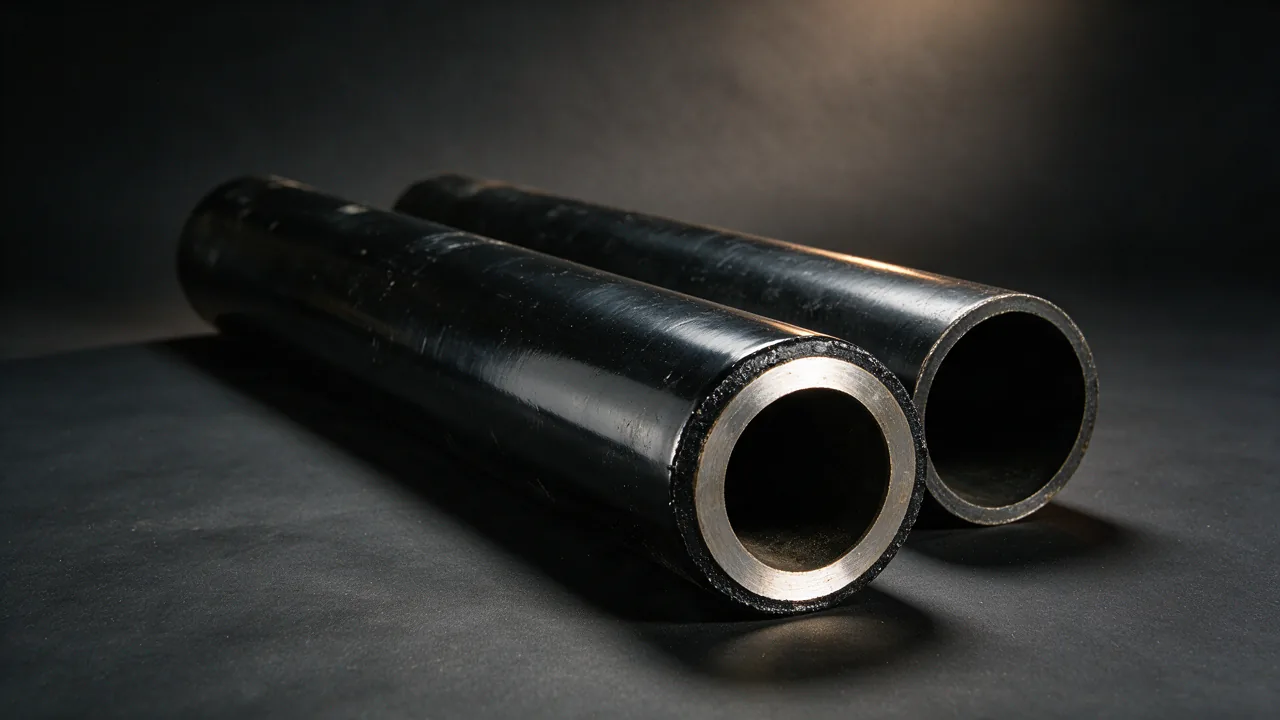
External and internal coated steel pipe with 3PE, 3PP, FBE, epoxy lining and cement mortar lining for buried, subsea and corrosive service.
- Standard: API 5L, DIN 30670, ISO 21809, AWWA C210, AWWA C205
- Grades: Depends on base pipe, Grade B to X80
- Certificate: EN 10204 3.1 with every order, 3.2 on request
Mejor Steel is the export agent for the mills that make your material: one contract, one delivery date, and the mill named on the quotation. How we supply
We reply within one business day, Monday to Friday 09:00-18:00 CST. Or write to info@mejorsteel.com / WhatsApp.
Specifications
| Outer diameter | 1" - 60" (25 - 1524 mm) |
|---|---|
| Wall thickness | Depends on base pipe |
| Length | 6 m, 12 m, or custom |
| Ends | Beveled or plain with cutback, coated field joint |
| Surface treatment | 3PE / 3LPE, 3PP, FBE, epoxy lining, cement mortar lining, coal tar enamel |
| Manufacturing process | Applied over seamless, ERW, LSAW or SSAW base pipe |
| Pressure rating | Buried, subsea and highly corrosive service |
3PE, 3PP and FBE Compared
FBE, or fusion bonded epoxy, is a single layer of epoxy powder applied electrostatically to a heated pipe surface, where it melts and cures into a hard, tightly bonded film typically 300 to 500 microns thick. It is the most widely used external coating for buried pipelines, offers excellent adhesion and high temperature resistance, but is relatively thin and can be damaged by handling. Three layer polyethylene, 3PE, consists of an FBE primer, a copolymer adhesive layer and an outer high density polyethylene jacket, giving total thickness typically 2.0 to 3.7 mm. It combines the adhesion of FBE with mechanical toughness, and is the preferred coating for large diameter transmission lines that must survive handling, rocky backfill and construction traffic. 3PP substitutes polypropylene for the outer layer and is chosen where higher operating temperatures exceed the capability of polyethylene.
How to Specify a Coated Pipe
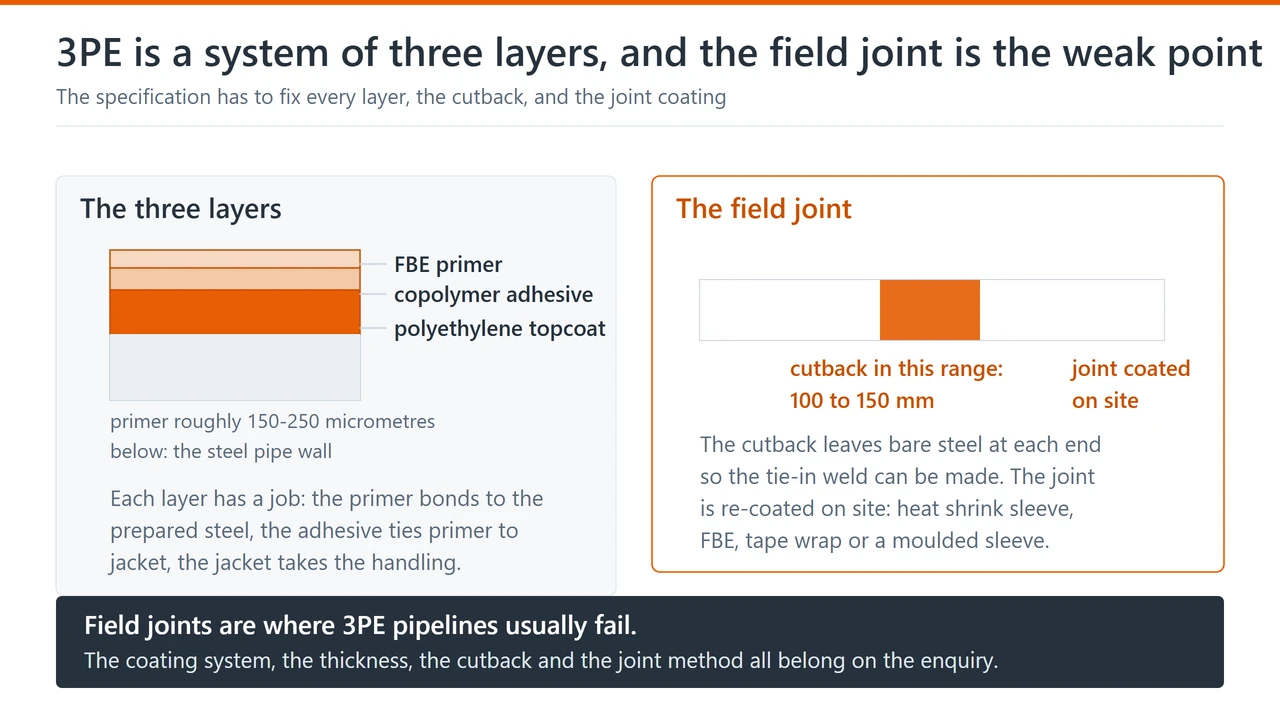
A coated pipe specification must define four things: the coating system and standard, the coating thickness, the cutback length at the pipe ends, and the field joint coating method. Cutback is the length of bare pipe left at each end so that the tie-in weld can be made on uncoated steel; a typical cutback is 100 to 150 mm. The field joint is then re-coated on site, and the specification should state whether this uses heat shrink sleeve, FBE, tape wrap or a moulded sleeve. For water lines the internal surface is often lined as well, either with epoxy for flow and corrosion control or with cement mortar for potable water. Coating test reports covering thickness, holiday detection, adhesion and cathodic disbondment are provided with each production run.
Coating Names and Pipe Sizes
3PE and 3LPE are two names for the same coating – three-layer polyethylene – and both appear on enquiries, so a 3LPE coated pipe and a 3PE coated pipe are the same article. 3PP is the polypropylene version, chosen where the pipe runs hotter, and FBE is the single-layer alternative; an FBE coated pipe is a different product with the different layer stack compared above. Coated pipe is commonly supplied from 2 in (60.3 mm) up to 48 in (1219 mm) outside diameter, and the coating is applied to pipe that has already passed its dimensional and weld inspection, so the line pipe underneath can be API 5L, ASTM A53 or ASTM A106. Specify the coating system, the film thickness, the standard it is applied to, and whether the ends are left bare for field welding.
Coated pipe: the soil and the service choose the coating
Coating is applied over a base pipe that is already specified, so the coating question is separate from the pipe question. What decides it is where the line is buried, what the soil and the groundwater are like, whether the line is pulled or laid, and what operating temperature the coating has to survive.
| Service condition | What it decides | What to state on the enquiry |
|---|---|---|
| Buried onshore, ordinary soil | 3PE or 3LPE, the three layer system, is the usual default | the coating system, and the cutback length at the ends |
| Wet or high salinity ground | FBE, or a three layer system with a demonstrated disbondment result | the soil condition and the cathodic disbondment requirement |
| Subsea or offshore | Coating plus concrete weight coating for on-bottom stability | whether concrete weight coating is in scope |
| Internal corrosion or potable water | Cement mortar or epoxy lining, to a named standard | the lining standard and the finished thickness |
| High operating temperature | Coating selection is limited by the temperature it has to survive | the maximum operating temperature |
| Field joints | The joint coating has to be compatible with the line coating | whether field joint material is supplied with the pipe |
| Pulled or rough handling | Damage resistance becomes part of the specification | whether holiday testing is carried out at the works |
The two numbers to fix in the specification are the dry film thickness and the holiday test. FBE is specified at 300–500 µm; 3LPE as a total thickness of 2.0–3.7 mm — an FBE primer of roughly 150–250 µm, then an adhesive layer and a polyethylene outer. Holiday detection is run at high voltage on every coated length, with the voltage set from the coating thickness per the coating standard, to find pinholes that a thickness gauge alone will miss. Adhesion, peel and cathodic disbondment are run on coupons from the production run and reported on the coating certificate.
What is the difference between 3PE and 3LPE?
They refer to the same coating. 3LPE stands for three layer polyethylene, and 3PE is the common abbreviation. Both describe a system consisting of an FBE primer, a copolymer adhesive and a polyethylene topcoat. When you see 2LPE it means the adhesive layer has been omitted and the polyethylene is bonded directly to the FBE primer, which is a cheaper but lower performance system normally used for smaller diameter or less critical lines.
How much does 3PE coating add to the pipe cost?
As a general indication, 3PE coating typically adds 15 to 30 percent to the bare pipe price depending on diameter, coating thickness and order quantity, with smaller diameters carrying a proportionally higher increase. FBE alone is cheaper, typically adding around 8 to 15 percent. Because coating cost is quoted per square metre and varies with coating plant loading, always request a specific quotation for your diameter and quantity.
The three layers and what each one does
Three-layer polyethylene is a system, not a single coating. Each layer has one job, and a failure in any one of them shows up as a coating failure years later.
| Layer | Material | Job | What the order must fix |
|---|---|---|---|
| First (primer) | Fusion bonded epoxy | Bonds to the prepared steel surface and forms the corrosion barrier | Primer type and thickness, as required by the coating specification |
| Second (adhesive) | Copolymer adhesive | Bonds the primer to the topcoat so the system acts as one film | Adhesive grade and extruder conditions, verified by peel testing |
| Third (topcoat) | Polyethylene | Mechanical protection and moisture barrier against soil stress and backfill damage | Topcoat type, total film thickness and the coating class |
Source: coating structure per DIN 30670 and ISO 21809-1. Total film thickness depends on pipe diameter and the coating class written in the project specification — it is not chosen from the pipe size alone.
One consequence worth stating on the order: because the thickness is set by the project class rather than by the pipe size, two quotations for the same pipe diameter can legitimately differ. Ask which coating class and which total thickness the price is based on.
What is inspected before the pipe leaves the coating plant
| Test | What it proves | How the acceptance value is set |
|---|---|---|
| Surface preparation and anchor profile | The primer can bond | Surface standard and profile range in the coating specification |
| Coating thickness | The corrosion barrier is present and even | Measured against the required total and layer thickness |
| Holiday (pinhole) detection | The film is continuous | Acceptance level in the coating specification |
| Peel or adhesion strength | The three layers act as one system | Minimum peel strength at the specified temperature |
| Cathodic disbondment | The coating resists disbonding where it is damaged | Test conditions and maximum disbondment radius |
| Impact and indentation resistance | The pipe survives handling and backfill | Test method and acceptance for the coating class |
| Flexibility and elongation | The coating survives field bending | Test temperature and percentage elongation |
Source: test families per ISO 21809-1 and DIN 30670. The nominated test, temperature and acceptance value must come from the project coating specification; confirm them before the coating order is placed.
Field joints are where 3PE pipelines usually fail
The mainline coating is applied in a plant under controlled conditions. The girth weld area is coated in the field, by a different crew, often in worse weather. That is where water finds its way in.
Three details decide the outcome:
- Compatibility. The field-joint material has to be qualified against the plant-applied 3PE system. A heat-shrink sleeve that is compatible with one polyethylene topcoat is not automatically compatible with another.
- Cutback length. The coating is cut back from each pipe end at the coating plant, so the cutback has to match the field-joint sleeve width. Fix the cutback with the field-joint supplier before coating starts, not after the pipe is coated.
- Surface preparation at the joint. The field joint is the only part of the line where the steel is prepared outside a coating plant; its surface preparation standard should be written into the construction specification.
Which pipe can be coated, and what to state on the enquiry
- Base pipe type: seamless, ERW, LSAW or SSAW.
- Outside diameter and wall thickness, or the pipe schedule.
- Coating system and class: 3PE (3LPE), 3PP, or FBE, with the standard (DIN 30670, ISO 21809-1 or the project specification).
- Required total film thickness, or the coating class from which it follows.
- Pipe end condition and cutback length.
- Inspection requirement: coating plant test reports, and whether third-party witnessing is required.
- Quantity, length per joint, and destination port.
Grades supplied and minimum properties
The grade fixes the minimum strength and the chemistry. The table below gives the requirements that separate the API 5L grades ordered most often; the full composition and mechanical table for each grade is on its own page.
| Grade | Yield strength | Tensile strength |
|---|---|---|
| Grade B | 245 MPa min (35,500 psi) | 415 MPa min (60,200 psi) |
| X42 | 290 MPa min (42,000 psi) | 414 MPa min (60,000 psi) |
| X52 | 359 MPa min (52,000 psi) | 455 MPa min (66,000 psi) |
| X60 | 414 MPa min (60,000 psi) | 517 MPa min (75,000 psi) |
| X65 | 448 MPa min (65,000 psi) | 531 MPa min (77,000 psi) |
| X70 | 483 MPa min (70,000 psi) | 565 MPa min (82,000 psi) |
| X80 | 555 – 705 MPa (80,500 – 102,300 psi) | 625 – 825 MPa (90,600 – 119,700 psi) |
The complete chemistry and mechanical table for each grade, with the notes that qualify it, is on the individual grade page – for example API 5L X65 pipe. The coating goes on pipe that has already passed its dimensional and weld inspection, so these are the base pipe requirements; the coating system is specified separately on top of them.
Source: specified minimum yield and tensile strength for each grade, per API 5L / ISO 3183, Table 7. The standard is the governing document.
- Depends on base pipe
- Grade B to X80
Download Anti-Corrosion Coated Steel Pipe data sheet (PDF) One page: supply range, grades and key sizes, what to state on the enquiry, and the inspection documents that come with the order. The standard is the governing document.
Where to go next
- 3PE vs FBE coating — which system suits which soil, temperature and installation method.
- API 5L LSAW welded steel pipe — the base pipe most often used for large-diameter coated lines.
- Quality and inspection — how the coating inspection fits into the pre-shipment checks.
Materials
- Carbon steel with coating system
- Coating: PE, PP, FBE, epoxy, cement mortar
Typical applications
- Buried oil and gas transmission pipelines
- Subsea and offshore pipelines
- High salinity and wet H2S service
- Municipal water and wastewater lines
- Chemical plant corrosive service
Inspection & testing
- Coating thickness measurement
- Holiday (pinhole) detection
- Adhesion and peel strength test
- Cathodic disbondment test
- Impact resistance test
- Third-party inspection (SGS, BV, TUV)
| Packaging | Sea-worthy export packing: bundled by size, plastic caps on both ends, corrosion protection on request, stencilled with size, grade and heat number. |
|---|---|
| MOQ | One bundle or one truckload; mixed sizes within a bundle accepted. |
| Lead time | Stock sizes: 7-15 days. Mill run / non-stock: 4-6 weeks after order confirmation. |
Payment: T/T 30% deposit with the balance before shipment; L/C at sight also accepted. Final terms are confirmed on the quotation.
How we supply: sourced through partner mills; the producing mill is named on the quotation. How we supply sets out who is accountable for the order.
Need this product? Send the size, grade, quantity and destination port and we will reply with availability and pricing.
Request a quotation