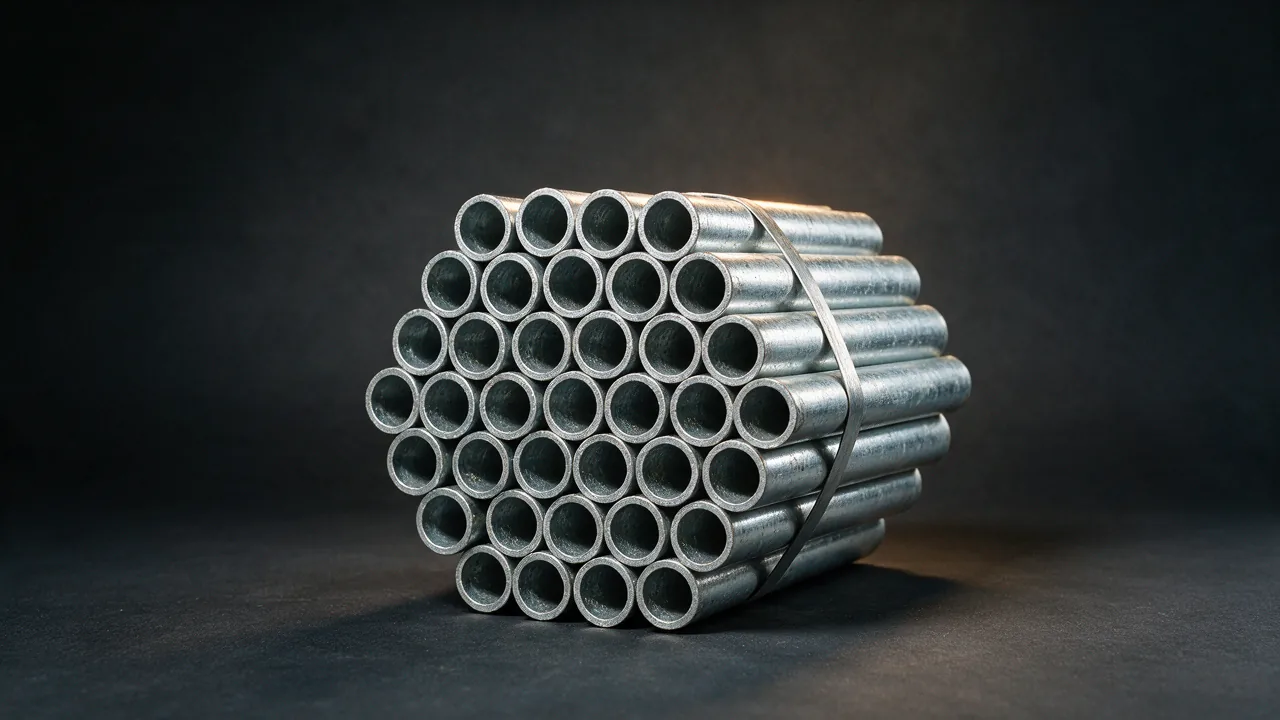
Hot dip galvanized steel pipe to ASTM A53, EN 10255 and BS 1387, in round, square and rectangular sections for structural, water and fencing use.
- Standard: ASTM A53, EN 10255, BS 1387, ISO 1461, ASTM A123
- Grades: Grade A, Grade B, S235JR, St 37
- Certificate: EN 10204 3.1 with every order, 3.2 on request
- Also known as: GI pipe, galvanised steel pipe, HDG pipe
Mejor Steel is the export agent for the mills that make your material: one contract, one delivery date, and the mill named on the quotation. How we supply
We reply within one business day, Monday to Friday 09:00-18:00 CST. Or write to info@mejorsteel.com / WhatsApp.
Specifications
| Outer diameter | 1/2" - 12" (21.3 - 323.9 mm) |
|---|---|
| Wall thickness | 1.5 - 12 mm |
| Schedule | Light, medium, heavy (BS 1387) |
| Length | 6 m, or custom 5.8 - 12 m |
| Ends | Plain, threaded and coupled, grooved |
| Surface treatment | Hot dip galvanized, pre-galvanized |
| Manufacturing process | ERW or seamless base pipe, then hot dip galvanized |
| Pressure rating | Low to medium pressure |
How Hot Dip Galvanizing Protects Steel
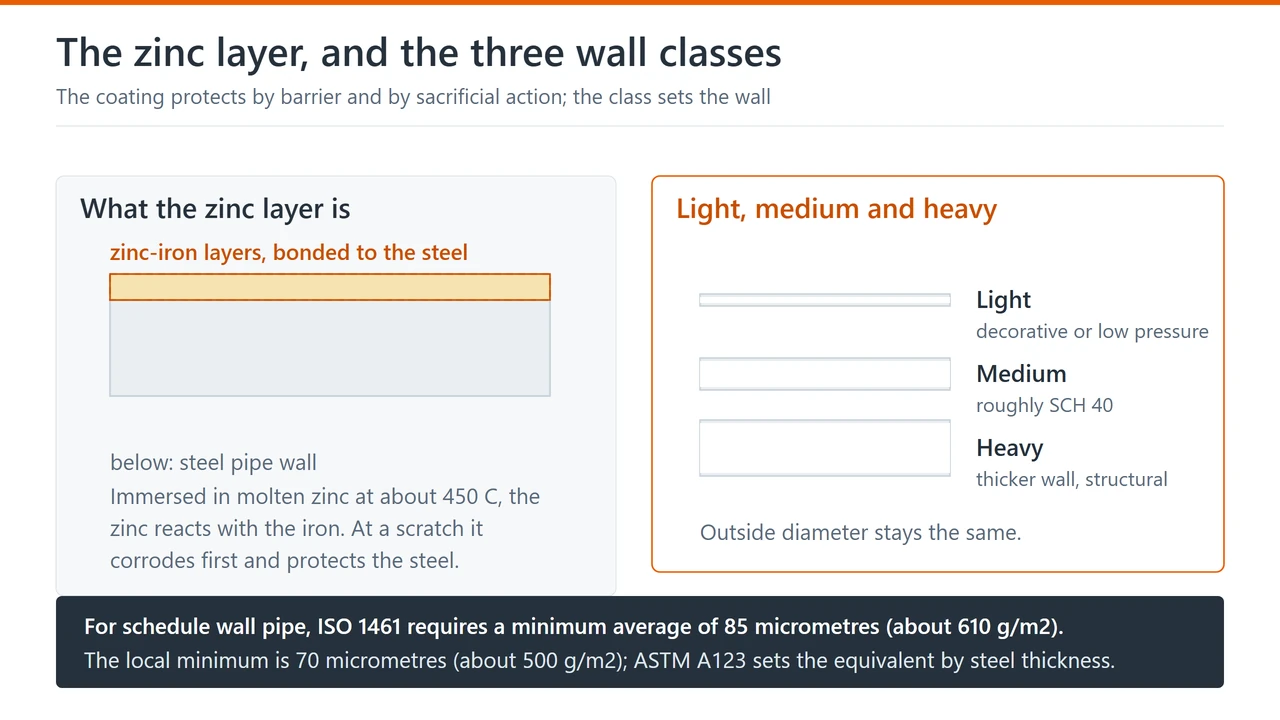
In hot dip galvanizing the cleaned steel pipe is immersed in molten zinc at approximately 450 degrees C, so the zinc reacts with the iron to form a series of zinc-iron intermetallic layers that are metallurgically bonded to the steel. This bond is far stronger than a paint film, so the coating does not flake off under impact. The protection works in two ways. First, as a barrier that seals the steel from the environment. Second, and more importantly, by sacrificial action: zinc is more electrochemically active than iron, so at a scratch or cut edge the zinc corrodes preferentially and protects the exposed steel. This is why galvanized pipe continues to perform well at cut ends and damaged areas, unlike painted pipe. A typical hot dip coating of 500 g/m2 provides a service life measured in decades in rural or mild industrial atmospheres.
As a galvanized steel pipe supplier, Mejor Steel supplies hot dip galvanized pipe from China, galvanized to the base pipe specification the order names, with the coating thickness, the end finish and the threaded-and-coupled option set out on this page.
Light, Medium and Heavy Class Pipe
BS 1387 and EN 10255 classify galvanized pipe into light, medium and heavy classes for each nominal size, where the outside diameter stays constant and only the wall thickness changes. Medium class corresponds roughly to SCH 40 and is by far the most common, used for general water and gas service. Heavy class has a thicker wall for higher pressure and mechanical strength, and is often used for structural columns and load-bearing frames. Light class is thin walled and is restricted to low pressure or purely decorative applications. When ordering it is essential to state the class, because a light class pipe and a heavy class pipe of the same nominal size are visually almost identical but differ significantly in weight, pressure rating and price.
Galvanized pipe: the coating class sets the service life
Galvanizing is a corrosion barrier whose life is proportional to how much zinc is on the surface, so the useful question is not whether the pipe is galvanized but to what coating weight or thickness and to which standard. Hot dip galvanized and pre-galvanized are different products and are not interchangeable.
| Service condition | What it decides | What to state on the enquiry |
|---|---|---|
| Fencing, handrail, general outdoor use | A light coating class is normally sufficient | the coating class, and the standard it is measured against |
| Water or irrigation line | Medium class, with the internal surface coated as well | whether the bore is coated as well as the outside |
| Structural or greenhouse frame | Coating weight per unit area is the real specification | the minimum coating weight in g/m2 |
| Coastal or aggressive atmosphere | A heavier coating, or a duplex coating system | the exposure category the structure sits in |
| Threaded and coupled pipe | Cut threads are uncoated, so the threaded ends are a separate item | whether threaded ends are to be protected |
| Square, rectangular or round section | The section shape changes how the coating builds at the corners | the section shape and the wall |
| Fabrication after delivery | Welding and cutting breaks the coating locally | whether repair coating is to be supplied with the order |
Coating weight is the number to specify, not just thickness. For schedule-wall pipe (steel 6 mm and over), ISO 1461 requires a minimum average of 85 µm (≈610 g/m²) and a local minimum of 70 µm (≈500 g/m²); ASTM A123 sets the equivalent by steel thickness. State the minimum coating weight per unit area and the standard it is applied to, and confirm the figure on the test certificate.
How long does a galvanized pipe last?
Service life depends almost entirely on the environment and the coating weight. In a rural or mild atmosphere, a 500 g/m2 coating typically gives 30 to 50 years or more. In a marine or heavily industrial atmosphere the same coating may give 10 to 20 years. In soil, life varies with soil resistivity and pH, but buried galvanized pipe commonly performs for 25 to 50 years. Coating weight, not just thickness, is the key parameter – always specify the minimum coating weight per unit area and confirm it on the test certificate.
Can galvanized pipe be welded?
It can, but it requires care. The zinc coating vaporizes at around 900 degrees C, well below the welding temperature, producing zinc oxide fume that is harmful if inhaled and that can cause porosity in the weld. Best practice is to grind the coating back at least 25 to 50 mm from the joint on both sides, weld, and then restore the coating with a zinc-rich paint or a heat shrink sleeve. Adequate fume extraction is essential. For small bore threaded pipe, threading is preferred over welding because it avoids the problem entirely.
Grades supplied and minimum properties
The grade fixes the minimum strength and the chemistry. The table below gives the requirements that separate the ASTM A53 grades ordered most often; the full composition and mechanical table for each grade is on its own page.
| Grade | Yield strength | Tensile strength |
|---|---|---|
| Grade A | 205 MPa (30,000 psi) | 330 MPa (48,000 psi) |
| Grade B | 240 MPa (35,000 psi) | 415 MPa (60,000 psi) |
The complete chemistry and mechanical table for each grade, with the notes that qualify it, is on the individual grade page – for example ASTM A53 Grade B pipe. Galvanizing is applied to the finished pipe and does not change these requirements; the class (light, medium or heavy) is what sets the wall.
Source: specified minimum yield and tensile strength for each grade, per ASTM A53 / ASME SA53, Table 2. The standard is the governing document.
- Grade A
- Grade B
- S235JR
- St 37
Download Hot Dip Galvanized Steel Pipe data sheet (PDF) One page: supply range, grades and key sizes, what to state on the enquiry, and the inspection documents that come with the order. The standard is the governing document.
Materials
- Carbon steel with hot dip zinc coating
Typical applications
- Water supply and irrigation lines
- Greenhouse and agricultural structures
- Fencing and guardrails
- Scaffolding and handrails
- Steel structures and support frames
Inspection & testing
- Zinc coating weight measurement
- Coating thickness measurement
- Uniformity of coating test
- Hydrostatic pressure test
- Visual and dimensional inspection
- Third-party inspection (SGS, BV, TUV)
| Packaging | Sea-worthy export packing: bundled by size, plastic caps on both ends, corrosion protection on request, stencilled with size, grade and heat number. |
|---|---|
| MOQ | One bundle or one truckload; mixed sizes within a bundle accepted. |
| Lead time | Stock sizes: 7-15 days. Mill run / non-stock: 4-6 weeks after order confirmation. |
Payment: T/T 30% deposit with the balance before shipment; L/C at sight also accepted. Final terms are confirmed on the quotation.
How we supply: sourced through partner mills; the producing mill is named on the quotation. How we supply sets out who is accountable for the order.
Need this product? Send the size, grade, quantity and destination port and we will reply with availability and pricing.
Request a quotation