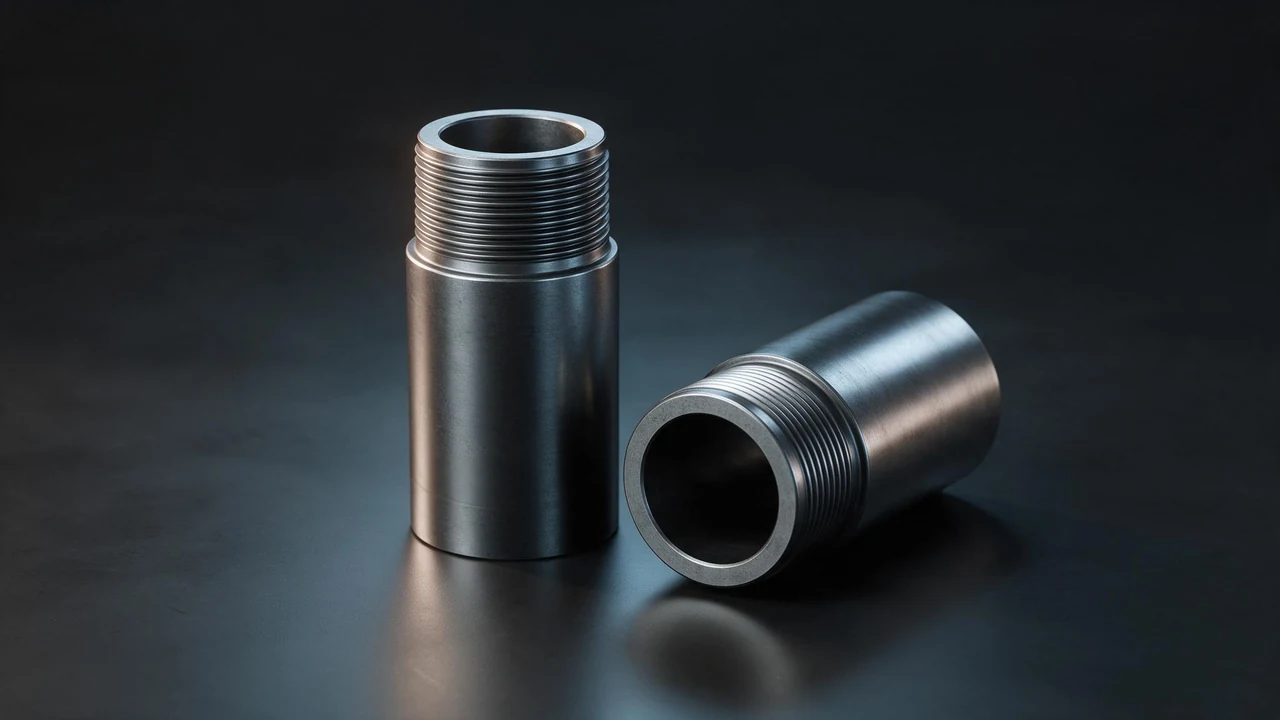
API 5CT Q125 is the highest-strength grade in the standard casing list, with a minimum yield strength of 125,000 psi (862 MPa), a maximum yield strength of 150,000 psi (1,034 MPa) and a minimum tensile strength of 135,000 psi (931 MPa). It is supplied quenched and tempered, with mandatory impact testing, and it is ordered for deep, high-pressure wells.
Download API 5CT Q125 Casing data sheet (PDF) One-page summary of the supply range, chemistry, mechanical properties and inspection documents on this page. The standard is the governing document.
Mejor Steel is the export agent for the mills that make your material: one contract, one delivery date, and the mill named on the quotation. How we supply
We reply within one business day, Monday to Friday 09:00-18:00 CST. Or write to info@mejorsteel.com / WhatsApp.
Size range and specification
- Outside diameter 4-1/2 inch – 13-3/8 inch (114.3 – 339.7 mm), including 7-5/8 inch (193.7 mm) and 10-3/4 inch (273.1 mm)
- Wall thickness by the API 5CT weight designation in lb/ft, or by wall thickness on request
- Length R1 4.88 – 7.62 m, R2 7.62 – 10.36 m, R3 10.36 – 14.63 m
- Ends BTC or premium connection; premium connections are the norm at this strength level
- Surface treatment Bare, varnish, phosphate, or as specified
- Delivery condition Quenched and tempered, with mandatory impact testing; no maximum hardness is specified for the grade
- Manufacturing process Seamless
- Heat treatment Quenched and tempered
- Delivery standard API 5CT / ISO 11960, threads to API 5B
- Types One delivery condition only – Q125 is quenched and tempered and impact tested as a requirement of the grade, and it is a casing grade rather than a tubing grade
How this grade is supplied
- Inspection Inspected by the producing mill’s own inspection department, which is independent of production, against the delivery standard above. Third-party inspection — SGS, BV or TUV, or an inspector you send yourself — can be arranged at the mill or before shipment; give us the dates and the scope at the order stage.
- Certificate A mill test certificate to EN 10204 3.1 showing the heat number, the chemical composition and the mechanical results is standard on every order. EN 10204 3.2, countersigned by the inspector you nominate, is available on request.
- Documents with the goods The mill test certificate and the packing list travel with the shipment, and the heat number is traceable from cast through to the finished product.
- Packing Sea-worthy export packing: bundled by size with end protection, corrosion protection on request, stencilled with the size, grade and heat number.
- MOQ One bundle or one truckload; mixed sizes within a bundle accepted.
- Lead time Counted from order confirmation, not from the enquiry. Stock sizes 5–10 days; mill run or non-stock 3–5 weeks. The delivery window is fixed on the quotation.
- How we supply Sourced through partner mills; the producing mill is named on the quotation.
API 5CT Q125 chemical composition (%)
| Element | Requirement | Element | Requirement |
|---|---|---|---|
| Phosphorus, P | 0.030 max | Carbon, C | not specified |
| Sulphur, S | 0.030 max | Manganese, Mn | not specified |
| Silicon, Si | not specified | Chromium, Cr | not specified |
| Nickel, Ni | not specified | Molybdenum, Mo | not specified |
Like the lower carbon grades, Q125 leaves the alloying to the manufacturer, who has to reach a 125,000 to 150,000 psi yield window with a tempered structure that also passes a mandatory impact test. In practice that means a low-alloy, fine-grain, quench and tempered steel, and mills typically use chromium, molybdenum and microalloying additions rather than a plain carbon-manganese composition. Those additions are the mill’s own choice: a published table quoting a specific Cr-Mo or Mn-Mo range for Q125 is describing one mill’s steel, not a requirement of the standard. Where the casing is destined for even mildly sour service, the chemistry has to be assessed against NACE MR0175 / ISO 15156 directly rather than inferred from the grade.
Source: chemical composition requirements of API 5CT / ISO 11960. The standard is the governing document.
API 5CT Q125 mechanical properties (quenched and tempered)
| Grade | Yield strength | Tensile strength | Elongation | Impact test | Hardness |
|---|---|---|---|---|---|
| Q125 (API 5CT) | 862 – 1,034 MPa (125,000 – 150,000 psi) | 931 MPa min (135,000 psi) | per the API 5CT formula | mandatory Charpy V-notch testing; minimum absorbed energy and test temperature tabulated in the standard | no maximum hardness is specified for Q125; hardness variation is controlled (Table C.5, note b) |
The defining feature of Q125 is that it has a ceiling as well as a floor: material that tests above 1,034 MPa is a nonconformance in the same way as material below 862 MPa, because a string designed on the Q125 allowable stress assumes the steel stays inside that band. The 25,000 psi window is narrow for a steel whose minimum is already 125,000 psi, and it is held by the quench and temper route together with the mandatory impact test, which is the standard’s control on microstructure rather than on strength. Elongation is calculated from the specimen cross-sectional area using the API 5CT formula. API 5CT sets no maximum hardness for Q125: Table C.5 controls the hardness variation within a quadrant, not the absolute level.
Source: tensile requirements of API 5CT / ISO 11960. The standard is the governing document.
What Is API 5CT Q125 Casing?
API 5CT Q125 is the strongest grade in the standard casing list, with a minimum yield strength of 125,000 psi (862 MPa), a maximum yield strength of 150,000 psi (1,034 MPa) and a minimum tensile strength of 135,000 psi (931 MPa). It is supplied only in the quenched and tempered condition, with a mandatory Charpy impact test, and it is a casing grade rather than a tubing grade. Q125 sits above P110 and is the last grade a buyer can specify from API 5CT alone: anything stronger is a mill or buyer grade, defined by a manufacturer’s specification rather than by the standard.
Why the Q125 Yield Window Is So Tight
The Q125 specification does not only set a floor, it sets a ceiling, and the ceiling is what makes the grade difficult to make and to buy. The yield range is 125,000 to 150,000 psi – a window 25,000 psi wide on a material whose minimum is already 125,000 psi. Material that comes out above the ceiling is as much a nonconformance as material below the floor, because a casing designed on the Q125 allowable stress assumes the steel behaves inside that band, and an over-strength pipe changes the way the string fails. The quench and temper route and the mandatory impact test are the standard’s controls on microstructure and toughness rather than on strength, which is the point – at this level, strength without toughness is not a useful product.
Where Q125 Casing Is Used
Q125 is ordered for deep, high-pressure wells: deep gas wells, high-pressure high-temperature completions, deepwater wells with long casing strings, and wells where the collapse and burst loads on the production casing cannot be met in P110 within a wall thickness the mill can supply or the connection can carry. In US trade sizes the grade is seen most often as 4 1/2 in (114.3 mm), 5 1/2 in (139.7 mm), 7 in (177.8 mm), 7 5/8 in (193.7 mm), 9 5/8 in (244.5 mm), 10 3/4 in (273.1 mm) and 13 3/8 in (339.7 mm) casing. It is normally run with a premium, gas-tight connection rather than an API round or buttress thread.
The Limit Is Usually the Connection, Not the Pipe Body
At 125 ksi minimum yield the pipe body is rarely the first thing to fail. The connection is. A Q125 string is normally run with a premium connection because the coupling is where the wall is thinnest, where the seal has to be made, and where the torque has to be carried during make-up. Handling damage also matters more at this strength than at N80 or P110: a slip mark, a tong mark, a dent or a gouge on the body or on the coupling is a stress raiser, and a high-strength steel with correspondingly lower toughness tolerates it less well. Q125 orders therefore commonly carry requirements for the coupling stock grade, make-up torque, thread inspection, and the protection of the pipe during transport and running.
Q125 versus P110 and the Grades Above It
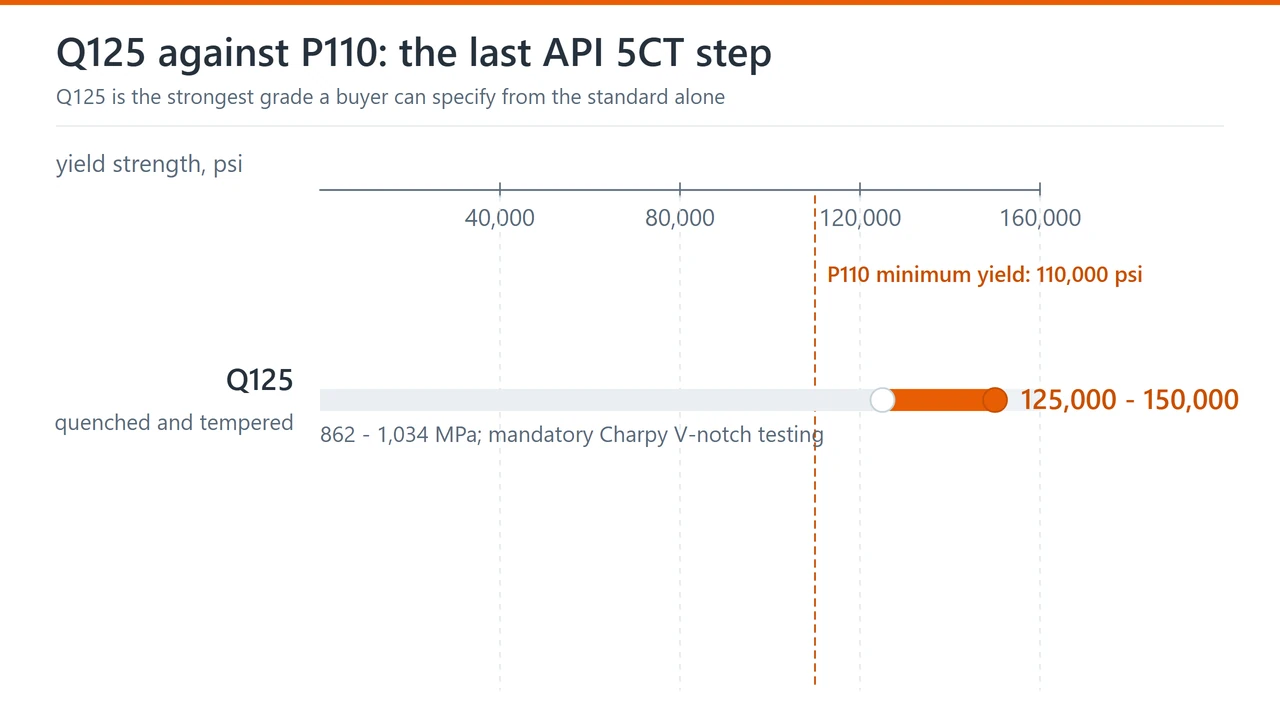
P110 has a minimum yield of 110,000 psi and is supplied quenched and tempered; Q125 adds 15,000 psi on top of that, and it is one of the three grades – with C110 and C125 – for which API 5CT makes impact testing mandatory rather than a purchase-order requirement. The step from P110 to Q125 buys wall thickness, or buys the ability to reach a depth P110 cannot, and it pays for that in handling discipline, in the tighter yield window and in the cost of the material. Above Q125 there is no further standard API 5CT casing grade. Casing stronger than 125 ksi is supplied to mill specifications or buyer specifications, commonly at 140 ksi or 150 ksi nominal minimum yield, with the composition, the properties and the acceptance criteria defined by the manufacturer’s own document rather than by the standard – so a quotation for such a grade is only meaningful against the specification named on the enquiry.
Q125 and P110 are compared below on minimum yield strength.
Ordering and Documentation
Because the alloying is the manufacturer’s choice, a Q125 order should be written on outside diameter and the API weight designation or wall thickness, thread form, length range and the mechanical requirements, plus whatever the well needs on top: impact test temperature and acceptance energy, a project hardness limit, and any sour-service restriction. The mill certificate should be read for the yield result inside the 125,000 to 150,000 psi window, the tensile result against the 135,000 psi minimum, the impact results and the hardness result, all against the heat number. Where the well is sour, the suitability of Q125 has to be assessed against NACE MR0175 / ISO 15156 rather than assumed: sour service at this strength level is a corrosion engineering decision, not a catalogue choice.
Typical applications
- Deep gas wells
- High-pressure high-temperature (HPHT) completions
- Deepwater wells with long casing strings
- Production casing where P110 runs out of collapse or burst capacity
- Wells designed with premium, gas-tight connections
Standards covered
Frequently asked questions
What is the yield strength range of Q125 casing?
125,000 to 150,000 psi, which is 862 to 1,034 MPa. Both limits apply: an over-strength result above 1,034 MPa is a nonconformance just as an under-strength result below 862 MPa is. The minimum tensile strength is 135,000 psi (931 MPa), and the grade is delivered quenched and tempered with a mandatory impact test; API 5CT sets no maximum hardness for Q125, only a limit on hardness variation.
Is Q125 stronger than P110?
Yes. P110 has a minimum yield strength of 110,000 psi and Q125 has 125,000 psi, so Q125 is the strongest standard grade in API 5CT. Both are quenched and tempered, but the mandatory impact test applies to Q125 as a requirement of the grade, while on P110 it has to be brought in by the order; the difference is load capacity rather than delivery condition. Above Q125 there is no further API grade: casing at 140 ksi or 150 ksi is supplied to mill or buyer specifications rather than to the standard.
Why is Q125 sensitive to handling damage?
Because high strength and high toughness pull in opposite directions. To reach a 125,000 psi minimum yield inside a 25,000 psi window, the steel is quenched and tempered to a high strength level with correspondingly less capacity to yield locally around a defect. A slip mark, a tong mark, a dent or a gouge concentrates stress, and at this strength that concentration is more likely to start a crack than it would in N80 or P110. That is why Q125 orders usually specify slip and tong protection, thread inspection and careful handling procedures as part of the delivery.
Where to go next
- OCTG: Casing and Tubing – which string, grade, connection and documents the well needs
- API 5CT P110 Casing – high-strength well casing
- API 5CT N80 Casing
- API 5CT L80 Tubing – sour-service tubing with controlled hardness
- Oil & Gas – the four products in the oil and gas chain
- Steel Pipe Weight Chart
- Get a Quote – send the grade, size, quantity and destination port
- API 5CT Casing Pipe – API 5CT well casing
- Premium Connection Casing and Tubing – gas-tight premium connections
- API 5CT Casing Coupling – casing couplings to API 5CT
Have a specification to price? Give us the standard or grade, the size and wall thickness, the quantity you need and the port of discharge. We come back with availability and a price.
Request a quotation