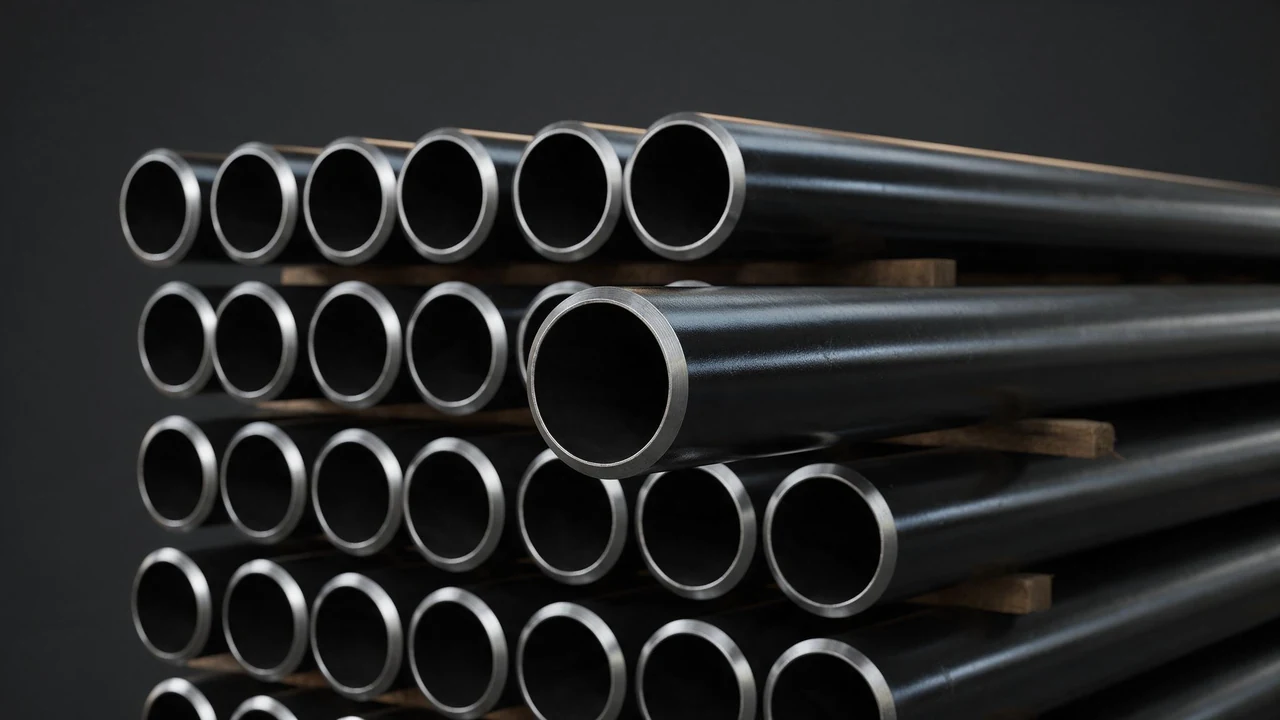
Grade B is the default A106 pipe. Grade C is the same specification with a higher minimum strength and a higher carbon ceiling, and that second difference is the one that decides whether the order is simple or not. This page sets out what changes between the grades, what an SA106 order means, and what has to be fixed before the heat is rolled.
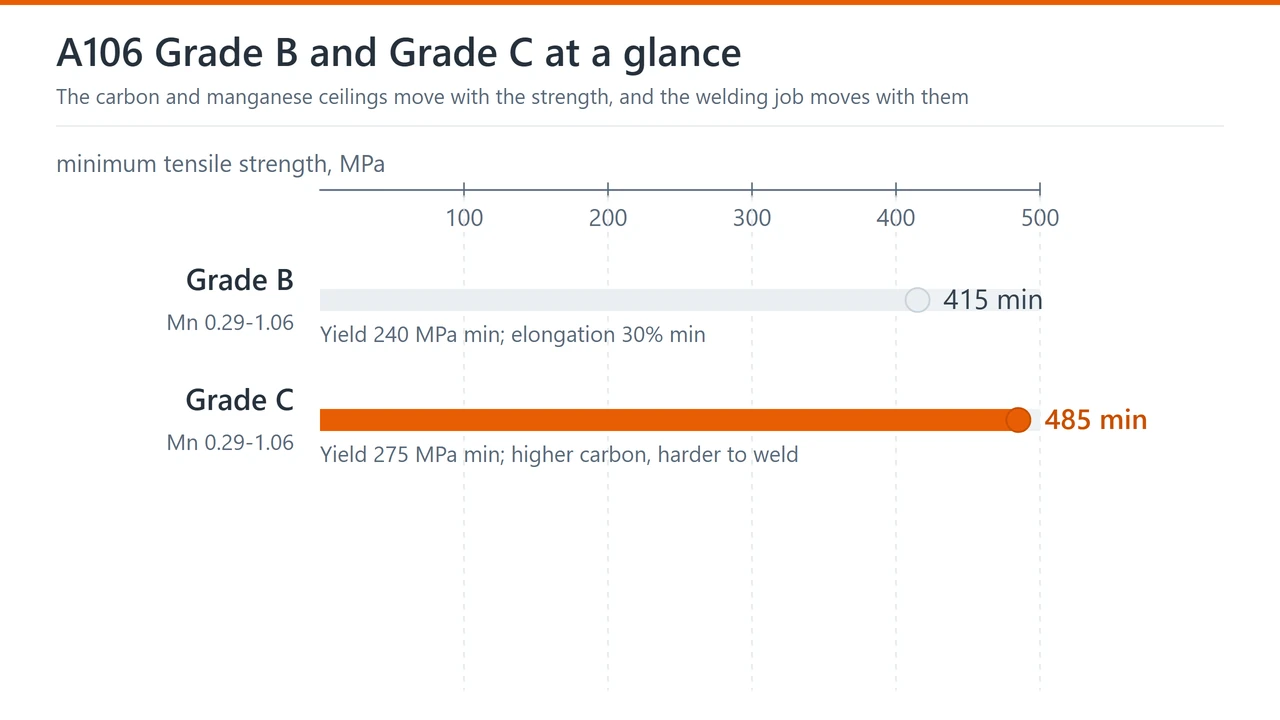
Which grade to specify. Grade B is the default and is held and rolled continuously. Grade C raises the minimum tensile strength from 415 to 485 MPa and the minimum yield from 240 to 275 MPa – roughly a 15 percent increase in allowable stress – but it also raises the carbon ceiling from 0.30 to 0.35 percent, and carbon is what drives carbon equivalent and therefore preheat and welding procedure control. So the question is not only whether the design needs the extra strength: it is also whether a heavier Grade B wall is the cheaper answer, and whether the fabrication can support the welding procedure Grade C needs. Grade C is ordered less often, so mill lot and lead time are confirmed per enquiry.
SA106 and A106 are the same pipe under two designations
ASTM A106 is the specification written by ASTM; ASME SA106 is the same specification adopted by ASME. A project that is designed to an ASME code – B31.1 for power piping, or Section I for boilers – normally cites SA106, and a project designed to ASTM cites A106. The chemical and mechanical requirements do not differ, so the alloy and the heat treatment are the same either way.
What can differ is the paperwork. Most mills dual certify, and the certificate then states both designations against the same heat. If the project requires the ASME designation on the marking or on the certificate, say so on the enquiry: the marking and the certificate wording follow the order, and a certificate cannot be re-issued as SA106 after the pipe has been marked and shipped.
The numbers that change between Grade A, B and C
| Requirement | Grade A | Grade B | Grade C |
|---|---|---|---|
| Carbon, C | 0.25 max | 0.30 max | 0.35 max |
| Manganese, Mn | 0.27 – 0.93 | 0.29 – 1.06 | 0.29 – 1.06 |
| Phosphorus, P | 0.035 max | 0.035 max | 0.035 max |
| Sulphur, S | 0.035 max | 0.035 max | 0.035 max |
| Silicon, Si | 0.10 min | 0.10 min | 0.10 min |
| Tensile strength, min | 330 MPa (48,000 psi) | 415 MPa (60,000 psi) | 485 MPa (70,000 psi) |
| Yield strength, min | 205 MPa (30,000 psi) | 240 MPa (35,000 psi) | 275 MPa (40,000 psi) |
| Elongation, min | 35% | 30% | 30% |
The values are the requirements of ASTM A106/A106M and match the tables on our A106 Grade B and A106 Grade C pages, so the same figures are used across the site.
What the grade actually changes in the field
Strength. Grade C raises the minimum tensile strength from 415 to 485 MPa and the minimum yield from 240 to 275 MPa. That is roughly a 15 percent increase in allowable stress, which is why Grade C is chosen where a heavier wall would otherwise be needed, or where a line has to carry the same pressure in a smaller size.
Carbon, and therefore welding. The carbon ceiling rises from 0.30 to 0.35 percent. Carbon is the element that raises carbon equivalent, and carbon equivalent is what drives preheat and welding procedure control. A Grade C pipe is welded every day, but it is not welded with the same procedure as Grade B by default: the welding procedure has to be qualified for the grade, and where the thickness and the code call for it, post weld heat treatment applies.
Availability. Grade B is held and rolled continuously because it is the default; Grade C is ordered less often, so the mill lot, the quantity and the lead time are confirmed per enquiry rather than assumed from stock.
Three questions that decide the order
1. Does the design need the extra strength, or is a heavier Grade B wall the better answer? Grade C costs more per tonne; a heavier wall costs more steel. Which one wins depends on whether the constraint is pressure, weight or welding.
2. Can the fabrication support the welding procedure Grade C needs? If the shop cannot control preheat and interpass temperature, or cannot carry out post weld heat treatment when the code requires it, Grade B is the lower risk order even where Grade C would be allowed.
3. Does the project need the ASME designation? If the code is B31.1 or Section I, confirm SA106 marking and certificate wording with the enquiry, not after delivery.
Where A106 sits against A53 and API 5L
All three cover carbon steel pipe, and Grade B shares the same 415 MPa minimum tensile and 240 MPa minimum yield across them, which is why a single heat can be certified to A106 Grade B, A53 Grade B and API 5L Grade B at once. A106 is the specification that permits seamless construction only, and it caps phosphorus and sulphur at 0.035 percent each. If the application is high temperature service, the code normally points to A106; if it is not, A53 or API 5L allow welded construction and are usually more economical. The comparisons are on our A106 versus A53 and API 5L versus ASTM A106 pages.
What to send with an A106 enquiry
- Designation: ASTM A106 or ASME SA106, and the edition the project works to.
- Grade: A, B or C, with the wall thickness and the length.
- Size: NPS or outside diameter, and the schedule or wall thickness.
- The certificate wording you need, and whether a third party inspects at the mill.
- Whether the pipe is for high temperature service, so the heat treatment condition and the test requirements are confirmed against the order.
All values are the requirements of ASTM A106/A106M in the edition named on the order. Grade C availability, mill lot and lead time are confirmed per enquiry.
Ordering A106 or SA106 pipe? Send the designation and edition, the grade, the size and wall thickness, the length and end preparation, and the certificate wording the project asks for. We confirm the mill lot, the heat treatment condition and the documents before the order is released.
Request a quotation