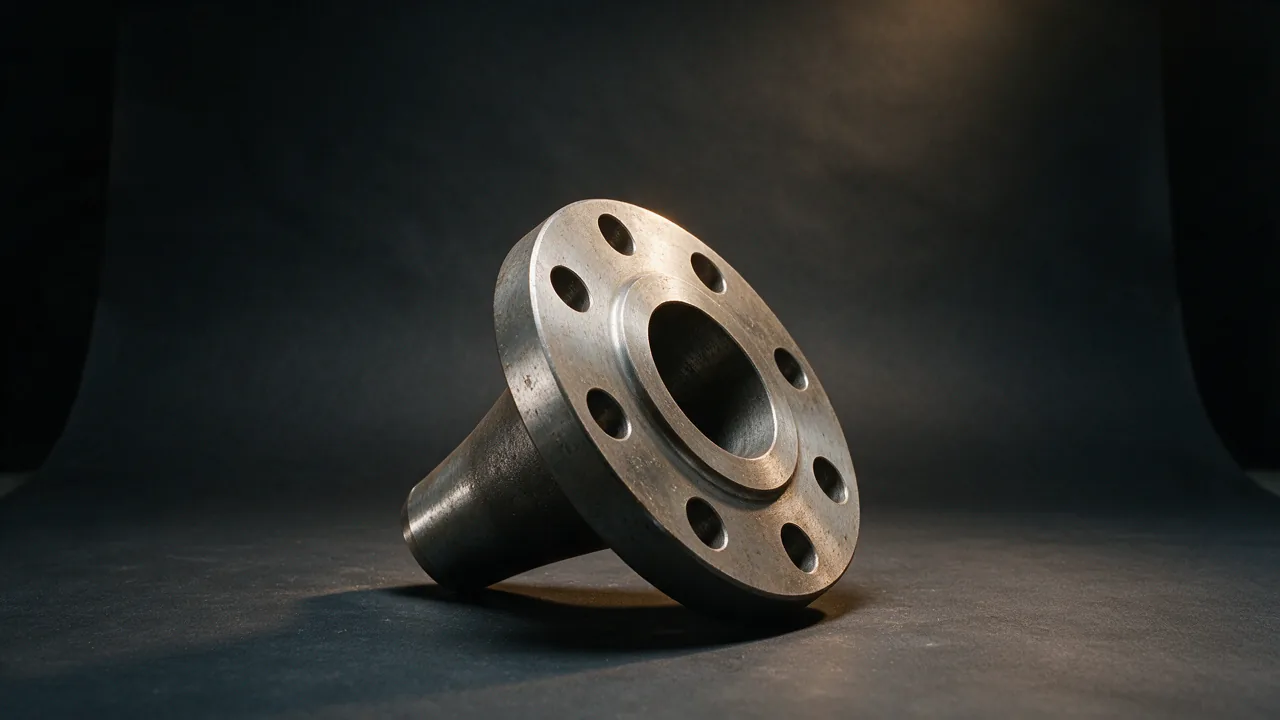
Long-hub weld neck flanges to ASME B16.5 (NPS 1/2 to 24) and ASME B16.47 (NPS 26 to 60), Class 150 to 2500, forged in carbon, alloy and stainless steel with raised face, flat face or ring joint facing.
- Standard: ASME B16.5, ASME B16.47, ASTM A105, ASTM A182, ASTM A350, MSS SP-44
- Grades: A105, A350 LF2, A694 F52, A694 F60, A694 F70, F11, F22, F91, F304, F304L, F316, F316L, F321, F51
- Certificate: EN 10204 3.1 with every order, 3.2 on request
Mejor Steel is the export agent for the mills that make your material: one contract, one delivery date, and the mill named on the quotation. How we supply
We reply within one business day, Monday to Friday 09:00-18:00 CST. Or write to info@mejorsteel.com / WhatsApp.
Specifications
| Outer diameter | 1/2" - 24" to ASME B16.5; 26" - 60" to ASME B16.47 |
|---|---|
| Schedule | Bore machined to match the pipe schedule (STD, XS, Sch 40 / 80 / 160, XXS) |
| Length | Flange thickness and hub per ASME B16.5 / B16.47; long hub pattern on request |
| Ends | Raised face (RF), flat face (FF) or ring joint (RTJ) |
| Surface treatment | Black oxide, anti-rust oil, hot dip galvanized, or machined finish |
| Manufacturing process | Forged and machined |
| Pressure rating | Class 150, 300, 400, 600, 900, 1500, 2500 |
| Connection type | Butt weld to pipe |
ASME B16.5 Class 150 flange dimensions
Flange outside diameter, minimum flange thickness, bolt circle, bolting and raised face, in millimetres, for NPS 1/2 to 12 in. These dimensions are set by the size and the pressure class and are common to the flange types on this line; the bore, hub, socket or thread detail changes with the type and is confirmed on the drawing or the quotation. Thickness includes the 1.6 mm raised face.
| NPS | DN | Flange OD (mm) | Min. thickness (mm) | Bolt circle / PCD (mm) | Bolts | Bolt size | Hole dia (mm) | Raised face dia (mm) |
|---|---|---|---|---|---|---|---|---|
| 1/2 | 15 | 88.9 | 11.2 | 60.5 | 4 | M14 | 15.9 | 34.9 |
| 3/4 | 20 | 98.6 | 12.7 | 69.9 | 4 | M14 | 15.9 | 42.9 |
| 1 | 25 | 108.0 | 14.3 | 79.4 | 4 | M14 | 15.9 | 50.8 |
| 1-1/4 | 32 | 117.5 | 15.9 | 88.9 | 4 | M14 | 15.9 | 63.5 |
| 1-1/2 | 40 | 127.0 | 17.5 | 98.6 | 4 | M14 | 15.9 | 73.0 |
| 2 | 50 | 152.4 | 19.1 | 120.7 | 4 | M16 | 19.1 | 92.1 |
| 2-1/2 | 65 | 177.8 | 22.4 | 139.7 | 4 | M16 | 19.1 | 104.8 |
| 3 | 80 | 190.5 | 23.9 | 152.4 | 4 | M16 | 19.1 | 127.0 |
| 3-1/2 | 90 | 215.9 | 23.9 | 177.8 | 8 | M16 | 19.1 | 139.7 |
| 4 | 100 | 228.6 | 23.9 | 190.5 | 8 | M16 | 19.1 | 157.2 |
| 5 | 125 | 254.0 | 23.9 | 215.9 | 8 | M20 | 22.2 | 185.7 |
| 6 | 150 | 279.4 | 25.4 | 241.3 | 8 | M20 | 22.2 | 215.9 |
| 8 | 200 | 342.9 | 28.4 | 298.5 | 8 | M20 | 22.2 | 269.9 |
| 10 | 250 | 406.4 | 30.2 | 362.0 | 12 | M24 | 25.4 | 323.9 |
| 12 | 300 | 482.6 | 31.8 | 431.8 | 12 | M24 | 25.4 | 381.0 |
Data to ASME B16.5; confirm against the project specification before fabrication. Sizes above 12 in and Class 300 to 2500 follow the same layout and are quoted against the specification. Send the size, class, facing and destination port and we will confirm availability and price within one business day.
What a Weld Neck Flange Is
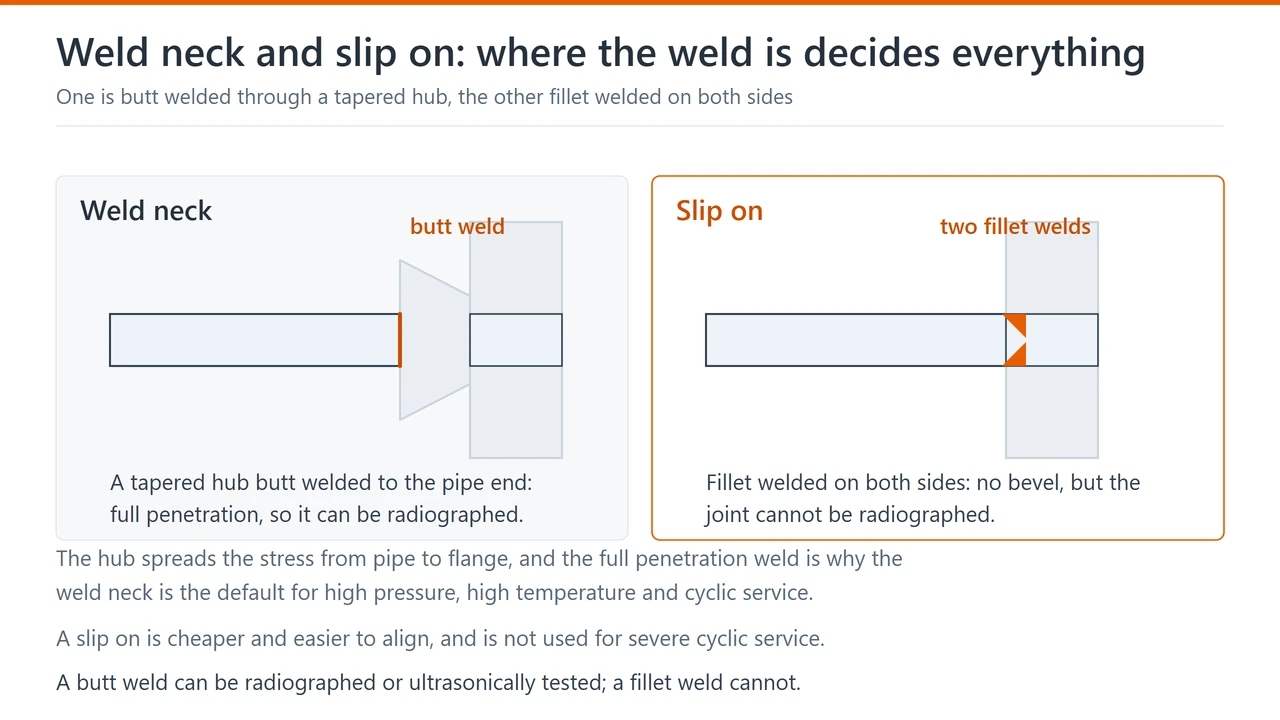
A weld neck flange has a tapered hub that is butt welded to the pipe end. The hub is the reason the type exists: it gradually increases the wall thickness from the pipe up to the flange, so the stress at the junction is spread over a longer distance instead of being concentrated in one corner. That is why the weld neck is the default choice for high pressure, high temperature and severe cyclic service, and for every joint that has to be examined – a butt weld can be radiographed or ultrasonically tested, a fillet weld cannot. The bore is machined to match the pipe inside diameter, so a weld neck flange is always ordered against a pipe schedule.
How to Specify a Weld Neck Flange
Six things fix the item: nominal pipe size, pressure class, material grade, bore, facing and hub length. The class is a rating class and not a pressure in psi – the permissible working pressure depends on the class together with the material group and the design temperature, so it has to be read from the pressure-temperature tables of ASME B16.5 for the actual material rather than assumed. The bore follows the pipe wall: an STD bore and a Schedule 160 bore in the same size and class are different flanges, so the wall thickness or schedule must be stated. Facings are raised face as standard, flat face where the mating component is cast iron or bronze, and ring joint where a metal gasket is required. Long hub patterns are available where a longer straight section is needed ahead of the weld.
Where It Is Used
Refinery and petrochemical process piping, compressor and pump suction and discharge nozzles, steam and condensate headers, high pressure gas lines and storage and transfer station piping, and any flanged joint at Class 900 and above. In sour service the flange is supplied to the hardness limits required by NACE MR0175, with the material grade and heat treatment agreed before the order is placed.
Facing Selection: Raised Face, Flat Face and Ring Joint
A raised face takes a sheet or spiral wound gasket and is the standard facing; the raised face height is 1.6 mm for Class 150 and 300 and 6.4 mm for Class 400 and above, so a Class 300 and a Class 600 flange of the same size do not have the same face height. A flat face is used where the mating component is cast iron or bronze and must not be overstressed by bolting – a flat face flange is always bolted to another flat face flange, never to a raised face. A ring joint facing takes a metal ring gasket seated in a machined groove; it is normal practice for high pressure and high temperature service and is less sensitive to thermal cycling than a sheet gasket.
What is the difference between a weld neck and a slip on flange?
A weld neck flange is butt welded to the pipe and its tapered hub transfers stress smoothly from the pipe into the flange, so it has the best fatigue performance and the weld can be radiographed. A slip on flange slips over the pipe and is fillet welded on both sides; it is cheaper and easier to align, but the fillet welds give lower fatigue strength and cannot be radiographed. Use weld neck for high pressure, high temperature and cyclic service, slip on for lower pressure utility and water lines.
What bore should I specify for a weld neck flange?
Give the pipe schedule or the wall thickness. The weld neck bore is machined to match the pipe inside diameter, so the flange has to suit the pipe it will be welded to – STD, XS, Schedule 40, 80, 160 or XXS all give a different bore in the same size and class. If only the size and class are given, the bore cannot be confirmed against your pipe.
Can a weld neck flange joint be radiographed?
Yes. The butt weld between the pipe and the flange can be examined by radiography or ultrasonic testing, which is one of the main reasons a weld neck flange is specified for critical service. A fillet welded joint such as that on a slip on or socket weld flange cannot be examined the same way.
Do you supply ring joint facing?
Yes. Ring joint facings are machined with the standard ring groove for the size and class, and the matching ring joint gaskets can be supplied with the flanges so that the joint parts arrive together. Ring gaskets are dimensioned to ASME B16.20.
Which material grade should I choose?
ASTM A105 for general carbon steel service, ASTM A350 LF2 where low temperature toughness is required, ASTM A182 F304 / F316 for corrosion resistance, ASTM A182 F11 / F22 / F91 for high temperature service, and ASTM A694 for high yield pipeline flanges. The grade must be stated with the order because it drives both the pressure temperature rating and the marking.
Flange type selection: which flange for which service
The six B16.5 flange types are not variants of one item; each one solves a different problem. This table is the short version of the decision — the sections above explain the weld neck itself, and each other type has its own page.
| Type | How it joins to the pipe | Where it is the right choice | Where it should not be used |
|---|---|---|---|
| Weld neck | Butt welded, tapered hub | High pressure, high temperature, severe cyclic service, and any joint that has to be radiographed or ultrasonically tested | Small bore utility and water lines, where the cost of the hub and the weld preparation is not repaid |
| Slip on | Slides over the pipe, fillet welded inside and outside | Lower pressure and lower temperature service, water, air and cooling lines, and spools where the bolt holes have to be rotated to line up with an existing flange | Severe cyclic or thermal cycling service, joints that have to be radiographed, and corrosive or sour service where the crevice behind the bore is a risk |
| Lap joint | Loose ring behind an ASME B16.9 stub end | Stainless and alloy lines, where the expensive material is confined to the wetted stub end; spools that have to be dropped in between two fixed flanges | High pressure, large sizes, and severe cyclic service |
| Blind | Solid disc, no bore | Closing a spare nozzle or a line end that will be reopened; forming a boundary for a pressure test | Where the joint has to be opened without breaking it — a spectacle blind is used for that |
| Threaded | Tapped bore, no welding at all | Tie-ins on a live plant, hazardous areas where no hot work permit can be obtained, small bore connections that come apart | Severe vibration or thermal cycling, high pressure, and anything above small bore sizes |
| Socket weld | Pipe pushed into a socket, single fillet weld | Small bore high pressure connections where a welded joint is preferred to a threaded one | Sizes above roughly NPS 4, and corrosive or sour service where fluid can collect in the socket |
Source: joint characteristics and service limits as described for each type in ASME B16.5 and in the piping code applied to the installation; type by type limits are described on the individual flange pages on this site.
Five checks before a flange is welded into the line
A flange that is right in the store room can still be wrong at the joint. These five checks take minutes and catch almost every flange rejection.
| Check | What to compare against | What it costs when it is missed |
|---|---|---|
| Class | The pressure class on the isometric, not the class of the nearest item in stock | Different classes do not share face height or bolt pattern, so the joint cannot be pulled up |
| Bore and schedule | The machined bore against the pipe inside diameter, from the pipe schedule or wall thickness | A weld neck bore is machined to suit the pipe; a mismatch leaves an internal step or a root gap that cannot be closed |
| Facing | Raised face, flat face or ring joint, against the facing of the mating flange | A raised face against a flat face overstresses the mating part; ratings also depend on the facing |
| Bolt pattern | Bolt circle and hole count, taken from the same standard table as the mating flange | Above NPS 24 the series governs: B16.47 Series A and Series B do not share a bolt circle |
| Marking and certificate | The marking on the flange against the mill certificate, including the heat number | Without traceable marking, a rejection at site cannot be closed without replacing the item |
Does the wall thickness of the pipe change the flange?
It changes the bore, not the outside dimensions. The class fixes the flange OD, bolt circle and thickness; the pipe schedule fixes the machined bore of a weld neck flange. That is why a weld neck flange is always ordered against a pipe schedule, and why two flanges of the same size and class can be different items.
Grades supplied and minimum properties
The grade fixes the minimum strength and the chemistry. The table below gives the requirements that separate the forged flange material grades ordered most often; the full composition and mechanical table for each grade is on its own page.
| Grade | Yield strength | Tensile strength |
|---|---|---|
| A105 (forged carbon steel) | 250 MPa (36,000 psi) | 485 MPa (70,000 psi) |
| F316 (forged stainless steel) | 205 MPa min (30,000 psi) | 515 MPa min (75,000 psi) |
The complete chemistry and mechanical table for each grade, with the notes that qualify it, is on the individual grade page – for example ASTM A105 flange. The stainless grade has the higher tensile requirement but the lower minimum yield strength, so the two are not interchangeable on the strength table alone. The pressure class sets the flange dimensions, so the grade does not set the wall.
Source: specified minimum yield and tensile strength for each grade, per ASTM A105 / ASME SA105 and ASTM A182 / ASME SA182. The standard named against each grade is the governing document.
Download Weld Neck Flange data sheet (PDF) One page: supply range, grades and key sizes, what to state on the enquiry, and the inspection documents that come with the order. The standard is the governing document.
What decides the price
There is no list price for flanges: the same drawing can be quoted at different numbers depending on seven things. Send them and the quotation comes back within one business day.
| Factor | Why it moves the price | What to send |
|---|---|---|
| Material grade | Carbon A105 is the baseline; F316, F51 and alloy grades cost more and take longer to source | The grade, or the line class |
| Size and pressure class | Weight and forging time rise with both | NPS and class |
| Facing | RTJ and special facings add machining | RF, FF or RTJ |
| Bore or schedule | A weld neck is bored to the pipe wall, so the schedule is part of the price | The pipe schedule |
| Quantity | Setup is spread over the pieces; a small lot carries more per piece | Pieces, or total weight |
| Inspection and certificate | EN 10204 3.2 and third-party inspection add cost and time | 3.1 or 3.2, and whether SGS, BV or TUV is required |
| Destination and Incoterm | Freight and packing follow the port | Destination port, FOB / CFR / CIF |
Reply within one business day. Send the seven items above with the quantity and the destination port. Send the specification or WhatsApp the specification.
Materials
- Forged carbon steel
- Forged alloy steel (Cr-Mo)
- Forged stainless steel
- Duplex stainless steel
Typical applications
- High pressure and high temperature process piping
- Refinery and petrochemical plant
- Compressor, pump and vessel nozzles
- Steam and condensate headers
- Pipeline and transmission stations
Inspection & testing
- Dimensional inspection per ASME B16.5 / B16.47
- Chemical and mechanical testing per ASTM
- PMI on alloy and stainless steel
- Hardness testing
- Magnetic particle or ultrasonic examination on request
- Third-party inspection (SGS, BV, TUV) on request
| Packaging | Sea-worthy export packing: wooden cases or pallets, tagged with size, grade and heat number; corrosion protection on request. |
|---|---|
| MOQ | By piece - mixed sizes accepted; no minimum on standard items. |
| Lead time | Stock items: 5-10 days. Made to order: 3-5 weeks after order confirmation. |
Payment: T/T 30% deposit with the balance before shipment; L/C at sight also accepted. Final terms are confirmed on the quotation.
How we supply: sourced through partner mills; the producing mill is named on the quotation. How we supply sets out who is accountable for the order.
Need this product? Send the size, grade, quantity and destination port and we will reply with availability and pricing.
Request a quotation