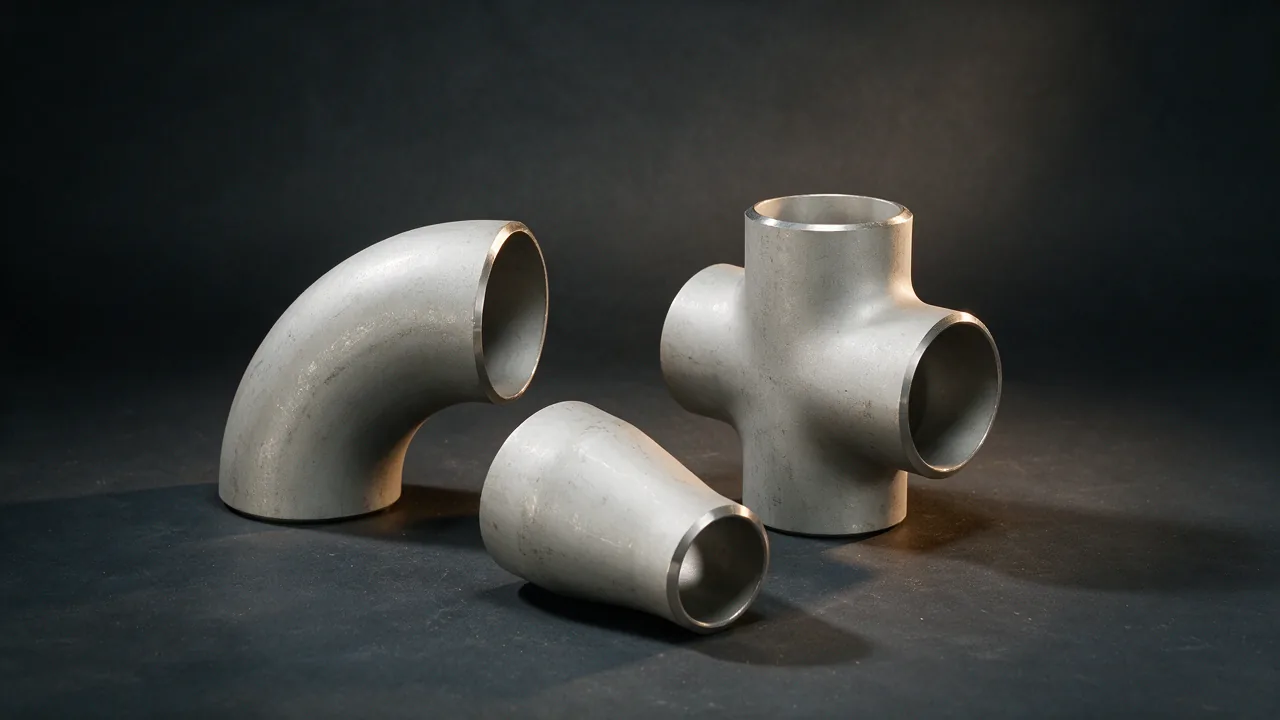
Stainless steel butt weld elbows, tees, reducers and caps to ASTM A403 and ASME B16.9 in WP304, WP316, WP321, WP347 and duplex grades.
- Standard: ASTM A403, ASME B16.9, ASME B16.25, MSS SP-43, NACE MR0175
- Grades: WP304, WP304L, WP316, WP316L, WP321, WP347, WP904L, S31803 duplex, S32205 duplex
- Certificate: EN 10204 3.1 with every order, 3.2 on request
Mejor Steel is the export agent for the mills that make your material: one contract, one delivery date, and the mill named on the quotation. How we supply
We reply within one business day, Monday to Friday 09:00-18:00 CST. Or write to info@mejorsteel.com / WhatsApp.
Specifications
| Outer diameter | 1/2" - 48" (DN15 - DN1200) |
|---|---|
| Wall thickness | SCH 10S - SCH XXS |
| Schedule | SCH 10S, 40S, 80S, 160S, XXS |
| Length | Center to end per ASME B16.9 |
| Ends | Bevelled to ASME B16.25, or plain end |
| Surface treatment | Pickled and passivated, sand blasted, or polished |
| Manufacturing process | Seamless or welded, solution annealed |
| Pressure rating | Per ASME B16.9 wall thickness and ASME B31.3 |
Choosing 304 or 316
Both 304 and 316 are austenitic stainless steels with excellent general corrosion resistance, and 316 is the more corrosion resistant of the two because it contains 2 to 3 percent molybdenum. That molybdenum addition markedly improves resistance to chlorides, to pitting and crevice corrosion, and to many organic and inorganic acids. As a rule, 304 is used for general water and mildly corrosive service and for food and pharmaceutical applications, while 316 is specified where chlorides are present, in marine environments, and in most chemical process service. The L grades, 304L and 316L, have a restricted carbon content of 0.03 percent maximum, which prevents the precipitation of chromium carbides at grain boundaries during welding and thereby avoids intergranular corrosion in the heat affected zone. For welded fittings, which by definition have a heat affected zone, the L grades are normally the correct choice, and the dual certified 304/304L and 316/316L materials meet both specifications at once.
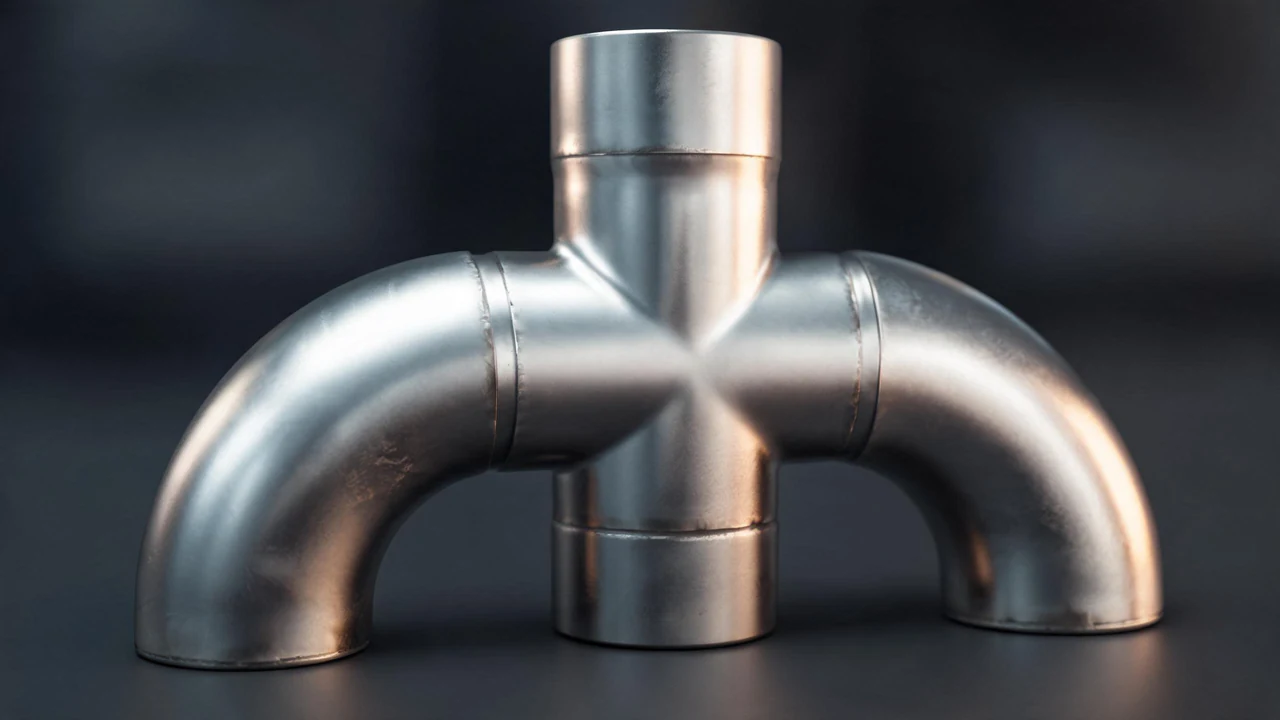
Duplex Stainless Steel Fittings
Duplex stainless steels such as S31803 (2205) have a two phase microstructure, roughly half austenite and half ferrite, which gives them roughly twice the yield strength of 316 and much higher resistance to chloride stress corrosion cracking and pitting. This makes them the standard choice for offshore piping, seawater systems, desalination and the oil and gas industry in chloride containing service. The practical cautions are that duplex must be welded with controlled heat input and interpass temperature to preserve the phase balance, and that the ferrite content of the finished fitting should be checked, typically required to be in the range of 35 to 65 percent. Super duplex grades such as S32750 (2507) extend the performance further for the most aggressive seawater and sour service. Where duplex is specified, the fitting and the pipe must both be duplex, and PMI plus ferrite testing should be specified on the order.
Stainless fittings: grade, stabilisation and ferrite
Stainless fittings are made to A403 rather than A234, and the grade letter is prefixed with WP in the same way. What matters is the molybdenum in the 316 grades, the stabilisation in 321 and 347, and the ferrite balance in the duplex grades, which is checked on the finished fitting rather than assumed from the plate.
| Where the fitting sits | What it fixes in the specification | What to state on the enquiry |
|---|---|---|
| General chemical service | WP304 or WP304L to A403 | the grade, and the pipe specification it has to match |
| Chloride bearing service | WP316 or WP316L for the molybdenum content | the chloride level and the operating temperature |
| Sensitising temperature range | WP321 or WP347, the stabilised grades | the service temperature |
| Sour service | NACE MR0175 applies to the fitting as well as the pipe | the partial pressures |
| Duplex or super duplex line | Ferrite content is checked and frequently specified | the ferrite percentage required, and the test method |
| Corrosion test requirement | Intergranular corrosion testing to ASTM A262 | whether the test is required, and which practice |
| Finished surface | Pickled and passivated, or polished | the finished surface requirement |
| Size above 24 in | Seamless availability changes, so welded and formed is used | the size, so the manufacturing route can be confirmed |
Which fitting is A403, and in which grade
A403 grades carry the WP prefix and the matching pipe grades carry TP: the fitting is WP316 and the pipe it joins is TP316. Both are 316 stainless, and they are ordered together so the chemistry at the joint matches.
| Fitting | Grade | Geometry to state | Page |
|---|---|---|---|
| Butt weld elbow | A403 WP304/304L, WP316/316L, WP321 or WP347 | 90° or 45°, and long or short radius | Butt weld elbow |
| Butt weld tee | A403 WP304/304L or WP316/316L | Equal or reducing | Butt weld tee |
| Butt weld reducer | A403 WP304/304L or WP316/316L | Concentric or eccentric | Butt weld reducer |
| Butt weld cap | A403 WP304/304L or WP316/316L | Cap | Butt weld cap |
| Socket weld or threaded | Not A403 — forged to ASTM A182 | Class 3000, 6000 or 9000 | Socket weld fittings |
A403 covers wrought butt weld fittings. Forged socket weld and threaded fittings to ASME B16.11 are a different material specification: the stainless forged grades follow ASTM A182, and the grade is written F316 rather than WP316. An enquiry for a stainless socket weld elbow is therefore an A182 fitting, not an A403 one.
Should I choose 304 or 316 stainless steel fittings?
Choose 316 where chlorides are present, in marine and offshore environments, and in most chemical process service, because its molybdenum content gives much better resistance to pitting and crevice corrosion. Choose 304 for general water service, for food and pharmaceutical applications, and where the environment is only mildly corrosive. Where the fitting will be welded and the service involves chlorides or elevated temperature, choose the L grade, 316L, to avoid intergranular corrosion.
Do you provide PMI reports with stainless fittings?
Yes. Positive material identification is standard practice for alloy and stainless steel fittings and can be supplied with the mill certificate. The report records the measured chemistry of the fitting, which is the practical way to confirm that the material is actually 316 and not, for example, a lower grade substituted in error. For duplex grades, a ferrite content measurement is also normally required and can be included.
Grades supplied and minimum properties
The grade fixes the minimum strength and the chemistry. The table below gives the requirements that separate the stainless butt weld fitting grades ordered most often; the full composition and mechanical table for each grade is on its own page.
| Grade | Yield strength | Tensile strength |
|---|---|---|
| WP304 | 205 MPa min (30,000 psi) | 515 MPa min (75,000 psi) |
| WP304L | 170 MPa min (25,000 psi) | 485 MPa min (70,000 psi) |
| WP316 | 205 MPa min (30,000 psi) | 515 MPa min (75,000 psi) |
| WP316L | 170 MPa min (25,000 psi) | 485 MPa min (70,000 psi) |
The complete chemistry and mechanical table for each grade, with the notes that qualify it, is on the individual grade page – for example ASTM A312 TP316 pipe. The L suffix denotes the low carbon version, which can be welded in most service without post-weld solution annealing.
Source: specified minimum yield and tensile strength for each grade, per ASTM A312 / ASME SA312. The standard is the governing document.
Download Stainless Steel Butt Weld Fittings data sheet (PDF) One page: supply range, grades and key sizes, what to state on the enquiry, and the inspection documents that come with the order. The standard is the governing document.
Materials
- Austenitic stainless steel
- Duplex stainless steel
- Super duplex
Typical applications
- Chemical and petrochemical plants
- Pharmaceutical and food processing
- Desalination and water treatment
- Pulp and paper industry
- Marine and offshore piping
- Sour service piping
Inspection & testing
- Dimensional inspection per ASME B16.9
- PMI to verify chemistry
- Intergranular corrosion test per ASTM A262
- Radiographic or ultrasonic examination
- Ferrite content check on duplex grades
- Third-party inspection (SGS, BV, TUV)
| Packaging | Sea-worthy export packing: wooden cases or pallets, tagged with size, grade and heat number; corrosion protection on request. |
|---|---|
| MOQ | By piece - mixed sizes accepted; no minimum on standard items. |
| Lead time | Stock items: 5-10 days. Made to order: 3-5 weeks after order confirmation. |
Payment: T/T 30% deposit with the balance before shipment; L/C at sight also accepted. Final terms are confirmed on the quotation.
How we supply: sourced through partner mills; the producing mill is named on the quotation. How we supply sets out who is accountable for the order.
Need this product? Send the size, grade, quantity and destination port and we will reply with availability and pricing.
Request a quotation