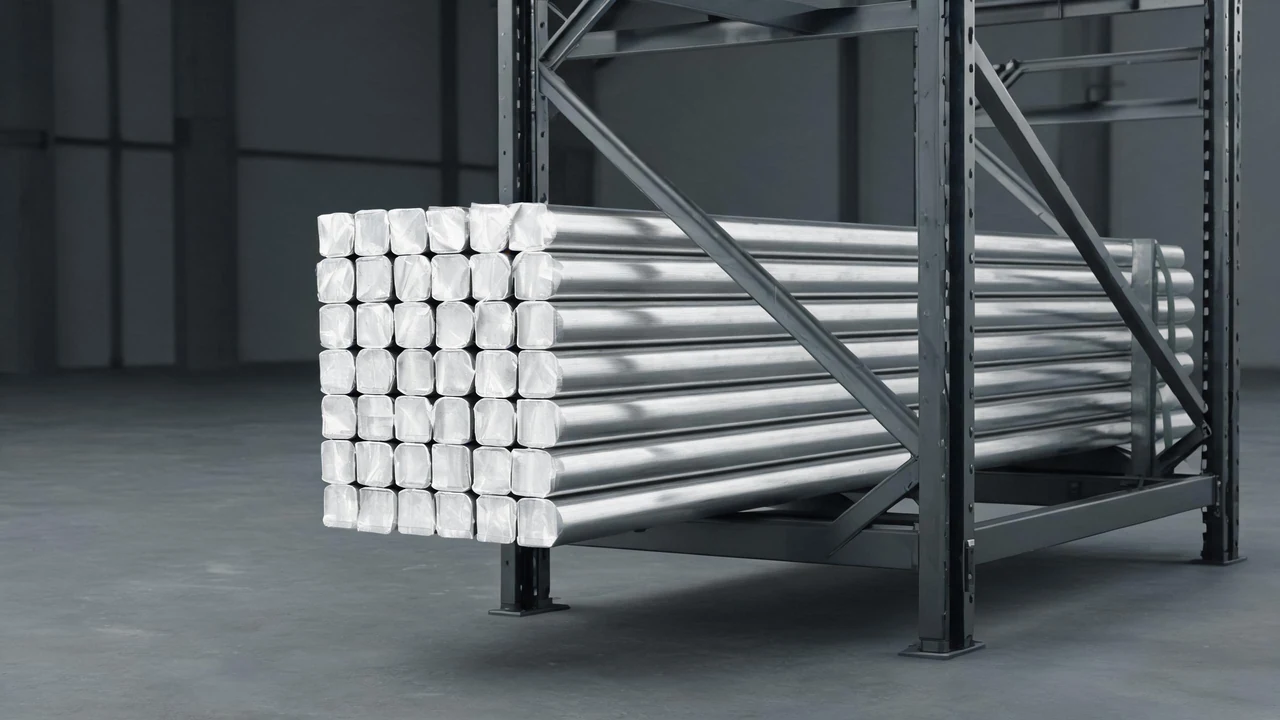
Austenitic and duplex stainless steel pipe to ASTM A312 and the standards named on the enquiry, seamless or welded, in grades from TP304 to TP310S and duplex 2205/2507.
- Standard: ASTM A312, ASME B36.19M, ASME B36.10M, ASTM A213, ASTM A269
- Grades: TP304, TP304L, TP316, TP316L, TP321, TP347, TP310S, TP317L, 2205, 2507
- Certificate: EN 10204 3.1 with every order, 3.2 on request
Mejor Steel is the export agent for the mills that make your material: one contract, one delivery date, and the mill named on the quotation. How we supply
We reply within one business day, Monday to Friday 09:00-18:00 CST. Or write to info@mejorsteel.com / WhatsApp.
Specifications
| Outer diameter | 1/8" - 24" (10.3 - 610 mm) |
|---|---|
| Wall thickness | SCH 5S - SCH 80S, or by wall thickness |
| Schedule | SCH 5S, 10S, 40S, 80S (ASME B36.19M) |
| Length | SRL 5.8 m, DRL 11.8 m, or fixed length |
| Ends | Plain end, beveled end, threaded |
| Surface treatment | Pickled, annealed and pickled, bright annealed, polished, shot blasted |
| Manufacturing process | Seamless, ERW welded, EFW welded |
| Pressure rating | Corrosive and high purity service |
Stainless steel pipe is bought for what it resists rather than for the pressure it carries. The range runs from 304 through 316L, 321, 347 and 310S to the duplex grades, supplied seamless or welded, and the decision that fixes an order is which standard and which grade the service calls for. This page sets out what we supply, how the specification is fixed, and where the detail on each grade sits.
What we supply
Stainless pipe is supplied seamless or welded, in the austenitic grades and in duplex where the project permits it. The table gives the dimensions the grade pages already quote, so the enquiry can be checked against them before it is priced.
| Form | Outside diameter | Wall | Where it is specified |
|---|---|---|---|
| Seamless stainless pipe | 1/8 – 24 in (10.3 – 610 mm) | SCH 5S – SCH 80S, or by wall thickness | Process and high pressure service, and wherever the project restricts welded pipe |
| Welded stainless pipe (ERW or EFW) | 1/8 – 24 in (10.3 – 610 mm) | SCH 5S – SCH 80S, or by wall thickness | General corrosive service, and larger sizes in thinner walls where welded pipe is permitted |
| Heat exchanger and boiler tube | Quoted to the size on the enquiry | By wall thickness | Boiler, superheater and heat exchanger service to ASTM A213 |
| Duplex pipe (2205, 2507) | Quoted to the size on the enquiry | By wall thickness | Chloride and CO2 service beyond what the austenitic grades hold |
Lengths are supplied SRL 5.8 m, DRL 11.8 m or a fixed length. Ends are plain, beveled or threaded. Surface condition is pickled, annealed and pickled, bright annealed, polished or shot blasted, and it is a separate line on the order rather than an assumption.
Which standard the enquiry belongs to
The standard decides the test regime, so it is worth fixing before the grade. The two that are most often confused are ASTM A312 and ASTM A269: A312 is pressure pipe, with a hydrostatic and eddy current regime behind it; A269 is general service tube, and it is quoted to the standard the project names.
| If the service is | The standard is | The form is | The detail sits on |
|---|---|---|---|
| General corrosive process or water piping | ASTM A312 | Seamless or welded austenitic pipe | ASTM A312 stainless steel pipe |
| Boiler, superheater or heat exchanger | ASTM A213 | Seamless tube | Boiler and heat exchanger tube |
| General service or mechanical tube | ASTM A269 | Welded or seamless tube | Quoted to the standard named on the enquiry |
| Chloride or CO2 service beyond the austenitic grades | Duplex grades, to the standard the project names | Seamless or welded | Sour service |
| Grade chemistry and mechanical data | ASTM A312 | Pipe | TP304 / TP316 / TP316L |
Where the project names a standard, that standard governs. We do not substitute a standard we hold stock against for one the project asked for, and the certificate follows the standard on the order.
How the specification is fixed
The decisions come in a particular order, and taking them the other way round is what produces a second quotation.
- The service condition – the fluid, the chloride content, the operating temperature, and whether H2S or CO2 is present. This is what rules grades in or out before strength is considered.
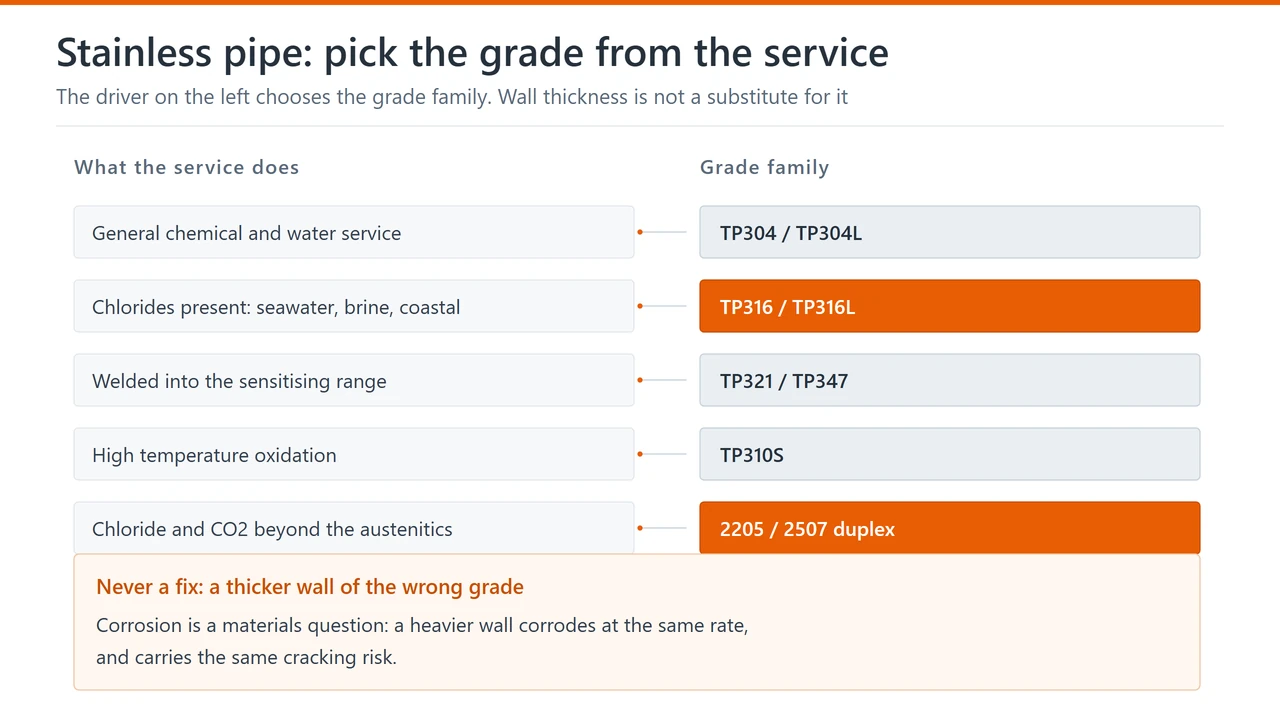
- The grade family – 304 or 304L for benign chemical and general industrial duty; 316 or 316L where chlorides are present, including seawater, brine and coastal atmospheres; 321 or 347 where the service is in the sensitising range; 310S for high temperature oxidation; duplex where the austenitic grades do not hold.
- The form – seamless or welded, after checking whether the project restricts welded pipe for that service.
- The size – outside diameter together with the schedule or the wall thickness. Stainless schedules follow ASME B36.19M, whose S schedules are thinner than the matching ASME B36.10M carbon steel schedules.
- The finish and the tolerance – pickled, annealed and pickled, bright annealed, polished to a stated roughness, or shot blasted.
- The test route and the documents – what is tested, and which certificate type the project accepts.
What to state on the enquiry: the standard and grade, the manufacturing route, the outside diameter and wall or schedule, the length and end finish, the surface condition, the test route, the quantity and the destination port. With those fields the order can be priced without another round of questions.
The finish and the test route are separate decisions
Finish decides how the surface behaves in service, not only how the pipe looks. A pickled or annealed-and-pickled surface removes the heat tint and the depleted layer left by welding; a bright annealed surface is specified where cleanliness or a low roughness matters; a polished surface is specified against a stated roughness rather than as “smooth”.
The test route is the second separate decision. Hydrostatic testing and eddy current examination are the routine routes on A312 pipe. Where the service is in the sensitising range, intergranular corrosion testing to ASTM A262 is specified alongside the grade. Positive material identification verifies the actual heat against the grade on the certificate, and it is a different check from a mill test certificate. The certificate itself is to EN 10204 3.1, or 3.2 where an inspector independent of the mill has to issue it – see mill test certificate for what each type has to show.
One boundary is worth stating plainly: the certificate is issued against the heat the pipe came from, so a test added after the heat is rolled becomes a re-test or a new heat, not a line on the same certificate.
Where stainless is the wrong answer
Stainless is not automatically the better pipe, and four of the cases where it is the wrong answer come up often.
| The belief | What actually happens | What to do instead |
|---|---|---|
| “Stainless cannot corrode” | Chlorides with temperature and stress cause stress corrosion cracking, and neither 304 nor 316 is immune to it. 316 resists more than 304 because of its molybdenum, but the resistance is not unlimited. | Assess the chloride, temperature and stress together, and move to a duplex or higher alloy grade where the austenitic grades run out |
| “Use a thicker wall instead of a better grade” | Corrosion is a materials question. A heavier wall of the wrong grade corrodes at the same rate and holds the same cracking risk. | Change the grade family; keep wall thickness for pressure and mechanical design |
| “Stainless is stronger” | The minimum yield strength is 205 MPa for TP304 and TP316, and 170 MPa for TP316L – below the carbon steel grades used in the same service. | Where the design needs strength, choose the material for the load case, not for corrosion resistance |
| “It is the same as carbon steel to install” | Austenitic stainless has a higher thermal expansion and a lower thermal conductivity than carbon steel, and welded joints in the sensitising range need the stabilised or low carbon grades. | Feed the expansion and the service temperature into the piping design, and state the welding route on the order |
Nickel is the main cost driver across the grades, and the grade and the form are the two decisions that move it most. Pricing follows the specification that comes out of the assessment above.
Frequently asked questions
Is stainless pipe ordered the same way as carbon steel pipe?
By outside diameter and wall, yes, but the schedule system differs. Stainless steel schedules are defined in ASME B36.19M, and the S suffix marks them: SCH 10S is thinner than SCH 10, and SCH 40S is thinner than SCH 40. Not every schedule has an S equivalent – SCH 5S, 10S, 40S and 80S are defined. The pipe schedule chart lists the wall for each size and schedule.
Can welded stainless pipe replace seamless?
ASTM A312 permits both, and welded pipe is supplied as-welded or cold worked to meet the same mechanical requirements, so for most corrosive service a properly made and solution annealed weld performs equivalently to seamless. Welded pipe is the economical choice in larger sizes and thinner walls. Some end users and specifications still restrict stainless pipe in critical service to seamless, and where that restriction exists it is stated on the enquiry rather than assumed by the mill.
What is the difference between A312 and A269?
A312 covers austenitic stainless pipe for pressure and corrosive service, with the hydrostatic and eddy current testing that goes with it. A269 covers general service tube, where the requirement is dimension and surface rather than a pressure regime. If the project names one of them, that one applies; ordering A269 because it is available when the project asked for A312 is a substitution, not a saving.
Do you supply duplex stainless pipe?
Yes – duplex and super duplex, the 2205 and 2507 grades, where the project permits them. Whether they are permitted is a corrosion assessment rather than a preference, and it turns on the H2S partial pressure, temperature, pH and chloride content together. The assessment inputs are set out on the sour service page.
Do you supply 904L stainless pipe?
Yes, where the corrosion assessment calls for it. 904L pipe (UNS N08904) sits between 316L and the 6% molybdenum grades: it is specified for sulphuric and phosphoric acid service and for chloride service at moderate temperature. One point is worth settling early, because it decides the certificate rather than the pipe: the grade is classified as a stainless steel rather than a nickel alloy, so the nickel alloy specifications no longer list it.
Download Stainless Steel Pipe data sheet (PDF) One page: supply range, grades and key sizes, what to state on the enquiry, and the inspection documents that come with the order. The standard is the governing document.
Where to go next
- ASTM A312 stainless steel pipe – the specification, and how to choose between 304 and 316
- ASTM A312 TP304 / TP316 / TP316L – chemistry, mechanical properties and inspection for each grade
- Boiler and heat exchanger tube – the A213 tube range
- Stainless steel butt weld fittings – fittings matched to the pipe grade
- Pipe schedule chart – wall thickness for every size and schedule
- Sour service – where duplex and the higher alloys are required
- Steel pipe – the carbon, alloy and coated pipe lines
Quoting stainless pipe? Send the standard and grade, the outside diameter and wall or schedule, the length, the surface condition, the test route and the destination port. We confirm the availability, the finish and the documents before the order is released.
Request a quotationMaterials
- Austenitic stainless steel
- Duplex stainless steel
Typical applications
- Chemical and petrochemical process piping
- Water treatment and desalination
- Food, dairy and pharmaceutical piping
- Pulp and paper processing
- Heat exchanger and condenser service
Inspection & testing
- Eddy current testing
- Hydrostatic pressure test
- Intergranular corrosion test (ASTM A262) where specified
- PMI positive material identification
- Third-party inspection (SGS, BV, TUV)
| Packaging | Sea-worthy export packing: bundled by size, plastic caps on both ends, corrosion protection on request, stencilled with size, grade and heat number. |
|---|---|
| MOQ | One bundle or one truckload; mixed sizes within a bundle accepted. |
| Lead time | Stock sizes: 7-15 days. Mill run / non-stock: 4-6 weeks after order confirmation. |
Payment: T/T 30% deposit with the balance before shipment; L/C at sight also accepted. Final terms are confirmed on the quotation.
How we supply: sourced through partner mills; the producing mill is named on the quotation. How we supply sets out who is accountable for the order.
Need this product? Send the size, grade, quantity and destination port and we will reply with availability and pricing.
Request a quotation