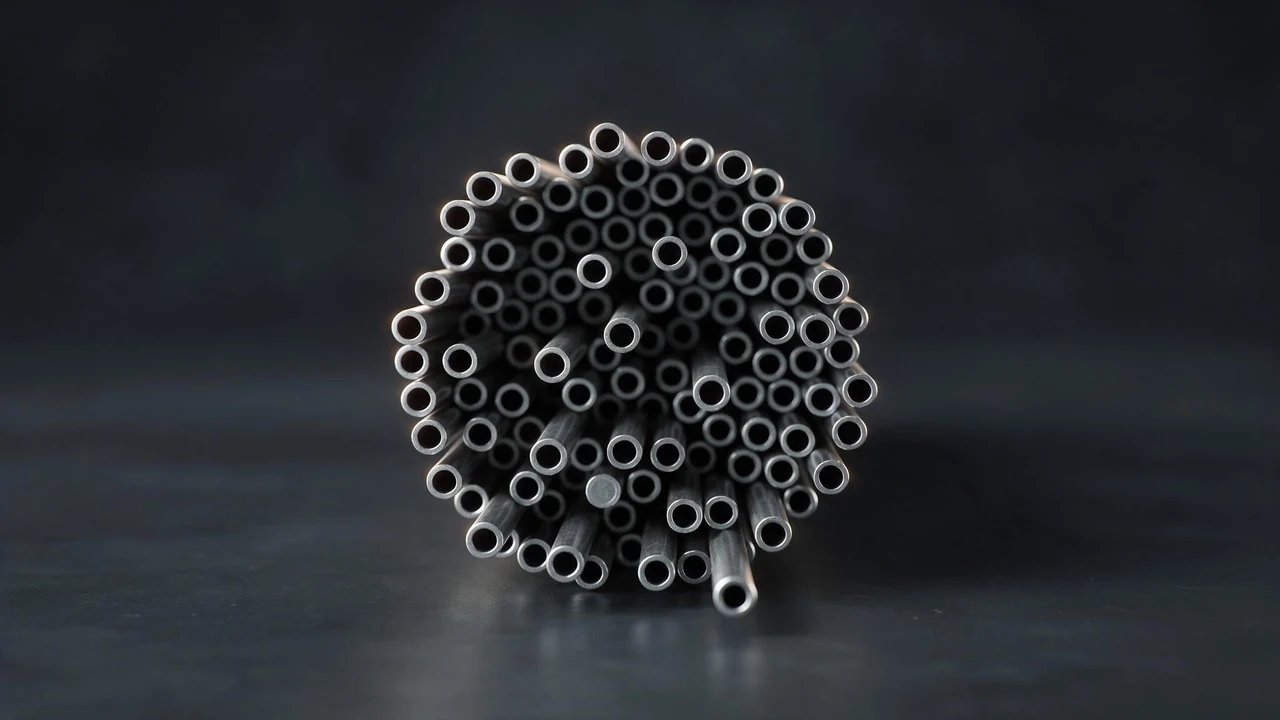
ASTM A179 is a seamless cold-drawn low-carbon steel tube for tubular heat exchangers, condensers and similar heat transfer equipment, with a minimum tensile strength of 325 MPa (47,000 psi) and a minimum yield strength of 180 MPa (26,000 psi). It is ordered by outside diameter and wall thickness, on a minimum wall or an average wall basis, rather than by pipe size and schedule.
Download ASTM A179 Heat Exchanger Tube data sheet (PDF) One-page summary of the supply range, chemistry, mechanical properties and inspection documents on this page. The standard is the governing document.
Mejor Steel is the export agent for the mills that make your material: one contract, one delivery date, and the mill named on the quotation. How we supply
We reply within one business day, Monday to Friday 09:00-18:00 CST. Or write to info@mejorsteel.com / WhatsApp.
Size range and specification
- Outside diameter 1/4 inch – 3 inch (6.35 – 76.2 mm), the usual heat exchanger tube range; larger on request
- Wall thickness 0.035 – 0.300 inch (0.89 – 7.62 mm), by minimum wall or average wall
- Length Straight lengths as ordered, or U-bent to drawing
- Ends Plain end, or prepared for the tube sheet
- Surface treatment Bare, oiled, or pickled on request
- Manufacturing process Seamless, cold drawn only
- Heat treatment Not required as delivered; annealing or stress relieving on request
- Delivery standard ASTM A179 / ASME SA179, general requirements to ASTM A450
- Delivery condition Cold drawn
How this grade is supplied
- Inspection Inspected by the producing mill’s own inspection department, which is independent of production, against the delivery standard above. Third-party inspection — SGS, BV or TUV, or an inspector you send yourself — can be arranged at the mill or before shipment; give us the dates and the scope at the order stage.
- Certificate A mill test certificate to EN 10204 3.1 showing the heat number, the chemical composition and the mechanical results is standard on every order. EN 10204 3.2, countersigned by the inspector you nominate, is available on request.
- Documents with the goods The mill test certificate and the packing list travel with the shipment, and the heat number is traceable from cast through to the finished product.
- Packing Sea-worthy export packing: bundled by size with end protection, corrosion protection on request, stencilled with the size, grade and heat number.
- MOQ One bundle or one truckload; mixed sizes within a bundle accepted.
- Lead time Counted from order confirmation, not from the enquiry. Stock sizes 5–10 days; mill run or non-stock 3–5 weeks. The delivery window is fixed on the quotation.
- How we supply Sourced through partner mills; the producing mill is named on the quotation.
ASTM A179 chemical composition (%)
| Element | Requirement | Element | Requirement |
|---|---|---|---|
| Carbon, C | 0.06 – 0.18 | Silicon, Si | not specified |
| Manganese, Mn | 0.27 – 0.63 | Nickel, Ni | not specified |
| Phosphorus, P | 0.035 max | Chromium, Cr | not specified |
| Sulphur, S | 0.035 max | Molybdenum, Mo | not specified |
The composition is deliberately narrow rather than strong. Carbon is held to a 0.06 to 0.18 percent range, low enough to keep the tube soft and cold-drawable and defined tightly enough to give it a predictable specified strength; manganese is only 0.27 to 0.63 percent. There is no deliberate alloy addition and no minimum silicon, so this is not the same steel as an A106 high-temperature pipe grade, which requires at least 0.10 percent silicon and allows up to 0.30 percent carbon. Phosphorus and sulphur are each capped at 0.035 percent. That narrow carbon and manganese band is what makes the heat-to-heat behaviour predictable in the drawing mill, and it is part of how the tight wall tolerances of a heat exchanger tube are achieved.
Source: chemical composition requirements of ASTM A179 / ASME SA179. The standard is the governing document.
ASTM A179 mechanical properties
| Grade | Tensile strength | Yield strength | Elongation | Delivery condition |
|---|---|---|---|---|
| A179 (ASTM A179) | 325 MPa min (47,000 psi) | 180 MPa min (26,000 psi) | 35% min | Seamless, cold drawn |
A179 is a low-strength tube by design. Its 325 MPa minimum tensile and 180 MPa minimum yield are below those of the boiler and superheater tube grade A210, and they are set for a tube whose job is to conduct heat through a thin wall rather than to carry a heavy pressure load. The elongation figure is the tabulated minimum for the standard specimen; because heat exchanger tubes are tested as small sections, the acceptance value should be read together with the specimen type shown on the test report. Where a hardness limit or a maximum carbon is needed for a particular duty, it belongs on the purchase order rather than being assumed from the grade.
Source: tensile requirements of ASTM A179 / ASME SA179. The standard is the governing document.
Tube ordering basis: minimum wall and average wall
| Ordering basis | What is guaranteed | Effect on the tube supplied | When it is used |
|---|---|---|---|
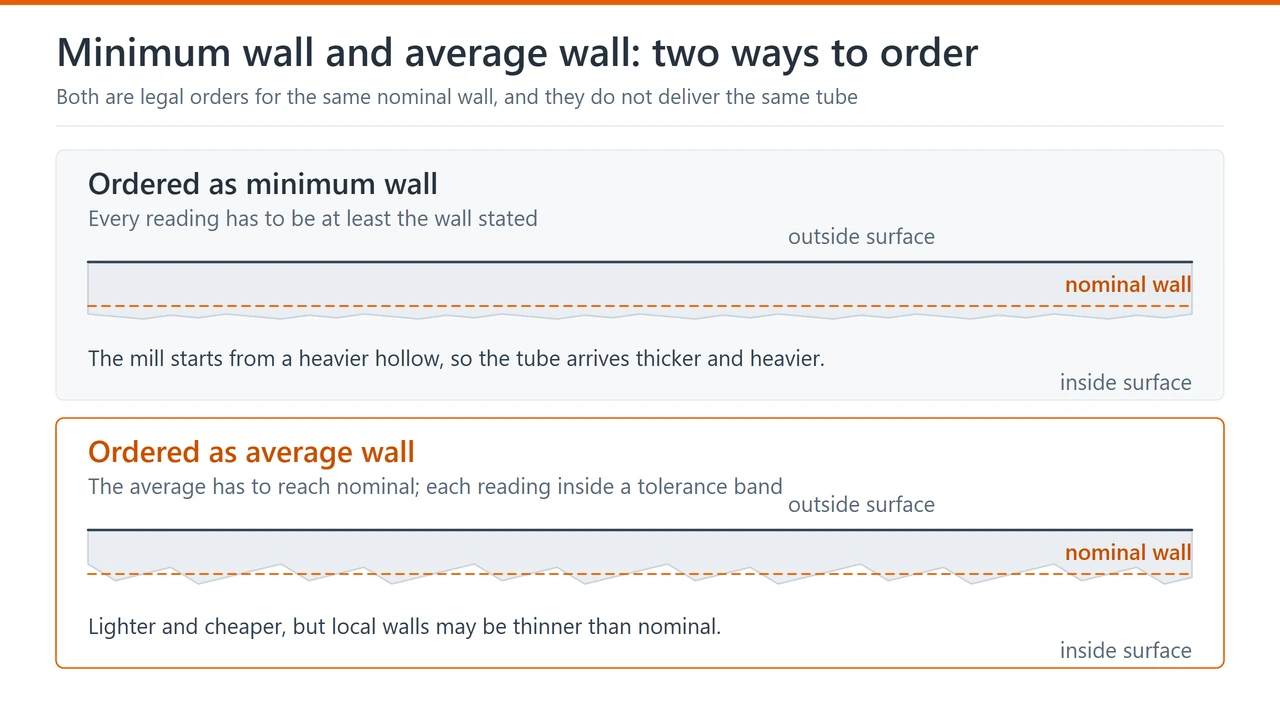
| Minimum wall | Every measurement along the tube is at least the wall stated | The mill starts from a heavier hollow, so the tube delivered is thicker and heavier than the nominal figure | When the wall is a design minimum – pressure containment, corrosion allowance, or a tube to be expanded into a tube sheet |
| Average wall | The average of the measurements reaches the nominal wall, with individual readings inside a tolerance band | The lighter and cheaper basis, but local walls may be thinner than the nominal figure | When the calculation can tolerate local thin spots inside the tolerance band |
The two bases are not interchangeable inside one design, and the confusion between them is the most common ordering error on heat exchanger tube. A minimum wall order buys a guarantee at a point; an average wall order buys a weight. Because the wall thickness in a heat exchanger calculation often includes a corrosion allowance – so that the tube still has enough metal at the end of its life – the design minimum is frequently the number on the drawing, and the order has to say so explicitly. The outside diameter, the wall, the basis and the length tolerance all appear on the mill certificate and should read the same way as the purchase order.
What Is ASTM A179 Tube?
ASTM A179 is the seamless cold-drawn low-carbon steel tube specification for tubular heat exchangers, condensers and similar heat transfer equipment. It is a tube rather than a pipe: the specification is written around a thin wall that has to transfer heat efficiently, be rolled and expanded into a tube sheet, and in U-tube form be bent without cracking. The grade has a minimum tensile strength of 325 MPa (47,000 psi) and a minimum yield strength of 180 MPa (26,000 psi), a carbon range of 0.06 to 0.18 percent and a manganese range of 0.27 to 0.63 percent, and it is supplied seamless and cold drawn. The chemistry is narrow rather than strong, because a narrow chemistry is what makes the cold drawing and the finished wall tolerance predictable.
Minimum Wall and Average Wall: the Two Ways to Order
A179 tube is ordered on one of two bases, and the difference is real metal and real money. Ordered to minimum wall, the wall measured at any point along the tube must be at least the thickness stated, so the mill has to start from a heavier hollow and the tube actually delivered is thicker and heavier than the nominal figure suggests. Ordered to average wall, the average of the measurements must reach the nominal wall with individual readings inside a tolerance band around it, which is the lighter and cheaper way to buy. Minimum wall is the right basis when the wall is a design minimum – for pressure containment, for corrosion allowance, or for a tube that will be expanded into a tube sheet – because only then is the figure on the drawing the figure that is guaranteed.
The two ordering bases are compared below, and they are not interchangeable.
Why the Grade Is Ordered by Outside Diameter and Wall, Not by Size
Pipe is bought by nominal size and schedule: NPS 6 SCH 40 is shorthand that resolves to one outside diameter and one wall thickness in ASME B36.10M. Heat exchanger tube is not bought that way. In a shell-and-tube exchanger the outside diameter is fixed by the tube count, the baffle holes and the tube sheet, and the wall is fixed by the heat transfer and pressure calculation, so the two are specified independently – typically as an outside diameter in inches and a wall in thousandths of an inch or in a Birmingham Wire Gauge number, for example 3/4 inch OD by 16 BWG. None of that maps onto a pipe schedule, and A179 does not use one. The tube is bought as an outside diameter plus a wall, on the minimum wall or average wall basis described above.
The Cold-Drawn Delivery Condition
A179 requires the tube to be cold drawn. Cold drawing is what gives the product its dimensional accuracy, its smooth bore and its surface finish, and it is the route by which a thin wall can be held to a tolerance that hot working cannot reach. The tube is drawn from a pierced hollow or a hot finished tube through a die and over a mandrel, reducing diameter and wall together, and it may be drawn more than once with annealing between passes to reach the finished size. The grade is supplied cold drawn and is not required to be heat treated as delivered; where the drawing leaves the steel harder than the rolling or bending operation allows, or where the order calls for it, the tube can be annealed or stress relieved. It remains seamless throughout, which matters for a tube that has to be expanded into a tube sheet and pressure tested.
Where A179 Tube Is Used, and What It Is Not For
A179 is used in shell-and-tube heat exchangers, surface condensers, air coolers, feedwater heaters, reboilers and similar heat transfer equipment, including U-tube bundles. Its service is set by the low-carbon chemistry: A179 has no alloying addition and no high-temperature strengthening mechanism, so it is not intended for service where creep strength governs. Heat exchanger and condenser tubes that run hotter, or that carry more pressure on the tube side, move to A210 in its Grade A-1 or Grade C form; boiler tubes for high-pressure service are covered by A192 and A210; and once the metal temperature is high enough to need a chrome-molybdenum or austenitic steel, none of these carbon grades is adequate. The right question is not what A179 costs but what the tube-side design temperature and pressure actually are.
Typical applications
- Shell-and-tube heat exchangers
- Surface condensers
- Feedwater heaters and reboilers
- Air coolers and intercoolers
- U-tube heat exchanger bundles
Standards covered
What to state on the enquiry
- ASTM A179, and whether minimum wall or average wall is meant.
- Outside diameter and minimum wall.
- Straight or U-bend, and the length.
- Quantity and destination port.
- Certificate type and any additional testing.
Frequently asked questions
What is the difference between minimum wall and average wall tube?
Minimum wall guarantees that every measurement along the tube is at least the thickness stated, so the mill supplies a heavier tube to be sure of clearing it. Average wall requires only that the average of the measurements reaches the nominal wall, with individual readings inside a tolerance band, which makes the tube lighter and cheaper. Choose minimum wall when the wall is a design minimum for pressure or corrosion allowance, and average wall when the calculation can tolerate local thin spots. The two must not be mixed within one design.
What is the difference between A179 and A192 tube?
In chemistry and strength they are usually published as the same: both are low-carbon seamless tubes with 0.06 to 0.18 percent carbon, 0.27 to 0.63 percent manganese, and minimum strengths of 325 MPa tensile and 180 MPa yield. What separates them is scope and supply condition. A179 is written for heat exchanger and condenser tubes and requires the cold-drawn route; A192 is written for boiler tubes for high-pressure service and permits the tube to be hot finished or cold drawn. Because the requirements overlap, one heat is often dual certified to both, but a heat exchanger tube should be ordered as A179 with its cold-drawn and dimensional requirements.
Can A179 tube be used in a boiler?
A179 is a heat exchanger tube specification. For boiler tubes the relevant carbon steel specifications are A192 for high-pressure boiler tubes and A210 for boiler and superheater tubes needing more strength. A179 shares the low-carbon chemistry of A192 but is written around cold-drawn heat exchanger tube dimensions and tolerances, and its scope is heat transfer equipment rather than boiler pressure parts. Where a boiler tube is required, order it as A192 or A210.
Is A179 tube always seamless?
Yes. A179 covers seamless tube only, and it requires the cold-drawn manufacturing route. Welded tube is not covered by the specification. That matters because a heat exchanger tube is expanded or rolled into a tube sheet and has to hold a pressure boundary, and a longitudinal seam is an additional feature that has to be examined and accepted rather than assumed. Where a welded tube is acceptable, a different specification applies.
Where to go next
- Boiler & Heat Exchanger Tube – tube specified by outside diameter and wall
- ASTM A192 Boiler Tube
- ASTM A106 Grade B Pipe – the high-temperature seamless grade most often quoted
- Boiler & Heat Exchanger – tube and pipe for boilers and heat exchangers
- Steel Pipe Weight Calculator – work out the weight of any size and wall thickness
- Get a Quote – send the grade, size, quantity and destination port
- ASTM A106 Seamless Carbon Steel Pipe – seamless pipe for process and boiler service
- ASTM A335 Alloy Steel Pipe – alloy steel pipe for high-temperature service
Ready to price your enquiry? Tell us the specification, the dimensions, how much you need and where it is going. We reply with what is available and what it costs.
Request a quotation