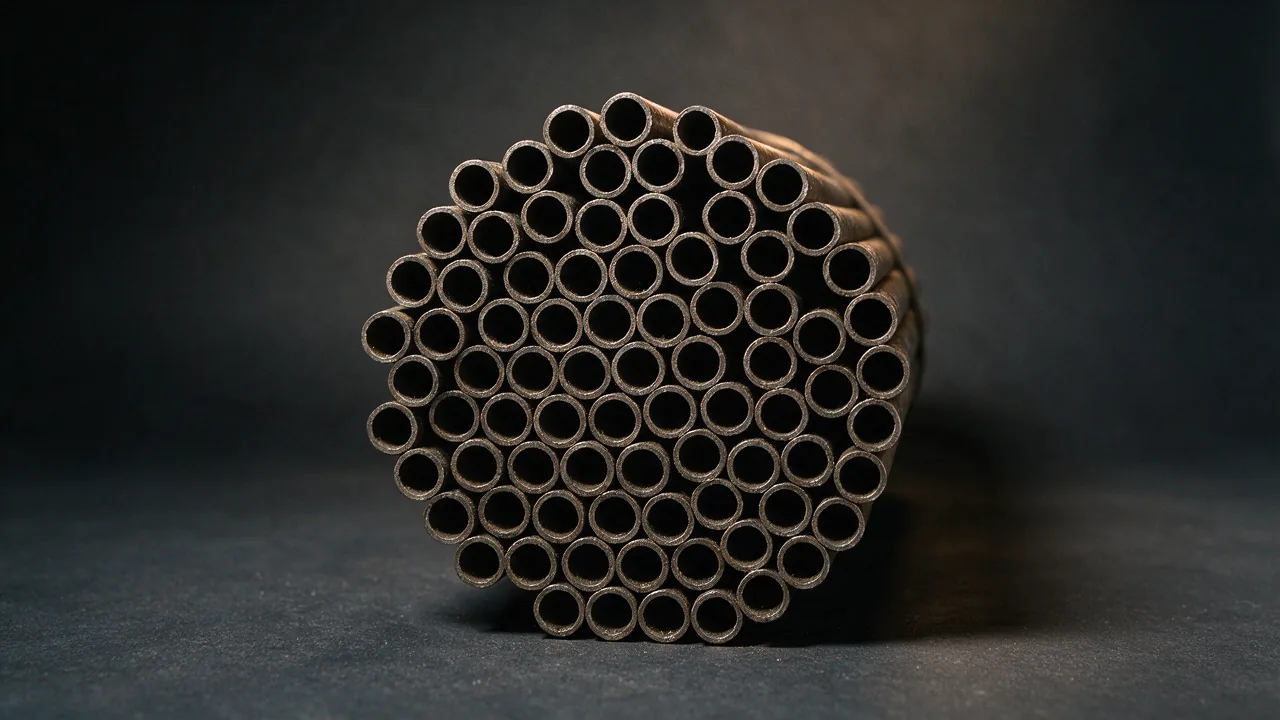
Boiler and heat exchanger tube is bought by outside diameter and wall thickness, not by nominal pipe size and schedule. That one difference is behind most of the confusion in a tube enquiry: a 2 inch tube and a 2 inch pipe are not the same item, and a quotation written against the wrong convention will be wrong by a wide margin.
Mejor Steel is the export agent for the mills that make your material: one contract, one delivery date, and the mill named on the quotation. How we supply
We reply within one business day, Monday to Friday 09:00-18:00 CST. Or write to info@mejorsteel.com / WhatsApp.
Tube is specified differently from pipe
Pressure pipe is ordered by nominal pipe size and schedule, and both are nominal figures that map to a fixed outside diameter and a wall thickness. Boiler and heat exchanger tube is ordered by the actual outside diameter and the actual wall thickness, usually expressed either in millimetres or as a wire gauge number such as BWG. A drawing that says “2 inch × 0.120 inch wall” is giving you the real dimensions, and the enquiry should repeat them in the same form.
Which specification applies
The specification follows the temperature and the duty. Low-carbon heat exchanger and condenser tubes are bought to ASTM A179, which is a cold-drawn seamless tube for exactly that service. Boiler tubes for higher pressure are A192 seamless carbon steel, and where greater strength is needed A210 covers seamless medium-carbon boiler and superheater tubes in grades A-1 and C. In the hot end of the unit, where metal temperature rules out carbon steel, A213 covers seamless ferritic and austenitic alloy tubes in grades such as T11, T22 and T91, and austenitic grades such as TP304, TP316 and TP347H.
Welded tube has its own specifications where a seamless tube is not required: A214 for welded carbon steel heat exchanger tube and A249 for welded austenitic tube. The piping that connects the boiler — steam lines, feedwater lines and headers — is pipe rather than tube, and is bought to ASTM A106 for carbon steel and ASTM A335 where the temperature demands an alloy.
Temperature drives the material
Carbon steel has a temperature ceiling above which it loses the properties the design depends on, and the alloy and austenitic grades exist to go beyond it. So the selection is a question of the metal temperature at the hottest point of the unit, not of the pressure alone. That is why a superheater outlet and a condenser on the same plant can use entirely different specifications, and why the design temperature belongs on the enquiry alongside the dimension.
What is normally called out
| Service need | Product | Standard and grade |
|---|---|---|
| Boiler, superheater, heat exchanger and condenser tubes | Boiler & Heat Exchanger Tube | ASTM A179, A192, A210 A-1 / C, A213 T11 / T22 / T91, A214, A249 |
| Steam, feedwater and blowdown piping | ASTM A106 Seamless Carbon Steel Pipe | ASTM A106 grades A, B, C |
| High-temperature steam lines | ASTM A335 Alloy Steel Pipe | ASTM A335 P5, P9, P11, P22, P91 |
| Corrosive process, condensers and coolers | ASTM A312 Stainless Steel Pipe | ASTM A312 TP304 / 304L, TP316 / 316L, TP321, TP347H |
| Headers and branch connections | Butt Weld Tee | ASME B16.9, ASTM A234 WPB / WP11 / WP22 / WP91 |
| Direction changes in steam and process lines | Butt Weld Elbow | ASME B16.9, ASTM A234 WPB / WP11 / WP22 / WP91 |
| Reductions and transitions | Butt Weld Reducer | ASME B16.9, ASTM A234 WPB, concentric and eccentric |
| Tube sheet, channel and nozzle flanges | Pipe Flanges | ASME B16.5 and B16.47, ASTM A105, A182 F11 / F22 / F316 |
| Alloy pipe and tube fittings | Alloy Steel Fittings | ASTM A234 WP11 / WP22 / WP91, ASTM A403 for stainless |
Specifying a tube order
A tube enquiry should carry the outside diameter, the wall thickness, the length, the specification and grade, the quantity, and the test and documentation requirements. Where the tube is bent, expanded or welded into a tube sheet, say so, because those operations impose their own requirements on the tube and on the heat treatment. Where the duty is a heat exchanger rather than a boiler, the tube may also be ordered as U-bends to a developed length.
- Give the actual outside diameter and wall. Tube is not ordered by nominal size, and a nominal figure will be read as an actual one.
- State the specification and the grade. A213 covers many grades that are not interchangeable, and T22 is not a substitute for T91.
- Give the design metal temperature. It decides whether carbon steel is acceptable and which alloy is required.
- Say whether the tube will be bent or expanded. U-bend tubes and expanded tubes need the requirements stated at the enquiry stage.
- Confirm the heat treatment and the surface condition. Pickling, passivation and bright annealing belong in the specification.
- Name the documentation. Third-party inspection and material certificates are priced in, not added later.
Frequently asked questions
What is the difference between boiler tube and pipe?
Tube is specified by its actual outside diameter and wall thickness and is made to a tube specification; pipe is specified by nominal pipe size and schedule. A tube and a pipe of the same nominal size therefore have different outside diameters, and the two are not interchangeable without checking the dimensions.
Which ASTM specification covers heat exchanger tubes?
ASTM A179 covers seamless cold-drawn low-carbon steel heat exchanger and condenser tubes, which is the usual starting point. Welded tube is covered by A214 for carbon steel and A249 for austenitic steel, and alloy and austenitic seamless tube is covered by A213.
When is an alloy tube needed instead of carbon steel?
When the metal temperature at the hottest point of the unit exceeds what carbon steel can carry, or when the service is corrosive. A213 covers the alloy and austenitic grades used for superheater and reheater service, and A335 covers the equivalent alloy pipe for the connecting steam lines.
Do you supply U-bend tubes and cut lengths?
Tube is supplied in straight lengths or formed to U-bends to a developed length and leg length given on the drawing. The bending requirements affect the specification and the heat treatment, so they should be stated with the enquiry rather than after the order is placed.
Where to go next
- Steel pipe weight calculator – work out the weight of any size and wall thickness
- Pipe schedule chart – wall thickness for every schedule, carbon and stainless
- Request a quotation – send the specification, quantity and destination port
- Boiler and heat exchanger tube – the product, with sizes and specifications
- ASTM A106 Grade B pipe – the carbon steel piping that connects the boiler
- Steel pipe and line pipe – seamless, ERW, LSAW and SSAW, coated and uncoated
Have a specification to price? Give us the standard or grade, the size and wall thickness, the quantity you need and the port of discharge. We come back with availability and a price.
Request a quotation