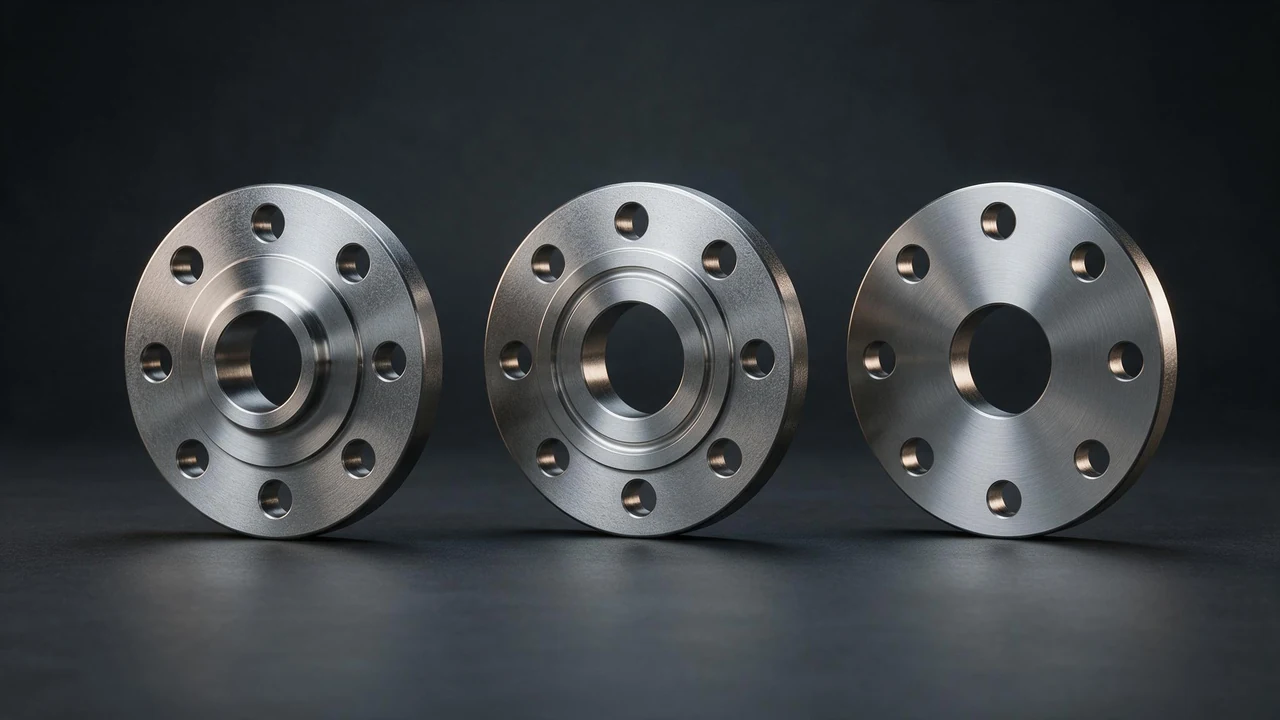
ASTM A182 F316 is the forged austenitic stainless steel grade used for flanges, fittings and valve parts, with 16 to 18 percent chromium, 10 to 14 percent nickel and 2 to 3 percent molybdenum, a minimum tensile strength of 515 MPa and a minimum yield strength of 205 MPa. Under ASME B16.5 it falls in material group 2.2, so its pressure rating is settled by temperature, class and size.
Download ASTM A182 F316 Flange data sheet (PDF) One-page summary of the supply range, chemistry, mechanical properties and inspection documents on this page. The standard is the governing document.
Mejor Steel is the export agent for the mills that make your material: one contract, one delivery date, and the mill named on the quotation. How we supply
We reply within one business day, Monday to Friday 09:00-18:00 CST. Or write to info@mejorsteel.com / WhatsApp.
Size range and specification
- Ends Weld neck with butt weld end; raised face (RF), flat face (FF) or ring joint (RTJ) facings
- Surface treatment Solution annealed and pickled, machined gasket face, or as specified
- Delivery condition Solution annealed
- Manufacturing process Forged or rolled, then machined
- Heat treatment Solution annealed at 1040 degrees C (1900 degrees F) minimum
- Delivery standard ASTM A182 / ASME SA182, dimensions and ratings to ASME B16.5
- Size range 1/2 inch – 24 inch (DN 15 – DN 600) to ASME B16.5; larger sizes to ASME B16.47 on request
- Types Weld neck, slip-on, blind, lap joint, threaded, socket weld, long weld neck
How this grade is supplied
- Inspection Inspected by the producing mill’s own inspection department, which is independent of production, against the delivery standard above. Third-party inspection — SGS, BV or TUV, or an inspector you send yourself — can be arranged at the mill or before shipment; give us the dates and the scope at the order stage.
- Certificate A mill test certificate to EN 10204 3.1 showing the heat number, the chemical composition and the mechanical results is standard on every order. EN 10204 3.2, countersigned by the inspector you nominate, is available on request.
- Documents with the goods The mill test certificate and the packing list travel with the shipment, and the heat number is traceable from cast through to the finished product.
- Packing Sea-worthy export packing: bundled by size with end protection, corrosion protection on request, stencilled with the size, grade and heat number.
- MOQ One bundle or one truckload; mixed sizes within a bundle accepted.
- Lead time Counted from order confirmation, not from the enquiry. Stock sizes 5–10 days; mill run or non-stock 3–5 weeks. The delivery window is fixed on the quotation.
- How we supply Sourced through partner mills; the producing mill is named on the quotation.
ASTM A182 F316 chemical composition (%)
| Element | Range | Element | Range |
|---|---|---|---|
| Carbon, C | 0.08 max | Nickel, Ni | 10.0 – 14.0 |
| Manganese, Mn | 2.00 max | Phosphorus, P | 0.045 max |
| Silicon, Si | 1.00 max | Sulphur, S | 0.030 max |
| Chromium, Cr | 16.0 – 18.0 | Molybdenum, Mo | 2.00 – 3.00 |
Chromium forms the passive oxide film that makes the steel stainless, nickel holds the austenitic structure that keeps it tough and formable, and molybdenum is what raises resistance to pitting and crevice corrosion in chloride service – which is the whole reason to buy F316 rather than the cheaper F304. The silicon limit for A182 forgings is 1.00 percent maximum, which is wider than the 0.75 percent maximum that A312 applies to stainless pipe of the same composition; the two documents describe the same alloy in two product forms and do not carry identical limits. F316L is the same composition with carbon capped at 0.035 percent, and F316H is the same composition with carbon set at 0.04 to 0.10 percent for elevated temperature service. For ASME B16.5 pressure ratings the carbon level changes the material group: F316 and F316H are Group 2.2, F316L is Group 2.3.
Source: chemical composition requirements of ASTM A182 / ASME SA182. The standard is the governing document.
ASTM A182 F316 mechanical properties (solution annealed)
| Grade | Tensile strength | Yield strength | Elongation | Reduction of area |
|---|---|---|---|---|
| F316 (ASTM A182) | 515 MPa min (75,000 psi) | 205 MPa min (30,000 psi) | 30% min | 50% min |
| F316L (for reference) | 485 MPa min (70,000 psi) | 170 MPa min (25,000 psi) | 30% min | 50% min |
| F316H (for reference) | 515 MPa min (75,000 psi) | 205 MPa min (30,000 psi) | 30% min | 50% min |
Yield strength for austenitic stainless steel is the 0.2 percent offset value, not the upper yield point a carbon steel shows. A182 requires both an elongation and a reduction of area for forgings – 30 percent and 50 percent – which is a wider set of requirements than A312 applies to pipe of the same chemistry, where the elongation minimum is 35 percent and no reduction of area is tabulated. The L grade is shown for comparison: it is the same alloy at a lower carbon level, and its lower specified strength is the price of weldability without post-weld annealing. A182 does not specify a hardness limit for the austenitic grades, so no hardness figure appears here; where a hardness limit is needed for a particular service it comes from the project specification or from NACE MR0175 / ISO 15156, not from A182.
Source: tensile requirements of ASTM A182 / ASME SA182. The standard is the governing document.
ASME B16.5 pressure-temperature ratings, material group 2.2 (A182 F316 and F316H), selected temperatures, psi
| Temperature | Class 150 | Class 300 | Class 600 |
|---|---|---|---|
| -20 to 100 degrees F (-29 to 38 degrees C) | 275 | 720 | 1440 |
| 200 degrees F (93 degrees C) | 235 | 620 | 1240 |
| 300 degrees F (149 degrees C) | 215 | 560 | 1120 |
| 400 degrees F (204 degrees C) | 195 | 515 | 1025 |
| 500 degrees F (260 degrees C) | 170 | 480 | 955 |
| 600 degrees F (316 degrees C) | 140 | 450 | 900 |
| 650 degrees F (343 degrees C) | 125 | 440 | 885 |
| 700 degrees F (371 degrees C) | 110 | 435 | 870 |
| 750 degrees F (399 degrees C) | 95 | 425 | 855 |
| 800 degrees F (427 degrees C) | 80 | 420 | 845 |
These are the ASME B16.5 Group 2.2 ratings, which cover A182 F316, F316H and F317. A182 F316L is in Group 2.3, whose pressure-temperature ratings are lower, so an F316L flange cannot be rated from this table. The ratings apply to standard B16.5 flanges from NPS 1/2 to NPS 24 – a 6 inch Class 150 weld neck flange and a 24 inch one are rated alike. The rating is temperature-dependent: it falls as the design temperature rises because the allowable stress of the material falls, so the table shows selected temperatures only and the full table in ASME B16.5 must be used for a design – interpolation between the rows shown here is not the method the standard uses. The rating is the maximum allowable working pressure for the flange and its facing in combination with a suitable gasket; it says nothing about the pipe, fitting or bolt it is joined to, and it is not a substitute for the calculation the piping design code requires. Where a higher rating is needed, the next step is a higher class – Class 900, 1500 or 2500 – or a higher-alloy material group, not a change of grade within group 2.2.
What Is ASTM A182 F316 Flange Material?
ASTM A182 F316 is the forged austenitic stainless steel grade used for flanges, forged fittings and valve parts – the components that cannot be made from pipe. It is the 316 composition written as a forging grade: 16 to 18 percent chromium, 10 to 14 percent nickel and 2 to 3 percent molybdenum, with a minimum tensile strength of 515 MPa (75,000 psi) and a minimum yield strength of 205 MPa (30,000 psi), supplied solution annealed. A182 covers the material; ASME B16.5 covers the dimensions and the pressure ratings of the flange itself. The F in the grade name identifies the forged product form, which is why F316 flanges, TP316 pipe and the matching stainless butt weld fittings can be welded into one line even though they come from three separate specifications.
F316 versus F304: What the Molybdenum Buys
F304 and F316 have the same specified minimum yield and tensile strengths and the same dimensions, so the choice between them is a corrosion decision rather than a strength decision. F316 adds 2 to 3 percent molybdenum and carries a higher nickel range and a lower chromium range than F304; the molybdenum is what raises resistance to pitting and crevice corrosion in chloride-bearing service, and that is the property that matters most in a flange. Flanges sit at joints, gasket faces and crevices, and a crevice is exactly where chlorides concentrate and where stainless steel is most likely to pit, so the flange is the component in which the molybdenum earns its cost. F316 is not immune to chlorides, though: in hot, concentrated or flowing chloride service the answer moves to a duplex or a higher-alloy austenitic grade.
F316 versus F316L and F316H
F316, F316L and F316H are the same alloy with different carbon contents. F316 allows up to 0.08 percent carbon. F316L caps carbon at 0.035 percent, which limits carbide precipitation at welds and is the reason it is specified where a fabricated assembly cannot be solution annealed afterwards; the cost is a lower specified minimum strength, 485 MPa tensile and 170 MPa yield. F316H sets carbon at 0.04 to 0.10 percent as a minimum, which is the opposite adjustment: the higher carbon improves creep strength at elevated temperature, so F316H is the grade for hot service in the creep range. In ASME B16.5 the ordinary and low-carbon versions sit in the same material group and take the same pressure ratings, so choosing the L grade does not reduce what the flange can carry.
How ASME B16.5 Sets the Pressure Rating of an F316 Flange
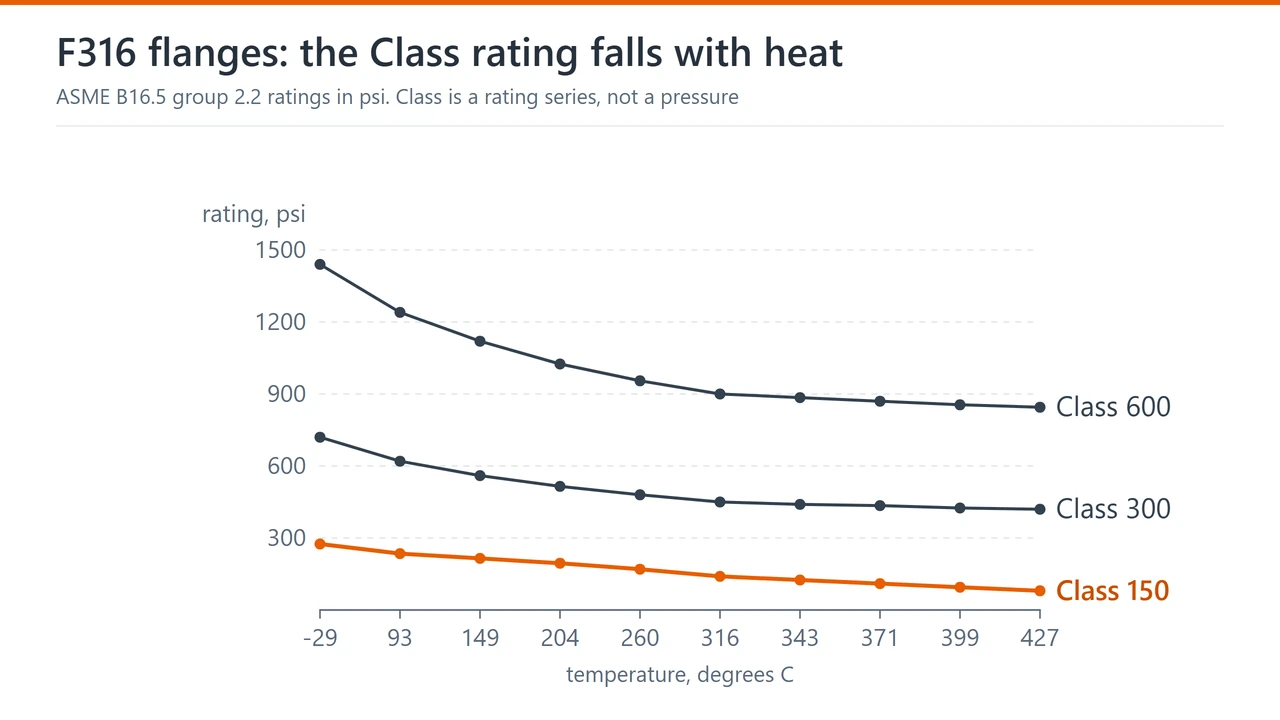
The pressure rating of a flange is not a property of the material alone. ASME B16.5 assigns every listed material to a material group, and each group has its own pressure-temperature table; F316 falls in group 2.2, the austenitic 16Cr-12Ni-2Mo group. Within a group the rating falls as the temperature rises, because the allowable stress of the material falls as it gets hotter, which is why a Class 150 flange rated 275 psi at ambient is rated far lower at 800 degrees Fahrenheit. The rating is also fixed by the class and the size: a Class 300 flange carries roughly twice the pressure of a Class 150 flange of the same size and material. Rating a flange therefore means choosing the class and reading the group table at the design temperature, not quoting a single number from a data sheet.
The rating falls as the temperature rises, and it falls fastest in the lowest class.
Solution Annealing, Forging and Documentation
A182 requires the austenitic grades to be supplied solution annealed, which for F316 means heating to at least 1040 degrees Celsius and cooling rapidly enough to keep the carbides in solution; the treatment is what gives the grade its corrosion resistance and its ductility, and it is recorded on the mill certificate. Flanges are forged or rolled and then machined, and the material is tested on the finished product rather than on the ingot. The certificate should carry the heat number, the chemical analysis against the chromium, nickel, molybdenum and carbon limits, the tensile and yield results with the elongation and reduction of area, and the heat treatment record. Where the flange is for corrosive or welded service the order can call for an intergranular corrosion test to A262 Practice E, and where it is for sour or offshore service the project specification adds its own requirements on top of A182.
Choosing the facing: RF, FF or RTJ
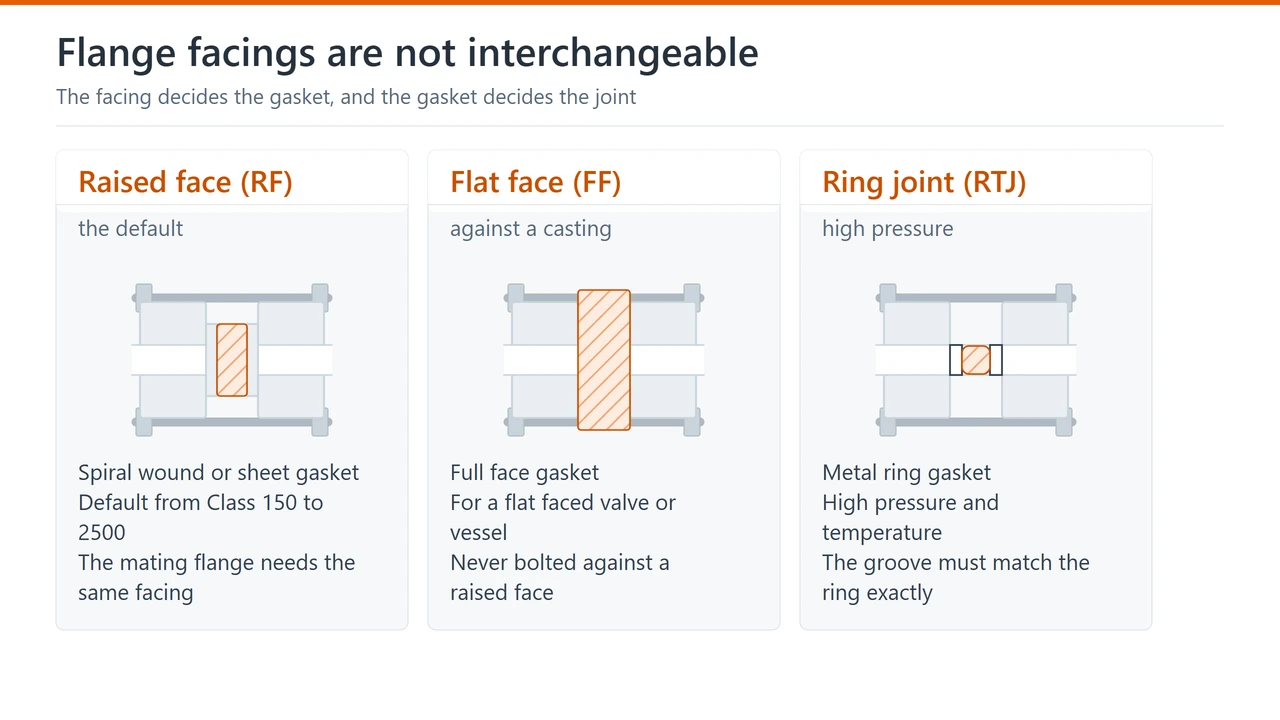
The facing decides the gasket, and the gasket decides the joint. The three facings on this page are not interchangeable, and the choice is normally fixed by the mating flange rather than by the F316 material.
| Facing | Gasket | Where it is the right answer | What it costs you |
|---|---|---|---|
| Raised face (RF) | Spiral wound or sheet gasket | General process piping, the default for Class 150 to Class 2500 | Concentrates the bolt load on the raised face; the mating flange must have the same facing |
| Flat face (FF) | Full face gasket | Where the F316 flange bolts to a flat faced casting, a valve or a lined vessel | Lower bolt load concentration; not used against a raised face, because the joint then relies on the outer ring alone |
| Ring joint (RTJ) | Metal ring gasket, softer than the flange | High pressure and high temperature, and anywhere the specification names a ring joint | Ring groove has to match the gasket profile exactly; a damaged groove cannot be repaired at site |
Two failures account for most rejected joints. Bolting an RTJ flange against an RF flange, which leaves the ring with nothing to seat into; and re-using a ring gasket, which has already been work hardened by the first make up. Both are decided at the enquiry stage, not in the field.
The three facings and the gaskets they take are compared below.
Matching the flange bore to the pipe schedule
A weld neck flange is bored to suit a pipe wall, and ASME B16.5 publishes a bore for each size and schedule. If the pipe is ordered in a heavier schedule than the standard flange bore, the standard bore no longer matches the pipe, and the flange either has to be supplied with a heavier bore or the weld preparation has to be machined to suit.
The mismatch shows up as an expensive problem: the bevel does not line up, the welder builds the root by hand, and the joint has to be radiographed again. State the pipe schedule, or the measured wall thickness, with the flange size and class so the bore is set before the forgings are machined.
What to put in an F316 flange enquiry
- Size and pressure class: NPS or DN, and Class 150 / 300 / 600 / 900 / 1500 / 2500.
- Facing: RF, FF or RTJ, and the mating flange facing if it is already on site.
- Standard: ASME B16.5 up to NPS 24; ASME B16.47 Series A or B above it.
- Bore: pipe schedule or wall thickness, and whether the bore has to match a specific pipe.
- Type: weld neck, blind, slip on, socket weld, threaded or lap joint, with the stub end if applicable.
- Certification: whether the project asks for an EN 10204 3.1 certificate only, or an EN 10204 3.2 certificate signed by an inspector independent of the mill.
- Marking and traceability: heat number, grade marking and any project tag the flange has to carry.
- Verification: whether a third party inspects at the mill or before shipment, and the dates available.
- Destination and packing: port, and whether the flanges travel loose or match marked to the pipe spools.
Values are the requirements of ASTM A182/A182M and ASME B16.5 in the edition the project works to; where a project specification adds a requirement, the order is confirmed against that document before the forgings are released.
Typical applications
- Chemical and petrochemical process piping
- Offshore, coastal and marine piping systems
- Valve bodies and pump components in chloride service
- Food, pharmaceutical and high-purity systems
- Desalination and cooling water piping
Standards covered
Frequently asked questions
What is the difference between F304 and F316 flanges?
F316 contains 2 to 3 percent molybdenum and F304 contains none. Both have the same specified minimum yield and tensile strengths and the same dimensions, so the difference is entirely about corrosion resistance: the molybdenum raises resistance to pitting and crevice corrosion in chloride-bearing service, and the flange, sitting at gasket faces and crevices, is where that matters most. In chloride-free service F304 performs as well and costs less.
Should I order an F316 flange or an F316L flange?
Order F316L where the flange will be welded and the assembly cannot be solution annealed afterwards, because the lower carbon reduces the risk of intergranular corrosion at the weld. Order F316 where the higher specified minimum strength is wanted, 515 MPa tensile against 485 MPa, or where the joint will be annealed. In ASME B16.5 both are in the same material group and take the same pressure ratings, so the low-carbon choice costs strength but not rating.
What is the pressure rating of an ASTM A182 F316 flange?
It is not one number. ASME B16.5 puts F316 in material group 2.2, and that group has a pressure-temperature table: a Class 150 flange is rated 275 psi at ambient but substantially less at 800 degrees Fahrenheit, and a Class 300 flange of the same size and material is rated roughly twice as high. The rating therefore depends on the class, the size and the design temperature, and it must be read from the table in the edition of B16.5 that governs the job.
Is A182 F316 the same material as A312 TP316 pipe?
The alloy is the same 316 composition and the two are welded together on the same line, but the product forms and the specifications differ. F316 is forged material to ASTM A182, used for flanges, fittings and valve bodies; TP316 is pipe to ASTM A312. Their limits are not identical – A182 allows silicon to 1.00 percent where A312 allows 0.75 percent, and A182 specifies a reduction of area that A312 does not. Matching the two is normal practice; treating the certificates as interchangeable documents is not.
Where to go next
- ASTM A105 Flange – the forged carbon steel flange material and its ratings
- ASTM A312 TP316 Pipe – the molybdenum-bearing grade for chloride service
- ASTM A312 TP316L Pipe
- Stainless Steel Butt Weld Fittings – stainless butt weld fittings to ASME B16.9
- Oil & Gas – the four products in the oil and gas chain
- Get a Quote – send the grade, size, quantity and destination port
- Weld Neck Flange
- Pipe Flanges – forged flanges to ASME B16.5
- Slip On Flange
Have a specification to price? Give us the standard or grade, the size and wall thickness, the quantity you need and the port of discharge. We come back with availability and a price.
Request a quotation